


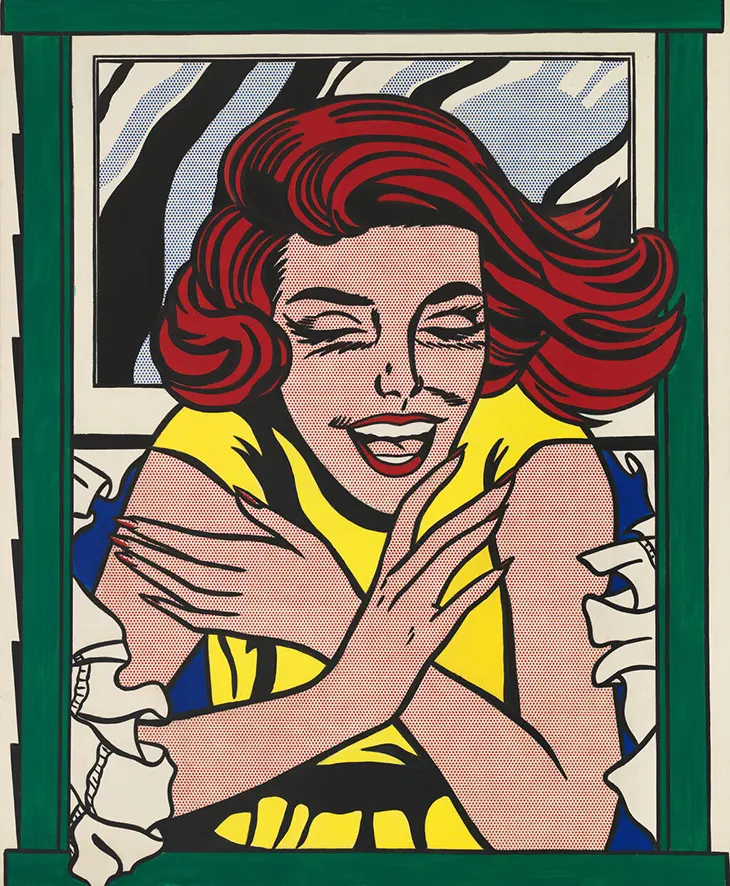
Roy Lichtenstein understood something fundamental about images that most artists of his era did not: they are never stable. A borrowed comic panel, enlarged through mechanical reproduction, transformed by his hand into paint and Ben Day dots, became something entirely new. What once circulated as mass culture ephemera entered the gallery as high art. The image had moved. The meaning had shifted. The rules had changed.
This October, the Whitney Museum opens Roy Lichtenstein: Like New, and the timing could not be sharper. We live in an era where images are cropped, filtered, reposted, and recirculated so constantly that instability has become the default condition of visual culture. A photograph spawns a meme spawns a TikTok spawns a screenshot spawned a meme again. We have become the apparatus of reproduction that Lichtenstein spent his career investigating. The work he made fifty, sixty, seventy years ago, work often dismissed as superficial appropriation or pop decoration, now reads as prophecy.
Permanence of Flux
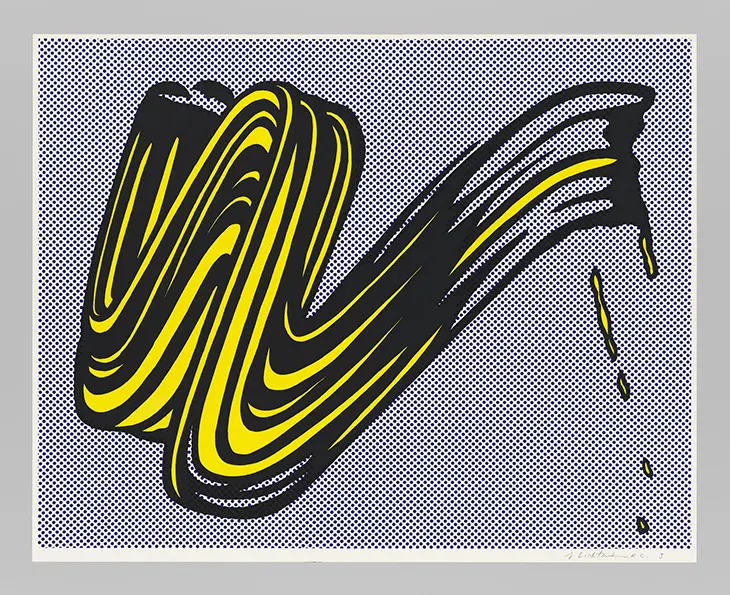
The exhibition brings together roughly 130 works spanning from the early 1940s through the 1990s, and the curatorial argument is deliberate: Lichtenstein was not simply a Pop artist who made iconic paintings. He was an artist obsessed with how images are built, copied, enlarged, circulated, and remade. From his early abstract work through his cartoon-sourced paintings to his later investigations of abstraction itself, Lichtenstein treated images as material to be studied, borrowed, and transformed. The medium changed (painting, drawing, collage, prints, sculpture, film), but the inquiry remained constant.
The exhibition reunites, for the first time, all the works from Lichtenstein’s 1962 Leo Castelli Gallery show, the exhibition that essentially launched Pop art as a movement. Paintings like Look Mickey (1961), Girl with Ball (1961), and Drowning Girl (1963) were once read as irreverent gestures, art world provocations. Today, they function as historical documents of a specific moment in mass media, but more pressingly, they function as records of what happens when an image moves from one context to another. The work is readable as both Mickey Mouse and as a painting. It holds both truths simultaneously. That simultaneity,that refusal to resolve into a single meaning, is precisely what contemporary image culture demands of us now.
Consider Masterpiece (1962), in which an artist paints a portrait while his female companion looks on. The image is borrowed. The sentiment is readable as ironic commentary on artistic ego, on gender dynamics in the studio, on the pretension of fine art. But what Lichtenstein actually did was isolate a moment of image-making itself. He painted a painting about painting. He borrowed a narrative about art and made art about that borrowing. The layers compound. The meaning doesn’t settle.
Influence as Architecture
The Whitney’s curatorial approach, led by Meg Onli and guest curator Alex Da Corte, extends beyond Lichtenstein himself. The exhibition includes work by Louise Lawler, Richard Pettibone, and Sturtevant, artists whose practices emerged directly from engaging with Lichtenstein’s relationship to copying, appropriation, and the afterlife of images. This is crucial. It positions Lichtenstein not as a singular genius but as an artist whose conceptual framework shaped how subsequent generations thought about originality, citation, and visual inheritance.
Pettibone’s meticulous reproductions of modernist paintings, for instance, operate in the direct lineage of Lichtenstein’s inquiry. Lawler’s photography of artworks in domestic spaces extends Lichtenstein’s interest in how images function within systems of circulation and display. Sturtevant’s appropriations of other artists’ work, including Lichtenstein, push the logic of copying and transformation to its conceptual limit. By including these artists, the Whitney makes explicit what was always implicit: Lichtenstein gave permission. He demonstrated that borrowing, copying, and transformation were not corruptions of artistic practice but potentially its deepest investigations.
Museum as Institution
There is also an institutional story here worth noting. The Whitney Museum has, over the past decade, repositioned itself as a space genuinely engaged with contemporary visual culture rather than simply preserving and presenting historical work. Exhibitions at the Whitney have increasingly addressed how artists understand and manipulate mass imagery, digital circulation, and the politics of representation.
Roy Lichtenstein: Like New represents something like the culmination of that argument. By reframing Lichtenstein through the lens of image instability—by explicitly connecting his mid-century investigations to our current moment of endless circulation and appropriation—the museum stakes a claim about what matters in art history right now. It is saying: the artists who understood images as unstable, as subject to transformation and recontextualization, are the artists we need to revisit now.
The exhibition includes a recreation of three murals, including a nearly 96-foot-long version of the Greene Street Mural (1983). This is scale as statement. It is the Whitney saying: this work deserves to command space, to be encountered with the same visual attention we give to advertising, to architecture, to the images that actually structure our perception of public space.
Recognition and Urgency
Lichtenstein’s reputation has been secure for decades. Girl with Ball is canonical. Drowning Girl is recognized as a landmark of twentieth-century art. What shifts in this moment is not the work’s historical importance but its contemporary urgency. In an era when almost every image we encounter has been borrowed, filtered, reframed, and recirculated, when the distinction between original and copy has become functionally meaningless, Lichtenstein’s career-long investigation into these exact questions feels newly necessary.
He was not making decorative paintings. He was documenting the condition of images themselves. He was asking: what happens to meaning when an image moves? What happens to authorship? What happens to the boundary between high and low, between art and commerce, between the original and the copy? These are no longer historical questions. They are the questions that structure daily life.
The exhibition opens October 11. Member previews run October 8–10. The Whitney is betting that this moment, this specific cultural juncture in which image circulation and transformation have become inescapable, is the right moment to ask the public to look at Lichtenstein again, not as a historical figure but as a contemporary artist. It may prove to be the defining exhibition of New York’s fall art season. More importantly, it may prove to be a mainstream moment for the Whitney Museum itself, a moment in which an institution asserts that understanding how images function, how they circulate, how they transform, is not a specialized concern but a central one. For a museum, that is a significant statement. For Lichtenstein, it is vindication.