


Salehe Bembury built his career by moving through the core systems of footwear, learning each layer from the inside before stepping out to define his own. Raised in New York and trained in industrial design, he moved from early roles at Payless and Cole Haan into positions that shaped the direction of contemporary sneaker culture, including leading men’s footwear at Yeezy and later overseeing sneakers at Versace. His work introduced a distinct visual language, grounded in organic form, texture, and function, with projects for Crocs and New Balance becoming reference points within the category.
ORDER IN PRINT AND DIGITAL
Now, with his independent label Spunge, Bembury enters a different phase. The shift moves from collaboration into authorship, from moment-driven releases into building a system that needs to hold over time. That transition sits at the center of this conversation. It carries a different kind of pressure, one tied to ownership, audience, and the need to communicate a clear position across product, design, and brand.
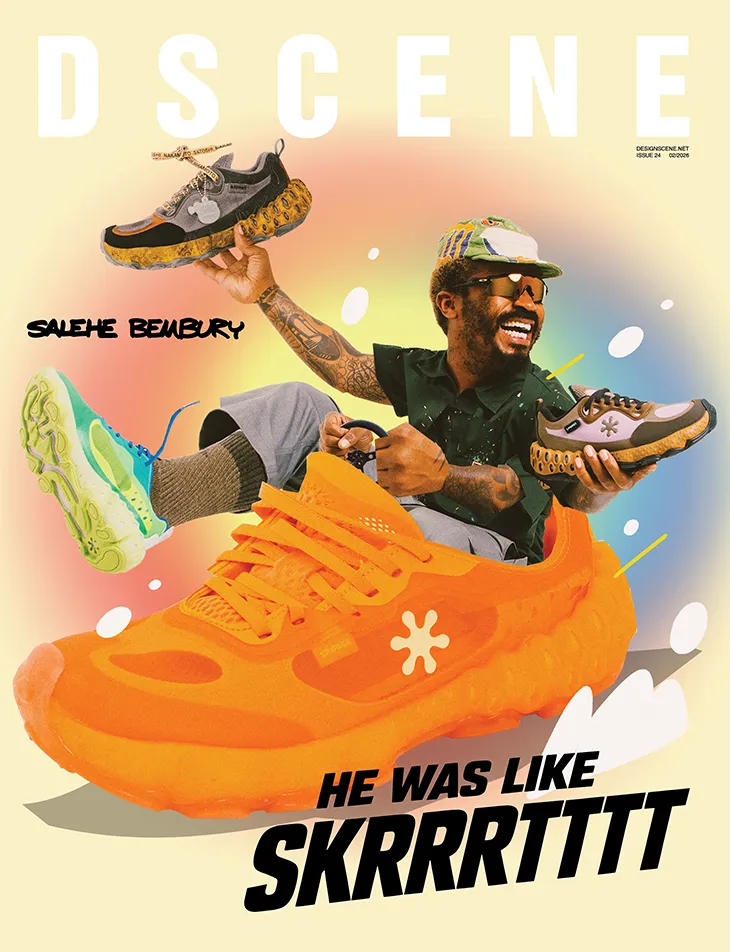
For DSCENE’s Design Under Pressure issue, Bembury also shapes the cover, working with long-time collaborator Troy Browne to develop an image that reflects this moment. In conversation with editor Katarina Doric, he speaks about the language he is learning, the instinct that guides his process, and the balance between function, identity, and scale as he builds something of his own.
What’s been taking up most of your headspace lately? – My brand, and more specifically, the transition that comes with it. I’m thinking a lot about language: the language I now have to speak, and the one I’m simultaneously learning and observing in real time. Careers have chapters, and I’m entering a new one centered around ownership.
I’ve just come out of a chapter defined by collaborative partnerships with large corporations, and while that work isn’t ending, my focus is shifting toward building something of my own, birthing and shaping a footwear brand from the ground up.
It’s a space I’ve experienced closely as both a consumer and a collaborator, but creating something entirely from scratch is new territory. I’m approaching it with a balance of caution and urgency, trying to move quickly while still being intentional about what I’m putting into the world. One of the biggest differences is that collaborations are moment-based, they have a beginning and an end. The tactics that work there, whether it’s polarizing design or short-term marketing energy, don’t necessarily translate to building a lasting brand.
There’s also a shift in audience. Speaking to a niche, hyper-fashion consumer is very different from speaking to a broader audience that a footwear brand needs to cultivate. While there will still be fashion-adjacent collaborations within the brand, the bigger challenge is figuring out how to build multiple communities at once, while introducing a distinct point of view and ultimately making a product that looks incredible and feels great to wear.
On top of that, I’m very aware of how difficult it is to convert consumers in footwear. Most people already have brands they trust. So the question becomes, how do we shift that behavior? How do we build trust not just in the product, but in the brand itself?
The fact that this answer feels like a stream of thoughts is reflective of where I am mentally, there’s a lot happening at once. It’s designing, storytelling, community-building, retail strategy, collaboration, and brand identity all at the same time. It’s a new language, one I was adjacent to before, but never had to fully speak. Now I’m learning it, actively using it, and making sure my audience understands that I’m operating in a new space. That clarity in communication is going to be key to making this transition successful.
So to simplify it, Spunge is taking up all of my headspace.
The foundation of SPUNGE is curiosity, the idea of being a sponge.
What made you decide it was the right moment to start your own brand and take full control of the process? – The foundation of SPUNGE is curiosity, the idea of being a sponge.
Over the past 15 years, I’ve moved through many different corners of the footwear industry, and throughout that time, I’ve been doing exactly that, absorbing everything. The good, the bad, the firings, the hirings, factory work, marketing, PR, all of the moving parts that go into creating a shoe. That range of experience, across startups, high fashion, and something as culturally impactful as Yeezy, allowed me to develop a multi-layered point of view on how this business actually operates.
Because of that, I’ve been able to hand-build my own ideologies around what works, what doesn’t, and what I believe best practices in footwear can look like. This brand is really a reflection of those learnings.
I’ve been fortunate to collaborate with brands at a scale that very few people get access to, and while that meant selling a lot of product, more importantly, it meant I was constantly learning.
So when I think about why now, it feels less like a sudden decision and more like a natural progression. From an education standpoint, I reached a point where that accumulation of knowledge felt like it needed an outlet. It was time to take everything I had absorbed and apply it to something of my own.
That said, this isn’t a departure from collaboration. I’ll continue to work with other brands under my own name. This is just an expansion, a new challenge that allows me to fully express everything I’ve learned, and build something that reflects my perspective from the ground up.
You’ve said stepping into your own brand required a different kind of responsibility. What part of that shift felt uncomfortable at first? – I’d say the most uncomfortable part of the shift has been the change in language. With collaborations, the goal was often to create something polarizing, something that grabs attention and feels new or unexpected. It’s about engaging eyes. But that formula isn’t necessarily what you use to build a lasting brand.
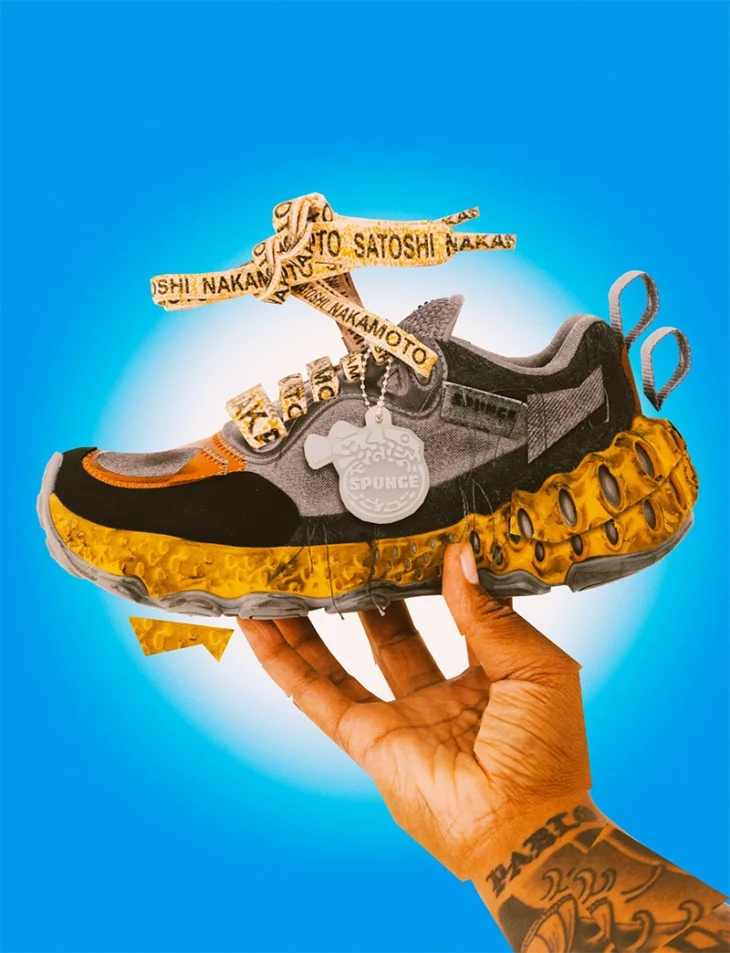
When launching the Osmosis, I observed that some people were expecting me to play the old hits, without realizing I had moved on to a new album. The intention wasn’t to shock, it was to create something that felt familiar, but still distinct. That balance is important when you’re trying to speak to a broader audience. If you look at something like the Crocs Pollex, for example, it was very successful, but it also had a ceiling.
There’s a large group of consumers who would never wear a foam shoe, and even more who wouldn’t wear one with such an aggressive design language.
With Osmosis, it was important for me to retain my design DNA, but also create something that more people could see themselves wearing. It’s about making a product that feels approachable, something that can actually shift consumer behavior and encourage people to try something new, even if they’re used to a different brand.
So the discomfort comes from changing how I communicate through design. I’ve been speaking one “language” to an audience for years, and now I’m speaking a different one. Naturally, there are going to be people who don’t immediately understand it, or who question the shift. But that’s part of growth. It’s uncomfortable, but it’s necessary, and it’s something I fully embrace.
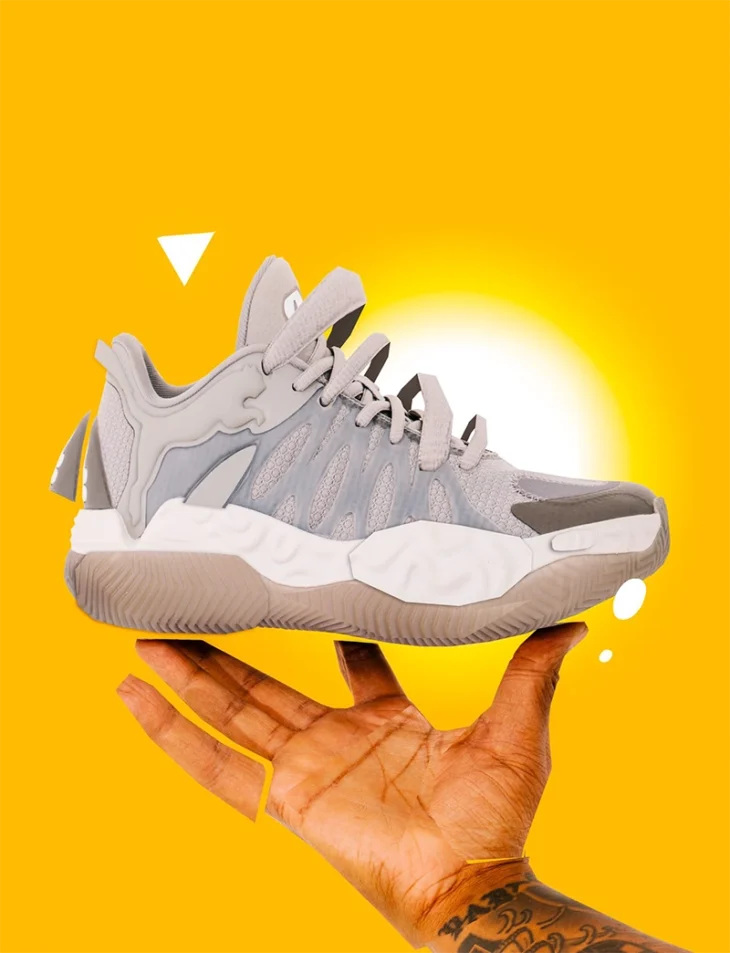
When you start a project now, what are you actually trying to get right first? – I just came out with a book, and for the first time I’ve really had the opportunity to look back at my work in a meaningful way. The same way you can look at old photos of yourself and understand where you were mentally at that time, I’m realizing I can do the same thing with my design work. Each project feels like a snapshot of my mindset at that moment.
For example, the Crocs Pollex came from a place of trying to prove myself, to my peers, to competitors, to people who doubted me, and even to myself. I was completely locked in, hyper-focused on being great, and I think that shoe reflects that energy. I’d even go as far as to call it a near-perfect design, humbly.
Then you look at something like my Clarks collaboration, and I was in a completely different headspace. My confidence was at an all-time high, and I was just going off instinct. I reworked the shoe, added asymmetrical lacing, reshaped the upper, and then pushed it further with hairy suede in a way that didn’t need explanation. It was more like, this feels right, let’s go with it.
Looking back, it’s interesting to see how clearly my psyche shows up in the work. So now, when I’m starting a new project, the main thing I’m chasing is a vibe. It’s something intangible that I don’t always have the words for. It’s a feeling more than a formula.
At this point, I’m fortunate to have a designer working with me who helps bring these ideas to life. And honestly, I’m sure it can be frustrating at times because I don’t always articulate exactly what we’re aiming for. But over time, he’s gotten better at understanding that internal compass, even when I’m not spelling it out. He can feel when we’re getting closer to that destination.
What’s been interesting is noticing how consistent that instinct is. I’ll see different projects across different brands, and somehow the color palettes or design sensibilities align, even when they weren’t planned that way. That tells me I’m creating from a very honest place, from the gut.
So now, the process really starts there. It’s about identifying the vibe first. Once that’s right, everything else can be refined and built around it.
View this post on Instagram
You’ve moved between very different systems: Yeezy, Versace, Crocs, and independent work. What stays consistent in how you approach design? – At its core, it’s always the same system. It starts with identifying a problem, then finding the insight, and ultimately using design as the solution. That’s really the foundation of industrial design, and it’s something that’s stayed consistent for me regardless of the brand or context.
Whether it was at Yeezy, where the goal was to bring Kanye’s ideas to life and introduce polarizing product into a market that wasn’t used to footwear, especially boots, coming from someone like him, or at Versace, where the sneaker category wasn’t taken as seriously, so the challenge became how to build that business while still respecting and acknowledging their existing consumer.
Or even with Crocs, working with a brand that wasn’t always respected by certain audiences, the question was how to create something that those same people could appreciate, or even covet, while helping move the brand into a new chapter.
On the surface, those challenges all look different, but they’re really all the same at their core. It’s about identifying the problem, uncovering the insight, and then solving it through design.
That’s the red thread for me. That system has never failed me, and it continues to guide how I approach everything I create.
Each project feels like a snapshot of my mindset at that moment.
You focus a lot on making things that actually work. How do you navigate the point where function and visual identity start to compete? – I could probably pull from a lot of classic design quotes to answer this, ideas around how the consumer doesn’t always know what they want until they see it, or how the best design is something you don’t even notice because it just works. But for me, it really comes back to my foundation in industrial design.
I was taught to create things that function, that have real utility. If we’re going to cut steel, build molds, and put product into the world, it should do something meaningful. It should be comfortable, or function in a way that introduces a new experience, something the user may not have even realized was possible.
That’s where design serves the consumer. It pushes things forward. And at the same time, there’s a personal satisfaction in that process, being able to introduce something new into the world, something that didn’t exist before. There’s something special about contributing to culture in that way.
For me, I’ve always been drawn to ideas that feel simple but unexpected. The kind of design where you see it and think, “why didn’t I think of that?” A lot of the best ideas live in that space because they’re so intuitive.
Whether it’s something like the Crocs Pollex or putting a whistle on the back of the New Balance Yurt, those moments come from wanting to explore something new while still keeping it grounded in function.
So yes, aesthetics matter, but that’s just the entry point. Especially in product design, it has to work. It should make someone’s life easier, more convenient, or even introduce them to a new way of interacting with something they thought they already understood.
And beyond that, I do think there’s a responsibility. I’ve always been deeply curious, even as a kid, and that curiosity still drives how I design today. A lot of what I create pulls from that same sense of exploration and discovery. I’ve had people say there’s a kind of childlike nostalgia in my work, in the colors, in the forms, and I think that’s exactly what it is. It’s me channeling that same curiosity I’ve always had, and sharing it in a way that others can connect with.
How much of your work is about solving a problem, and how much is about introducing something people didn’t know they wanted? – Recently, I went to a restaurant and had pigeon. And to be clear, I’m a native New Yorker, so I grew up around pigeons my entire life. To me, they’re both a majestic mascot of New York and also a disgusting animal. So the fact that I was able to eat pigeon, and not only eat it but think it was delicious, felt like a perfect example of a creator introducing something the consumer didn’t know they wanted.
I think that idea applies to design as well. At the end of the day, the priority is always solving a problem. That’s the foundation. But if you’re able to create something people didn’t even know they wanted, that says something bigger about your design ability and your capacity to be visionary.
To me, that’s the distinction. Solving a problem is the job. But introducing people to something they hadn’t imagined for themselves, and then making them understand why they want it, that’s where vision comes in.
If you don’t solve a problem, then what you’ve made is closer to art than design. And art is incredible, but it’s different. Design has a responsibility to function. So for me, the goal is always to solve the problem first, and then, if possible, go a step further and show people a future they didn’t know they were ready for.
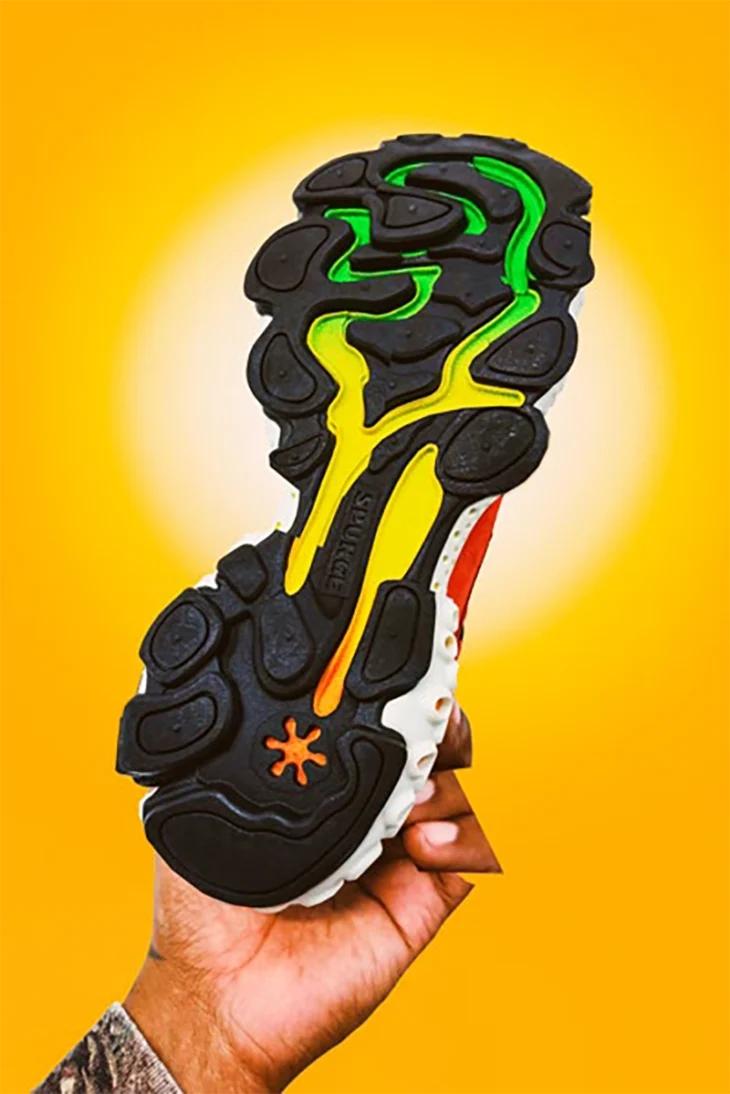
You’ve built a strong audience over time. Does that awareness ever interfere with how you design? – I’d be lying if I said it doesn’t affect things at all. The uninformed criticism that comes with putting work out into the world can definitely be frustrating, especially when you’re trying to introduce something new.
I’ve always relied on a trusted circle of friends and peers as a kind of internal focus group. When you’ve been staring at a design for so long, your perspective can get distorted, so getting honest feedback from people you respect helps bring clarity before release.
But once a product is out, it enters a much different environment. You have a large audience that feels deeply informed about footwear, whether that’s consumers, bloggers, or reviewers. And while there are definitely knowledgeable voices out there, there are also a lot of opinions that aren’t rooted in real understanding. The challenge is that those voices still shape perception. People go straight to the comments, and if the conversation is driven by surface-level or uninformed takes, it can influence how the product is received.
That can be frustrating, especially because of how much time and care goes into the work. You spend months developing something, there’s real effort and intention behind every detail, and then it’s reduced to a quick comparison or dismissed as something that already exists. That disconnect can feel both frustrating and, at times, disrespectful.
At the same time, I try not to let that become the focus. There’s always going to be noise, especially in an environment driven by quick reactions. What matters more is staying grounded in the work itself and trusting the process.
What’s something you learned the hard way that still affects how you work today? – When I was at Cole Haan, we had just finished designing the LunarGrand, which was about two years of work and ended up being extremely successful. It introduced Nike Lunar technology into a wingtip, essentially bringing sneaker-level comfort into formal footwear, and it really resonated with the professional market.
After that, we got word that Nike wanted us to explore using Nike Air, and my boss, Jeff Henderson, tapped me to lead the design. I spent about eight months developing a wingtip built around a 360 Nike Air unit, working through materials, colorways, and all the details. At the time, I had just experienced what LunarGrand did culturally and commercially, so I was convinced this was going to be the next evolution, and it was going to be my design. I was young, around 25, so this felt like a massive moment for me.
Right as I finished, Cole Haan and Umbro were sold by Nike, and the entire project got scrapped. I was devastated. It was a huge investment of time and energy, and I thought it was going to be a defining piece for my portfolio and my career at that stage.
I asked my boss if I could at least share it on my blog, which didn’t have much reach, but meant something to me. He said yes, so I posted it. Within hours, Nike’s legal team reached out, and the images had to come down immediately. And just like that, something I had spent months on disappeared from public view.
That experience taught me a lot about confidentiality and timing. It made me realize how important it is to protect work that isn’t meant to be seen yet, or sometimes ever. Since then, I’ve been extremely intentional about that. Contracts and NDAs are real, and as creatives, one of the most important things we have is the reveal. So anything that compromises that moment is something I take very seriously.
The career I’ve built came from that realization, from trusting my instincts and designing from the gut.
You came up through sneaker culture in a very specific era. What do you think today’s sneakerheads value differently? – I think the biggest thing is individuality. And even saying that, I’m aware it probably makes me sound a little older, but I’ve been in this space for a while now, and it feels like there’s less emphasis on personal expression and more focus on chasing what’s considered exclusive or desirable at the moment.
When I think back to my upbringing in downtown New York, it was really about individuality. Brands like 10 Deep, Rocksmith, Rockers NYC, Mishka, A-Life, Only NY, Lamour & Dolla, Mighty Healthy, Peg Leg, Staple, Awake, and others all represented distinct perspectives.
People wore things because they connected to them, because it reflected who they were, not because an algorithm told them it was the right thing to wear.
Now it often feels like people are dressing based on what their phones are telling them is relevant, what’s hyped, what’s scarce, what’s trending. And while there’s nothing inherently wrong with any specific aesthetic, it can start to feel like there’s less range, less experimentation, less individuality. Streetwear, at its core, has always been about disruption, expression, art, and color.
So if I could encourage anything, it would be to really lean into being yourself. No one can do that better than you. The career I’ve built came from that realization, from trusting my instincts and designing from the gut. That’s how you develop a point of view. That’s how people can look at your work and immediately recognize a palette, an environment, a story. That only comes from authenticity.
And I do think there’s also something to be said about understanding history. Not in a gatekeeping way, but in a way that gives context. A lot of decisions today feel driven by what’s being surfaced in real time, rather than a deeper understanding of where things come from. For me, it was always about what looked good, what felt right, what was cool to me, not just what was being labeled as important.
So the advice is simple, but not always easy. Be yourself, trust your instincts, and build from there. That’s where the real longevity comes from.
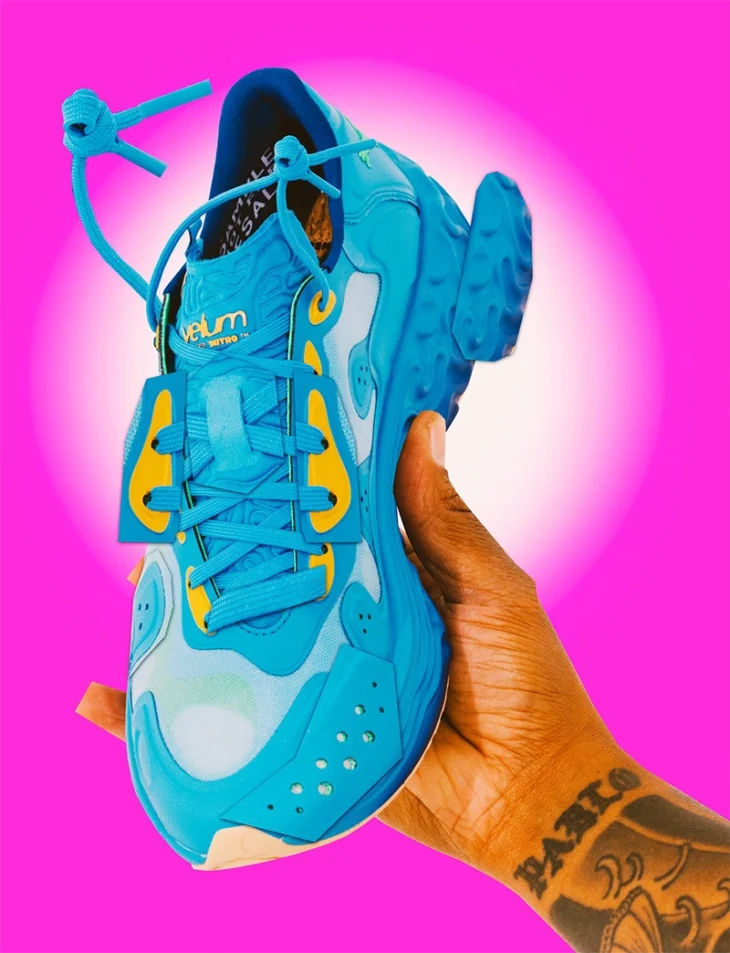
If someone could see your work that never made it out, what would surprise them most? – If anyone saw the work of mine that never made it out, I don’t think it would feel or look any different from the work that has. At the end of the day, within footwear and fashion, there are so many ideas that never see the light of day. (Shout out the cutting room floor only on Patreon.)
A lot of the time, what the consumer doesn’t realize is that what makes a product special is that it actually made it through. It survived all the meetings, all the edits, all the revisions. It was challenged, refined, and pushed until the designer, the company, or the creative director felt it was ready to exist in the world.
What ultimately reaches the consumer is really a result of refinement, critique, and restraint. I often see products that could have been finished earlier, but the designer keeps going and it becomes over-designed. To me, one of the clearest signs of a strong designer is the ability to know when to stop. Restraint is a skill.
Sometimes minimalism is more powerful than adding more. It’s about understanding when the idea is fully realized and not overworking it. That balance, between expression and restraint, is something I try to practice in everything I create.
The obstacle is the opportunity, and overcoming it is where the real value comes from.
What kind of projects still challenge you at this stage? – I would say the projects that challenge me most are the ones that exist in new environments or unfamiliar spaces within design. Industrial design trains you to be versatile and to approach any project through an insight-led process, but when you’re working on something you don’t have deep experience in, it naturally adds more layers to the climb.
That said, every project starts with research. If the research is done properly, it allows you to design from a truly informed place, regardless of the category. So while new spaces can feel more complex at first, they also present an opportunity to learn, expand your perspective, and apply the same core design principles in a different context.
And I don’t really view challenge as a negative. To me, it’s a positive. It’s what makes the process more fulfilling. The obstacle is the opportunity, and overcoming it is where the real value comes from.
Who are the people that influence how you think right now? – Lately, I’ve been really inspired by Gustav Westman. Out of a lot of the creators I see, he feels like someone who is creating very freely. As you get older and more experienced, you also become more aware of constraints, budgets, timelines, production limitations, and all of that naturally introduces boundaries. And those boundaries often show up in the work.
What stands out to me about Gustav is that his work feels almost untouched by those limitations. It feels like it’s coming from a place of childhood nostalgia, where there are no rules, just instinct and curiosity. The colors, the forms, the playfulness, it all feels very pure and intentional at the same time.
That’s something I try to bring into my own work as much as possible. Designing from the gut, staying connected to that sense of curiosity, and not overthinking to the point where the work loses its energy. What he’s been able to do is build a very clear design language, cultivate a community, and create a body of work that’s immediately recognizable.
That kind of clarity and freedom is really inspiring to me, especially within a space like footwear, where there are so many constraints.
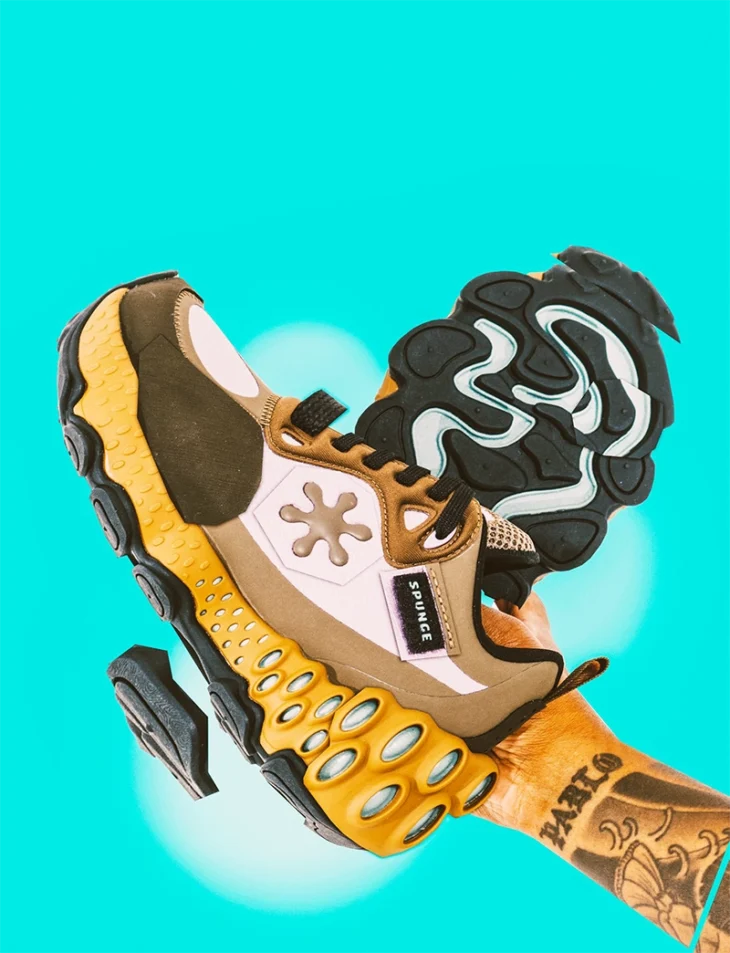
Which young designers or creatives should we be paying attention to right now? – During my book tour last year, I spent some time in London and got to visit Slawn’s studio. I was extremely inspired by his work, his operation, his energy as both an individual and an artist, and his story.
I think one thing my audience has become familiar with is my own coming-of-age story, paired with my design perspective, and how that’s helped me build a community around passion and commitment to a craft. When I heard Slawn’s story, it resonated in a similar way. And then actually visiting his studio, meeting his team, and seeing how everything operates, it really brought me back to that feeling of being young and hungry.
While I still have that hunger, I can’t claim youth anymore. So seeing someone in their 20s fully leveraging all the tools available today to execute their creative vision was really powerful. What also stood out is that he’s not just strong creatively, but he seems to have a solid handle on the business side as well, with a team that supports him in the right ways.
I don’t even like saying someone is “next up” because it minimizes what they’ve already accomplished. He’s already arrived. But he’s definitely someone people should be paying attention to.
Be yourself, trust your instincts, and build from there.
What’s been exciting you lately outside of your own work? – What’s been exciting me most lately is the technology that’s becoming available to creatives, and more importantly, how accessible it’s become. I’m really interested in how these tools are being used to increase efficiency and help designers achieve what they’re ultimately trying to do.
There’s a lot of conversation around AI replacing creativity, but I see it differently. To me, it’s no different than when tools like Photoshop or Illustrator were introduced. Those tools didn’t replace creativity, they enhanced it. They allowed people to move faster, explore more, and execute ideas more efficiently than doing everything by hand.
I think the same applies now. These tools are meant to be used in a way that allows creativity to thrive. My team and I have been using them in a way that’s both inspiring and highly efficient. For example, if we want to see a shoe we’ve already designed in 50 different colorways, doing that traditionally in Illustrator could take hours. Using AI, we can generate those variations in minutes, sometimes even seconds. The ability to accelerate that process is immeasurable.
That kind of efficiency expands your bandwidth. It allows you to iterate more, explore more directions, and ultimately refine ideas at a much higher level.
So for me, it’s less about the tool and more about how you use it. Technology doesn’t replace taste, it amplifies it. The designers who understand that will always have the advantage.
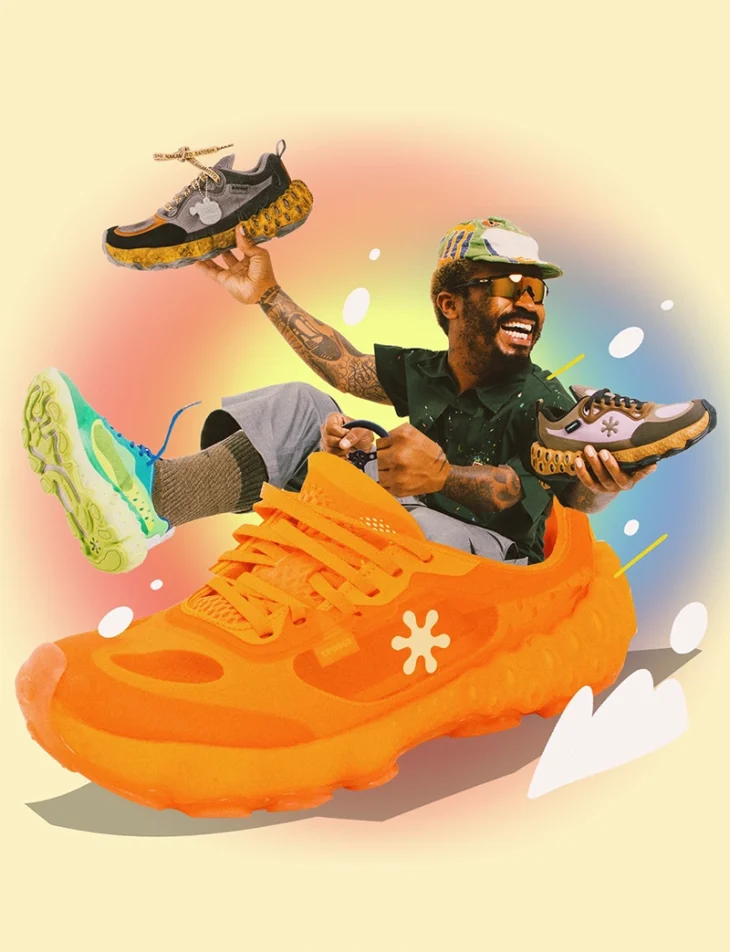
Tell us about your DSCENE cover. Where did the idea start, and how did you approach it? – I first came across Troy Browne on Instagram and was immediately drawn to his graphic work. He has a way of digitally distorting images that turns them into entirely new compositions, and that perspective really stood out to me.
We ended up working together for about two years on my Crocs campaigns, where he brought a lot of energy to the visuals. His work became a big part of the identity of those campaigns, especially in the still imagery that people now associate with that collaboration.
I had always wanted to collaborate with him on a magazine cover, and given the history and creative shorthand we’ve built over time, he felt like the right person to do it with.
It felt less like a one-off project and more like a continuation of a creative conversation we’ve been having for years, just translated into a new medium. And for me, that’s always the goal, to build with people over time and let that shared language evolve into something that feels both familiar and new.



wow that is quite read ! I enjoyed this ! Every time i listen or read to Salehe’s interview its a true masterclass in the fashion and design industry. HE is a true talent and i love the spunge!