

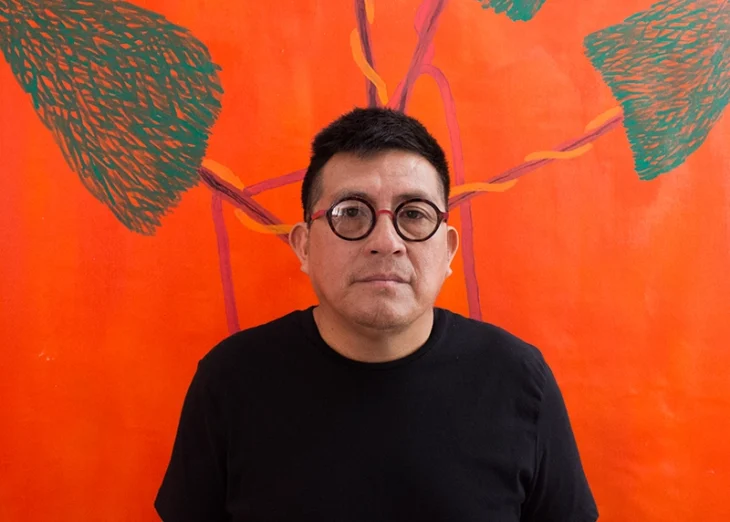
For Sheroanawe Hakihiiwe, drawing begins in the Amazon rainforest, where daily observations of plants, animals, and natural forms become part of a visual language shaped by Yanomami knowledge. Born in 1971 in Sheroana, Venezuela, the artist lives and works in the Poripori community along the upper Orinoco River. His practice draws from ancestral narratives, traditional body painting, medicinal plants, and shamanic songs, translating the knowledge of his community into drawings, paintings, and works on handmade paper.
ART
Hakihiiwe began developing his artistic practice in the early 1990s alongside Mexican artist Laura Anderson Barbata, with whom he created handmade books documenting Yanomami cultural traditions. Over the following decades, his work developed into an extensive exploration of the relationship between the natural environment, collective memory, and spiritual experience. His recent shamanic training has introduced new subjects into his paintings, as dreams, chants, and visions increasingly inform the images he creates.
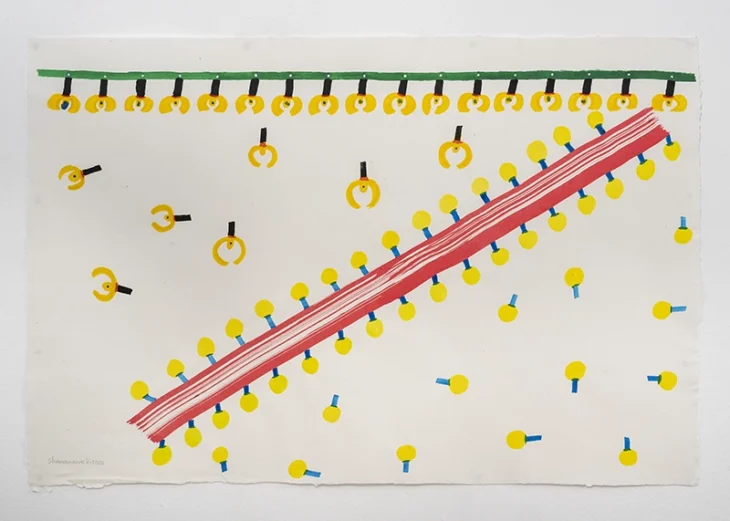
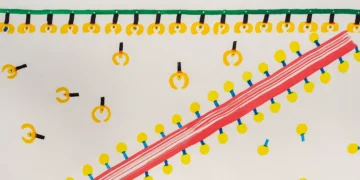
90 cm). Image courtesy Galería ABRA, Caracas / Josselin Chalbaud
On November 19, 2026, the Institute of Contemporary Art, Miami (ICA Miami) will open the artist’s first solo museum exhibition in the United States, organized jointly with the Fondation Cartier pour l’art contemporain. Bringing together more than 100 works from over 25 years of his practice, the exhibition includes drawings, paintings, animation, murals, and new site-specific installations. Architect Mauricio Rocha has developed an exhibition design inspired by the traditional Yanomami shapono, creating a setting that connects the works to their cultural origins.
In an exclusive conversation with DSCENE‘s Katarina Doric, Sheroanawe Hakihiiwe discusses the relationship between observation and drawing, the influence of dreams on his practice, and the responsibility of preserving Yanomami knowledge as the Amazon rainforest faces ongoing threats. Ahead of his Miami exhibition, the artist reflects on the possibilities of translating ancestral memory into images and what happens when those images travel far beyond the forest in which they originated.
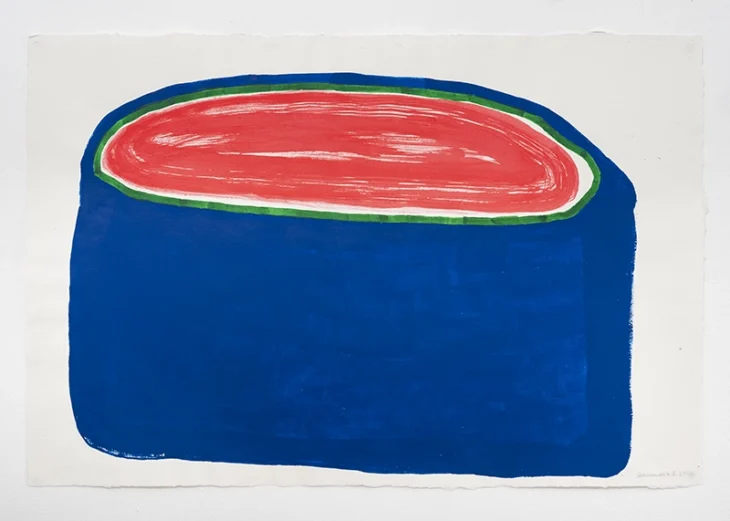
Image courtesy Galería ABRA, Caracas / Josselin Chalbaud
You have lived and worked in Poripori for much of your life. How does a day in the forest become a drawing? What happens between observing something and deciding to give it a form on paper? – When I go into the forest, I always bring a notebook and pencil. As I walk, I observe whatever catches my eye, whether it is something entirely new to me, or something familiar that I happen to see in a special light.
I do not want any of this knowledge to be lost. Our forest, nature, the songs, all of it matters deeply to me.
Your drawings often isolate a leaf, an animal, a pattern, or a fragment of the natural environment. What interests you about removing these forms from their surroundings? Does drawing something separately allow you to see it differently? – Working this way allows me to study each element in close detail. Rather than painting full landscapes, I enjoy freeing individual forms from their surroundings, focusing on specific qualities and details of each subject.
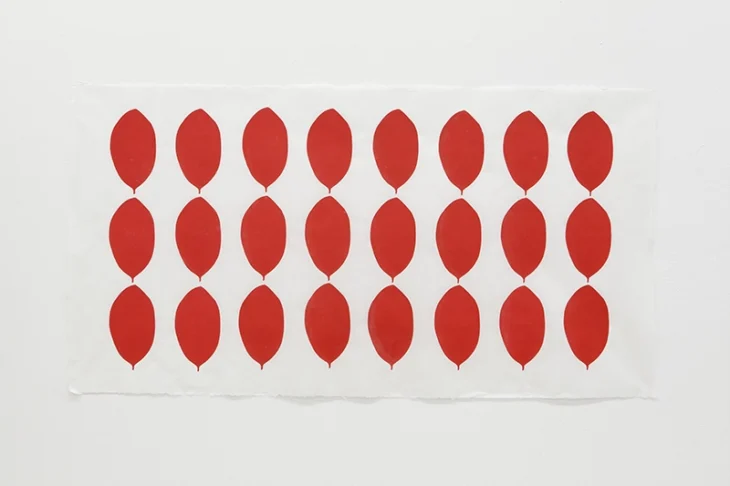
Feather), 2021. Monotype on mulberry paper, 29 15/16 x 56
11/16 in. (76 x 144 cm). Courtesy the artist and Galería ABRA, Caracas; © Sheroanawe Hakihiiwe. Image courtesy Galería ABRA, Caracas / María Teresa Hamon
You began making handmade books with Laura Anderson Barbata in the 1990s, at a time when you were developing your own artistic vocabulary. What did the book offer you as a way of organizing images and knowledge? Do you still think about your drawings in relation to these early publications? – Working alongside Laura taught me organization and structure. Creating those books allowed me to gather the drawings and patterns I saw my mother, my aunts, and other Yanomami women make. That is how I began placing them side by side, just as I learned to form my first letters in school. My process has evolved since then. Today, I translate my dreams directly onto the paper or canvas, though I never stopped keeping notes in my notebooks.
Images, sounds, and forms come to me in dreams: chants, ornaments, animals, plants, and the spirits of all those things. That process is what allows me to paint them.
There is a remarkable precision to your work, particularly in the repetition and variation of certain forms. Are these rules within your visual language that you follow, or do they change as you work? – I can always return to those initial repetitions and patterns when the piece calls for it, but my artistic practice has naturally evolved as my life has changed. Today, as a shaman, my dreams and spiritual visions guide much of what I paint.
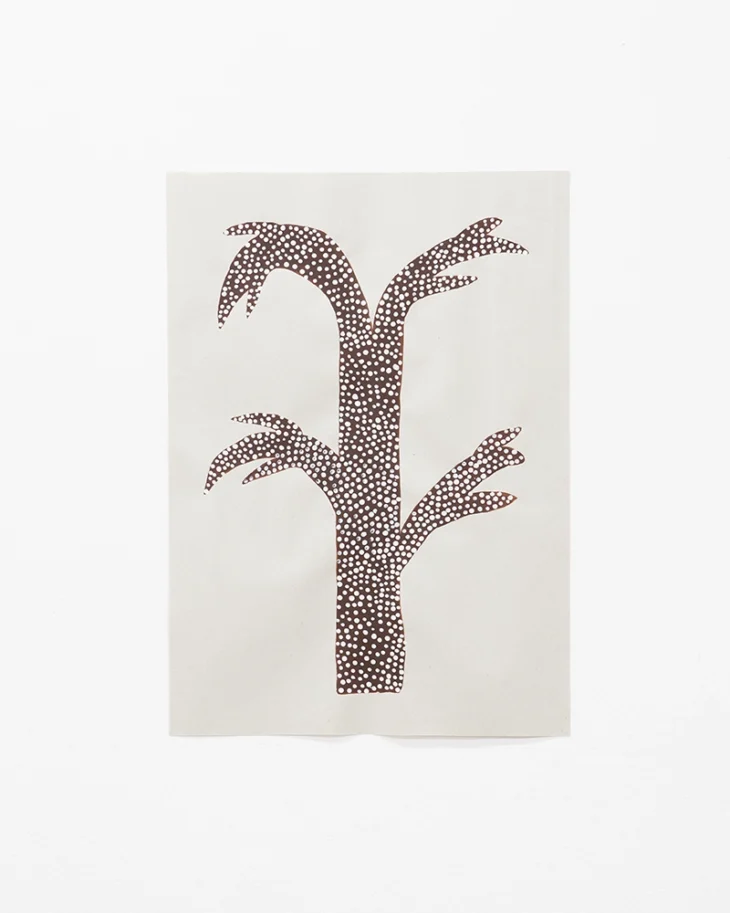
Galería ABRA, Caracas / María Teresa Hamon
Your practice draws on Yanomami knowledge, including medicinal plants, body painting, ancestral narratives, and shamanic songs. How do you approach knowledge that has traditionally circulated through speech, experience, and collective memory when translating it into images intended to exhibition? – I do not want any of this knowledge to be lost. Our forest, nature, the songs; all of it matters deeply to me. This knowledge was passed down by my grandparents and the wise elders of our community. Creating these images is my way of preserving that wisdom so it does not disappear.
Creating these images is my way of preserving that wisdom so it does not disappear.
Your work has interested museums and collections across Europe and the Americas. What happens to the meaning of an image when it travels so far from the circumstances in which you conceived it? Have you encountered interpretations of your work that surprised you? – Every piece I exhibit carries deep meaning, though people living outside our forest may not recognize what each symbol represents. When I can attend an exhibition in person, I appreciate being able to speak directly with visitors, answer their questions, and share the true stories behind the work. It is always fascinating to hear how people respond to my art, but my goal is to help them understand the real life and culture behind every image.
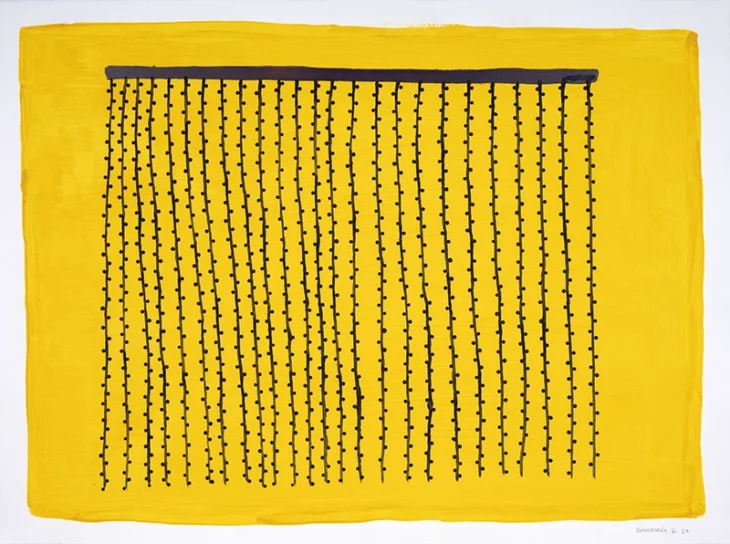
Fondation Cartier pour l’art contemporain; © Sheroanawe Hakihiiwe
In a previous conversation, you spoke about the possibility of losing the forest and, with it, the language and knowledge of your community. How do you understand the relationship between making art and preserving memory? Can an image carry knowledge that might otherwise disappear? – My artwork is now in many places around the world, which means the knowledge I want to preserve has also travelled far. But I recognize that it is difficult for a single image to safeguard all of our Yanomami heritage. As the forest faces constant threats, preserving our traditions has become very difficult. It will only be possible to keep our people’s knowledge alive if the younger generation becomes aware of what is at stake.
Every piece I exhibit carries deep meaning, though people living outside our forest may not recognize what each symbol represents.
Your recent shamanic training has informed a new body of work concerned with dreams and experiences beyond ordinary perception. Has this changed what you consider possible to represent? Are there things you have experienced that resist becoming images? – When I am practicing as a shaman during the day, I cannot immediately translate what I see into art. It is when night falls and I sleep that I recall everything I experienced or dreamed, and only then can it be painted. Images, sounds, and forms come to me in dreams; chants, ornaments, animals, plants, and the spirits of all those things; and that process is what allows me to paint them.
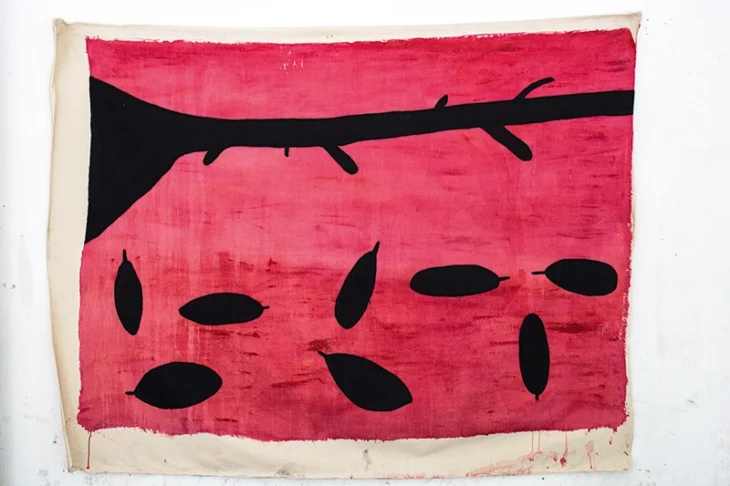
Cartier pour l’art contemporain; © Sheroanawe Hakihiiwe
The Miami exhibition introduces film, chanting, murals, and an installation of shamanic poles alongside your drawings. How did you arrive at these different forms? What relationship do you see between the physical presence of an installation and the intimate scale of a work on paper? – Drawing has always been the core of my practice. Working with Laura on our first animation, starting on paper before moving to video, showed me that I could create moving images independently. Similarly, I began creating murals in Caracas back in 2010; to me, a mural is simply an expanded canvas for my drawings, where the connection lies in the underlying forms rather than the size. The shamanic poles and chants come straight from my heritage, as sacred elements that shamans traditionally craft and practice. Bringing these ritual elements into gallery spaces, outdoors, or within my own community allows me to expand the intimate world of my paper drawings into a physical, living space.
My work does not follow a linear timeline. While my paintings come from what I am experiencing and dreaming today, I am always returning to and reconnecting with the practices of my past.
The exhibition brings together more than twenty-five years of your practice, with an architectural setting by Mauricio Rocha that draws from the Shapono. How do you feel about seeing your work presented as a history within a museum? Is there a particular work, experience, or question, that connects what you were making in the 1990s to what you are making now? – I feel happy and proud, as well as grateful to everyone who has worked to make this exhibition possible, the curators, the institutions, my gallery, my friends, and everyone involved. Seeing this become a reality means very much to me. My work does not follow a linear timeline; while my paintings come from what I am experiencing and dreaming today, I am always returning to and reconnecting with the practices of my past.