


Bob Mackie understood something about clothes that fashion can occasionally forget: sometimes the point is to be seen.
NEWS
The American fashion and costume designer died on September 14 in Palm Springs, California, at the age of 87. His publicist confirmed pneumonia as the cause of death. Over a career that began in Hollywood in the early 1960s, Mackie created clothes that became inseparable from the performers who wore them, from Cher and Carol Burnett to Diana Ross, Tina Turner, Elton John, Liza Minnelli and Barbra Streisand. He won nine Emmy Awards and a Tony Award and received three Academy Award nominations.
Born Robert Gordon Mackie in Monterey Park, California, in 1939, he discovered costume design through the Technicolor musicals he watched as a child. After studying at Pasadena City College and the Chouinard Art Institute, he entered Hollywood’s costume departments and worked with designers including Jean Louis and Edith Head. While working for Jean Louis, a young Mackie sketched the sheer crystal-covered gown Marilyn Monroe wore to sing “Happy Birthday” to President John F. Kennedy in 1962.
Television gave Mackie the freedom to develop a visual language entirely his own. The Carol Burnett Show, which began in 1967, became one of his defining projects. During its 11 seasons, he created thousands of costumes, often using clothing as part of the comedy itself. His famous curtain dress for Burnett’s Went With the Wind! parody placed an actual curtain rod over her shoulders. The costume now belongs to the Smithsonian National Museum of American History.
Then came Cher.
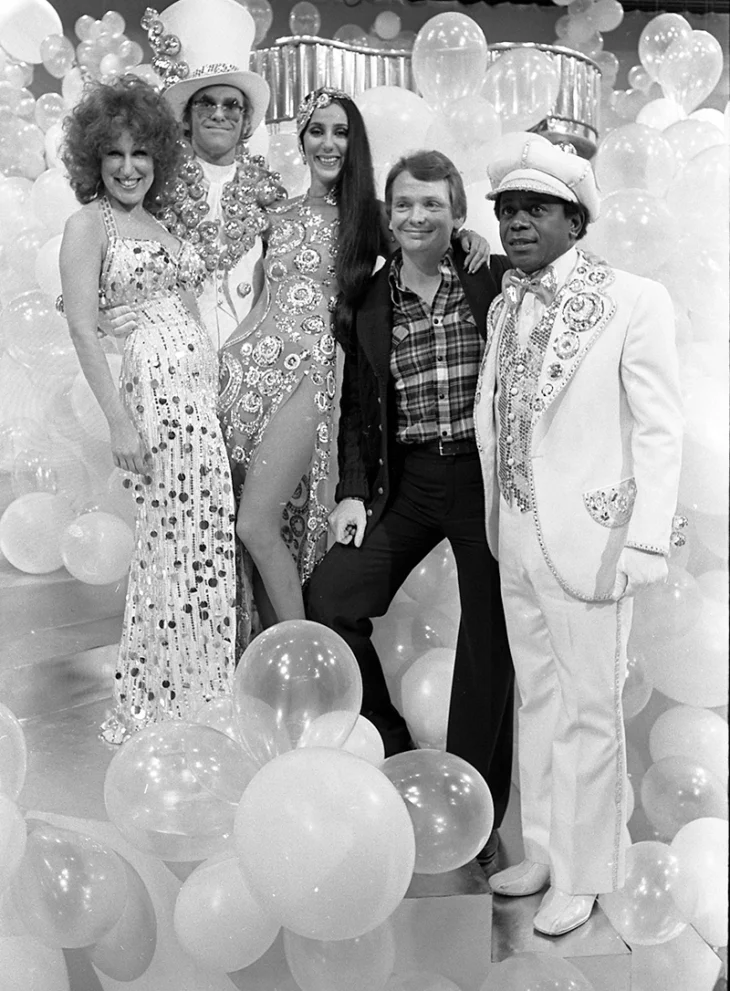
Their collaboration began through television and developed into one of the most recognizable relationships between a performer and a designer in American popular culture. Mackie understood Cher’s physicality, confidence and willingness to take risks. He dressed her in sheer fabrics, feathers, beads, enormous headdresses and silhouettes that exposed the body without making it appear vulnerable.
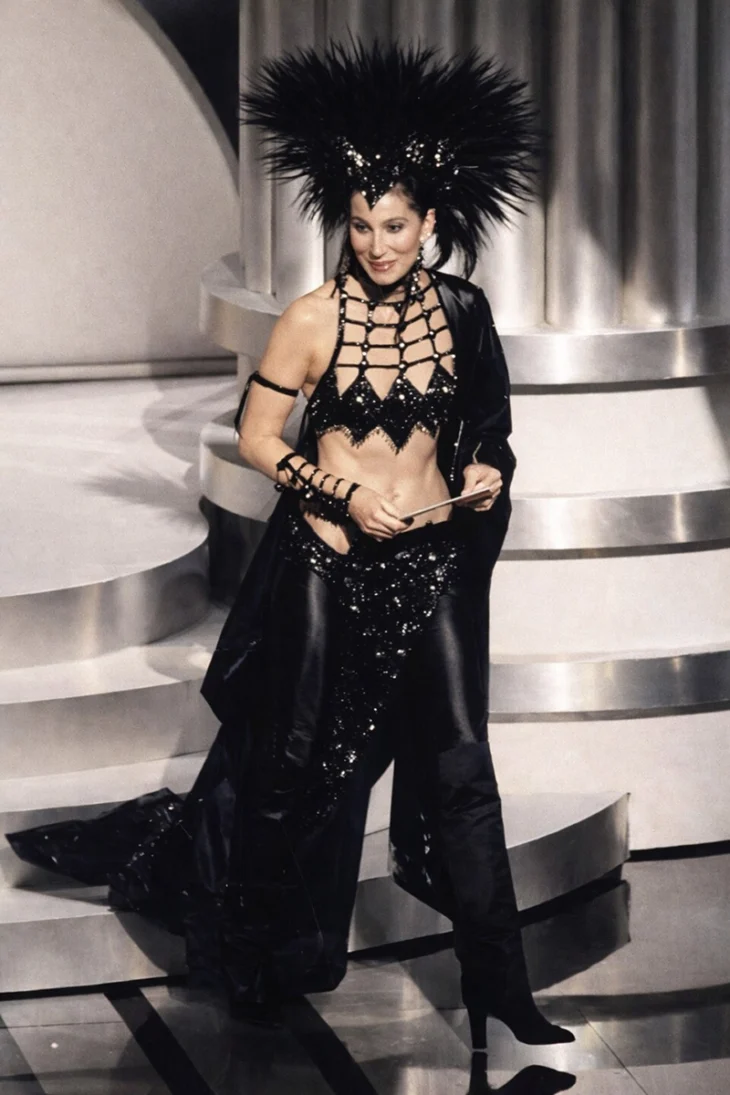
For the 1974 Met Gala, he created Cher’s feathered sheer “naked” dress, an image that still circulates more than five decades later. In 1986, when Cher attended the Academy Awards in an enormous feathered headpiece and exposed black ensemble, Mackie again helped her turn a red carpet appearance into an act of performance.
His work with performers always depended on personality. Mackie watched how someone walked, sat and performed before deciding what clothes could do for them. That distinction separated his work from costume as simple decoration. The clothes needed to amplify whoever stood inside them.
That approach produced a remarkable catalogue. Tina Turner performed in his winged, fringed bodysuits. Elton John took the stage at Dodger Stadium in 1975 wearing Mackie’s rhinestone-covered baseball uniform. Diana Ross, Bette Midler, Madonna and countless others entered his orbit. Younger generations continued to discover the archive: Miley Cyrus wore vintage Mackie to the 2024 Grammys, while Sabrina Carpenter wore a Mackie gown originally created for Madonna at the 2024 VMAs.
View this post on Instagram
Mackie’s influence also sits outside conventional ideas of good taste. He never needed glamour to behave itself. His clothes could be sexy, funny, excessive, theatrical and knowingly artificial. Sequins did not need an excuse. Feathers could reach several feet into the air. A dress could expose almost everything and still depend on extraordinary technical construction.
That sensibility made him particularly important to performers whose identities depended on transformation. His work became deeply influential within drag and queer visual culture, where exaggeration and theatrical self-creation could function as their own form of freedom.
iconic duo pic.twitter.com/OcfWytzEtD
— mizge (@mihailo____) September 14, 2026
Cher marked his death with a characteristically personal farewell, imagining her longtime collaborator arriving in heaven with “Sequins, Beads, & his sketch pad.”
With Mackie’s archive continuing to find new audiences, his death also raises an obvious question: is it finally time for the Costume Institute to give his work the major exhibition it deserves? Few designers have contributed so extensively to the visual history of American entertainment. A retrospective could place the spectacle of his costumes alongside the technical skill, humor and understanding of performance that sustained a career spanning more than six decades.
It is difficult to separate Bob Mackie from those materials. Yet reducing him to glitter misses what made the work matter. He understood the mechanics of an unforgettable entrance. He knew clothing could establish a character before she spoke, complete a joke before its punchline or turn a singer standing under stage lights into an image remembered for decades.
Mackie designed clothes to perform.
And they still do.