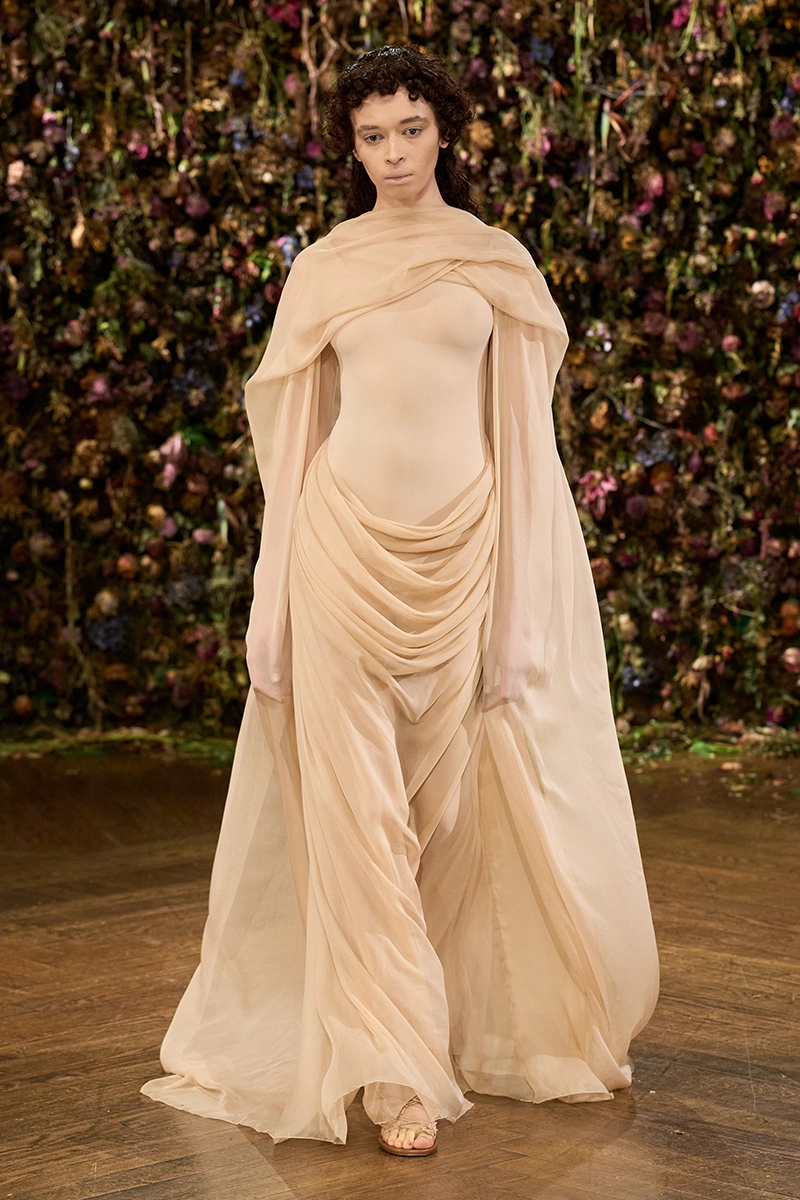



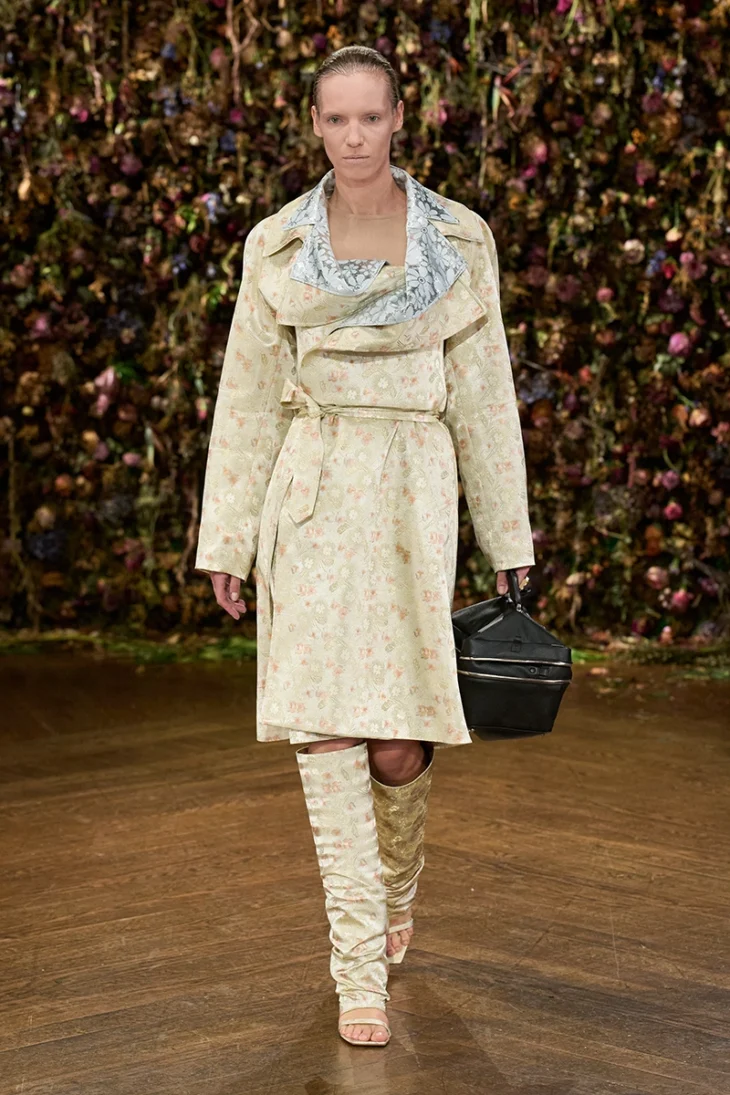
There is a clear intelligence behind Maison Margiela Spring Summer 2027. Glenn Martens begins with HARD and SOFT, two deceptively simple terms that allow him to examine the construction of clothes from the inside. Yet seeing the show, I found myself more convinced by the proposition than by much of what it produced.
SPRING SUMMER 2027
The collection takes its starting point from the traditional organization of Parisian ateliers. Tailoring handles structure, while Flou deals with dressmaking and draping. Martens deliberately disrupts that separation, inserting rigidity into fluid garments and introducing softness where we expect an object to maintain its form. Maison Margiela describes the exercise as part of its continuing interest in radically rereading fashion history and the systems supporting it.
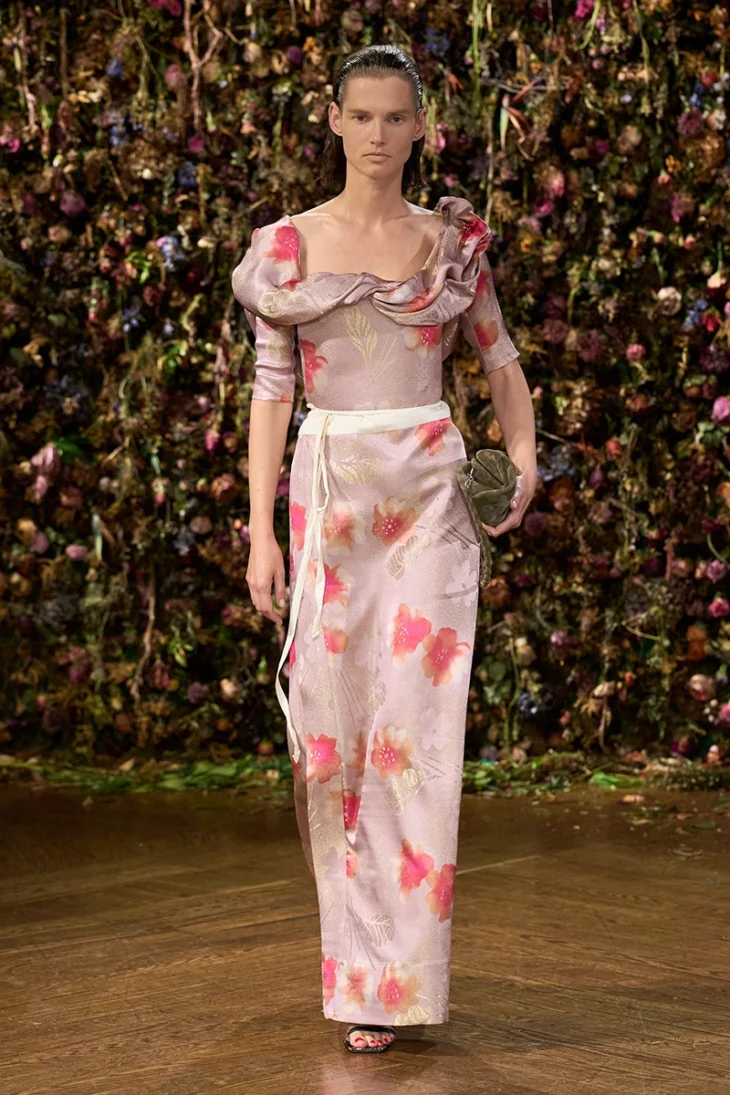
It is an appropriate subject for Margiela. This is a house built around asking why clothes are constructed, finished and worn in particular ways. The difficulty this season is that the intellectual argument sometimes becomes more compelling than the silhouette in front of us.
Trench coats receive rigid horizontal or vertical panels. Jackets and waistcoats turn inward, concealing their conventional closures while fortified creases retain evidence of their altered position. Dresses gain hardened structures at the chest, allowing fabric to fall outward without conventional corsetry. Enormous reinforced darts transform otherwise fluid dresses, while exposed corset constructions determine the movement of fabric from chest to ankle.
There are good ideas here. Yet the resulting volumes feel surprisingly controlled compared with what Martens has already demonstrated at Margiela. His Fall 2026 collection manipulated jersey, leather, metal wire, antique dresses, wax, porcelain and layers of organza, while draping twisted dramatically around the body. Spring Summer 2027 frequently feels more polite. For a designer whose understanding of distortion and proportion can make familiar clothes look almost unstable, I expected HARD and SOFT to generate greater friction.
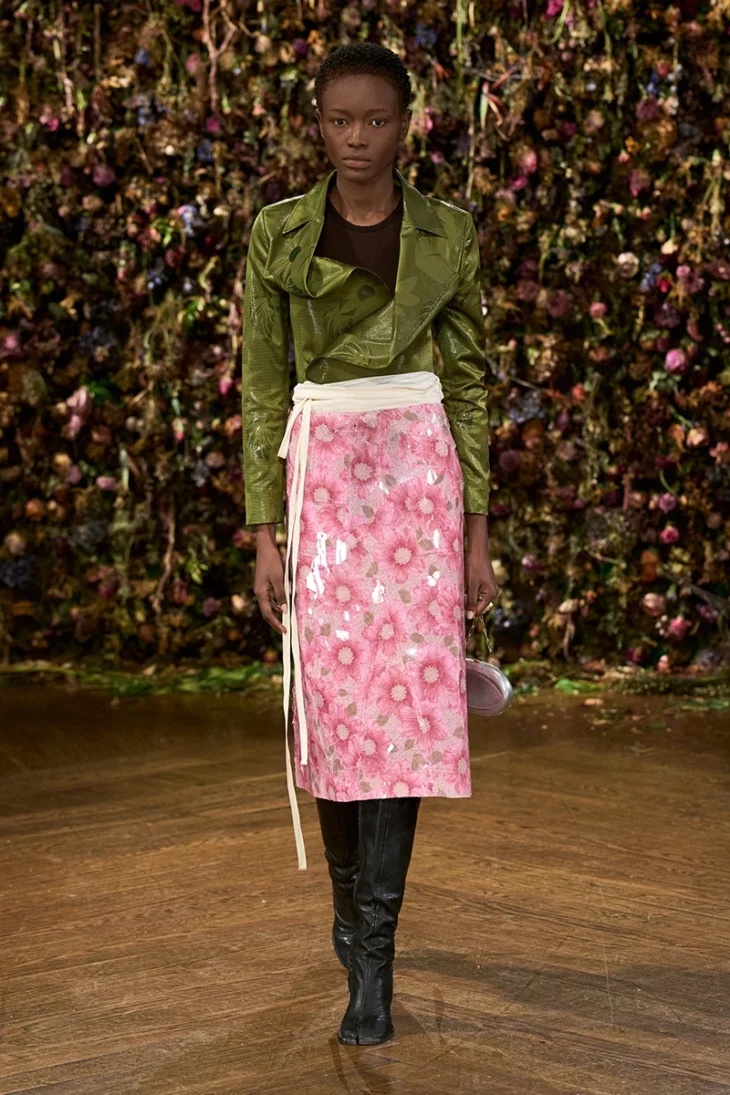
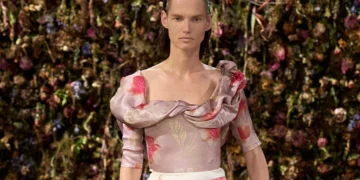
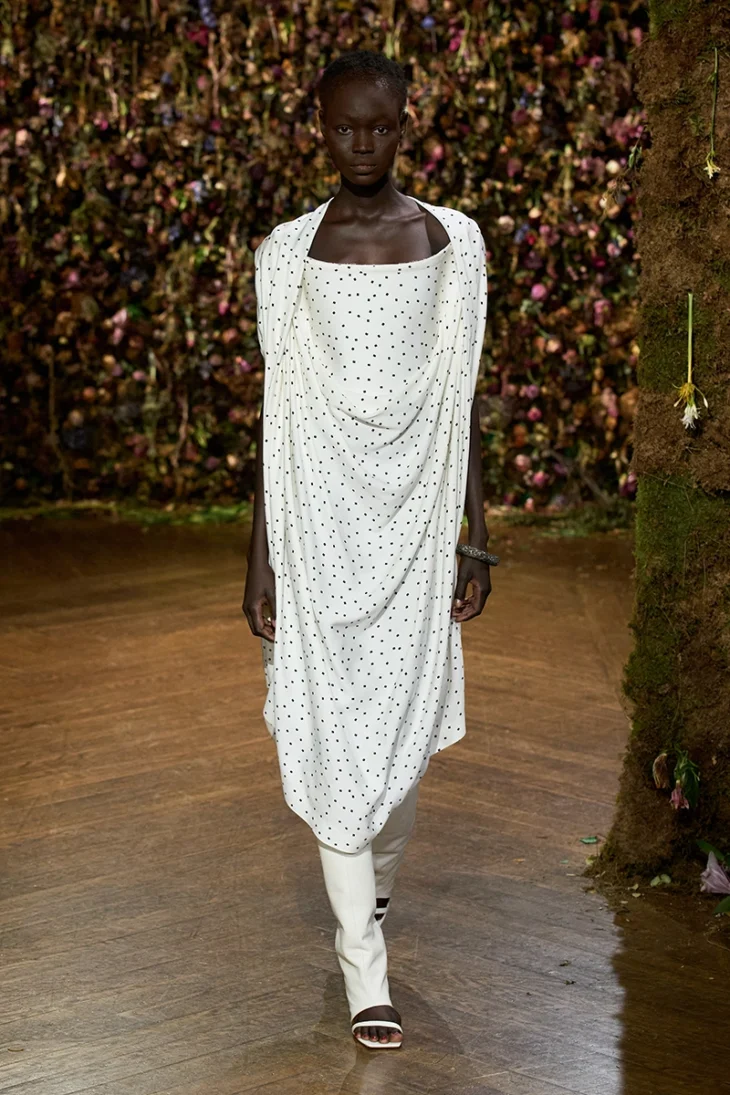
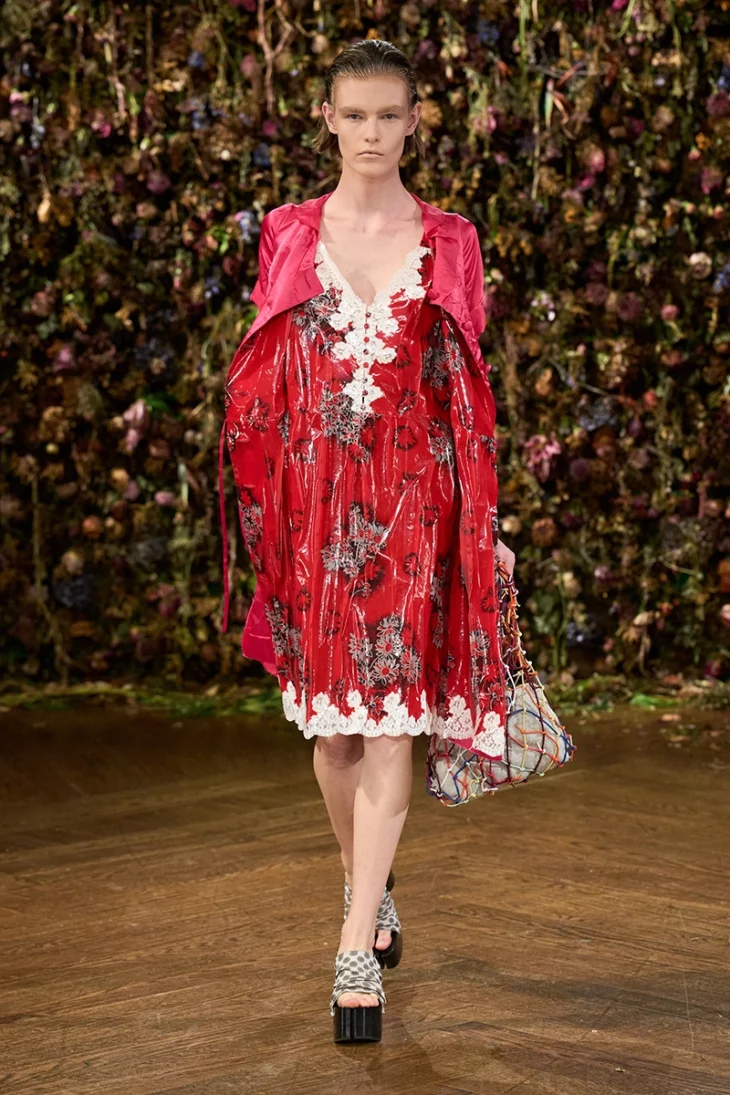
The collection becomes more complicated when print and color enter the conversation. Florals recur throughout, accompanied by polka dots, vivid colors and decorative surfaces. They connect directly to Mark Colle’s show installation, itself an homage to Raf Simons’s famous flower-filled 2012 couture debut. Margiela imagines Colle’s flowers as having experienced the passage of time, while the flowers printed onto garments remain permanently vivid. Conceptually, it works. Visually, I am less persuaded.
The floral prints in particular sometimes pull attention away from construction, which should be the collection’s most important subject. I found myself looking at a patterned dress rather than considering what Martens had done to its architecture. The brighter palette and graphic prints also introduce a decorative language that feels unexpectedly distant from the tension, anonymity and material experimentation I associate with Maison Margiela.
Of course, a house cannot remain imprisoned by what we expect it to look like. Margiela itself exists because expectations were challenged. Yet change becomes interesting when it reveals something more precise. Here, some of the florals and polka dots feel closer to styling vocabulary than a necessary consequence of the HARD and SOFT investigation.
The strongest pieces are often those where the construction speaks first. Linings become particularly effective. They appear as garments in their own right or attach to floral dresses opened and extended at the back. What appears to be a coat layered over a dress becomes one object. This returns to a fundamental Margiela question: why should the component designed to remain invisible be considered secondary?
The accessories make the collection’s thesis even clearer. Ghost bags take rigid archetypes such as briefcases, weekenders and vanity cases and remove their internal structures while retaining recognizable metal hardware. The 5AC receives a softer leather construction. Here, HARD and SOFT requires almost no explanation: remove rigidity from an object defined by rigidity and our perception of that object changes.
The timing inevitably matters. Martens has just ended his six-year tenure at Diesel and will now focus exclusively on Maison Margiela. It would be difficult to argue that working across both houses has produced a shortage of creativity. Quite the opposite: Martens has generated an extraordinary quantity of ideas across very different brands. His departure from Diesel raises expectations rather than explaining anything that feels unresolved here.
That is where I ultimately land with Spring Summer 2027. I understand HARD and SOFT. I understand the atelier research, the manipulation of archetypes, the exposed linings and the decision to make rigidity produce fluidity. I even understand why flowers, permanence and replication belong within the wider argument. I simply don’t think every part of the collection carries the same conviction.
There are strong constructions and intelligent propositions, but also prints, colors and silhouettes that occasionally dilute rather than sharpen the Margiela vocabulary. After the intensity of Martens’s earlier work for the house, this feels unexpectedly restrained in places where I wanted him to push harder.
Now that Diesel is behind him, there is no reason to demand more clothes or more ideas from Glenn Martens. There are already plenty of both. What I will be looking for next season is greater concentration: fewer ideas competing for attention, more pressure applied to the best ones, and a clearer sense of what Maison Margiela becomes when it has his undivided attention.