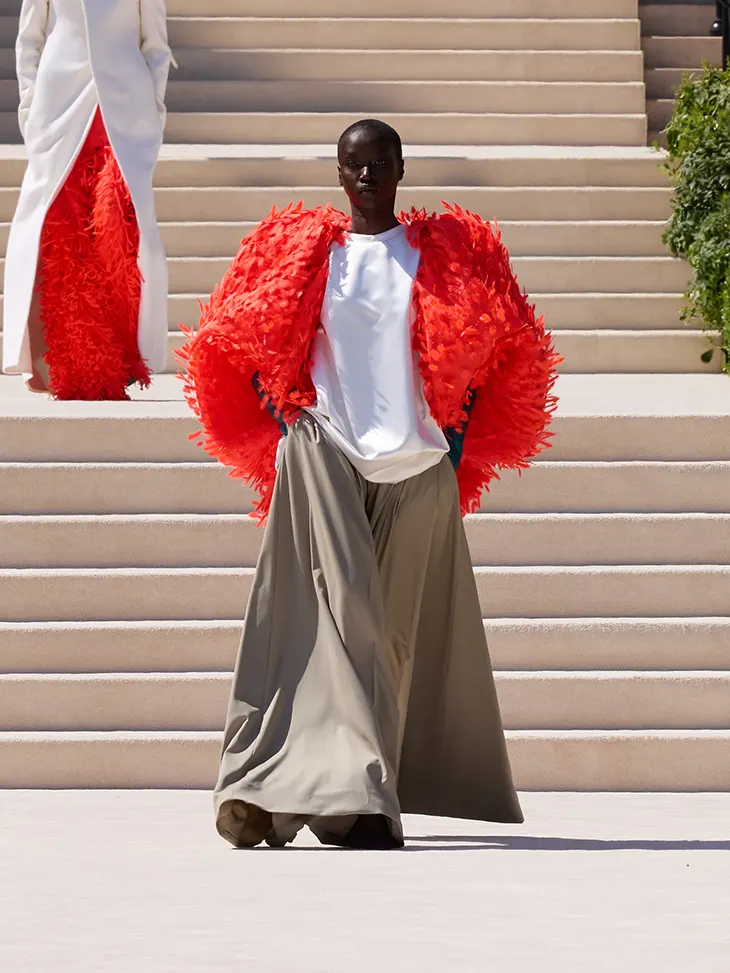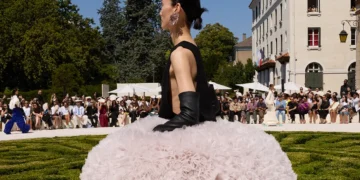



Pierpaolo Piccioli arrives at Balenciaga not to resurrect the dead, but to resurrect the principles. The 55th couture collection, his first as creative director, moves with the deliberation of someone who understands the weight of inheritance, yet refuses genuflection. He brings his own PP DNA into the maison’s timeless couture design lines, and in doing so, recasts what it means to speak the language of Balenciaga in 2026.
The collection is paradoxical by necessity. It is both minimalist and maximalist simultaneously, a duality that mirrors the house’s heritage itself. This is couture not as spectacle, but as philosophy. Piccioli has excavated Cristóbal Balenciaga’s fundamental obsession (the body in three dimensions, the garment as sculpture) and rebuilt it for contemporary urgency.
Discover the side view of the Balenciaga Couture 55th collection:
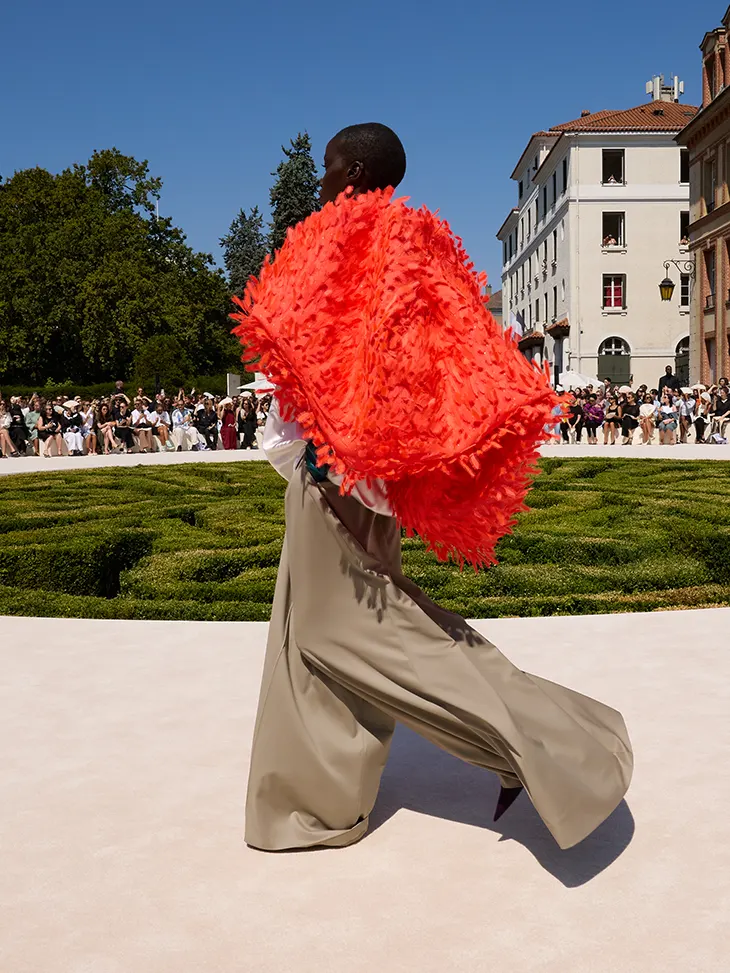
The architecture begins internally. Silhouettes are sculpted through tailored coats and cashmere dresses derived from three-dimensional digital scans of individuals, their poses and attitudes transformed into physical structure. Leather becomes internal carapaces, affording both architectonic rigor and improbable lightness. The outside remains austere, controlled. The rebellion unfolds at hems and within lapels, decoration breaking from within. This is information design at its most refined: couture as a manner of creation that orients both action and reaction.
The innovation is rooted in material as meaning. Amsilk, a bioengineered silk alternative created through DNA editing and protein engineering, enters couture for the first time. Its fibers mirror spider’s silk with tensile strength 2.5 times that of steel. Yet it reads as weightless, renewable, fossil fuel-free. Balenciaga‘s neo-gazar (a reconsideration of Cristóbal’s own invention) operates as both outer fabric and internal structure, its paradoxical marriage of lightness and strength reshaping the silhouettes around it. Some outfits are reiterated in black, reduced to pure shadow, to reset the eye and reassert form.
Feathers function as metaphor and material. They are weightless, delicate, yet structurally sound. A collaboration with Philip Treacy yields sculptural headpieces that dissolve the boundary between millinery and garment. Embroideries become integral, load-bearing, architectural elements rather than ornament.
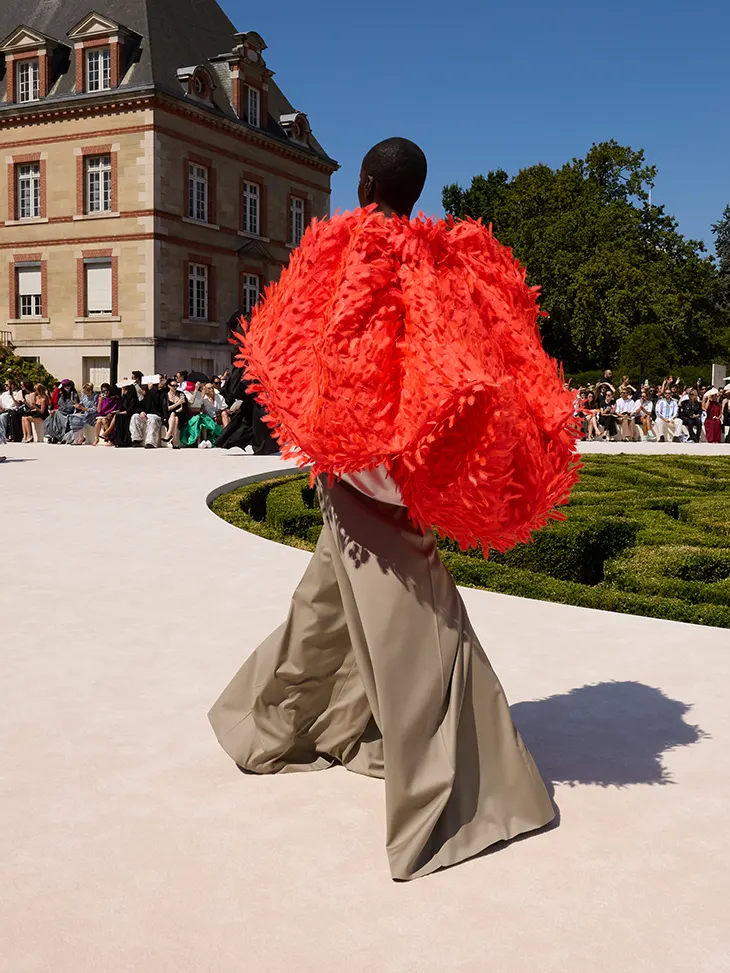
But the collection’s true achievement lies in its refusal of surface translation. History is past. There is no rigid archaeology here. Instead, Pierpaolo Piccioli echoes the ideology of Cristóbal Balenciaga, the belief systems beneath the work. His dichotomies persist: garments that oscillate between austerity and exuberance, where tailoring melts into flou, where two noble traditions fuse in pursuit of lightness. The obsession with three dimensionality remains unchanged. These are forms that demand to be circled, understood from all angles, experienced rather than consumed.
Discover the striking back view of the Balenciaga’s 55th couture collection:
Pierpaolo Piccioli has been deliberate in his approach to introducing this collection. In the weeks preceding the Paris Fashion Week show, Balenciaga stripped its Instagram presence to its essence, posting only three images from the Balenciaga Ateliers De Couture. The photographs documented the studio creatives shaping the collection alongside Piccioli: Tidjane, Christine, and Suzy. It was a quiet proclamation of what was to come, a focus on the hands and minds that build couture rather than the machinery of fashion promotion.
“This collection is the result of a feeling,” Piccioli stated. “We worked while getting to know each other, learning to understand one another. We built our own language, full of new words and timeless ones. We searched, we tried, we remembered. This collection is the result of the work of the people in the atelier, human beings who are couture because couture is made by the people who live it. This note is to thank each and every one of them for their time, love, and commitment. This is our collection, this is our work, this is Balenciaga couture, now.“
It is also unmistakably Piccioli. For the first time under his direction, Fall Winter 2026-27 couture is not a collection designed for the spotlight, but one born from the rigor of the studio, where a new language was built word by word, tried and remembered and tried again.
Discover the complete Piepaolo Piccioli debut collection for Balenciaga in our gallery: