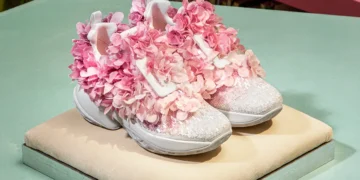



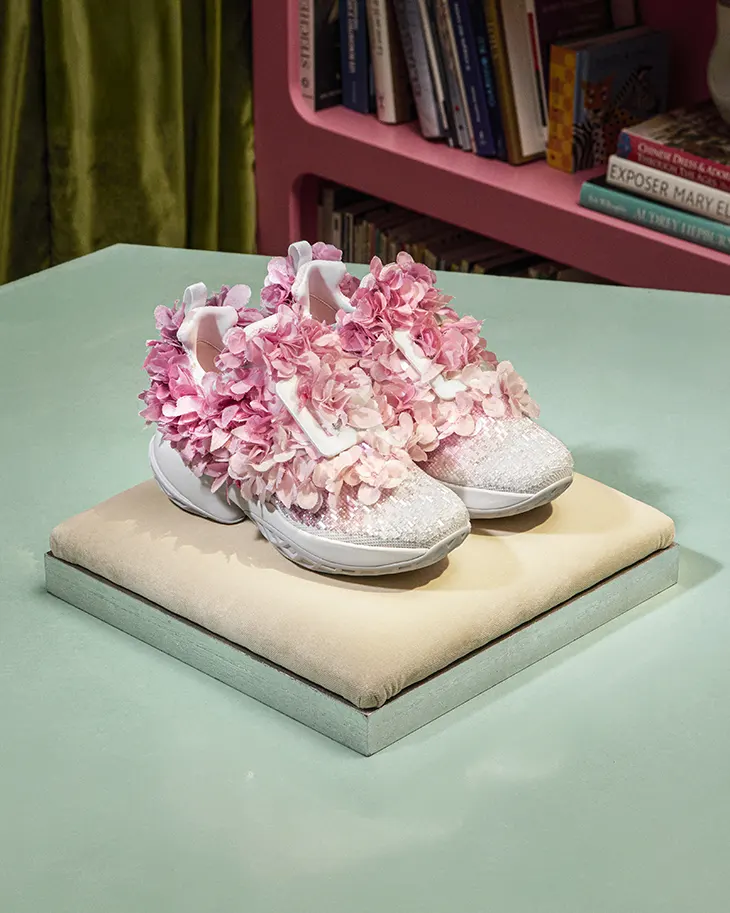
During Paris Haute Couture Week, Roger Vivier presented L’Atelier des Papillons, the Autumn-Winter 2026/27 Pièce Unique collection, marking a significant pivot for the Maison. For the first time, Gherardo Felloni‘s highest expression of couture craftsmanship extends beyond handbags and embroidered pieces to embrace footwear, reclaiming Roger Vivier’s founding identity as one of the 20th century’s most revolutionary shoemakers.
The expansion feels neither opportunistic nor forced. Instead, it reads as a natural return to the Maison’s roots, a corrective gesture acknowledging that Monsieur Vivier built his legend on shoes first. That his successors have spent years establishing Pièce Unique as the pinnacle of decorative excellence across accessories and wearables makes sense now: the foundation was being laid for this moment. The sneaker’s inclusion in Pièce Unique is equally deliberate. By introducing a couture interpretation of a silhouette Felloni originally designed in 2018, the collection argues something essential about contemporary luxury, that exceptional craftsmanship need not restrict itself to traditional categories. The language of haute couture, the collection suggests, is stronger when it moves.
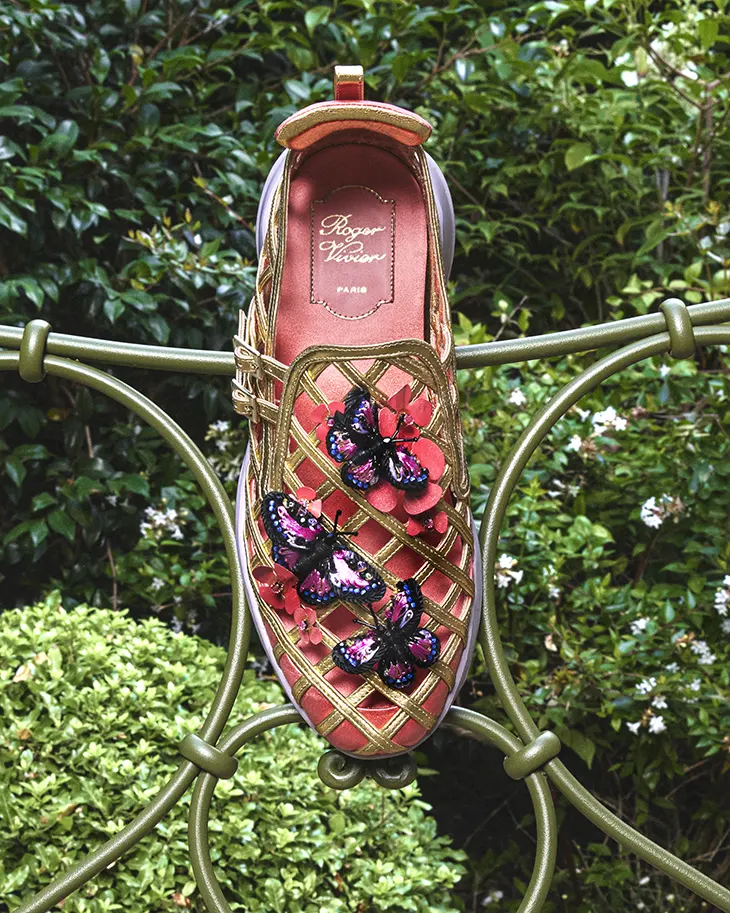
The butterfly remains the collection’s organizing principle, and here lies Felloni’s most refined conceptual work. Rather than pastiche, his approach treats the motif as a living vocabulary. Monsieur Vivier returned to the butterfly throughout his career—embroidered on gowns for Christian Dior in 1955 and 1963, sculpted into heel forms, rendered as jeweled ornament. It appeared again in the celebrated Papillon shoes for Vivier’s 1987 retrospective at the Musée des Arts Décoratifs. The symbol accumulated meaning across decades: femininity, movement, transformation. Most importantly, it carried the weight of genuine artistic inquiry rather than decorative whimsy.
Felloni doesn’t repeat this archive. He allows it to breathe. Across L’Atelier des Papillons, butterflies emerge through an orchestrated vocabulary of techniques. Intricate bead embroidery catches light in different registers. Hand-painted feathers provide dimensional texture and color shift. Organza, macramé, sculpted metal, and crystal work create variations in surface treatment that feel less like stylistic choices and more like different visual translations of the same poetic impulse. The constraint is elegant: just as no two butterflies in nature are identical, each Pièce Unique object becomes a singular interpretation. Individuality is structurally built into the collection’s premise.
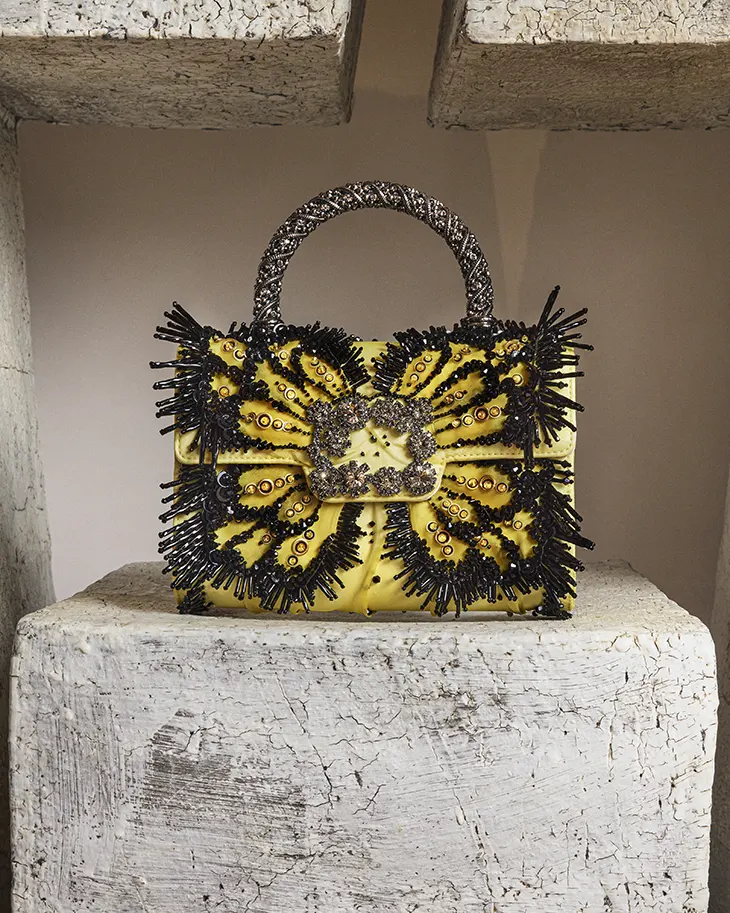
The Efflorescence Jewel bag demonstrates this principle most vividly. The sculptural butterfly wings, articulated in beadwork with fringe detailing, transform the silhouette into something almost architectural. The proportions are confident, almost architectural in their geometry. In black with gold tones and in soft jewel colors, the bag functions as both object and artwork, a piece that justifies the “one-of-a-kind” designation not through scarcity alone but through evident conceptual rigor. This is not a limited edition recycled as exclusivity. The obsessive attention to surface, the considered variation of each piece, suggests these objects were genuinely imagined individually.
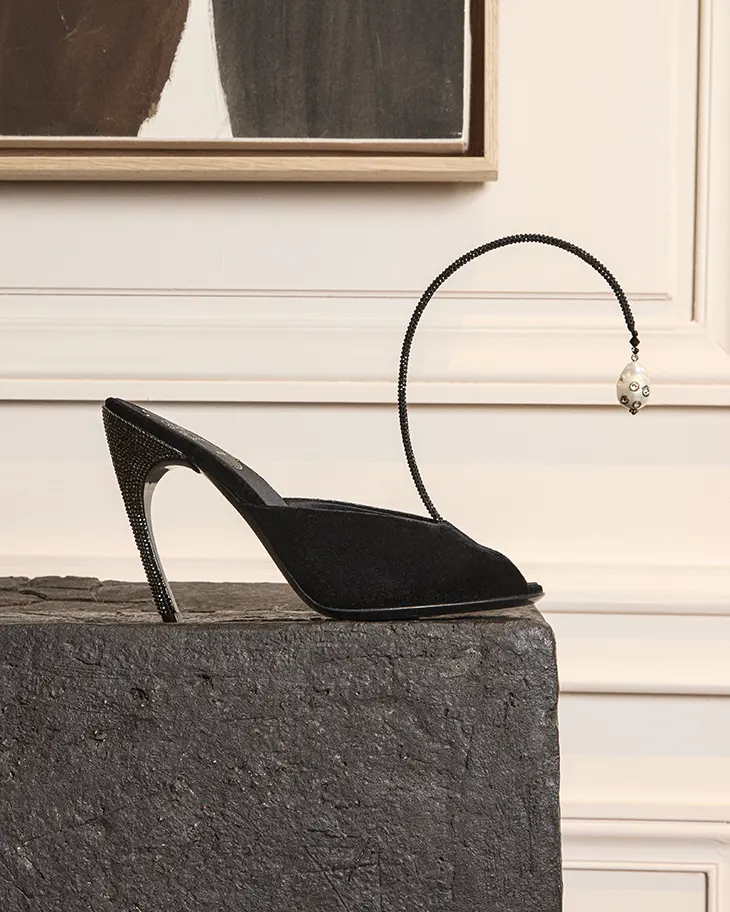
The Choc pump, built around Monsieur Vivier’s 1959 revolutionary curved heel, becomes the foundation for the first Pièce Unique shoe collection. Felloni has reinterpreted this heel for his 2026/27 ready-to-wear work, but here it reaches its apotheosis. Photographed amid garden settings, the pumps emerge with hand-painted floral compositions, delicate, almost watercolor in their execution, with areas of dense embellishment and carefully considered negative space. The shoes read as wearable art objects, though “wearable” almost seems to diminish them. What Felloni has done is extend the decorative language of Vivier’s beaded and embroidered tradition directly onto the shoe’s surface, making the shoe itself a canvas rather than a support for ornament.
The introduction of a Pièce Unique sneaker signals something broader about how luxury houses are reconsidering their own hierarchies. The sneaker, that most democratic of silhouettes, has become increasingly common in haute couture presentations, but rarely with the kind of restraint and conviction Felloni demonstrates. The curved heel, derived from the Choc pump and the 1959 archive, ensures the sneaker reads as coherent with Vivier’s design language rather than as a categorical compromise. Its inclusion argues that the standards of exclusivity, craft, and conceptual coherence that justify Pièce Unique pricing and positioning need not be confined to traditional couture categories.
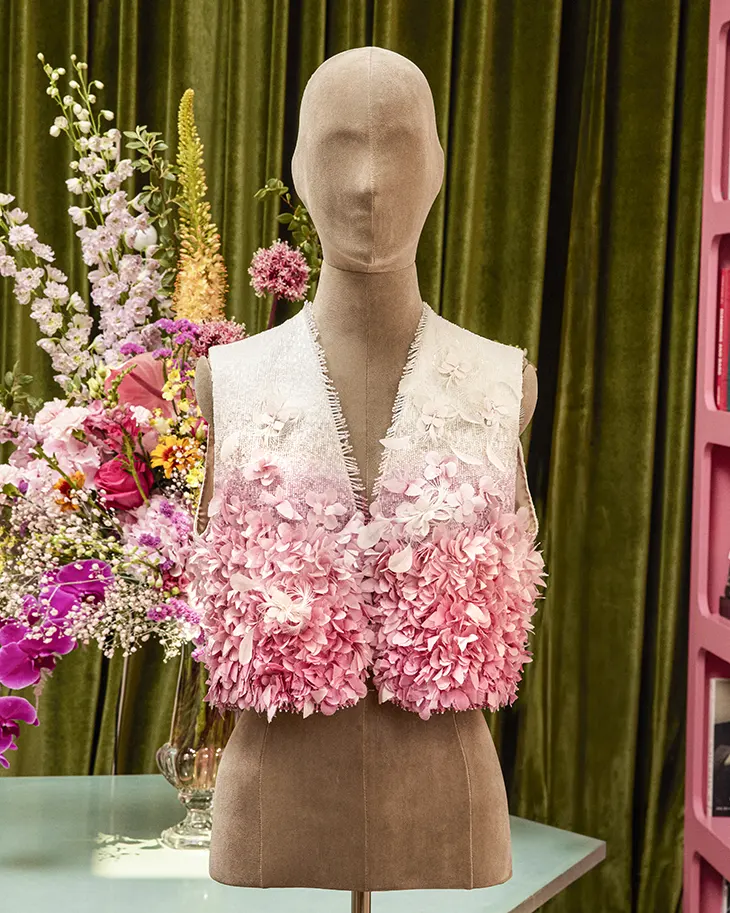
The presentation itself, unfolded across Maison Vivier’s salons, reinforced the collection’s intellectual scaffolding. Moodboards pairing archival photographs, historical documents, and sketches made transparent the research behind each piece. Historical shoes and original embroideries were on display, traceable connections between Monsieur Vivier’s visionary work and Felloni’s contemporary interpretation. This curatorial approach transforms heritage from abstraction into visible dialogue. The archive becomes not a constraint or nostalgic reference point but an active collaborator in the design process.
What L’Atelier des Papillons achieves is perhaps more significant than its individual pieces: it demonstrates that Vivier’s legacy can accommodate expansion without dilution. The Maison’s founding identity as a shoemaker, long dormant in Pièce Unique’s previous iterations, has been reclaimed and recontextualized. The butterfly motif, which carries genuine historical weight, proves flexible enough to accommodate infinite variations without losing coherence. And the inclusion of the sneaker suggests that luxury’s future may lie not in categorical purity but in the confidence to apply uncompromising standards of craft and concept across traditional and contemporary silhouettes alike.
Discover more of the collection in our gallery:
For a maison built on the premise that shoes are not functional objects but expressions of an individual’s aspirations and identity, the return to footwear as the primary category feels inevitable in hindsight. Felloni has orchestrated that return with intelligence and visual poetry. L’Atelier des Papillons isn’t a retrospective. It’s a reclamation.