





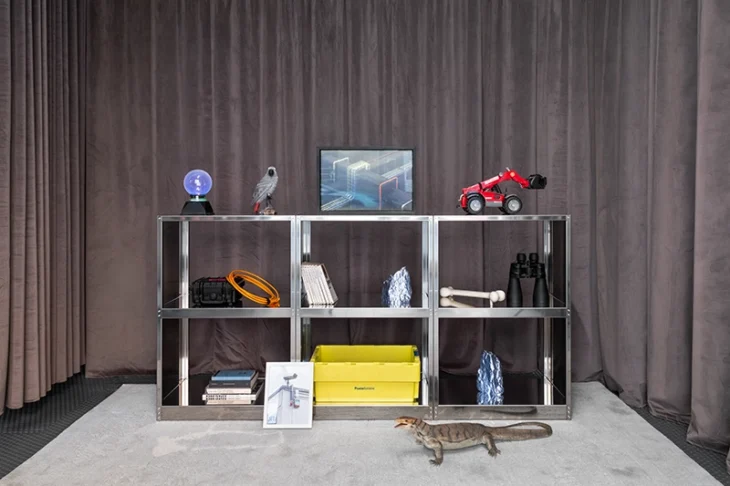
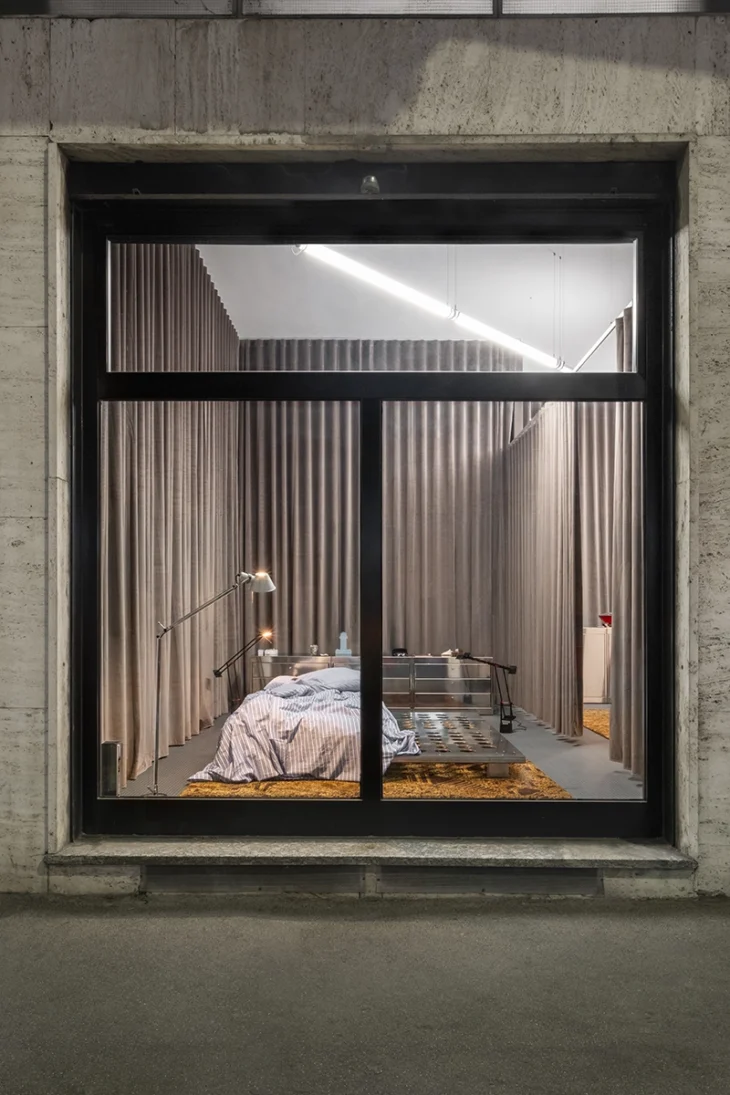
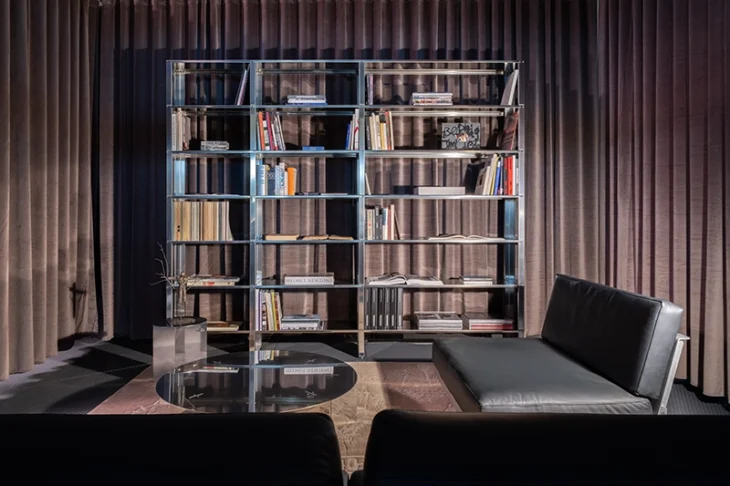
CASA NM3 arrives in Milan during Salone del Mobile 2026 as a controlled rethinking of the domestic interior. Installed at Via Carlo Farini 93, NM3 constructs a home without fixed walls, replacing enclosure with a system of movable partitions that outline four rooms without ever fully defining them. The reference to Mies van der Rohe and Lilly Reich’s Velvet and Silk Café remains clear, yet the project operates within NM3’s own language, where structure stays light, open, and responsive. The result is a space that holds together without relying on permanence, where boundaries shift and the idea of the room becomes fluid.
ORDER IN PRINT AND DIGITAL
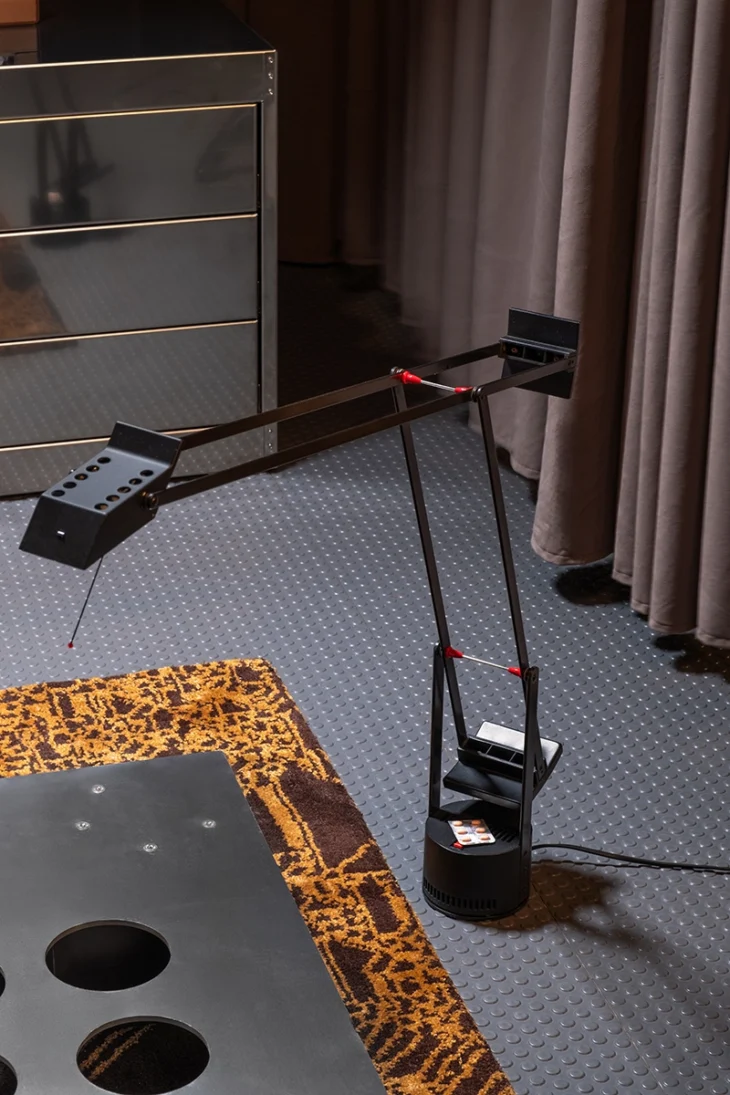
Within this framework, furniture takes on a central role. NM3’s objects move beyond singular pieces and begin to operate as systems, with the evolution of NM25 and NM26 introducing a fully modular approach that extends into kitchens, desks, and additional elements. Stainless steel, left untreated and precise, defines the atmosphere, while personal objects and textiles bring a lived-in dimension that resists the neutrality of a showroom. DSCENE Editor Katarina Doric speaks with NM3 about building a domestic environment through subtraction, the moment furniture becomes architecture, and how everyday objects can structure a space as effectively as walls.
CASA NM3 builds a home without fixed walls. What does a room mean to you today? - A room has always been the most fundamental unit of dwelling, the most immediate form of protection in architectural terms, the space closest to us.
Traditionally, a room is defined by fixed boundaries: solid walls and a rigid perimeter. Within this stable container, objects are mobile, interchangeable, and temporary. Here, however, that relationship is reversed: objects become the architecture, while the walls take on the role of furniture.
A room has always been the most fundamental unit of dwelling.
At what point does furniture stop being an object and start becoming architecture? - It begins at the moment it is conceived as such. When, from a structural and functional perspective, it is no longer thought of as furniture, but as architecture, capable of existing independently, with its own coherent and consistent structural and functional logic.
This shift also implies scalability: the object maintains its integrity and meaning even when imagined across different scales, reinforcing its autonomy as an architectural element rather than a mere piece of furniture.
Your work often sits between presence and disappearance. When do you want a piece to be seen, and when should it fade? - A former university professor of ours, someone we consider a mentor, once said that the greatest ambition of architecture is to dissolve into its urban context, like the Blur paintings by Gerhard Richter. That idea has stayed with us and has deeply influenced our work.
Ultimately, we believe that objects are most noticed precisely when they fade into their surroundings, hen they are not loud or overtly expressive, but instead quietly resonate within the context they inhabit.
We believe that objects are most noticed precisely when they fade into their surroundings.
You reference Mies and Lilly Reich, but through a softer system. What did you take from that history, and what did you deliberately leave behind? - In fact, Mies and Lilly Reich’s installation was entirely soft and permeable. We adopted their setup in a fairly literal way, embracing that same sense of openness and fluidity.
However, for obvious spatial constraints, we are not able to work at the same scale as their original project. At the same time, we introduced a different system for attaching the curtains to the supporting structure, adapting the construction logic to our own context and needs.
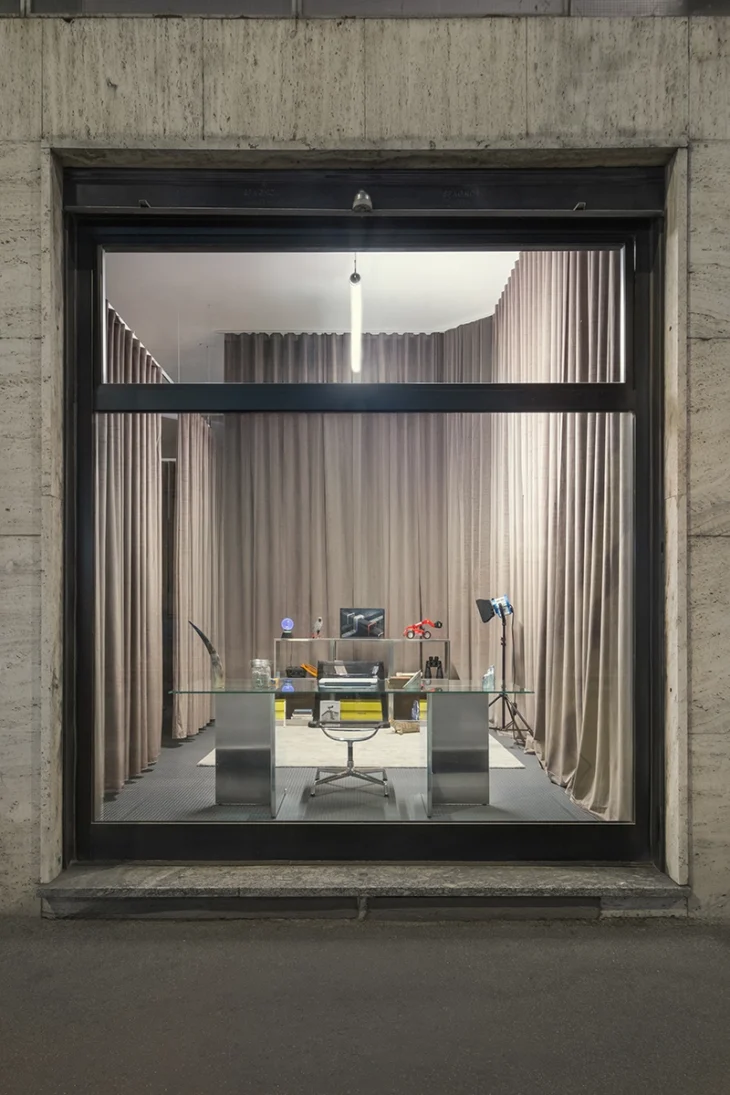
The installation feels quiet, almost restrained. What do you remove to get there? - We usually work, as you rightly suggest, through a process of subtraction. However, in this case, the preview only reveals two elements of the project.
There will be an additional layer of personal objects that will give the space the qualities of a real home. For instance, I will bring items from my own private bedroom, introducing a more intimate and lived-in dimension to the installation.
Control usually ends when we begin to feel a sense of boredom in working on an object.
Where does control end in your process, and where do you allow things to remain unresolved? - Control usually ends when we begin to feel a sense of boredom in working on an object. This is not merely a matter of lightness or detachment; it is also about recognizing the precise moment when continuous adjustments and modifications start to erode the freshness and beauty of the work.
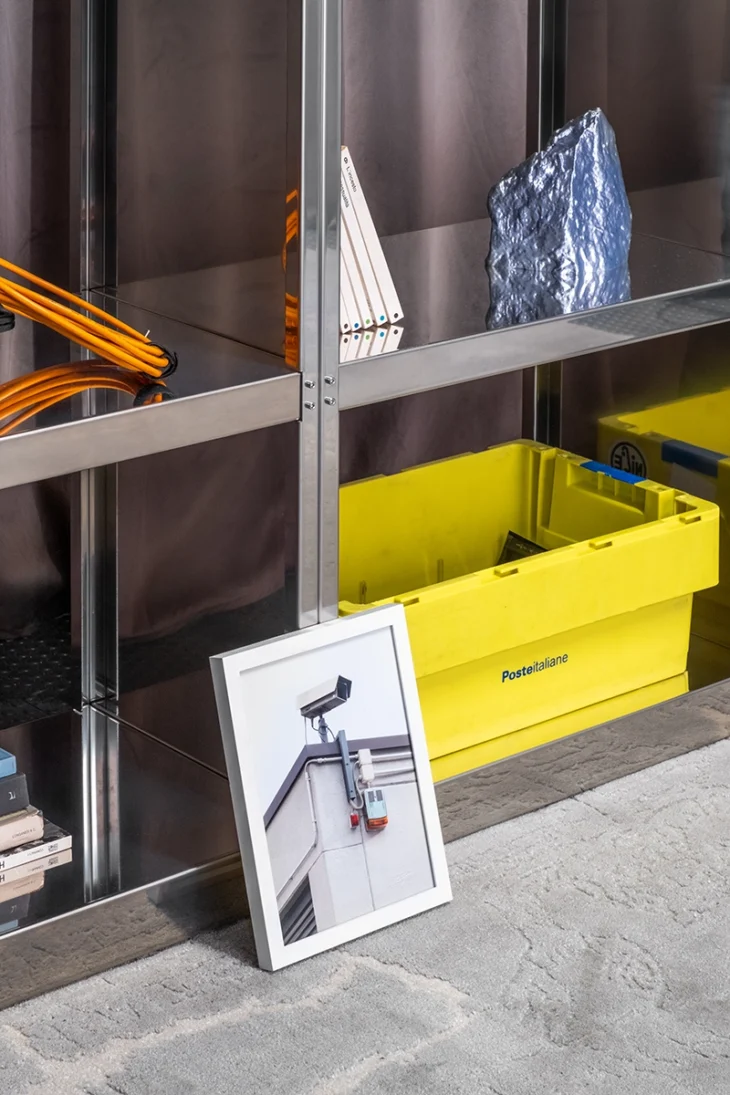
Stainless steel usually reads as industrial or cold. How do you bring it into a domestic setting without changing its nature? - As I mentioned earlier, on one hand there is the idea of blur, the ability of the material to merge with and adapt to a specific context. On the other, these are perfectly functional objects.
By using them in everyday life, they gradually become an integral part of the home, of daily routines, and of one’s personal world. In this way, stainless steel does not need to change its nature; it is domesticated through use and familiarity. Even a so-called “cold” or uninviting material, once it becomes an everyday object, is never truly perceived as such.
We consider it essential to avoid treating creativity as the starting point of a project.
NM25 and NM26 evolve here into systems. When does a product become a system in your process? - For us, this happens when a specific detail, together with certain formal characteristics, allows for complete modularity. At that point, a product is no longer a single, isolated object, but a system, capable of performing different functions and generating a variety of typologies through the same underlying logic.
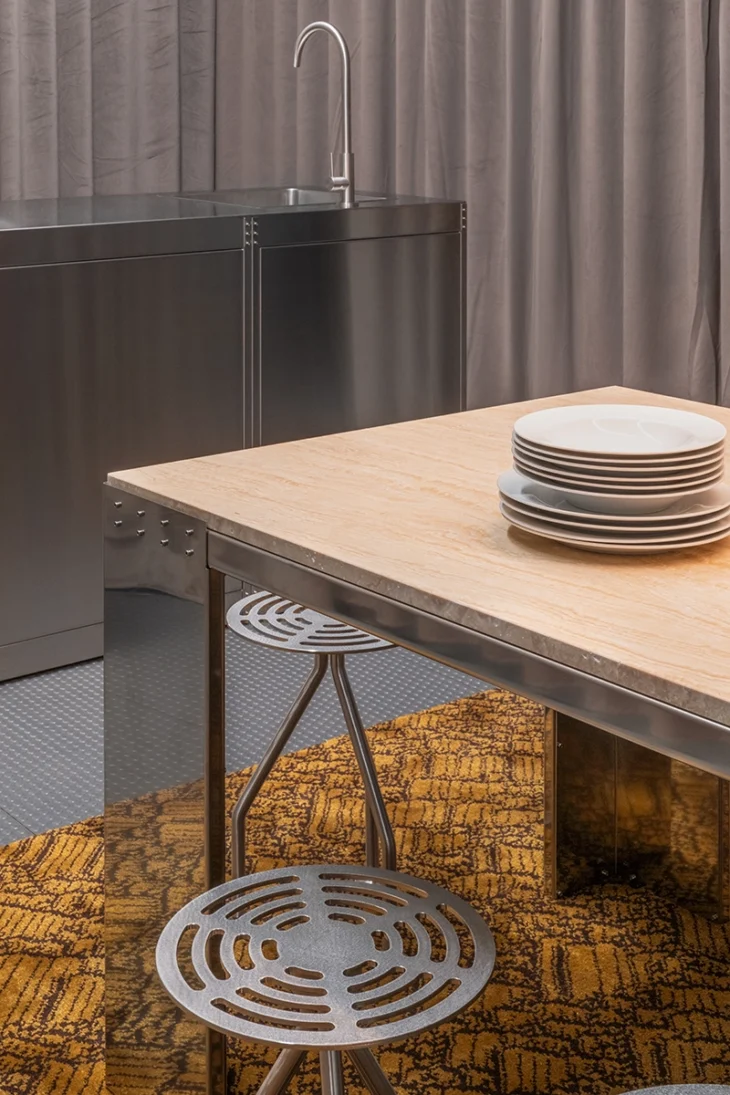
Your work trusts the “ordinary.” What is something most designers overlook that you consider essential? - We consider it essential to avoid treating creativity as the starting point of a project. Instead, the process should begin with production, understanding the limits and capabilities of the relevant industry. Only once these boundaries are clearly defined does it make sense to develop the project. We believe that work gains consistency when it emerges from constraints; when something is driven purely by creativity, it often ends up inconsistent, if not outright crap.
We believe that work gains consistency when it emerges from constraints.
CASA NM3 includes objects from real homes. What happens when personal memory enters such a controlled environment? - What happens is that an abstract environment becomes marked, almost contaminated, by real life. We hope to show that a home entirely composed of our furniture can truly be perceived as a home. For this reason, we deliberately chose to move away from the typical “showroom-like” installation, allowing personal memory and lived experience to coexist with the display.
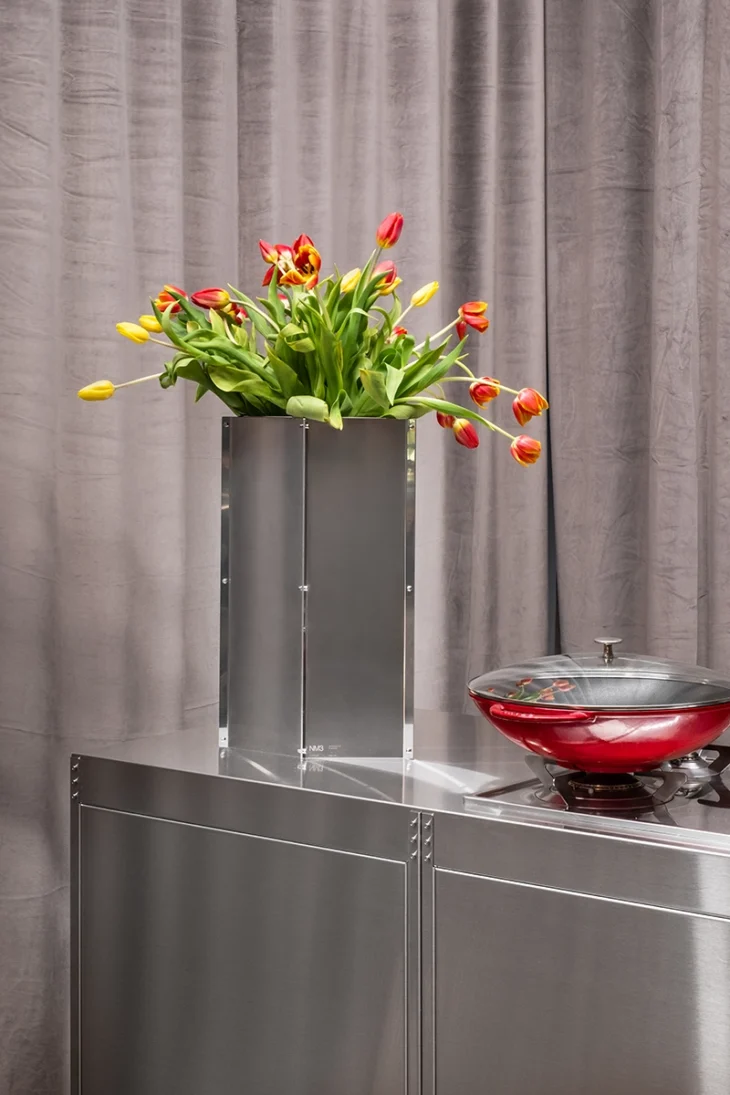
If you had to reduce the domestic space to its absolute minimum, what would remain? - For me, Francesco Zorzi, if I had to reduce domestic space to a single object, it would be the sofa. Because on a sofa you can perform all the fundamental acts of domestic life: sleeping, eating, making love, working, reading, watching a film, and, if it comes to it, you are even comfortably placed to die. In reality, the same could be said for a bed, but I hate eating in bed.
Originally published in DSCENE #024 “Design Under Pressure” Issue.









industrial but actually really coool, i am loving it a new way to do it always good spotlights in DSCENE print