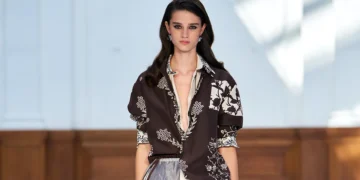



Seeing Dhruv Kapoor on the Milan calendar has become non-negotiable for me. The designer has found his home here, and Spring Summer 2027 only deepens that conviction. What distinguishes Kapoor is not novelty for its own sake, but a refusal to separate idea from execution: the prints are always original, the metal work signature, the casting deliberately diverse. These are not afterthoughts. They are the collection.
SPRING SUMMER 2027
This season, Kapoor turns toward presence. After exploring transit and movement, the designer has stepped into stillness, not as pause but as awareness. In a world built on speed, presence becomes radical. It means noticing what is already here, what is aging, what is taking root.
Language of Layering
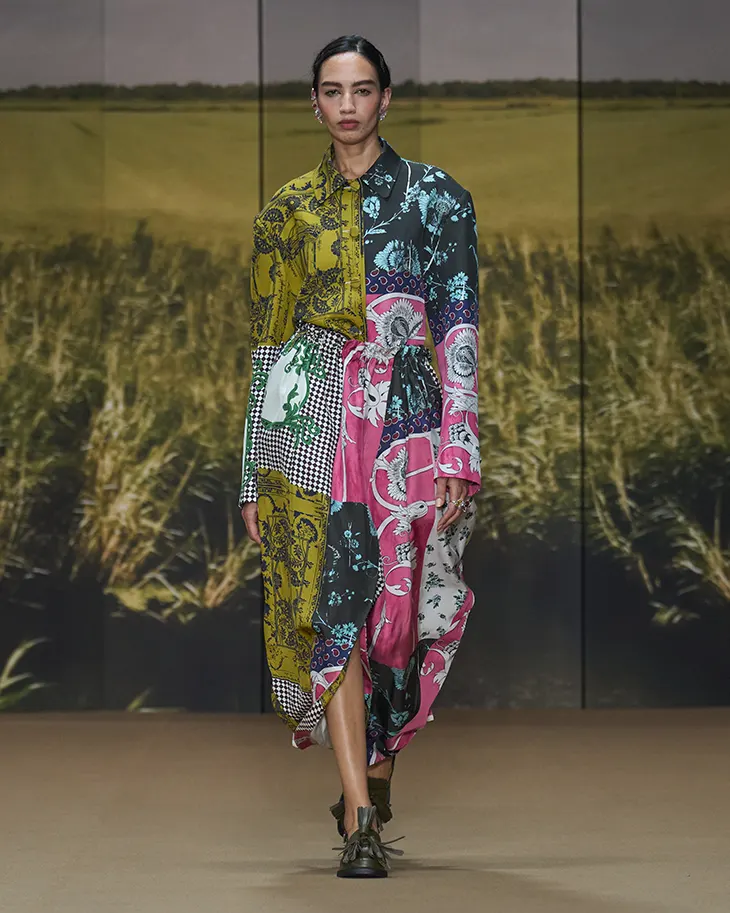
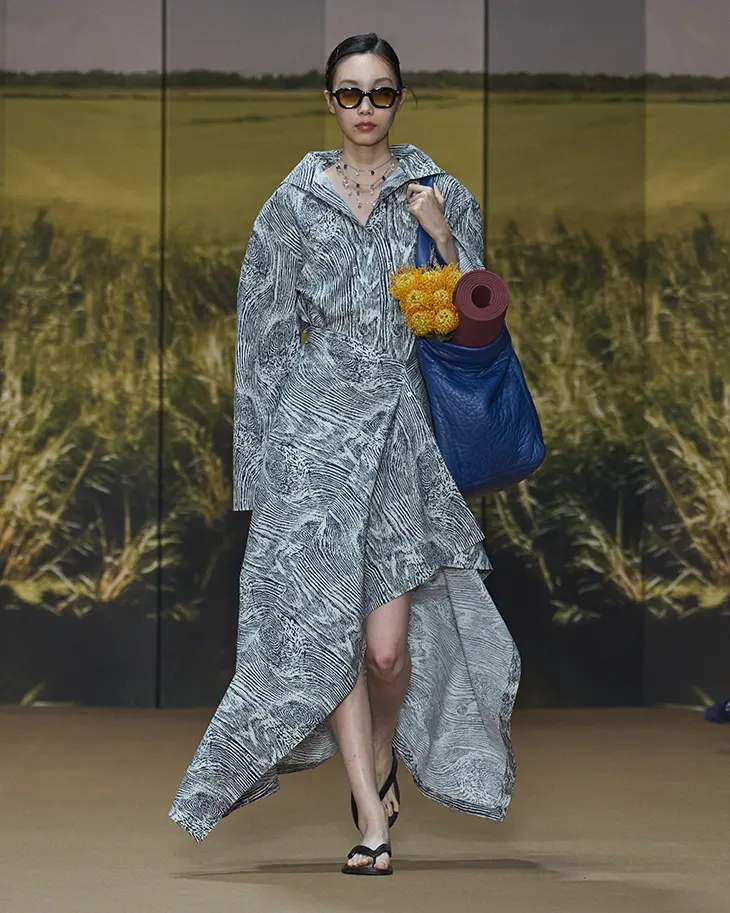
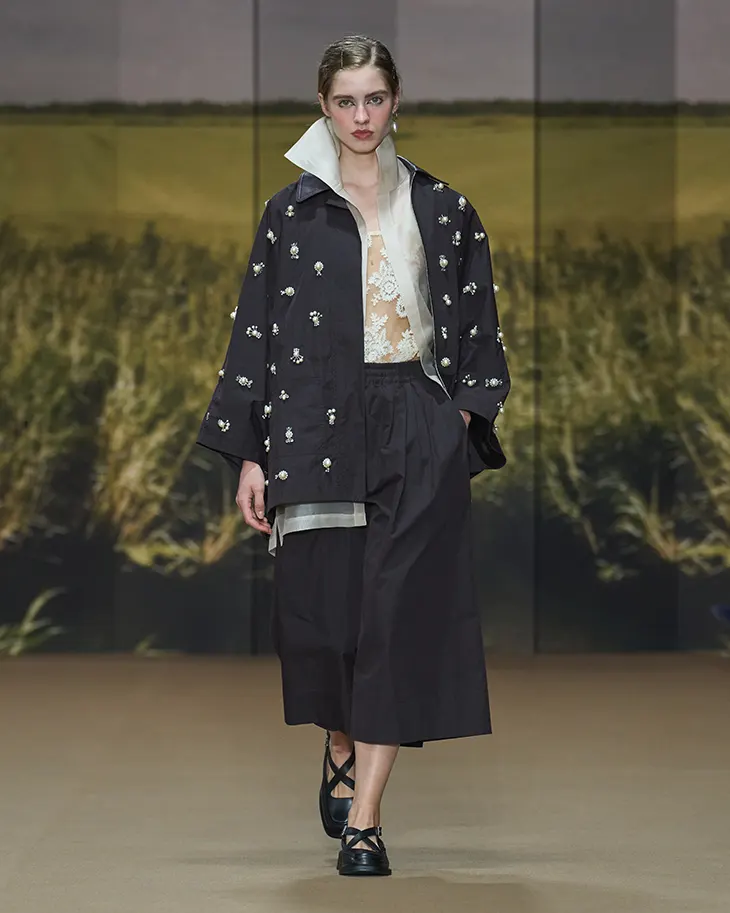
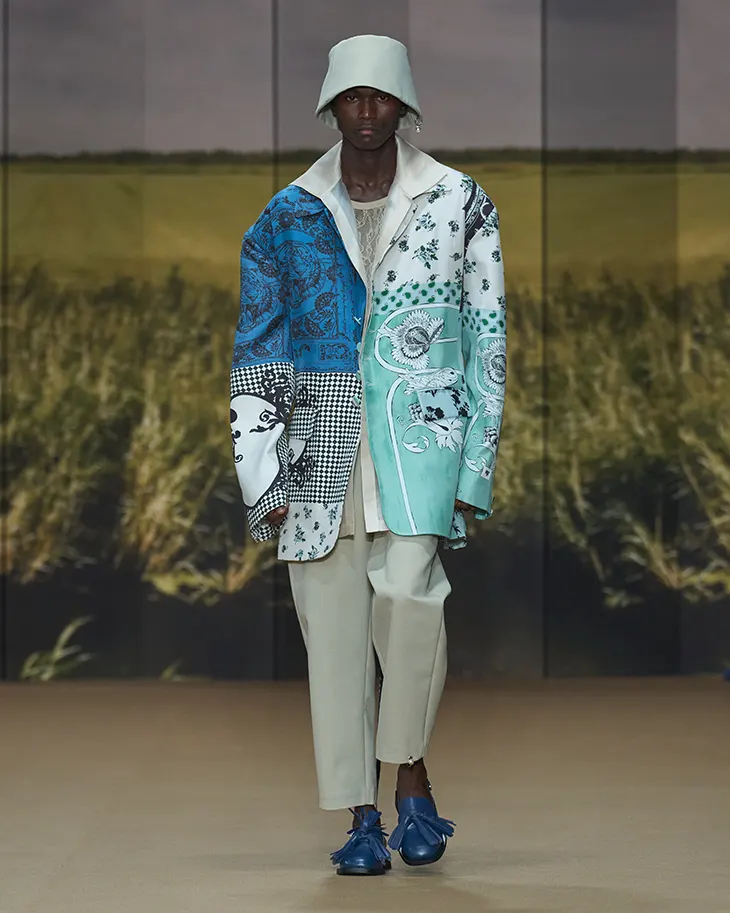
The Spring Summer collection speaks through proportion and wrapping. Silhouettes refuse to settle, shifting from generous and elongated to cropped, close to skin. Draped forms sit alongside defined structures. What feels revolutionary is how Kapoor dismantles the familiar: the lungi, the vest, the sari become methods of reconstruction rather than references. They are reworked in new proportions, new configurations, stripped back to their essential logic and rebuilt.
Foundational garments return softened, faded, altered. Embroidery creeps across seams and surfaces through loose stems and uninterrupted natural lines. The prints recall sun-faded posters, moss formations, aged wood, imagery drawn from different moments in time. This is not nostalgia. This is the visible record of living.
Material as Time
The textile work is where Kapoor’s thinking becomes tangible. Silk bonded with jersey. Checks crumpled and fused. Leather wrinkled to resemble aged skin. Faded denim, tattered appliqué, mixed lace, softened poplin, bonded tailoring. Each material choice documents transformation. Nothing exists in a fixed state. Materials age. Familiar forms evolve. Traces of what came before remain visible.
The color palette moves between sun-faded and saturated, bringing different stages of age and growth into the same wardrobe. A sleeve can be muted while an adjacent seam burns with color. The effect is of a garment that has lived, that carries history in its fabric.
Unisex as Necessity
What Kapoor achieves with the menswear and womenswear blend is essential to this moment. The mixing feels neither gimmick nor statement, but inevitable. This is what fashion should actually be now, today. Not gender as decoration, but silhouette and proportion as the primary language. A draped form works across bodies. A cropped proportion speaks the same whether it wraps a frame read as masculine or feminine. For many of the pieces sent on the runway Kapoor has moved past the conversation entirely, which is the only way forward.
Accessories and Partnerships
The “Constant” trunk evolves. A maxi vanity pouch arrives in wrinkled, bonded, hand-embroidered variations. The Mary Jane returns with a squared toe, evolves into a tasseled mule. Leather-wrapped thong sliders draw from the ease of Indian dressing, bringing utility into luxury. The PUMA x RCB x Dhruv Kapoor capsule extends this logic into sport. Existing codes are revisited through Kapoor’s lens, familiar forms reconstructed in new proportions. It is not collaboration as branding exercise, but as genuine dialogue between heritage and innovation. SENNES by the House of Senco brings lab-grown diamonds into selected looks, held between natural and manmade. Paloceras eyewear provides sculptural counterpoint. These partnerships are not scattered across the collection, they are woven into its logic.
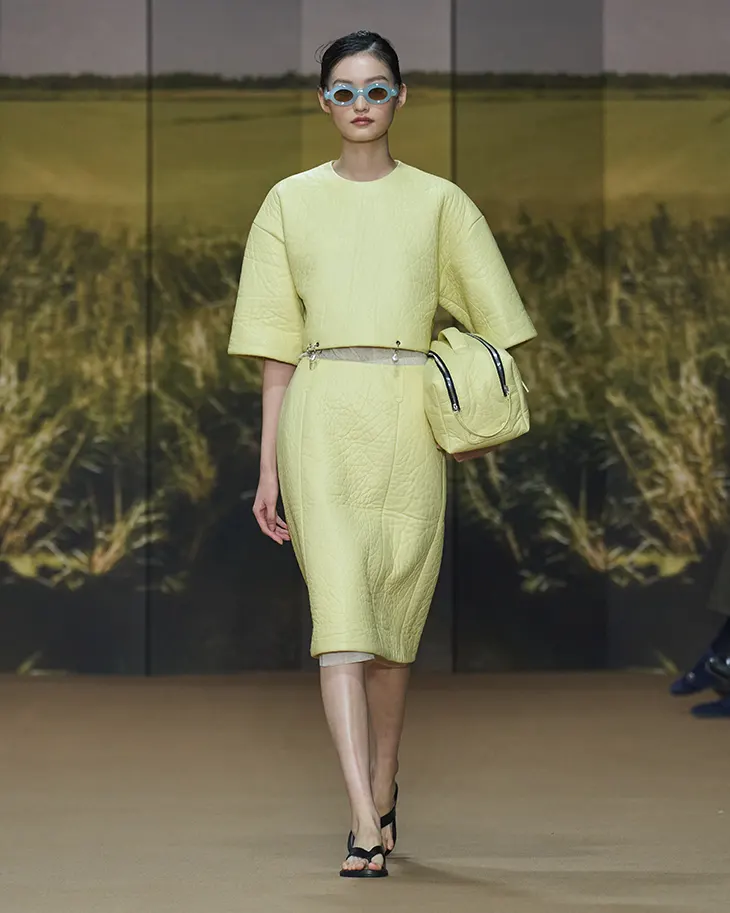
Dhruv Kapoor’s Milan show proves that presence is not passive. It is a practice of noticing, of allowing materials to age, of choosing what to carry forward. The collection is full of movement because it is rooted in awareness. Every layer has purpose. Every proportion has been questioned. Every detail remains visible. This is why the designer belongs in Milan. Not because he has assimilated into European fashion, but because he has brought something the calendar desperately needs: a vision built on transformation rather than novelty, on presence rather than hype. Dhruv Kapoor is no longer an emerging voice. He is essential.