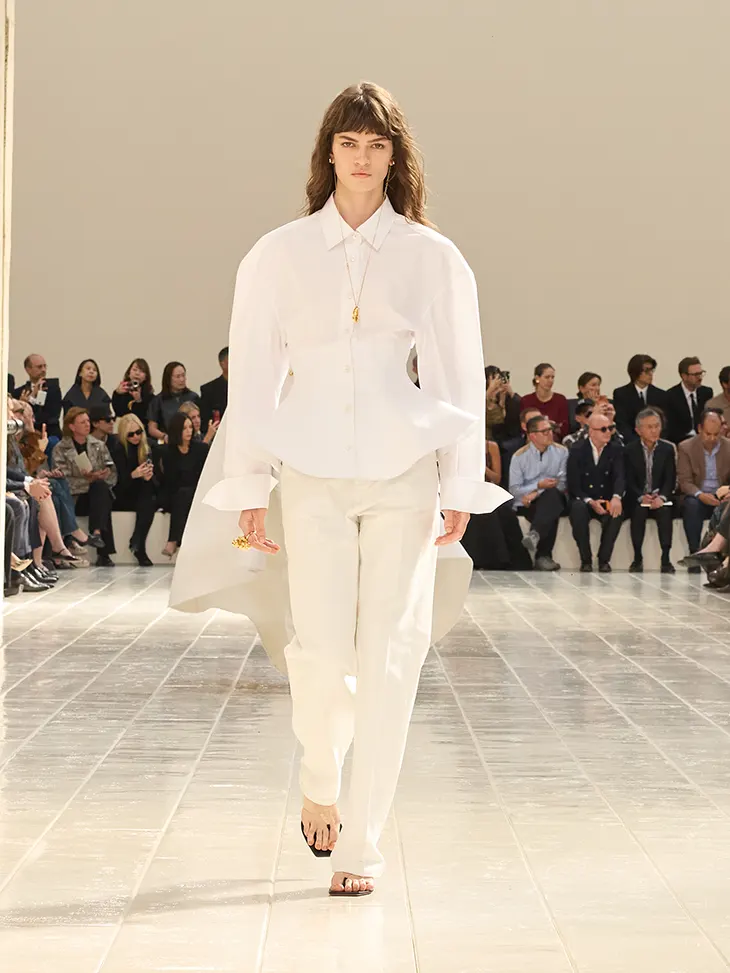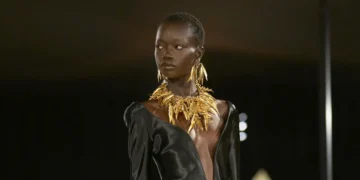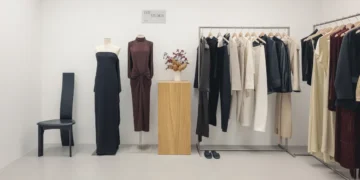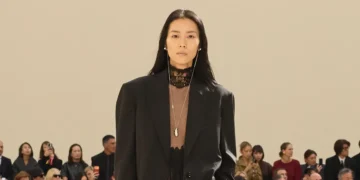



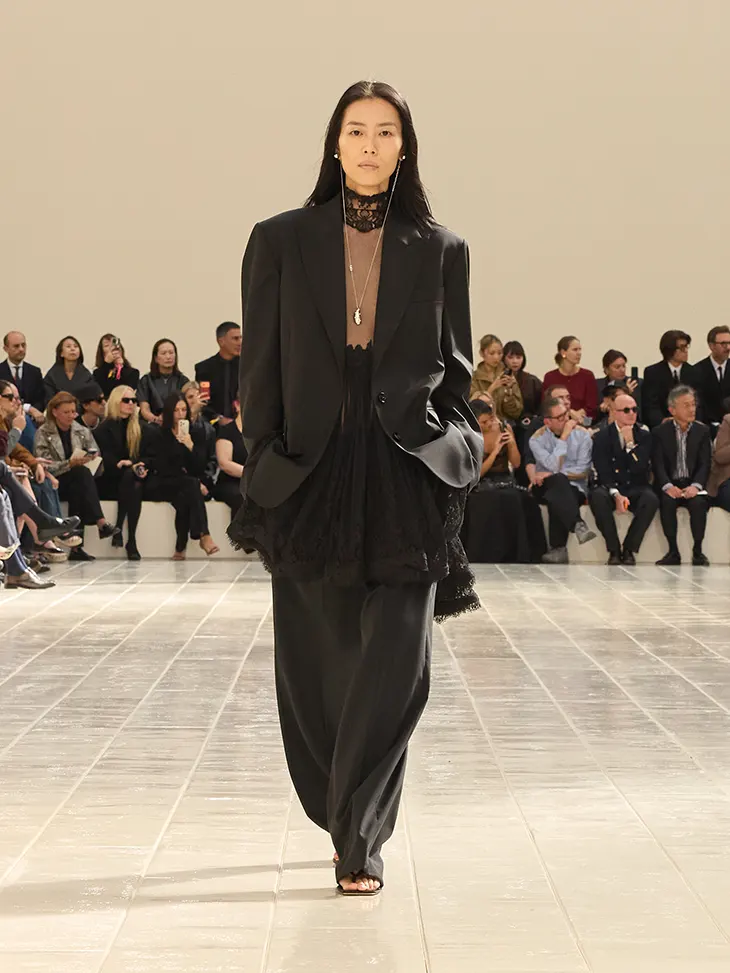
Watching Pierpaolo Piccioli‘s third collection for Balenciaga unfold on the runway at Paris Fashion Week yesterday was witnessing a designer systematically dismantle the false boundary between couture and ready-to-wear. There was no dramatic rupture, no collision of high and low. Instead, Piccioli presented something far more rigorous: couture as a working methodology, not a category.
SPRING SUMMER 2027
The collection opens with this thesis immediately. Denim jeans, t-shirts, bombers, leather jackets, the vocabulary of everyday dressing, arrive transformed through techniques born in the house’s 55th Couture Collection. Watching these pieces move down the runway, their architecture becomes undeniable. A t-shirt doesn’t simply sit on the body; it has been constructed, studied, redrawn through draping and forming in the atelier. The garment carries evidence of human intervention in its proportions, its seams, the way it breaks at the hip. This is the operative insight: couture as a laboratory doesn’t produce unobtainable objects. It produces a method, one that can reshape the known into something unmistakably worked.
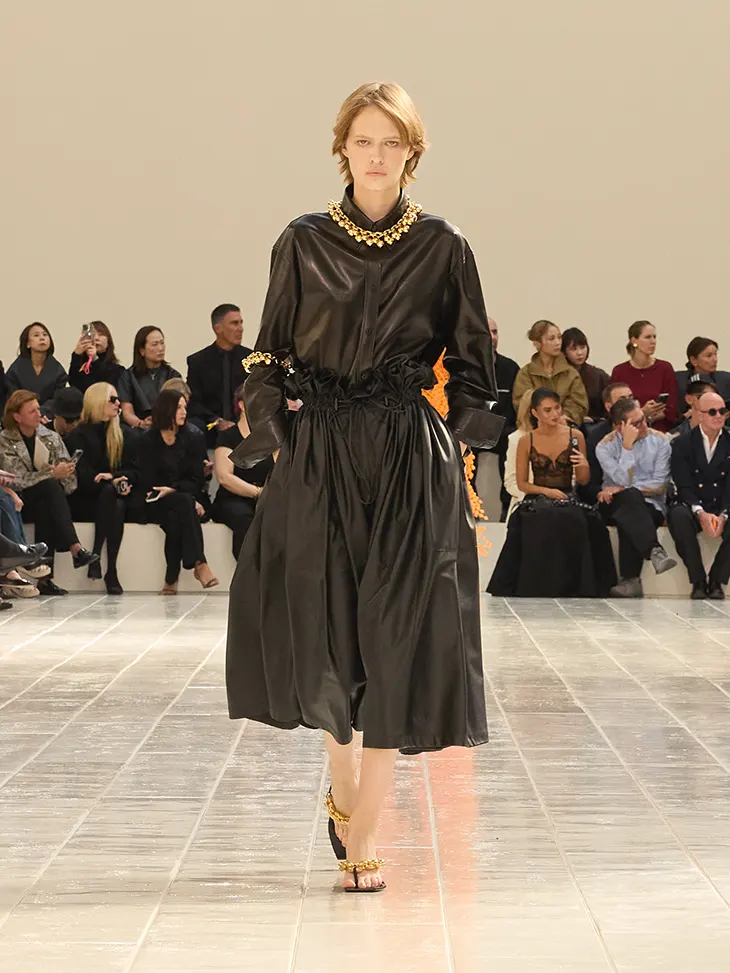
Stitching as Language
The most visually arresting element throughout was Piccioli’s use of a specific couture stitching technique, transposed from internal tailoring structures directly onto external surfaces. On leather jackets and cotton t-shirts, this stitching creates basque shapes that echo archival Balenciaga silhouettes, those iconic nipped waists and controlled volumes, yet shifted onto pieces designed for movement and daily wear. It’s a direct translation: take the hidden architecture that makes couture garments hold their shape, expose it, make it functional on a bomber. The effect is neither decorative nor arbitrary. Each stitch line restructures the silhouette.
Bias cutting, too, operates as a structural tool rather than an aesthetic flourish. Applied to evening dresses, jeans, shirts, and men’s suiting, the bias shifts how familiar pieces rapport with the body. A pair of bias-cut jeans doesn’t look radically different from across the room, but the moment a model walks, the fabric negotiates the body differently, it moves with a fluidity that suggests ease without suggesting slackness. This is the distinction Piccioli maintains throughout: nothing is soft for softness’s sake. Softness is the result of how the garment is constructed to move.
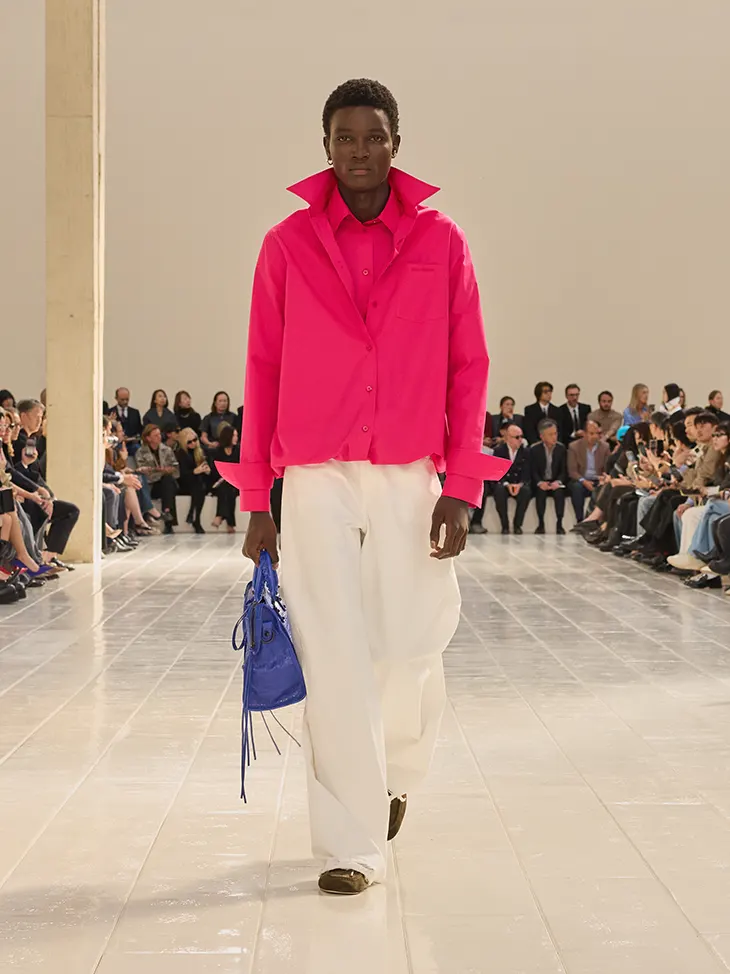
Body as Foundation
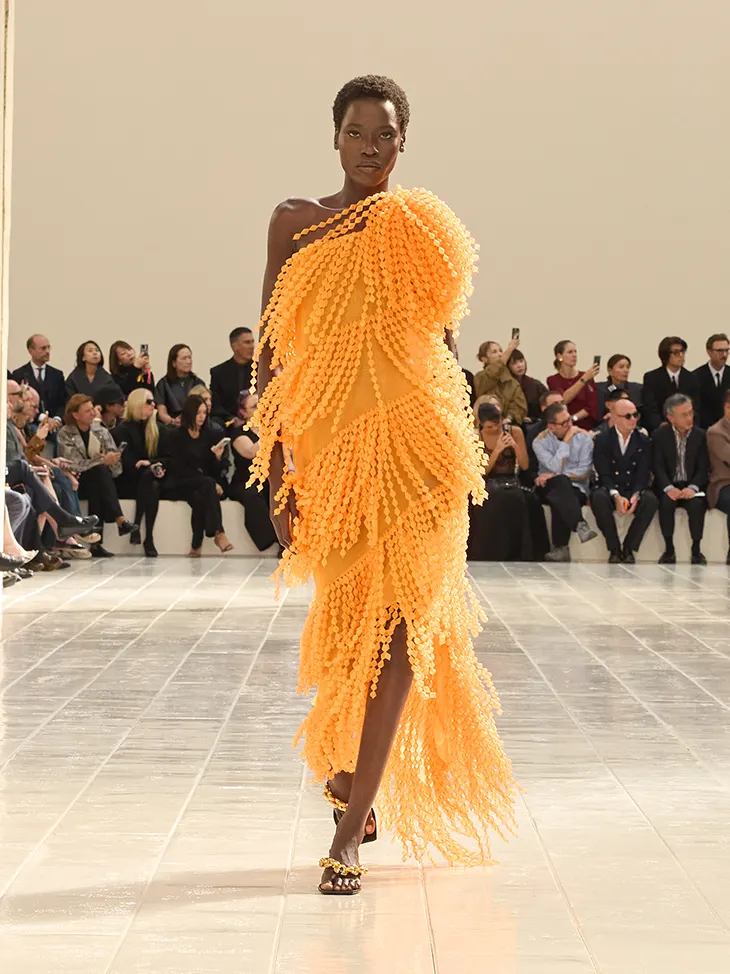
Cristóbal Balenciaga‘s foundational philosophy, the body as the basis for design, resurfaces here, but through Piccioli’s own lens. Calais lace insertions and cutwork function as structure, not ornament. Windows of lace open onto skin, but they’re placed with the precision of an architect, not scattered as embellishment. Abstracted, imaginary flowers rendered in organza and filled with compressed air create volume through mathematical rhythm rather than romantic excess. Even the accessories, the Wave Thong Sandal in its pliant simplicity, the new Lounge Sneaker’s unstructured ease, the draped Nodo bag shaped by hand, all return to the same principle. The body dictates form.
The shoes are particularly instructive here. The Wave Thong Sandal feels almost austere in its flatness, yet the leather has been worked so that it responds to the foot rather than resisting it. The Lounge Sneaker, similarly unstructured, suggests comfort as a design outcome rather than a marketing claim. These aren’t shoes that look expensive because they’re minimal; they look minimal because they’ve been stripped of everything except what allows them to function in service of the wearer.
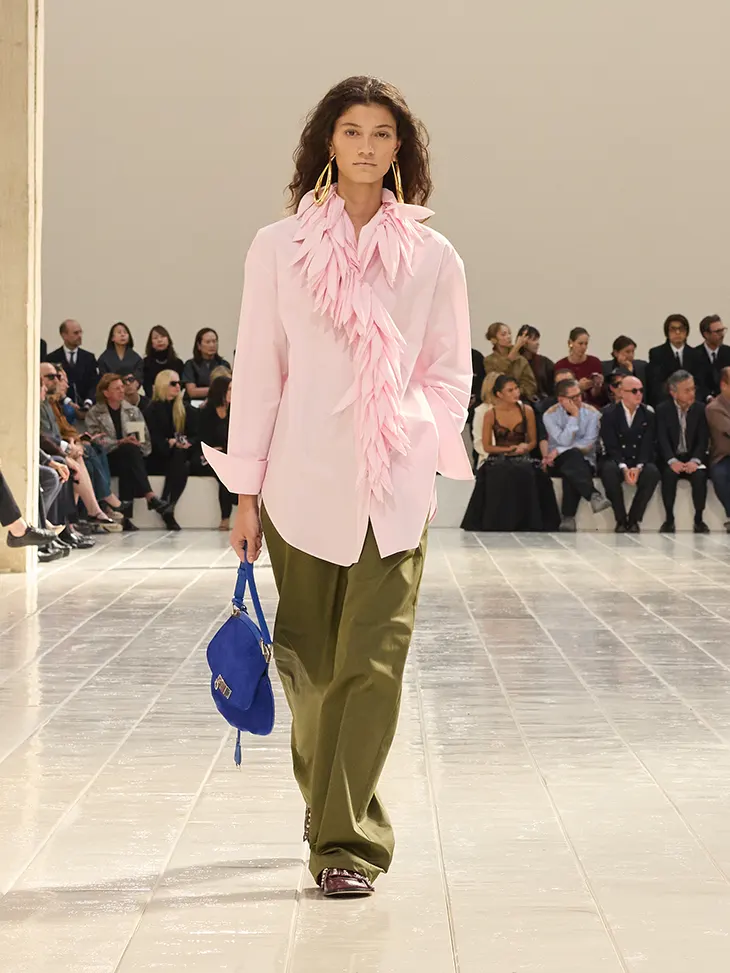
Ornamentation That Functions
Piccioli’s statement that “decoration is never in service of artifice” could read as reductive, yet watching the collection proves its rigor. The Getaria seashell-inspired jewelry feels organic not because it mimics nature aesthetically, but because each piece has been considered from the logic of its form. Bow Mask Sunglasses with artisan-braided arms aren’t precious despite their craft; they’re precise because of it. The Silhou Tote, executed in supple leather and shaped by hand, has the quality of something lived with rather than displayed.
This restraint, however, never reads as cold. The collection breathes with what Piccioli calls “a modern sensibility”, a lightness present throughout that acknowledges comfort and ease not as concessions but as priorities. Watching the pieces move, it’s clear that the priority afforded to how garments move and feel isn’t a secondary consideration. It’s embedded in every decision about cut, weight, and proportion.
Larger Proposition
The collection’s title, taken from Aude Franjou‘s sculptural work Les Coraux de la Liberté (which sat at the center of the scenography), gestures toward something beyond fashion. Franjou’s meticulously wrapped linen piece proposes an analogy: a couture house not as a mere physical structure, but as an entire ecosystem, living, breathing, alive. Piccioli’s collection extends this thinking. By treating couture as a system rather than a category, by insisting that methodology can permeate ready-to-wear without diluting either, he’s arguing for a different model of luxury altogether. Not scarcity. Not exclusivity. But intention, applied systematically to every garment, at every price point.
In a moment when minimalism has become a default, Piccioli’s approach feels genuinely investigative. The collection doesn’t deploy minimalism as a trend or an aesthetic shorthand. It uses it as a discipline: every element must justify its presence through function or structure. Freedom of gesture, freedom of movement, freedom of choice, these aren’t slogans in this collection. They’re outcomes of design decisions made with precision and rigor. That’s what makes Balenciaga Summer 2027 one of the season’s most coherent statements.