




For most of the history of software, the person at the screen made every decision. The interface was a set of controls, and nothing happened until someone pressed one.
DESIGN
That assumption no longer holds. AI agents now book travel, sort inboxes, write and ship code, and even move money. The user is moving from the wheel to the captain’s chair.
The industry’s first answer was the chat box, and the chat box is quickly filling up with interactive interfaces. Claude’s artifacts open documents and small tools beside the conversation, and since March 2026 it has drawn interactive charts and diagrams inline. Apps in ChatGPT put maps, forms and playlists inside the thread, and Google is experimenting with Gemini coding a custom interactive layout for an answer. The conversation is becoming something you can click, adjust and answer mid-chat.
Most of that work, though, is about what the model shows you. Far less of it addresses the harder moment that follows, when the agent has already acted and the person needs to know what happened, whether it stayed inside the limits, and whether it understood the request at all.
That moment is the focus of designer Zui Chen. “What does an interface feel like when the AI is the actor?” she asks. “Not a chat box, and not an AI feature bolted onto an existing product. The AI just did something on your behalf. It made a call. Now what?”
Trained in statistics at the University of Michigan and data visualization at Parsons School of Design, Chen approaches product design through a combination of analytical reasoning, visual experimentation, and hands-on engineering. Her independent projects have also attracted recognition beyond the AI industry. Windspell, an interactive work translating live wind data into music, was named a finalist in Fast Company’s 2026 Innovation by Design Awards for Data Design. Trinity, her concept for an AI-assisted tennis coaching system, received Gold at the 2026 MUSE Design Awards, alongside recognition from the European Product Design Awards and Tokyo Design Awards.
A prompt that checks before it acts
In 2025, as product design lead and art director at an early-stage AI startup, Chen designed agents that handle real money. One was a fund with no human manager. An agent allocates and rebalances each vault around the clock, within limits enforced at the contract level. The question became what a person needs before trusting money to a fund they cannot call anyone about.
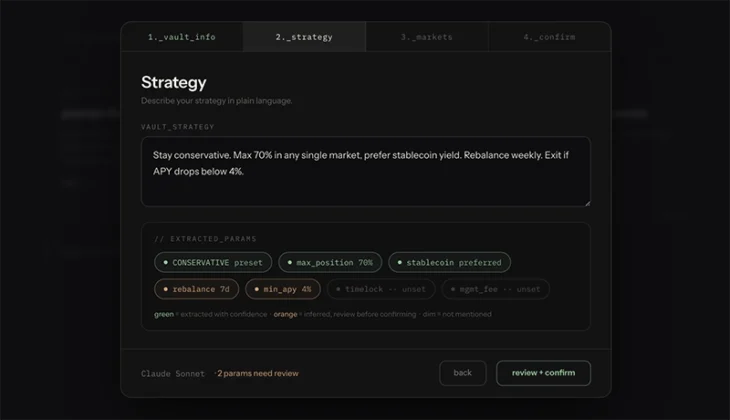
The obvious options failed. A settings panel of risk sliders and allocation caps was precise, but it forced a strategy into a vocabulary nobody actually thinks in. A free-text prompt fixed that, but removed the one checkpoint that mattered: nothing told the user whether the agent read “aggressive” the way they meant it before capital moved.
Chen kept the prompt and added the missing step. The user describes a strategy in plain language. The agent returns what it understood as structure, a risk band, allocation limits and rebalance triggers, each with a confidence score. Confident readings need no attention; uncertain ones are flagged for the user to correct. “The confirmation step isn’t filling in fields,” she says. “It’s verifying the agent understood you.”
Once a vault is live, a running decision log sits beside performance, recording each rebalance and exit with a timestamp and a reason. “The dashboard shows what changed. The log shows why it was allowed to.” In its first alpha month, the platform took in more than $350,000 in deposits. Chen designed and animated its launch motion piece herself in After Effects and Cavalry, in a blueprint-style visual language, drawn like a technical diagram, that extends the product’s own logic: structure over character.
A chat that can do more than talk
Earlier that year, Chen had designed the same team’s iOS trading app, which dealt with the next moment: an agent managing a user’s investment positions in real time. The stakes made the design problem unusually clear. When software trades with your money, you need to see what it did, and that it stayed within your limits, without reading a log.
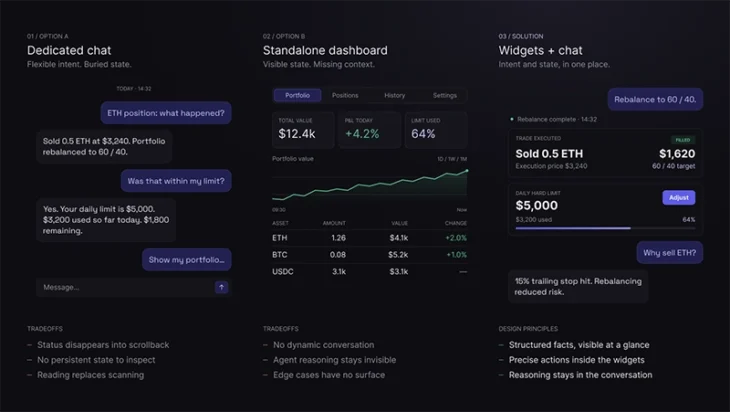
Her first two versions failed in opposite directions. A pure chat interface buried state in the scroll: a rebalance confirmation slid out of view, and the only way to check a trade against its limit was to ask again. A pure dashboard made numbers easy to scan but lost the agent entirely. Figures changed with no visible reasoning, and anything outside the preset views had nowhere to appear.
Her way out came from an app most people use every day without thinking of it as interface design: iMessage. Inside a single thread you can send money, share a live location, run a poll or play a game. “People overlook how interactive iMessage already is,” Chen says. “If chat is the core frame of the interaction, it should be just as capable.” This was early 2025, when Chen was already designing interactive moments inside an AI conversation, the same direction where major AI platforms were taking up.
The design that held split the work. Chat carries intent: the why, the edge cases, anything that does not fit a fixed layout. Small interactive widgets inside the conversation carry facts: trade executed, limit used, stop triggered, each rendered as structured state rather than prose. A daily spending cap enforced at the contract level does not get a reassuring sentence. It sits on screen as a number, with the remaining headroom shown.
“The real safety harness is invisible, because users can’t see code,” Chen says. “The design job is to make a technical guarantee feel human. Legible limits, not reassuring copy.”
Chen also art-directed the product’s launch film, a live-action piece she describes as a post-futurist western: characters with warm, theatrical 1980s silhouettes inside a clean, cold, architectural world. The contrast was the point, human warmth inside a system run by an AI. The app was shelved before release when the market shifted, and the team moved on to the vault platform.

What the conversation leaves behind
Not every agent handles money. Chen’s own project, Melo, is about a much smaller act, and it began with a personal frustration. Learning French, she kept asking Claude about words she came across in articles, recipes and films. Claude explained them well. By the next day they were gone.
Existing vocabulary apps did not help, because they only knew someone else’s word list, not the words she had actually met. So Chen built the capture into the conversation itself. Melo is an iOS app (available on the App Store) paired with a server built on the Model Context Protocol, the open standard that lets AI connect to outside tools. Ask Claude or Grok about a word and Melo saves it quietly in the background, with pronunciation, an example sentence, conjugation and grammatical gender, ready for review.
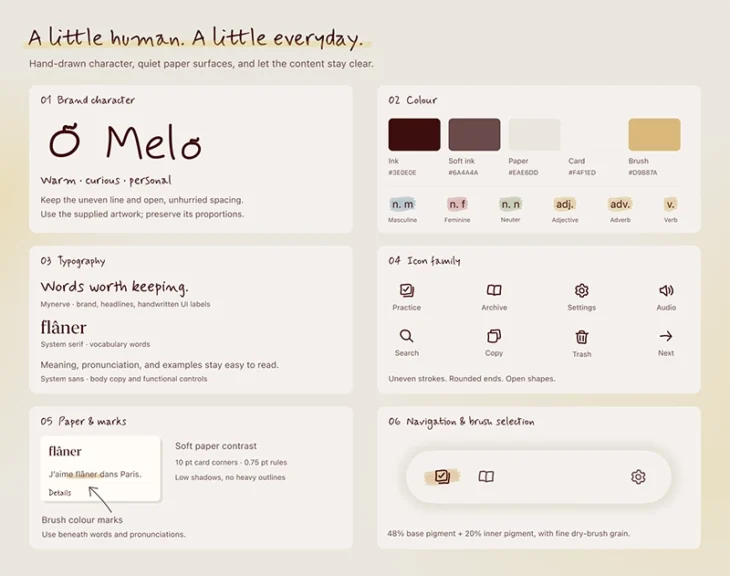
Here the agent’s action is deliberately invisible, and the design work moves to what the user finds afterward. Visually, Melo steps away from the gamified gloss of most learning apps. Its logo is handwritten, and Chen created a full icon family to match: deep ink-brown strokes on warm paper tones, with softer curves and a slight natural wobble. The same hand carries into the cards. A loose, marker-style highlight sits under the pronunciation and under the word where it appears in its example sentence, the way a student marks up a notebook. The effect is deliberate: a word the machine saved should still feel like something you wrote down yourself. Grammatical gender is not a label to memorize but a consistent color, a visual fact absorbed over time. For Chen, Melo became an experiment in what an agent leaves behind once the chat ends. “A word I asked about in a chat becomes a card on my phone, a takeaway I keep interacting with days after the conversation,” she says. “The chat stops being the whole interaction. It becomes the entry point to a longer one.”
One principle, three scales
From a product’s visual identity to how it behaves day to day, Chen designs the whole experience around two questions a person has after an AI acts: what did it just do, and what can I do next?
Set side by side, the three projects cover a wide range of agentic experiences: an agent trading on your behalf, an agent running a fund, and an agent doing a small favor mid-conversation. Chen applies the same rule to all of them. Decide what the person must confirm and what can disappear. Then show what the agent did in a form that can be read in a glance, as a number, a color or a flagged line, rather than a paragraph asking to be believed.
It is the same instinct that runs through her data work, applied to a new kind of data: the record of what a machine did for you. Across financial automation, conversational interfaces, and independent consumer applications, Chen’s work returns to a consistent challenge: making the consequences of AI action visible without overwhelming the person who delegated it. As AI systems gain greater autonomy, the most consequential interface may no longer be the one through which a person gives an instruction, but the one that helps them understand, evaluate, and, when necessary, intervene in what happens afterward.
Words by DSCENE Editor Maya Lane.