The creative universe of Sébastien Léon exists in a state of perpetual ambiguity. The French-born, New York–based artist has built a practice that refuses categorization, spanning sculpture, collectible furniture, blown glass, sound, and immersive environments, yet maintains an unmistakable through-line: the subversion of material truth. His objects trick the eye, defy gravity, and invite viewers into spaces where reason and imagination negotiate uneasy truces. Now, with Inca City on view at Ralph Pucci in New York, Léon presents his most ambitious exploration yet of illusion, craft, and speculative mythology.
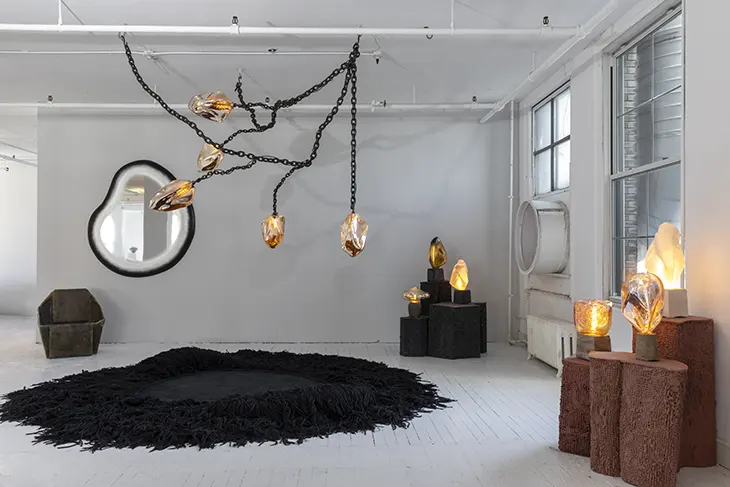
The exhibition takes its name from a geological formation on Mars, a network of geometric ridges that uncannily resembles ancient ruins. It’s the kind of cosmic coincidence that perfectly encapsulates Léon’s obsessions: the tension between scientific explanation and intuitive recognition, between what we know and what we feel compelled to believe. Working within Ralph Pucci’s sculpture studio alongside master artisans, Léon approached the collection not as design but as excavation, unearthing objects that feel as though they’ve weathered millennia on some distant, half-remembered world. Metal, resin, fiber, plaster, blown glass, and woven textiles converge in pieces that oscillate between solid and void, fragility and strength, the ancient and the futuristic.
Photo courtesy of Ralph Pucci
In conversation with DSCENE Editor-in-Chief Žarko Davinic, Léon reveals the philosophy behind his trompe-l’œil techniques, his debt to Houdini, and why he believes the best illusions require flawless execution. What emerges is a portrait of an artist who treats uncertainty not as a problem to solve but as a territory to inhabit, a maker of doorways into singular, evolving universes where questioning reality becomes the point.
The title Inca City references a geological formation on Mars that resembles ancient ruins. What drew you to this extraterrestrial mystery as a conceptual anchor for this body of work, and how did it shape your creative process? – I was immediately drawn to Inca City because it exists in a space of ambiguity. It is a real geological formation, yet it reads uncannily like architecture. Finding something so reminiscent of an Inca ruin on Mars does not quite make logical sense, and that tension between scientific explanation and intuitive recognition is where my work often begins. It opens up a space of what if, where reason and imagination coexist.
Photo courtesy of Ralph Pucci
Inca City became an imagined site for a speculative civilization, suspended between ancient memory and futuristic longing. Rather than designing objects, I approached the work as an excavation. Each piece emerged as if it had already existed somewhere else, shaped by erosion, time, and myth.
Finding something so reminiscent of an Inca ruin on Mars does not quite make logical sense, and that tension between scientific explanation and intuitive recognition is where my work often begins. It opens up a space of what if, where reason and imagination coexist.
Working within Ralph Pucci’s sculpture studio gave you access to master artisans across disciplines. How did this collaborative environment influence the direction of Inca City? -The Pucci studio is extraordinary because it fosters a constant dialogue between craft and experimentation. Being surrounded by master artisans allowed ideas to evolve in real time, while also giving me the freedom to act as a disruptor within their processes. I could push, break, or misbuild things, trusting that their depth of knowledge meant anything could be repaired.
That sense of trust created a space where risk felt productive. There is nothing like having your hands directly in the material to generate new ideas. In that sense, the Ralph Pucci Sculpture Studio became a creative medium in itself.
The collection spans metal, resin, fiber, plaster, blown glass, and woven textiles. How do you approach the dialogue between such disparate materials? – I think of myself as a bit of a Houdini of design. I am always trying to integrate a trick. I will use a material that looks like another, give an object an unexpected function, or build something that seems to defy gravity.
Photo courtesy of Ralph Pucci
Rather than focusing on materials individually, I thought in terms of creating a universe made of unexpected fabrication processes. At one point, Michael Pucci asked how we could make a cohesive show from so many radically different pieces. My answer was simple: If it feels right, let us go with it. We will understand later.
Often, the material I imagine for a piece is not physically possible, so I use another material and make it look like the first. Trompe l’oeil plays a major role in my work. Thinking about it now, this mirrors the images we consume daily. Artificial imagery that looks real enough to require close analysis. That questioning of reality has certainly influenced me, consciously or not.
Your work is often described as having illusionary magic. How do you balance technical execution with perceptual trickery? – Years ago, I worked as a curator and exhibition designer for Audemars Piguet, whose motto is to break the rules, you must first master them. Illusion is about breaking rules, but it only works when execution is seamless.
Photo courtesy of Ralph Pucci
I push fabrication to the point where an object begins to contradict itself, both visually and physically. The process involves extensive refinement of surfaces and transitions until the technique disappears and the illusion takes over. That moment of questioning is where the piece truly lives.
The Memento mirror embodies this approach. Its core is polished steel, framed in resin, yet it reads as a single cast metal object emerging from a foundry, polished at the center and gradually patinated toward the edges. The illusion relies on disguising the transition between materials through surface treatment.
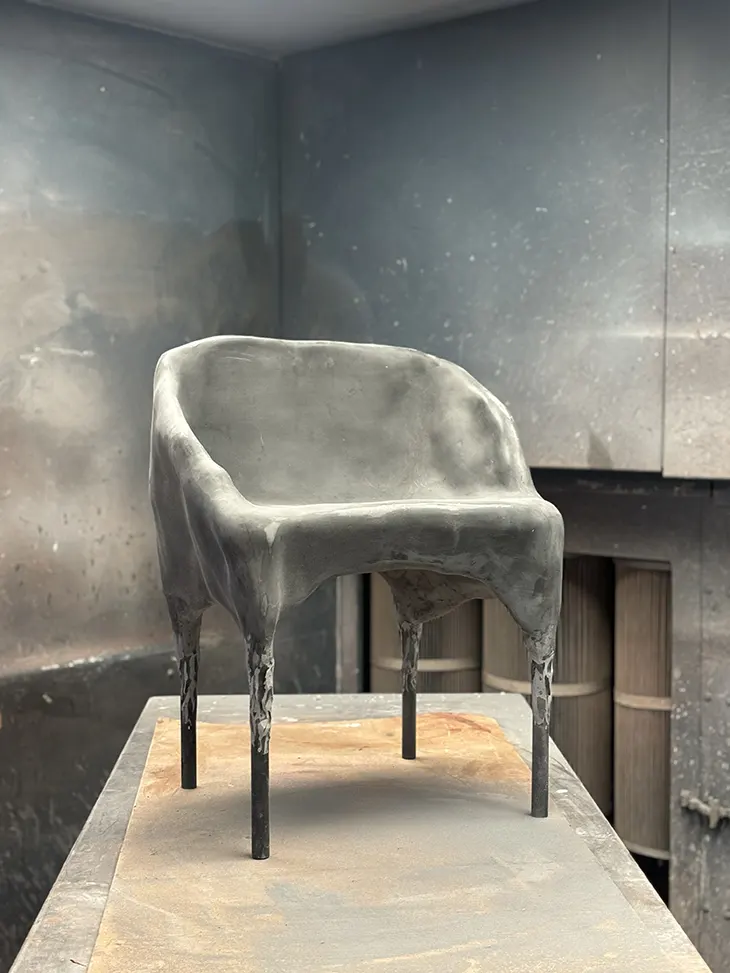
The Memento and Obsidian chairs were sculpted by hand in clay to evoke material ambiguity. Shrink wrapped leather in one case, liquid lava in the other. From those clay positives, we made molds and produced the pieces in Pucci’s Plasterglass, a resin and plaster composite originally developed for mannequins. I love working with it because it allows both molding and hand finishing, so every piece ends up slightly different.
When viewers encounter these pieces, I want them to feel briefly disoriented. Are they looking at a solid object or a void. Is the light emanating from within, or being reflected back at them. That instability mirrors how we experience reality today. Mediated, shifting, and uncertain.
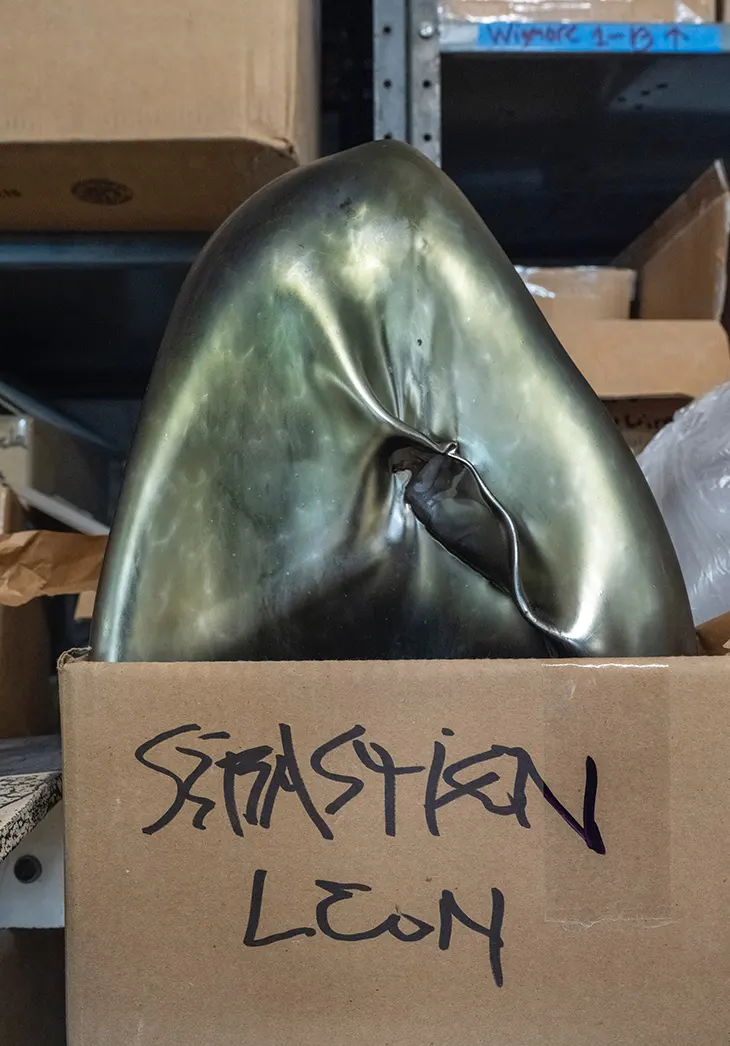
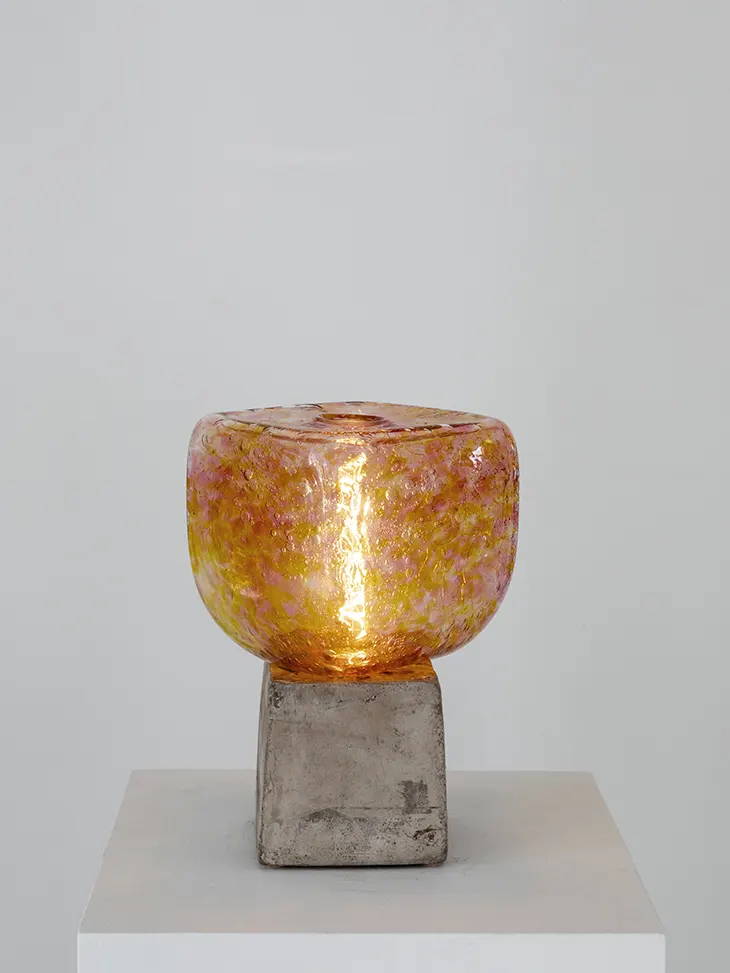
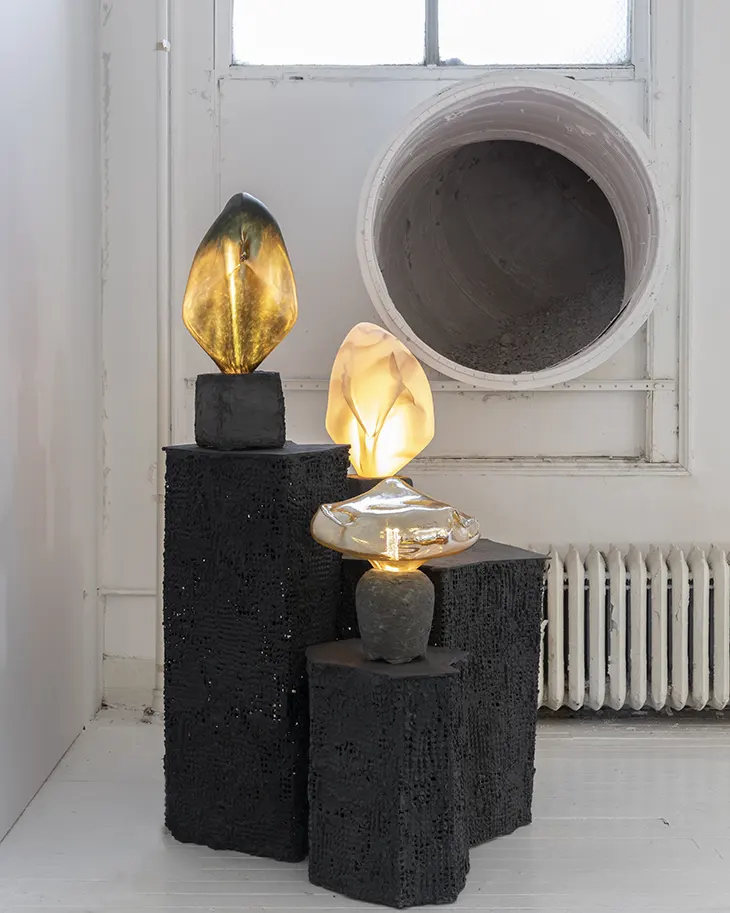
The Mirage lights oscillate between reflective solids and glowing voids. What did you want viewers to experience when encountering these works? – I work from a single mold for each glass piece, which I reuse repeatedly. As soon as a vessel comes out of the mold, I deform it through flame and gravity, pushing and stretching it so no two are ever the same.
Photo courtesy of Ralph Pucci
The Mirage works emerged after months of experimentation. I had a transparent volume sitting on my desk for nearly a year before a moment of clarity. Silvering the glass could give it the illusion of a cast metal sculpture. Realizing it could also be lit from within was the second breakthrough. A silver sculpture that suddenly glows. A truly alchemical moment.
From there, I pushed the finishes further, making glass resemble marble, graphite, or other materials. When viewers encounter these pieces, I want them to feel briefly disoriented. Are they looking at a solid object or a void. Is the light emanating from within, or being reflected back at them. That instability mirrors how we experience reality today. Mediated, shifting, and uncertain.
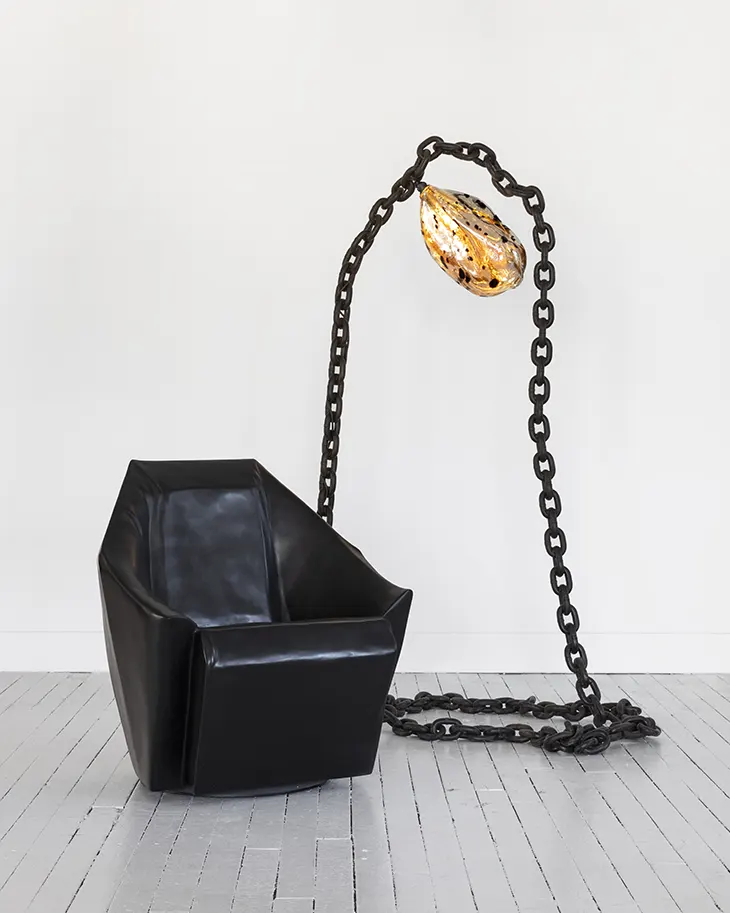
The Sapera sculptures combine blown glass with welded chain. What draws you to this tension between fragility and strength? – The pairing came from a desire to materialize physical tension. Glass and chain are opposites. One is fragile and luminous, the other industrial and heavy. When combined, they enter a state of mutual dependency. The chain restrains the glass, while the glass lends the chain vulnerability.
The serpentine forms suggest movement, danger, and temptation. A moment of risk frozen in time, defying gravity. The work is also deeply connected to my fascination with Houdini. I lived near his house in the Hollywood Hills, and I was struck by his multi level vertical garden defined by welded chain railings. For an escape artist, that choice feels deliberate.
Houdini took his name from Robert Houdin, a magician from my hometown. In a way, this piece completes the loop. He took the name, I took the chains.
The Ouroboros rugscapes blur the line between carpet and furniture. How did this collaboration with Carini Rugs unfold? – The collaboration grew from a shared desire to push traditional craft into unfamiliar territory. The challenge was treating carpet not as a flat surface, but as a topographical form. A sculptural conversation pit.
I originally imagined a black object somewhere between a sofa and a rug, something that could exist in Dune or Prometheus. Without Joe Carini, the piece would not exist. He immediately understood the ambition and was just as invested in pushing the medium as I was.
The rugscapes are made from hand spun Himalayan wool, mohair, and felted fringes, with high density foam concealed beneath the surface to create an immersive lounge experience.
His relationship with the weavers in Nepal is remarkable. They are willing to experiment and refine the process alongside him. Working with them was incredibly humbling. The result is a lush landscape meant to be inhabited rather than simply walked across. The rugscapes are made from hand spun Himalayan wool, mohair, and felted fringes, with high density foam concealed beneath the surface to create an immersive lounge experience.
Photo courtesy of Ralph Pucci
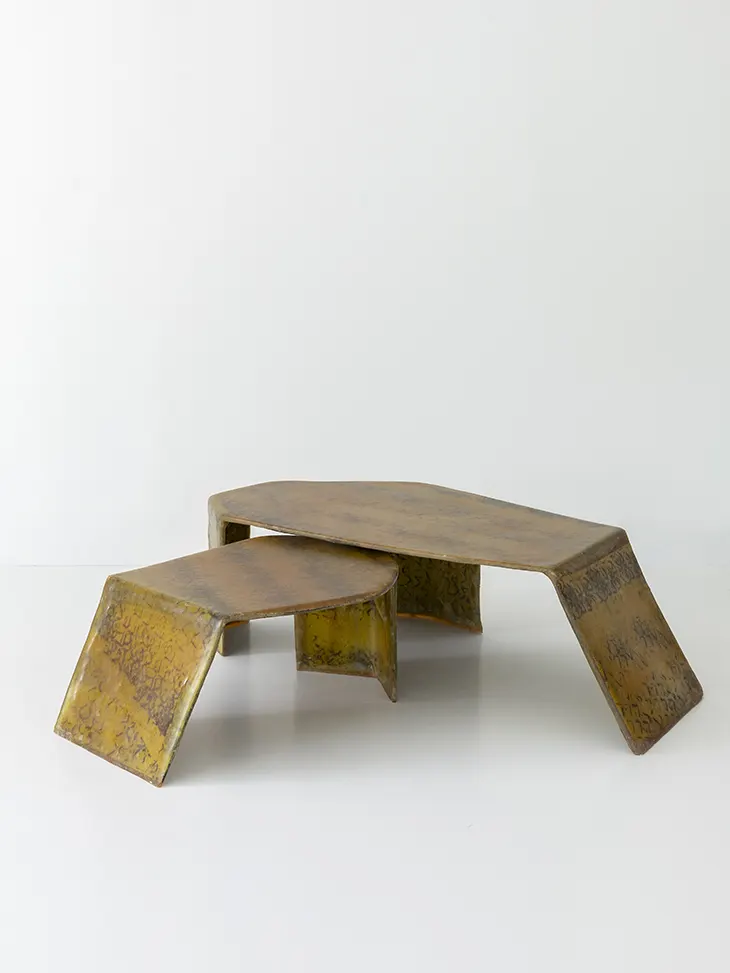
The Codex tables feature hand painted cryptic inscriptions. Do these marks carry meaning? – They are not meant to be read literally, though interestingly they often end up forming my initials. An accidental monogram. I think of them instead as fragments of a lost alphabet, traces of a language whose meaning has eroded over time.
They suggest presence rather than information. A culture rather than a message. Like ancient ruins or undeciphered scripts, they invite projection. The narrative is intentionally incomplete.
Inca City imagines relics of a distant civilization. Do you see yourself as an archaeologist uncovering these forms, or as the civilization itself? – Both. At times, it feels like I am excavating objects that already exist somewhere in the subconscious. At others, I am constructing a mythology from scratch.
The objects act as clues, inviting speculation and escapism. The narrative is deliberately open, leaving space for each viewer to build their own reality.
Having pushed material experimentation this far with Inca City, where does your practice go from here? – What excites me now is convergence. Allowing the different material languages I have developed to merge and contaminate each other further. I see the next phase of my practice becoming increasingly immersive, where objects, architecture, and sensory experience blur more completely.
Zarko Davinic is an architect by education, Founder and Editor-in-Chief at DSCENE Publishing, having studied at the Faculty of Civil Engineering and Architecture in Niš, Serbia. In 2007, he founded DSCENE, which grew into an international publishing network with MMSCENE, ARCHISCENE, and DSCENE Beauty. Today, the platform features two globally distributed print editions, combining a vision for design, fashion, and culture.





Ralph pucci in new york does it again !! 😍