


When Bad Bunny stepped onto the Super Bowl LX halftime show at Levi’s Stadium in Santa Clara, the performance immediately signaled that this would not follow the usual formula. Rather than leaning into spectacle for spectacle’s sake, the artist transformed one of the most watched television moments in the world into a carefully constructed expression of Puerto Rican culture, language, and lived experience.
EVENTS
The performance opened with a cinematic sequence set in a sugar cane field, a deliberate nod to Puerto Rico’s agricultural history and labor legacy. Dancers dressed as field workers moved alongside Bad Bunny as he made his way through the tall stalks, grounding the show in imagery that rarely finds space on a stage of this scale. From the outset, the tone was clear: this was not a neutral backdrop designed to offend no one, but a specific cultural landscape brought fully into view.
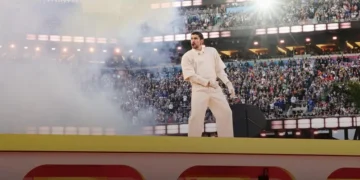
Dressed in an all-white, jersey-like outfit by Zara, bearing his surname, Martínez Ocasio, Bad Bunny began with “Tití Me Preguntó,” immediately centering Spanish-language music without translation or apology. The choice set the rhythm for the rest of the performance, which moved fluidly through his catalog while maintaining a strong narrative through-line. Songs such as “BAILE INoLVIDABLE” and “NUEVAYoL” unfolded against a set modeled after a bustling market labeled “La Marqueta,” evoking the everyday spaces of community life rather than abstract grandeur.
Midway through the show, Bad Bunny crashed through a rooftop into a new stage environment, a moment that could have easily read as pure theatrics. Instead, it reinforced the sense of continuity, as the performance carried on without pause, resisting the traditional peaks and resets associated with halftime productions. At another point, he handed a Grammy Award to a young boy on stage, as a quiet acknowledgment of legacy and possibility.
The show’s closing moments brought that symbolism into sharper focus. As fireworks erupted overhead during a performance of “DtMF,” Bad Bunny carried a Puerto Rican flag across his back, making the statement unmistakable. National identity was not hidden in metaphor but presented directly, occupying the center of the frame during the broadcast’s final images.
View this post on Instagram
Guest appearances were integrated into the narrative rather than positioned as headline-grabbing interruptions. Lady Gaga joined Bad Bunny for a salsa-inspired version of “Die with a Smile,” dressed in a light blue Luar gown accented with a red flower, while a live band in coordinated red and blue suits underscored the performance’s musicality. Ricky Martin later appeared to perform part of “Lo Que Le Pasó a Hawaii,” reinforcing the generational and cultural continuity threaded throughout the set. Additional appearances by figures such as Cardi B, Karol G, and Pedro Pascal contributed to the celebratory atmosphere without overshadowing the show’s core message.
Beyond the stagecraft, the performance carried broader cultural weight. Bad Bunny’s halftime appearance arrived just days after he made Grammy history, becoming the first artist to win Album of the Year with a fully Spanish-language project. Together, the two moments marked a clear shift in the visibility and legitimacy of Spanish-language music within mainstream American culture.
That clarity also drew predictable backlash. His selection as halftime performer had already prompted criticism from conservative commentators, some of whom questioned the prominence of Spanish on the Super Bowl stage and took issue with his outspoken support for immigrant communities. A counterprogrammed halftime event streamed by a conservative advocacy group underscored the political tension surrounding his appearance. Yet the NFL stood by its choice, with commissioner Roger Goodell publicly describing Bad Bunny as “one of the great artists in the world.”
View this post on Instagram
In press appearances leading up to the game, Bad Bunny avoided grand statements, focusing instead on joy and connection. “You always have to be proud of who you are and feel comfortable being yourself,” he said, framing the performance not as provocation but as authenticity. That philosophy carried through the show itself. There were no explanatory speeches or overt political slogans, only the steady accumulation of images, sounds, and gestures that made the statement unmistakable.
Born in Bayamón and raised in Vega Baja, Puerto Rico, Bad Bunny’s rise to global stardom has never required him to shed his cultural specificity. The Super Bowl halftime show extended that trajectory onto its largest possible stage. By centering Puerto Rican culture, Spanish language, and Caribbean rhythm without compromise, he reframed what belonging looks like in American pop spectacle. The halftime show became, in his hands, not a moment of assimilation, but one of assertion.