


Albert Kriemler arrived at Akris Spring Summer 2027 with a seismograph, not a sketch pad. The collection reads as a visual diary of Austrian painter Martha Jungwirth‘s abstract gestural work, but filtered through the precise language of tailoring. In converting canvas to cloth, Kriemler has created something rare: a collection that honors the artist’s emotional urgency while remaining utterly wearable, utterly Akris.
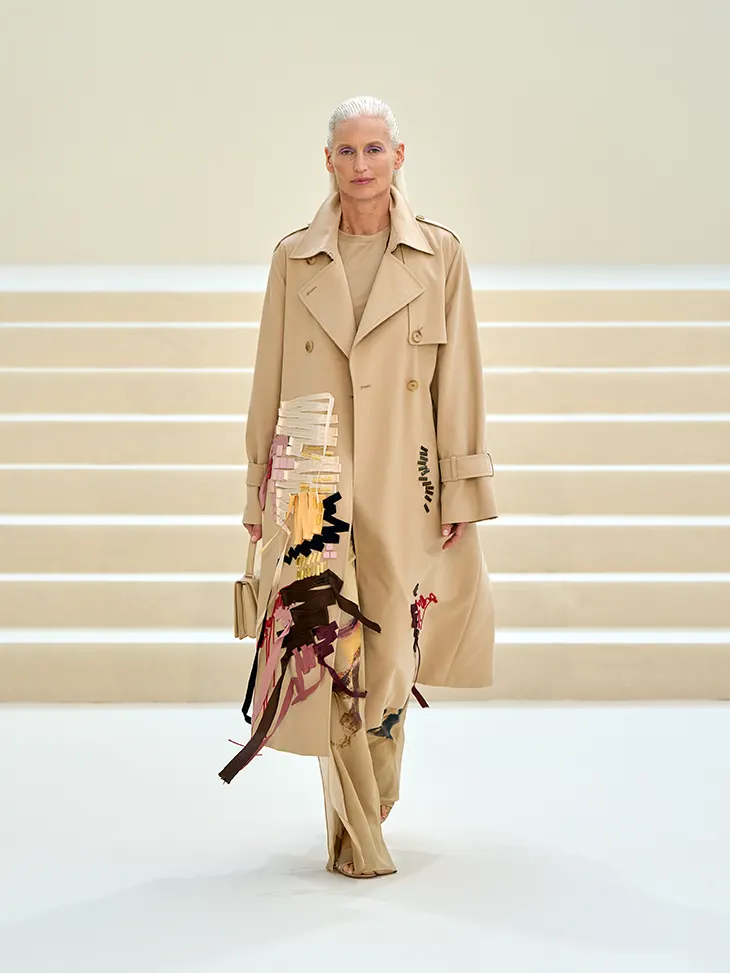
To understand this collection is to understand Kriemler’s relationship to paint itself. Jungwirth’s work (characterized by her expressive brushwork, audacious color, and what she calls “Gefühlsfarben,” or felt colors) captures emotion in its most raw, unguarded state. She paints the way we actually feel, not the way we think we should appear. Kriemler has translated this philosophy into fabric. The beige trench coat opens to reveal hand-applied ribbons in pink, ochre, black, and burgundy that zigzag across its lining like the trail of a brush mid-stroke. Loose ends dangle. The seams remain visible, almost confessional. This is not haute couture disguising its labor. This is craft made visible.
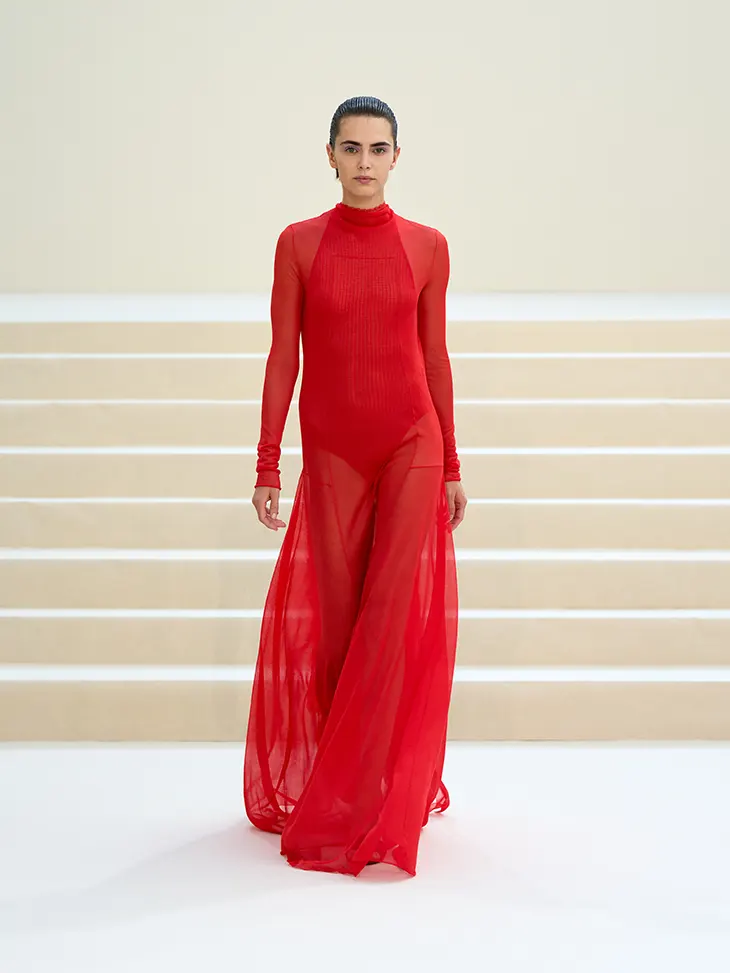
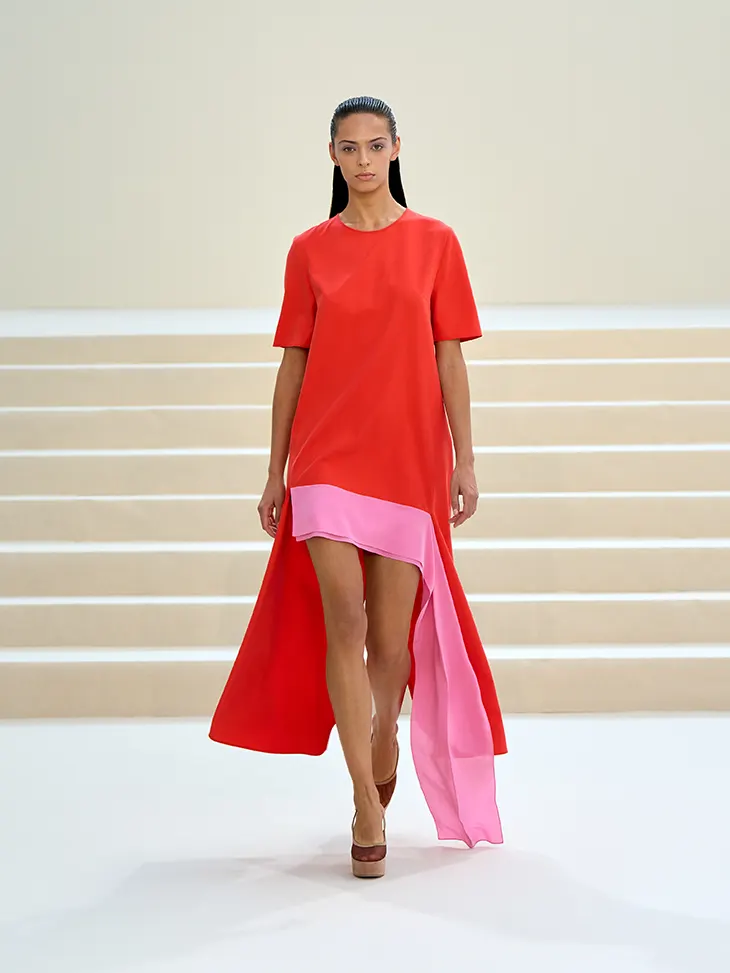
The collection’s technical vocabulary reads like a manifesto of process. Laser-cut fringe, normally employed for decorative precision, is turned upside down, its underside exposed and frayed, undoing the expectation of finish. Reversed jacquards expose their inner workings, the warp and weft laid bare. Tailoring loosens without surrendering precision. A red wool blazer sits on the body with volume and movement, its shoulders structured yet fluid, as though the wearer has just arrived and is still settling into the shape of fabric. A vibrant crimson knit dress flows in a single column, its simplicity absolute, its color audacious. There is no apology in the red. It is Jungwirth’s red, pulled from her palette yet so Akris: feeling made visible.
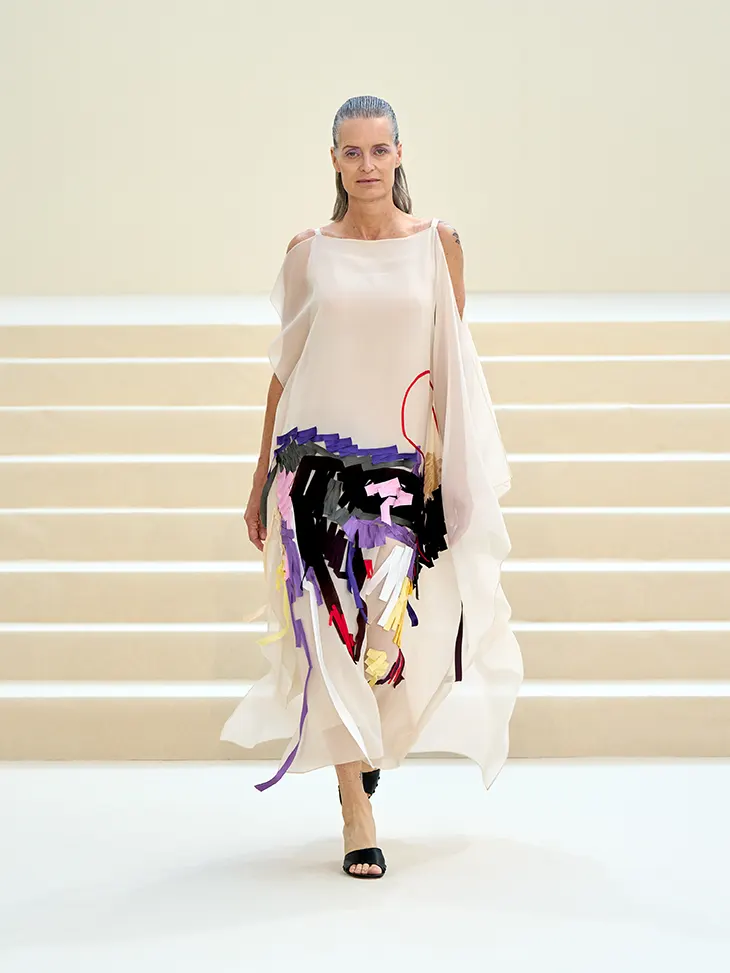
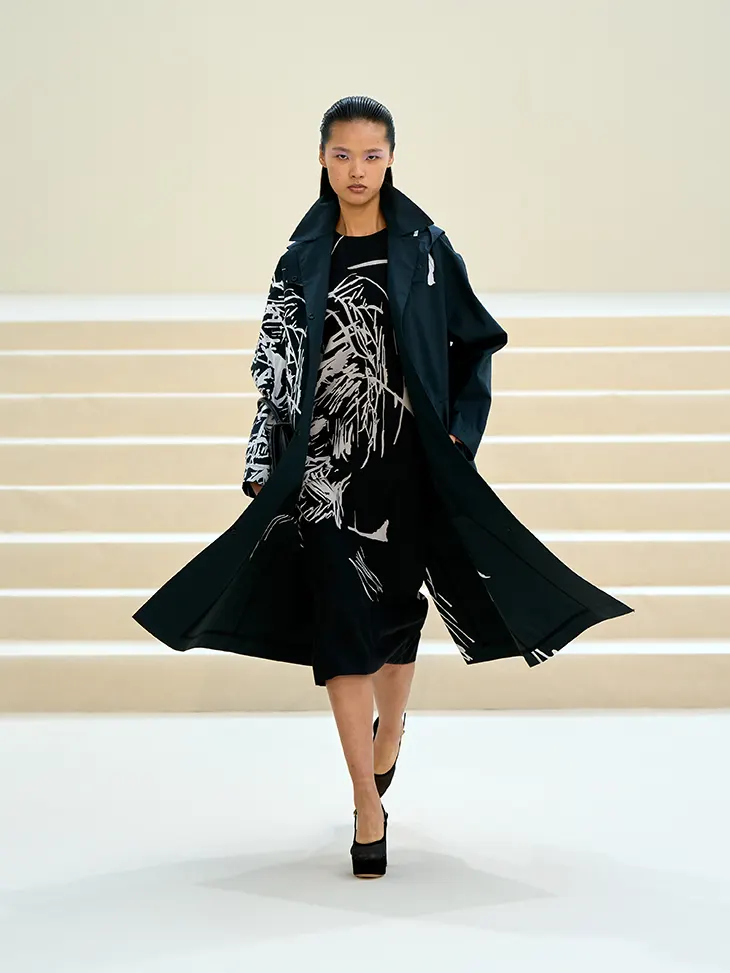
What sets this collection apart from a simple artist inspiration is Kriemler’s refusal to merely print or adapt. Instead, he has absorbed Jungwirth’s methodology and made it structural. The collection becomes three-dimensional painterly thinking. A black wool coat with white brushstroke prints arrives in a sculptural silhouette, the skirt swaying with the force of movement, the proportions generous yet controlled. The prints themselves are not literal reproductions but interpretations, hand-drawn marks that evoke the artist’s gestural language without copying it directly. This is homage as creation.
Akris’ DNA originating form an apron emerges as a quiet but profound symbol throughout the collection. Appearing in petite iterations, layered over dresses and worn as functional garment pieces, it carries multiple meanings. It is Martha’s working wardrobe, the uniform of the studio. It is also Akris at its origins, referencing Alice Kriemler’s designs from the 1950s, the grandmother whose legacy threads through every collection. By suspending it on the body, delicate and freed from its utilitarian purpose, Kriemler elevates labor itself. The apron becomes adornment, becomes memory, becomes the bridge between past and present “worn at once.”
The color palette refuses to whisper. Beyond the expected beige and black sit the reds, pinks, and violets that Jungwirth favors. These are not trend colors. They are emotional colors, the hues of vulnerability and power. A wine-colored skirt appears with structural precision, its pleats geometric yet organic, as though the fabric remembers the force of a hand pressing it into shape. Alongside the signature Akris color-blocking and monochrome looks sits this new boldness, this insistence on color as feeling rather than fashion.
Kriemler’s statement on the collection crystallizes its intention: “Getting dressed as an intuitive act. Not only how we want to appear, but what we carry within: instinct, habit, desire, memory, fantasy. Life, really.” This is not the language of seasonal collections. This is the language of identity, of accumulation, of the garments we return to because they hold something of ourselves.
The collection succeeds precisely because Kriemler understands that Akris has always been about this proposition: clothes that respond to the body, becoming part of the wearer’s life. The beige trench with its hidden ribbons becomes more interesting over time, its linings revealing themselves through repeated wear and opening. The red blazer settles into the body’s contours, its volume reading differently depending on how it is worn, whether buttoned or open, whether the wearer is still or in motion. These are not pieces that demand interpretation. They demand inhabitation.
Shown at the Palais de Tokyo during Paris Fashion Week, the collection transported the viewer momentarily into a Vienna gallery, that specific day light of a studio space where paint dries and brushes sit. The presentation itself honored the artist, not merely housing her work but creating a spatial echo of her practice. And in that moment, Akris Spring Summer 2027 revealed what Kriemler has always understood: that fashion and art are not separate languages but extensions of the same human need to mark, to express, to leave the trace of our passage.
For the loyal Akris collector, this is the season. A truly collectable collection, one that will deepen with wear, with pairing, with the accumulation of personal memory. The kind of collection that, like Jungwirth’s paintings, demands you keep looking. Emotion and experience, recorded in cloth. Feeling given form.
Akris | Spring Summer 2027 Womenswear
Discover more of AKRIS Spring Summer 2027 runway collection in our gallery: