



You love your engagement ring. You also like the look of a fine chain draped across the back of the hand, and you want to wear both without crowding your hand or tugging at the setting every time you reach for a mug.
The trick is a fine chain, a little open space around the ring, and a finger placement that doesn’t pull when you move. Repeat one detail, such as the metal tone or a curve, and the two pieces look like they belong together. The same approach works with a diamond solitaire, a colored stone, or a nature-inspired band.
Understand the ring chain bracelet
A ring chain bracelet, sometimes called a hand chain, runs from a bracelet at the wrist, across the back of the hand, to a small loop on one finger. It’s different from an engagement ring worn on a necklace chain, because it has its own wrist section, connecting chain, and finger loop.
You wear it alongside your ring, with each piece sitting independently. That separation is what keeps the look comfortable and the setting safe.
Use the bracelet’s own finger loop. The loop goes around a finger. Never hook it onto a prong, gemstone, or the band of your engagement ring.
Keeping the pieces separate also gives you options. If wearing them together feels crowded, simply move the bracelet to the opposite hand.
Hand chains also come in stone-accented versions that gather small gems at the center of the hand. That adds another point of sparkle, which can suit a simple ring but may compete with a detailed setting. A plain chain leaves the focus on your engagement ring.
Choose a metal palette that feels like you
Start with a shared tone. Matching the visible metal of your engagement ring is the easiest starting point. A yellow-gold ring with a yellow-gold chain feels warm, while a platinum or white-gold ring with a white-metal chain keeps the palette cool.
Connect mixed metals through a shared detail. If your chain is a different color, repeat a curve, a finish, or a fine, unornamented line. A two-tone piece you already own can bridge the metals, but you don’t need to buy anything new.
For example, try a white-metal solitaire with a yellow-gold hand chain and small yellow-gold studs. The earrings repeat the chain’s tone. If you prefer the contrast on its own, leave the earrings out.
Keep meaningful pieces. A sentimental ring, a family stone reset in a new band, or an unusual metal doesn’t have to dictate every accessory you wear. Lay the ring and chain beside your usual earrings or pendant, then look for a connection you enjoy rather than following a rule.
Color coordination doesn’t tell you whether the pieces will rub. Check that separately, even when the metals match exactly.
Balance the chain with your ring’s setting
Give detailed rings room. A halo, cluster, ornate vintage setting, or nature-inspired band already has plenty going on. Beside a ring like that, a plain chain and fewer extra rings keep the setting visible.
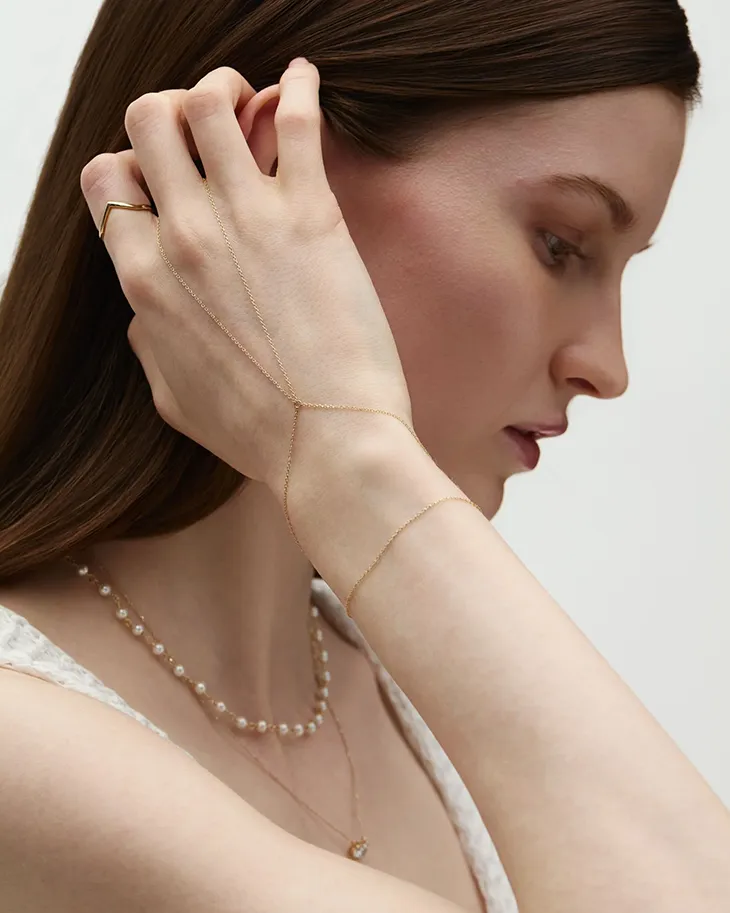
A fine, stone-free chain is the easiest partner for most engagement rings. For a sense of that proportion, the ring chain bracelet from ENEA Studio pairs a slim gold chain with a simple finger ring and no stone accent, so it adds a light line across the hand without competing with your center stone.
Echo one design detail. If your ring has a curved band, a chain draped in a soft arc repeats that curve. With a geometric ring, a plain loop and an uncluttered chain keep the lines clean.
Try these combinations as starting points:
- Simple solitaire: a plain fine chain on an adjacent finger, in the same metal, with no other rings on that hand.
- Sculptural ring: the ring on one hand and the chain on the other, leaving the ring’s outline uninterrupted.
- Colored-stone ring: a chain that matches the band’s metal, keeping the stone as the main color on the hand.
Check where the pieces touch. Rings that rub against each other can show wear over time, and a hand chain adds moving contact. Watch the chain’s path around any exposed prongs or raised details rather than assuming a low-profile or bezel setting makes the pairing safe.
Place the finger loop and check the fit
Try the layout first. Start with the loop on a finger beside your engagement ring, or move the whole bracelet to the opposite hand. Whether the adjacent finger works depends on the loop size, the connecting chain’s length, and how it drapes across your hand.
Check the measurements of the actual bracelet. A longer wrist section doesn’t necessarily lengthen the chain that reaches the finger, and a loop that fits one finger may not fit another.
Put it on without forcing it. Slide the finger loop on first, bring the chain across the back of the hand, then fasten the wrist clasp. If the loop won’t pass comfortably over a knuckle, stop rather than pulling it into place.
Check ordinary movement. Open your hand fully, then close it. Bend your fingers one at a time, type a few words, and pick up a bag.
Watch for a chain that pulls taut, a loop that digs in, or a connector that drags across the setting. If anything catches, adjust the placement or take the bracelet off. Standard sizes are a starting point, not a promise of comfort.
Check sleeves and nearby jewelry. A fitted cuff, knit, or textured fabric may catch a fine chain or press it against the ring. Gently push the sleeve up and down while watching the chain, and repeat with any bracelet you plan to wear on the same wrist.
Build three looks around your engagement ring
Start with pieces you already own. Keep the same movement checks as you swap accessories in and out.
Quiet everyday. Pair a simple engagement ring with a plain hand chain in the same metal and small earrings. Leave the wrist otherwise clear, so the look stays understated with jeans and a sweater.
Nature-inspired and personal. Pair a botanical band, textured setting, or colored-stone ring with a fine chain that echoes one detail, such as a curve or the band’s metal. Organic, story-led designs are among this year’s nature-inspired ring trends, and a quiet chain lets that texture lead.
Dressed-up without competing. Give a detailed ring space by moving the chain to the opposite hand. Try statement earrings or a necklace first, then decide whether you want both, since choosing a single focal point is the simplest way to style bold jewelry without crowding your hand.
| Ring style | Chain approach | Supporting jewelry | One fit or fabric check |
| Simple solitaire | Plain fine chain, same metal, adjacent finger | Small studs; no second bracelet | Open and close the hand; the chain shouldn’t pull taut |
| Nature-inspired or colored stone | Fine chain that echoes the band’s metal or curve | A pendant or earrings with a related detail | Bend the fingers; the loop shouldn’t dig in |
| Halo, cluster, or ornate vintage | Plain chain on the opposite hand if needed | Earrings or a necklace, not both at first | Move sleeves gently; watch for catching |

Protect both pieces between wears
Remove delicate jewelry for demanding activities. Take fine chains off before sleep, swimming, showering, exercise, or manual work, and keep them away from harsh chemicals. Follow each maker’s care instructions for the materials involved.
Clean for the materials you own. A gold chain and an engagement ring may need different care. Rings with inlays of natural materials such as turquoise, antler, or wood shouldn’t be soaked, so follow their specific care instructions.
For the chain, a gentle wipe with a soft cloth after wear is usually enough. Clean the pieces separately so a method that suits one doesn’t harm the other.
Store the pieces separately. Keep each piece in its own pouch or jewelry box compartment so they don’t scratch or tangle. Lay the chain loosely rather than dropping it into a dish with the ring.
Stop when something catches or loosens. If the chain keeps catching on a prong, or a stone feels loose, stop wearing the pairing and have a jeweler check the ring. Don’t bend a prong yourself, and have prong-set rings inspected at least once a year.
Let your ring stay the star
A ring chain bracelet works best as a supporting line, not a rival. Choose a fine chain, connect it to your ring through one shared detail, and give the setting enough room to shine.
Most of all, trust how it feels. If the chain moves freely and never touches the setting, you’ve found a pairing you can wear every day.
FAQ
Can I wear a hand chain on the same hand as my engagement ring? Yes, as long as the finger loop sits on a different finger and the chain doesn’t rub the setting when you move. If it does, wear the bracelet on the other hand.
Should my hand chain match my engagement ring’s metal? Matching is the simplest option, but mixed metals work too. Connect them with a shared detail, such as a curve or a two-tone piece you already own.
Which finger should the loop go on? There’s no single rule. Try the finger next to your ring first, then check that the chain doesn’t pull when you open and close your hand.
Can a hand chain damage my engagement ring? Repeated contact can cause wear or catch on prongs. Check the chain’s path around the setting and stop wearing the pair if anything catches.
How should I store a hand chain? Keep it in its own pouch or compartment, laid loosely, so it doesn’t tangle or scratch your ring.