


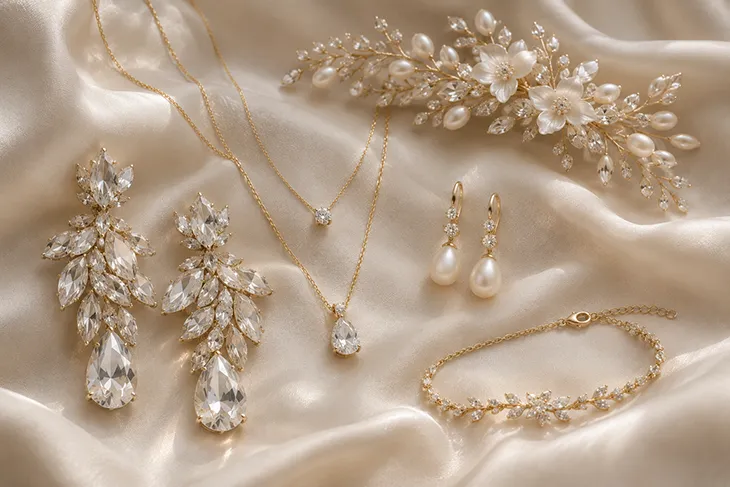
Wedding accessories do more than complete an outfit. They influence how formalwear looks in photographs, how a hairstyle appears from different angles, and how comfortable and confident someone feels throughout the celebrations. Earrings, necklaces, hairpieces, and bracelets should be considered in relation to the neckline, hair texture, lighting, and movement, all of which can affect how they look and feel when worn.
Even something as classic as bridal earrings deserves as much attention to comfort as to appearance, since a piece worn for twelve hours straight needs to hold up very differently than one worn for a quick two-hour photo session. Thoughtful accessory planning means balancing visual harmony with practical wearability, personal sensitivity, and the realities of staying on your feet, and in motion, all day long.
Start With the Outfit’s Overall Structure
Consider the neckline. High necklines, square cuts, sweetheart shapes, halters, and open necklines all change how a necklace sits and how much visual space is left near the collarbone. A heavily detailed neckline often calls for simpler jewelry, while a minimal one can carry a stronger focal piece without feeling crowded. Consider how each accessory works with the overall outfit before making individual selections.
Account for fabric and embellishment. Lace, beading, sequins, satin, velvet, and matte finishes all reflect light differently, and pairing heavy embellishment with equally ornate jewelry can tip into visual competition rather than cohesion. One practical step, drawn from real styling experience, is photographing accessory combinations under lighting similar to the ceremony or reception space, daylight, candlelight, and indoor flash each reveal a different level of shine and texture, sometimes surprisingly so.
Coordinate Accessories With the Hairstyle and Face Shape
Match accessory scale to the hairstyle. Whether hair is worn up, down, half-up, or swept to one side changes how much of an earring or hairpiece actually shows and how freely it can move. Larger dangling earrings may tangle in loose hair, while delicate studs can all but vanish under volume. Testing accessories with the actual hairstyle, or at least a close approximation of it, helps avoid last-minute surprises on the day.
Use face shape as a flexible styling guide, not a rulebook. The length and shape of earrings can complement or contrast with different face shapes, but personal preference and comfort should remain the main considerations. Choose proportion, not arbitrary rules. What feels balanced to the wearer, looking in their own mirror, matters far more than generic guidance.
Build a Balanced Accessory Combination
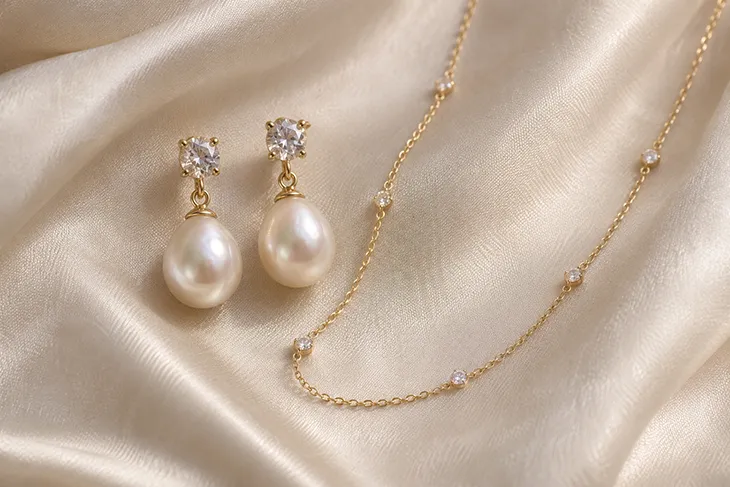
Select one primary focal point. Designating a single dominant piece, statement earrings, a detailed necklace, or a prominent hairpiece, keeps multiple ornate items from competing for attention in photographs. Consider options such as statement earrings paired with a simple necklace, a detailed necklace balanced by understated earrings, or a prominent hair accessory worn with minimal jewelry elsewhere.
Repeat one visual element, such as metal tone, pearl finish, gemstone color, or a recurring shape, to tie everything together. Exact matching isn’t necessary; intentional repetition tends to read as cohesive on its own, and even deliberately mixed metals can work well when the contrast feels purposeful rather than accidental.
A quick balance check before the big day:
– Is one accessory clearly the focal point?
– Do the materials work with the outfit?
– Can the accessories be worn comfortably for several hours?
– Do they stay secure during movement?
Prioritize Comfort, Fit, and Skin Safety
Check materials before the event, rather than trusting vague labels like “hypoallergenic.” Nickel is a well-documented cause of allergic contact dermatitis, producing itching, redness, dryness, or rash in sensitive individuals, and jewelry is one of the most common sources of exposure. Anyone with a known sensitivity should look for materials that are explicitly documented as nickel-free and consult a healthcare professional about any recurring reactions.
Test accessories in advance by wearing each item for a limited stretch of time first. Check for pressure points, sharp edges, loose fasteners, hair snagging, or irritation, paying particular attention to clasps, earring backs, and adhesive components. A dermatologist or allergist can help evaluate a suspected metal allergy, sometimes through patch testing.
Match Accessories to the Ceremony and Reception Setting
Consider weather and venue conditions. Heat, humidity, wind, dust, and cold all affect comfort and durability in ways that are easy to underestimate ahead of time. Heavy or dangling pieces may become uncomfortable during outdoor ceremonies or an active reception, so secure fastenings and spare earring backs are worth considering.
Plan for photographs and movement. Accessories should look right from the front, side, and three-quarter angles, and reflective surfaces can behave unpredictably under camera flash. It helps to practice walking, dancing, hugging, and sitting while wearing the full accessory set, an item that looks flawless during a stationary mirror check can still catch on clothing or start to feel heavy once the wearer has been in motion for hours.
Evaluate Quality and Care Without Focusing Only on Price
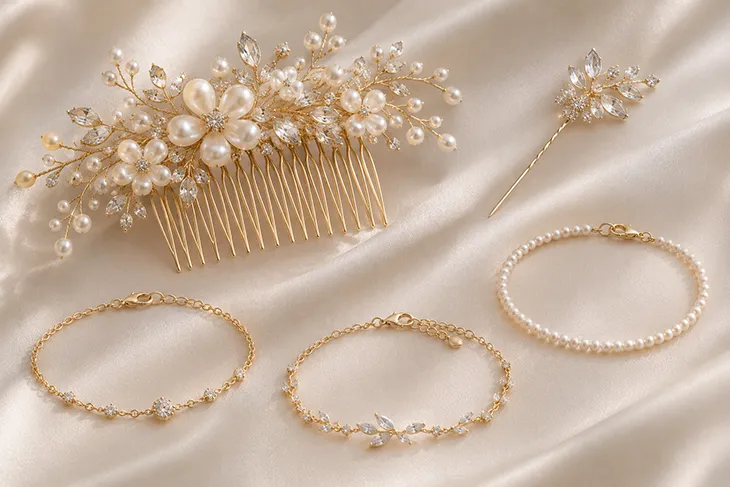
Look for clear product information, including stated materials, dimensions, weight, finish, and care or repair terms. Sellers are expected to represent jewelry accurately, covering material content, durability, and size. Solid metals, plated finishes, gemstones, glass, and acrylic vary in durability, weight, and maintenance requirements. The right choice depends on the intended use and personal preferences.
Consider future use. Ask whether the piece could work with other formal or everyday outfits down the line, how repairable it is, and whether it needs any special storage. Weight, closure design, plating, and surface finish all shape both day-of comfort and how well an item holds up over time.
Create a Practical Wedding-Day Accessory Plan
A simple accessory kit can keep small disruptions from turning into real stress: spare earring backs or fasteners, a soft storage pouch, a small mirror, skin-safe adhesive where appropriate, and a cleaning cloth suited to the material. Assign one trusted person to look after the accessories before and after the ceremony. Store delicate pieces securely when they are not being worn and follow the manufacturer’s care instructions.
Make the Accessories Work for the Wearer
Coordinating with the outfit, choosing a clear focal point, testing for comfort, verifying materials, and preparing for real movement all contribute to accessories that hold up well beyond a single photograph. The most successful choices support confidence and ease rather than conforming to rigid conventions. The best wedding accessories are cohesive in photographs, comfortable in real life, and suited to the person wearing them.