


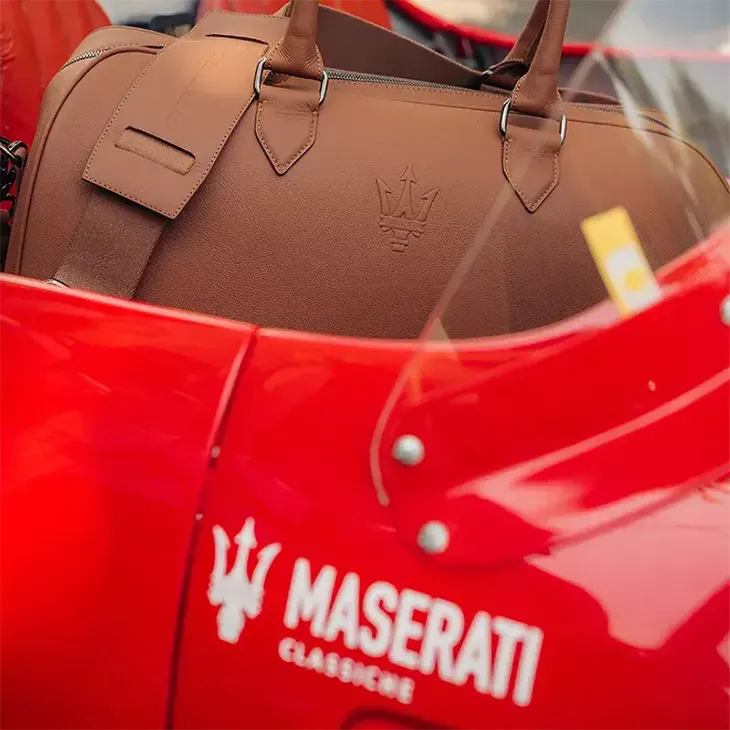
A bag can begin its life as a car seat. For the Maserati Weekend Bag, that is precisely the point. Created by Maserati and Poltrona Frau In Motion, the Poltrona Frau business unit devoted to exclusive interiors for cars, aircraft and boats, this capsule of 100 limited-edition travel bags marks the Trident’s centenary and the long tradition of Italian Grand Touring. Each bag starts with Poltrona Frau leather originally selected for Maserati seats, now given a second, handcrafted life.
It is a quietly radical idea in a category that usually chases novelty. Rather than cutting new hides to celebrate a milestone, the project asks what a premium material can still become after its first job is done. The answer sits at the intersection of design, heritage and circular thinking, and it speaks directly to how automotive brands are beginning to reconsider what luxury leaves behind.
A material’s lifespan is not defined only by its original application, but by the intelligence with which its qualities can be preserved and reinterpreted.
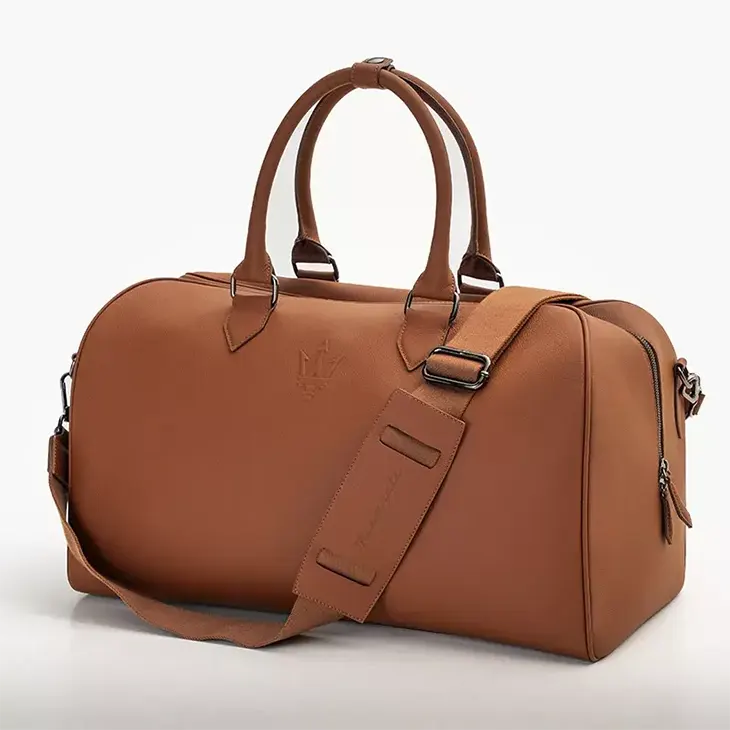
Entirely handcrafted in Italy in Cuoio leather, the bag keeps a structured silhouette that feels closer to luggage than to a casual carryall. Burnished metal finishes, a zip closure and a canvas shoulder strap with a custom Maserati-branded pad give it a tailored, travel-ready presence. The Trident is embossed on the front flap, while a dedicated Centenary logo marks the side panel. Protective metal feet complete a build designed to be set down in a hotel lobby, a boot or a boarding lounge without losing its composure.
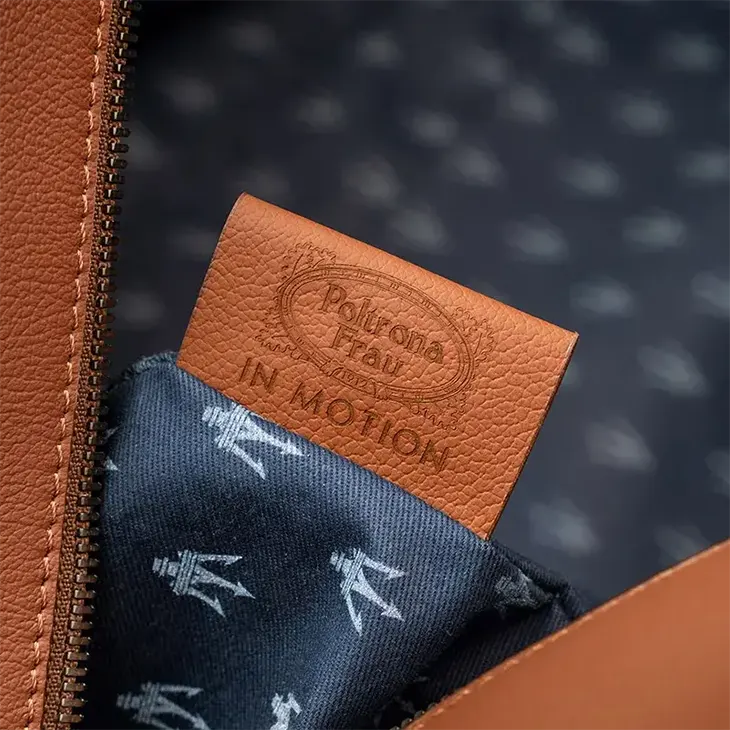
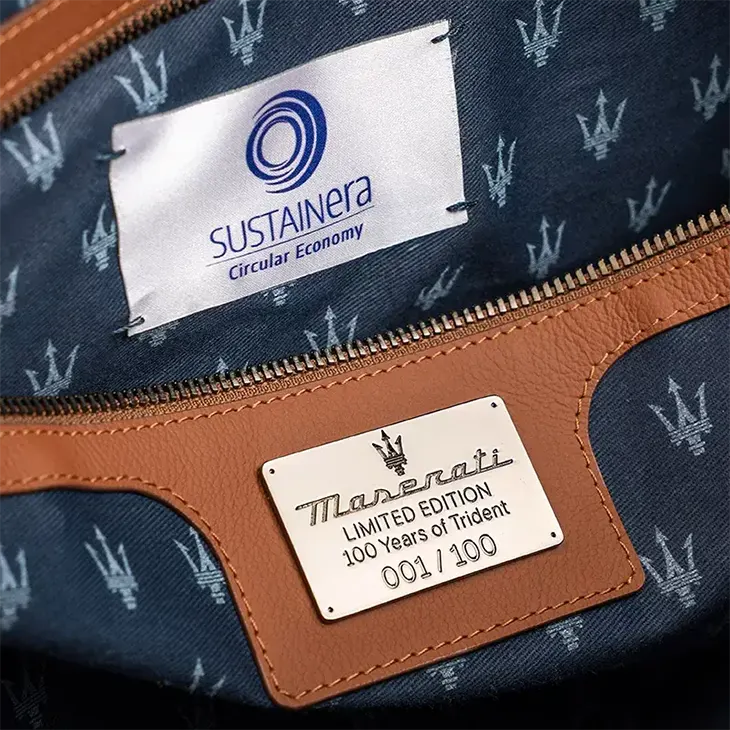
Inside, a blue canvas lining carries the beige Trident monogram and frames a leather-trimmed pocket. A metal plaque engraved with the progressive number of the edition turns each of the 100 pieces into a numbered object rather than a product run. Further details acknowledge the collaboration with Poltrona Frau In Motion and the origins of the SUSTAINera project. For anyone following the evolution of luxury bags and accessories, it reads as a clear step toward pieces with provenance built into the construction.
Design must respond simultaneously to aesthetics, function, use and durability.
The leather is 100% reclaimed through a circular economy process developed by SUSTAINera, the Stellantis division dedicated to the circular economy. It is also sourced from tanneries certified to the Gold standard of the Leather Working Group, the most authoritative international benchmark for tanning. That certification assesses environmental performance through criteria such as energy consumption and the management of chemicals and water during production. The entire initiative began within Star*Up, the Stellantis global intrapreneurship programme created to turn employees’ business ideas into concrete solutions.
The capsule is available exclusively to registered users of the Tridente App, currently offered in selected markets through the App Store and Google Play, with deliveries scheduled to begin in October. The tone from Modena is one of continuity. Davide Baldini, Head of Maserati Fuoriserie and Responsible for Global Merchandising Strategy, frames the project as an expression of Grand Touring itself, a philosophy that has united performance, comfort and elegance for more than a century and continues today in the new Grecale, GranTurismo and GranCabrio. Readers who follow Maserati will recognize the thread: a brand extending its identity beyond the garage without diluting what makes it distinctive.
The bag therefore becomes a natural extension of our work.
For this exclusive, DSCENE Editor in Chief Zarko Davinic spoke with Giovanni Maiolo, General Manager of Poltrona Frau In Motion, about the moment the material left the car, the logic of designing for objects in motion, and where the balance between excellence and responsibility gets hardest to hold.
The Weekend Bag begins with leather originally selected for Maserati seats and 100% reclaimed through SUSTAINera. What was the moment of seeing that material leave the car and become a travel bag, and what did it change in how you think about the leather’s lifespan? – The transformation demonstrated that an exceptional material can retain its value while taking on an entirely new function. Through SUSTAINera, leather reclaimed from the production of Maserati interiors became the starting point for a handcrafted travel object. This expanded our understanding of longevity. A material’s lifespan is not defined only by its original application, but by the intelligence with which its qualities can be preserved and reinterpreted.
Poltrona Frau In Motion designs exclusive interiors for cars, aircraft and boats. How does that experience of shaping spaces in motion inform the way you approach a bag meant to accompany a journey? – Our experience in mobility teaches us that design must respond simultaneously to aesthetics, function, use and durability. Those same principles guided the Weekend Bag. Its structured silhouette, considered proportions and carefully resolved details reflect an understanding of objects in motion. The bag therefore becomes a natural extension of our work.
The intention was to preserve coherence between the product, the occasion and its audience, creating an experience defined by proximity to the brand rather than volume.
From Star*Up to the centenary collection.The project began inside Star*Up, the Stellantis intrapreneurship programme. How did an idea born within the company make its way to a 100-piece Maserati centenary collection? – It started as an internal idea about giving a valuable material a new purpose. The project gained strength by bringing together circularity, craftsmanship and Maserati’s Grand Touring culture. The centenary transformed that idea into 100 numbered pieces, one for each year of the Trident’s history.
Each of the 100 bags carries a numbered metal plaque inside, and the collection is available only to registered users of the Tridente App. Why did you want to keep it this intimate and exclusive? – The decision reflects the commemorative nature of the project. Limiting the collection to 100 individually numbered pieces reinforces its connection to the Trident centenary, while distribution through the Tridente App places it within Maserati’s registered community. The intention was to preserve coherence between the product, the occasion and its audience, creating an experience defined by proximity to the brand rather than volume.
We wanted to demonstrate that circularity and excellence are not opposing values, but can reinforce each other.
You describe contemporary luxury as a balance between manufacturing excellence, the culture of travel and responsibility. Where does that balance get hardest to hold in practice, and what did you refuse to compromise on with this bag? – The greatest challenge is ensuring that responsibility never comes at the expense of a brand’s identity and the values that make it distinctive and recognizable to its customers. True luxury requires a clear vision, where exceptional quality, timeless elegance and minimalist design come together to create something unmistakable.
With this bag, we refused to compromise on those principles. Our ambition was to translate the same exceptional craftsmanship, refined materials and understated elegance that define our interiors into an object that becomes their natural extension. At the same time, we wanted to demonstrate that circularity and excellence are not opposing values, but can reinforce each other. Because true luxury is not simply about creating something new, but about extending a brand’s identity into new expressions while preserving the values that make it unique.