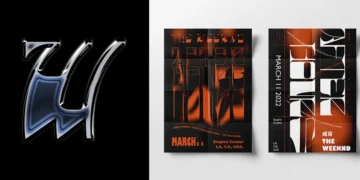




In an industry polarized between commercial practice and experimental exploration, Yuying (Lisa) Liu navigates the space in between. She treats her multidisciplinary practice as a shifting lens to move across media. She is drawn to complexity only to make it simple again, translating concepts into ideas that are grounded, long-lasting, and visionary.
DESIGN
Currently leading design initiatives at Passport Brand Design, Yuying operates within the powerhouse ecosystem of VML and WPP, the world’s most expansive creative network serving over 300 of the Fortune 500. In this high-stakes environment, she holds a critical role as a designer in bridging high-level strategy with granular execution, driving end-to-end creative solutions that define the visual presence for a market-leading client that holds a 40%+ share of the U.S. nicotine alternatives category.
Yuying architects a cohesive visual language within the U.S. market, navigating the constraints of scaling design across 100,000+ retail touchpoints, including major national chains, and digital platforms serving 1.5 million monthly users. From spearheading pivotal brand reimaginings to designing for a global community of 31 million consumers, she ensures that expansive brand environments remain consistently impactful and timeless.
Brutalist Strength and Haunting Elegance:
Decoding Bespoke Typography
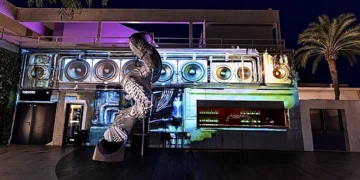
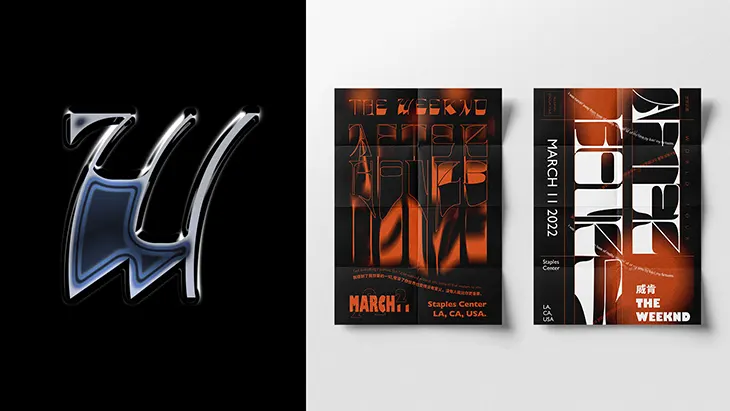
As the lead type designer and system architect, Yuying developed a bespoke typographic framework for The Weeknd, the multi-Grammy-winning artist with over 100 million monthly listeners, that serves as a cornerstone of her evolving practice. Designed for international tour infrastructure, this system functions as a visual anchor, ensuring a cohesive visual presence across stadium screens, digital and physical platforms worldwide.
Originating from rigorous conceptual inquiry and recognized for its pioneering visual language, the work distills cultural persona into a cohesive, rule-based system. The design process began by identifying core contradictions within the artist’s identity: the tension between vulnerability and authority, and a mood that is rough yet romantic. Yuying extracted these abstract traits and translated them into tangible letterforms through a novel stroke logic. By departing from traditional typographic proportions, she engineered a system where razor-sharp angular terminals meet calibrated, fluid curves. This visual language functions as a direct communication tool, allowing the audience to feel the artist’s cinematic atmosphere, a transition from brutalist strength to haunting elegance, without the need for additional explanation.
Serving as a visual translation of the artist’s multifaceted persona, the logic was then applied to a suite of production-ready letterforms, integrated into bilingual posters, brochures and digital assets for global commercial use. By rooting expressive form in disciplined construction, the resulting system provides a strategic blueprint for maintaining visual integrity across fragmented merchandise environments. This approach transforms the letterform from a functional tool into a visceral experience, making the intangible complexities of a cultural persona visible and felt.
Brand Ecosystems: Bridging Intelligent Functionality
and Sustainable Strategy
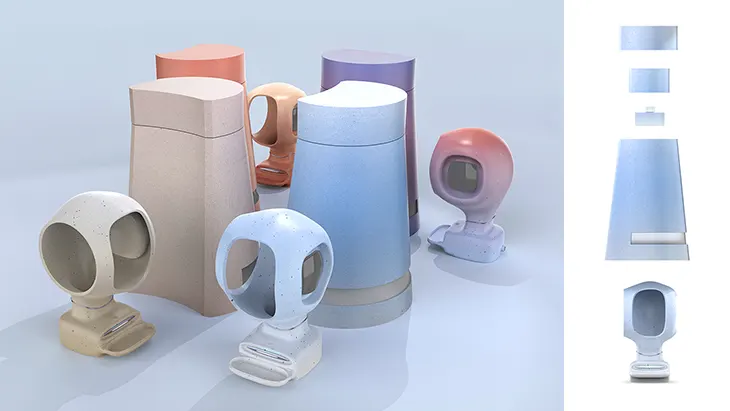
Building upon her methodological approach, Yuying developed OUSIA, a comprehensive product and brand ecosystem designed to evolve the core philosophy of Aesop into the future of intelligent design. Grounded in brand archetype analysis and site-oriented research, the initiative addresses the industry-wide challenge of visual homogenization, reimagining how technology can facilitate a more profound connection to the environment.
Inspired by volcanic topography, OUSIA explores the artistic merit of organic geological forms, translating them into a refined, tactile configuration to achieve functional precision. This exploration transcends mere aesthetics; it is a meticulous ergonomic and behavioral study that integrates soap dispensing and air-drying functions into an intuitive, innovative silhouette.
Material selection prioritizes circular sustainability, utilizing refined recycled minerals and a refillable packaging system to reflect a commitment to long-term environmental stewardship. By integrating these earth-derived materials, Yuying demonstrates how applied design systems can function as a mediator between ecological consciousness and technological integration, transforming a daily ritual into a profound, harmonious moment of coexistence. Consequently, OUSIA offers a scalable strategic framework for transnational luxury brands seeking to maintain artisanal soul within a highly digitized market landscape. It is precisely this cross-sector artistic intuition that endows her practice with its distinct contemporaneity and the capacity for continuous evolution.
Critical Landscapes: Mapping Social Conditions
through Poetic Involution
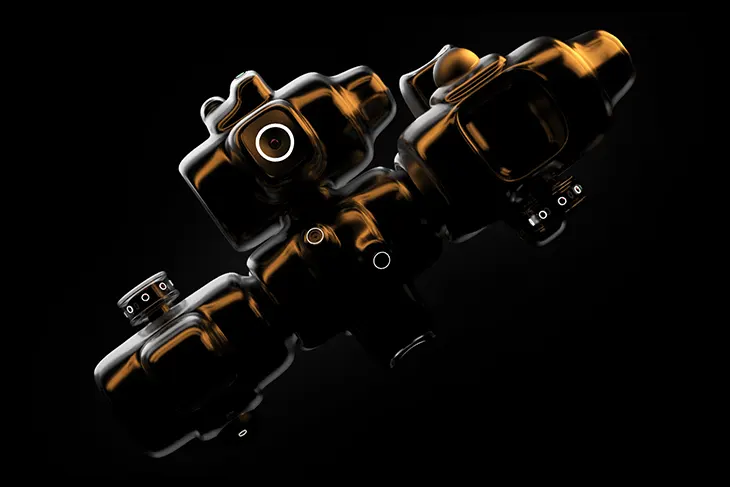
While Yuying harmonizes commercial systems, her practice equally embraces the role of the designer as a cultural critic. This analytical depth is most evident in Poetic Involution, a multi-dimensional project that shifts the focus to the internal pressures of contemporary life. Widely recognized for its compelling artistic merit and technical innovation, the project stands as a sophisticated synthesis of independent sociological research and advanced visual mapping.
By deconstructing the ‘inward-turning’ pressure of modern society, often referred to as ‘involution’, Yuying translates abstract social compression into a sophisticated visual language that visualizes the latent tension and introspection shaped by our current global condition. The project’s impact was notably acknowledged by the Pratt Institute’s official platforms, where it was featured as a premier example of innovative speculative design.
“What intrigued me about ‘involution’ wasn’t merely its negative connotation,” she reflects. “It was the internalized pressure that builds when systems prioritize acceleration over genuine meaning. I wanted to translate that invisible compression, and the sense of powerlessness within it, into something tangible, expansive, and deeply reflective.”
In Poetic Involution, the boundaries between medium and message dissolve. Through the use of repetitive typographic grids, narrative motion designs, speculative products, and layered 3D environments, she mirrors the relentless cycles of productivity, transforming systemic density into a “territory to be mapped.” The project finds its ultimate power in the balance of extremes, where fluid, dense information systems are finally met with moments of “visual silence.”
The project’s significance lies in its ability to bridge the gap between scholarly inquiry and public resonance. Through this synthesis, Yuying extends the expressive capacity of design beyond utility, transforming collective anxiety into a poetic dialogue. Ultimately, Poetic Involution challenges the passive consumption of design, urging a re-evaluation of our spatial and mental density; it stands as a pivotal case study in redefining how visual systems can render the invisible complexities of our era visible and resonant.
“Design often reacts to trends,” Yuying observes. “I’m more interested in reacting to conditions, the structural forces that shape how we think, work, and feel.” For Yuying, design is not a self-contained ivory tower, but a penetrative visual methodology and a fluidity across art, design, commerce, and culture, capable of reshaping industries, audiences, and environments alike.
From the visual authority exerted in international concert promotion for The Weeknd, and the sustainable strategic frameworks developed for Aesop, to the profound cultural critique embodied in Poetic Involution, Yuying demonstrates a rare capacity to reconcile commercial necessity with conceptual depth. Her ability to navigate diverse media, integrating 3D modeling, narrative motion, user experience, and systematic typography, allows her to translate complex contemporary conditions into definitive brand ecosystems.
By rejecting the binary of utility and art and distilling chaos into clarity, Yuying confirms her role not merely as a designer, but as an architect of meaning. Guided by methodological precision and validated by global industry leaders, her practice decodes the invisible currents of our society into forms that are as strategically resilient as they are poetically resonant. Through this unique multidisciplinary lens, she continues to redefine the boundaries of visual communication, solidifying her standing as a leading voice in the global advertising and design landscape.
Words by DSCENE Editor Eli Porter.