


DSCENE Magazine Editor-in-Chief Zarko Davinic speaks with Enrico Bonetti and Dominic Kozerski about Gabby Karan Felice’s newest restaurant, its waterfront setting, and the restoration of the historic Royal Poinciana Playhouse’s Celebrity Room.
Bonetti Kozerski Architecture has designed the architecture and interiors of Tutto Mare, the newest restaurant from Gabby Karan Felice. Located at the Royal Poinciana in Palm Beach, the project continues the studio’s long-running collaboration with Felice, whose previous restaurants were also developed by Enrico Bonetti and Dominic Kozerski.
Founded in New York City in 2000, Bonetti/Kozerski Architecture works across hospitality, residential, cultural, commercial, and custom yacht commissions, creating architecture, interiors, objects, and environments defined by warm minimalism and understated luxury. Led by long-time partners Enrico Bonetti and Dominic Kozerski, the studio’s disciplined, context-driven process is collaborative and holistic, expressed through refined forms, rhythm, proportion, and material nuance. Tutto Mare grows out of the studio’s long-running collaboration with Donna Karan, now continued with her daughter Gabby Felice Karan. It reflects that ongoing relationship in a project shaped through trust, continuity, and a shared point of view.
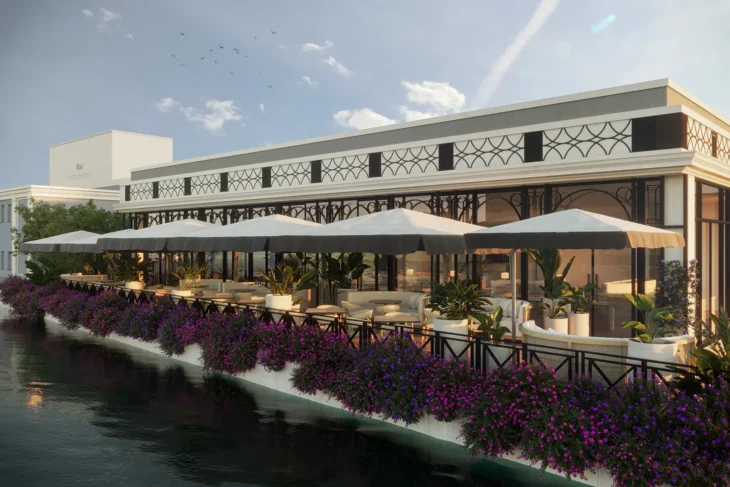
Tutto Mare introduces Felice’s first waterfront restaurant, with a Mediterranean-inspired dining concept positioned directly along Lake Worth Lagoon and the Palm Harbor Marina. The 8,390-square-foot project sits beside the historic Royal Poinciana Playhouse and returns its former Celebrity Room to active use for the first time in decades.
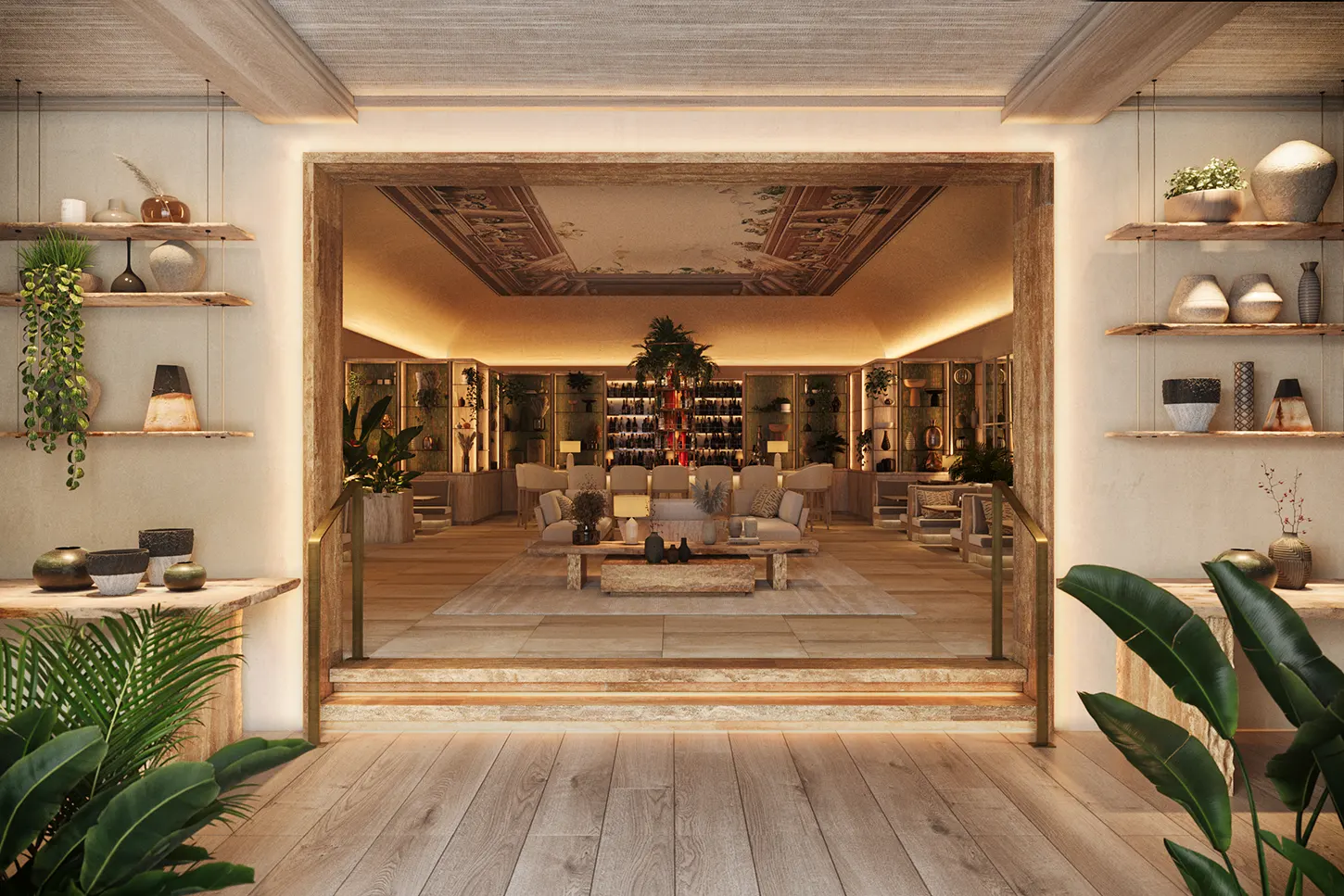
Bonetti/Kozerski approached the project through a combination of restoration and new construction. The addition responds to the architecture of the Playhouse before extending toward the water, accommodating a main dining room, bar, two wine rooms, and a 1,620-square-foot waterfront terrace.
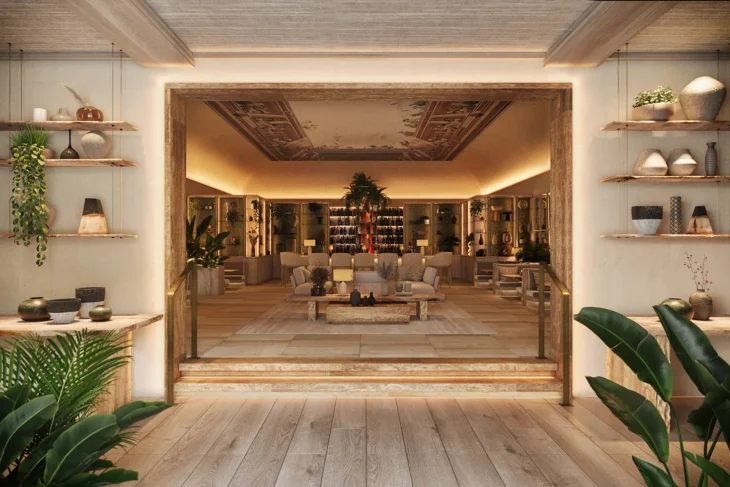
The vaulted Celebrity Room centers on Venetian Festival, a late-1950s trompe-l’oeil mural by New York artist Robert Bushnell. The studio restored the mural, reinstated the room’s original barrel vaults, and introduced oak conservatory-style windows to bring natural light and views of the lagoon into the interior.
Oak, travertine, teak, bronze detailing, planting, and custom furniture define the restaurant’s material language. Bonetti Kozerski also incorporated Urban Zen pieces made by Balinese artisans, extending the personal and collected character associated with Felice’s projects. Lighting by L’Observatoire International supports the transition from daytime dining to evening service while remaining closely integrated with the architecture.
In conversation with DSCENE Magazine Editor-in-Chief Zarko Davinic, Bonetti and Kozerski discuss the project’s relationship with Palm Beach history, the legacy of the Royal Poinciana site, and the process of adapting the Celebrity Room for a new chapter.
DSCENE: Can you introduce the setting of Tutto Mare and the building you inherited?
Bonetti/Kozerski: The restaurant sits within an upscale open-air shopping destination in Palm Beach, centered around the historic Playhouse. Built in the 1940s, the Playhouse became an important theatre and performance venue during the 1950s and 1960s. Tutto Mare occupies part of that original building.
One of the most important existing elements was a protected ceiling mural in a room once known as the Celebrity Room. The mural, painted by a New York artist in the late 1950s, creates a trompe-l’œil view of the sky, surrounded by figures from the period, including Fred Astaire, Ginger Rogers, Clark Gable and Audrey Hepburn.
That process gave the restaurant a more personal and collected character. The objects do not feel as though they came from a standard hospitality catalogue. They bring variation, texture and a sense of history into the rooms.
DSCENE: What condition was the mural in, and how did you approach its restoration?
Bonetti/Kozerski: It was mainly dirty, so we cleaned it while leaving the surviving fragments intact. We approached it as you might treat a fresco in an Italian palazzo. Rather than making it look new, we wanted to preserve its age and imperfections.
It is theatrical and distinctly American, which became part of its charm. That quality allowed us to connect the history of the Playhouse with an interior design informed by Italian references.
DSCENE: How did the collaboration with Gabby Karan shape the interior?
Bonetti/Kozerski: Tutto Mare belongs to Gabby Karan, Donna Karan’s daughter, and her husband, Gianpaolo. We sourced the furniture and decorative objects together with Gabby in Bali. The pieces were then produced by craftspeople we have worked with for around 25 years.
That process gave the restaurant a more personal and collected character. The objects do not feel as though they came from a standard hospitality catalogue. They bring variation, texture and a sense of history into the rooms.
DSCENE: One of the interior dining rooms has very little direct daylight, yet it appears unusually luminous. How did you achieve that?
Bonetti/Kozerski: We wanted the room to feel like a conservatory, so we introduced a series of windows that are actually mirrors. They catch and reflect light from the exterior, giving the impression that the room opens toward another space.
Although it is an internal room, it can appear even brighter than the dining area facing the water. The reflected light changes its atmosphere and prevents it from feeling enclosed.
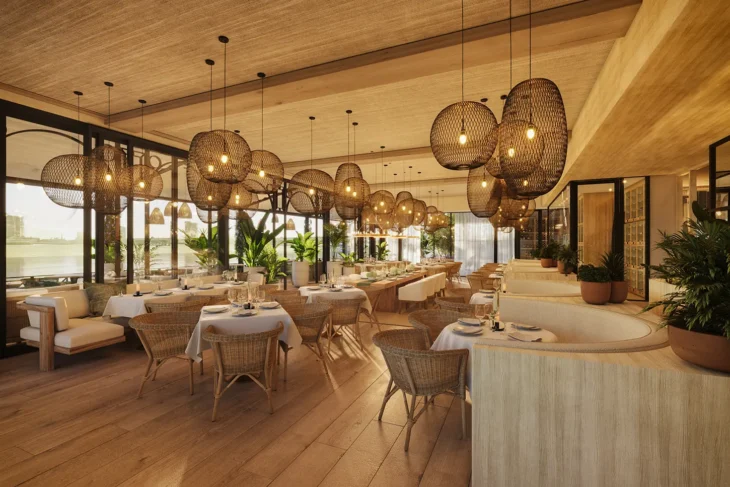
DSCENE: How does the waterfront location influence the layout?
Bonetti/Kozerski: The restaurant sits on the lagoon side of Palm Beach and has a terrace directly on the water. It is the only restaurant in Palm Beach with that particular relationship to the waterfront.
The terrace became a central part of the experience, especially in the early evening. Across the interior and exterior areas, the restaurant accommodates around 200 guests.
DSCENE: What materials define the dining spaces?
Bonetti/Kozerski: The banquettes are upholstered in a silk-linen textile by Dedar, a company we have worked with for a long time. We also created a substantial stone bar from travertine. It consists of three connected blocks, which were shaped and chiselled to read almost as one continuous piece.
There is also a glazed wine cellar positioned between different areas of the restaurant. It allows the bottles, collected objects and surrounding rooms to remain visually connected.
Rather than separating dining, retail and decoration, the project allows them to exist together. Guests move through a series of spaces that feel collected and residential rather than rigidly programmed.
DSCENE: Tutto Mare also includes a retail element. How does that fit within the restaurant?
Bonetti/Kozerski: A small store sits directly off the main dining room. Gabby previously ran the retail concept with her mother, so it introduces another connection to the Karan family’s creative history.
Rather than separating dining, retail and decoration, the project allows them to exist together. Guests move through a series of spaces that feel collected and residential rather than rigidly programmed.
DSCENE: The restaurant feels removed from many of the familiar visual codes associated with South Florida. Was that deliberate?
Bonetti/Kozerski: Yes. Gabby and Gianpaolo did not want the restaurant to reference the concrete-heavy architectural language associated with Miami. We wanted it to feel distinct from its surroundings and avoid predictable coastal imagery.
The design instead developed through the historic Playhouse, Italian production, materials made by specialist craftspeople and objects sourced in Indonesia. Those different elements give the restaurant its character.
DSCENE: How much of the project was produced outside the United States?
Bonetti/Kozerski: Much of the interior was built in Italy and brought to Palm Beach. The project relied heavily on Italian craftsmanship, while some of its furniture and decorative pieces were developed with fabricators in Bali.
That combination was important. The design connects an American building with Italian fabrication and objects carrying the hand of Indonesian craftspeople. Even the irregularities of the existing construction became part of the installation process.
The setting in Palm Beach is part of the story, but the project is not defined by a conventional Palm Beach aesthetic. Its identity comes from how these different histories, materials and methods of production were brought together.
DSCENE: What do you find most interesting about Tutto Mare as a design story?
Bonetti/Kozerski: Its relationship with the old Playhouse gives the project an unexpected foundation. The preserved mural, Italian craftsmanship, reflected light, travertine, custom furniture and objects from Bali all contribute to a layered interior.
The setting in Palm Beach is part of the story, but the project is not defined by a conventional Palm Beach aesthetic. Its identity comes from how these different histories, materials and methods of production were brought together.
Discover more of the restaurant design by Bonetti/Kozerski in DSCENEs gallery: