


 Photo ©Matthieu Salvaing courtesy of Bus Palladium
There is something profoundly Parisian about reviving a legend without reproducing it. The Bus Palladium, reopened in 2026 as a five-star hotel, does not attempt to recreate the anarchic energy of James Arch‘s 1965 dream. Instead, it honors that dream by understanding it: a place where social barriers dissolve, where art and hedonism coexist without apology, where the night is not background but protagonist.
Six rue Pierre Fontaine has always known how to concentrate creative electricity. Toulouse-Lautrec lived steps away. Degas painted here. The Surrealists convened on this very street, arguing over drinks and changing the course of art. When Arch opened the Bus, he was not inventing something new so much as crystallizing an idea that had been dormant in Parisian stone for decades: that nightlife could be democratic, that dancing could be a form of resistance, that a red neon sign could promise something more than cocktails.
DSCENE HOTEL REVIEWS
For sixty years, the Bus delivered on that promise. Serge Gainsbourg wrote “Qui est in? Qui est out?” at a table wreathed in Gitanes smoke. The Rolling Stones played harmonica there. Alain Bashung, The Strokes, Rita Mitsouko, Noir Désir, each generation left their fingerprints on the walls. In July 2022, after 57 years of existence, the doors closed. The question was not whether it would reopen, but how anyone could possibly do it justice. Salvador Dali had his own room, now the striking crowne jewel of the hotel’s suites.
Nicolas Saltiel, founder of Chapitre Six, has made a career of this exact challenge: reviving places steeped in history without betraying them. His previous work- La Ponche in Saint-Tropez, Cap d’Antibes Beach Hotel, Hôtel La Ponche, reveals a philosophy: these are not museums but living organisms, spaces that breathe with their own logic. When he met Christian Casmèze in 2019 over backgammon, the conversation that followed felt inevitable. Saltiel wanted to create what the Chelsea Hotel once meant to New York: a place where artists, musicians, filmmakers and ordinary people would choose to stay, not for the thread count but for the air they’d breathe there.
Studio KO Teams Up With Bus Palladium
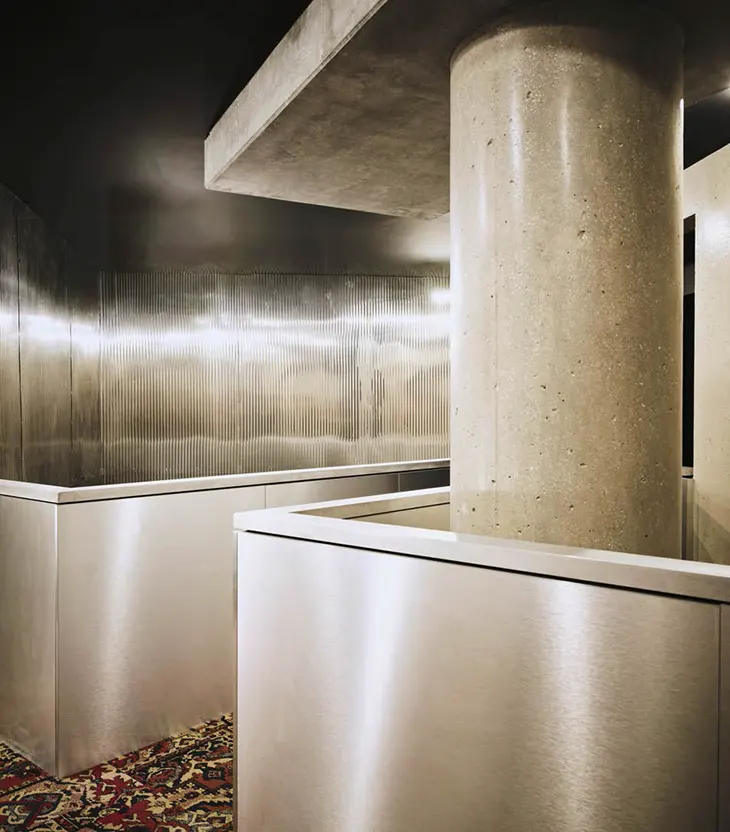
The architecture tells the story first. Studio KO, the firm behind the Yves Saint Laurent Museum in Marrakech and the Château Marmont renovation in Los Angeles, faced an unusual constraint: a two-story building in a gap between taller structures. Rather than fight this modesty, they dug 14 meters underground, creating 11 levels including four below ground. The façade is sandblasted with geometric patterns that echo the original building’s language, a minimalist gesture that refuses spectacle.
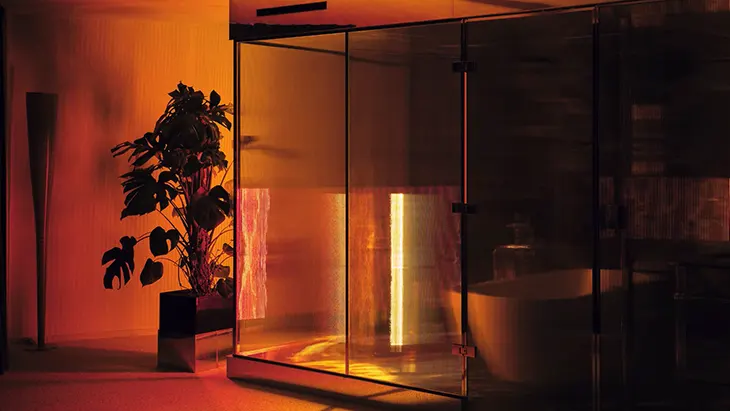
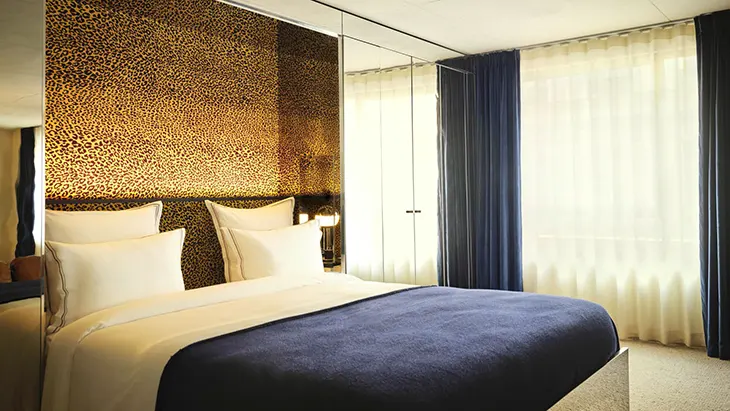
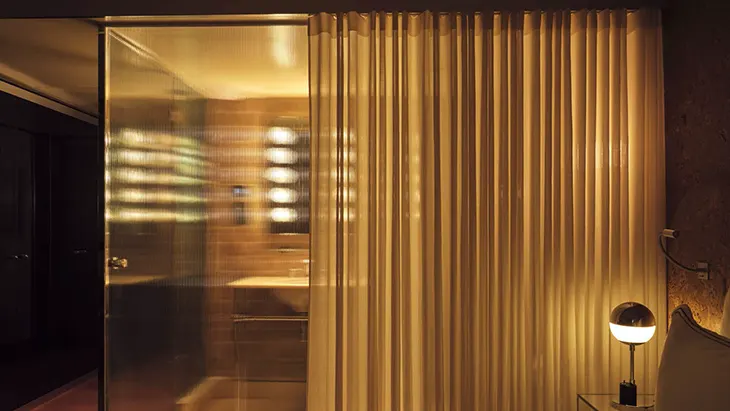
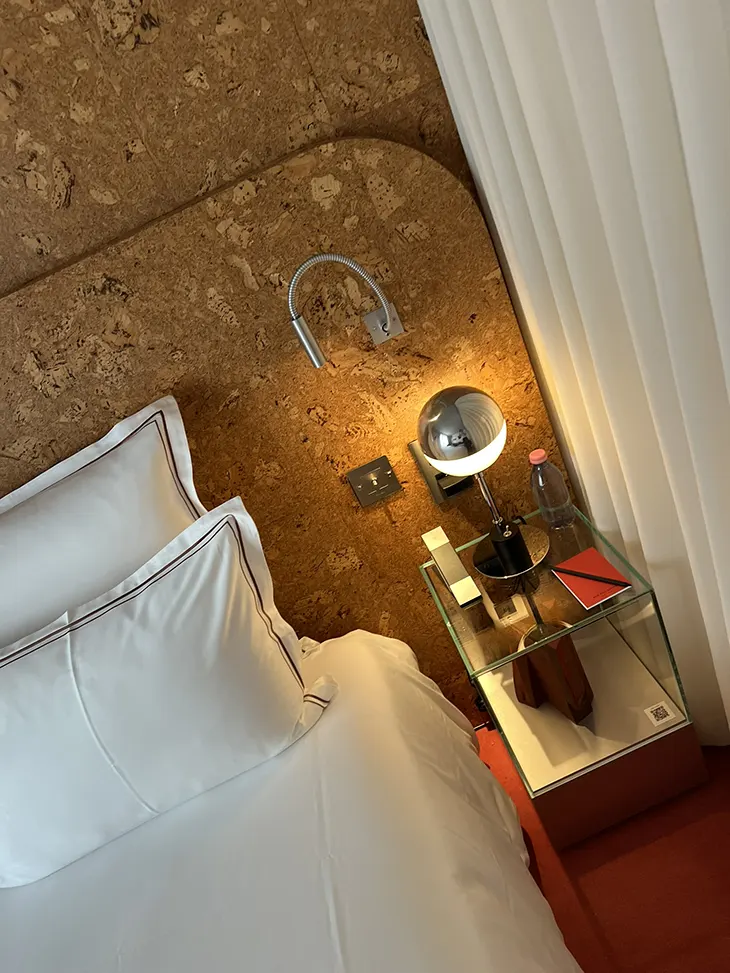
Inside, the cinematic language emerges, inspired by the 1960s and 70s, the era when the original Bus reached its fever pitch. The rooms feel like sets from a Michelangelo Antonioni film. Raw concrete ceilings. Cork walls (Studio KO first explored this material in Francis Ford Coppola‘s New York apartment). Powder-pink carpeting. Bathrooms entirely tiled in Klein blue or dusty pink, glimpsed through semi-transparent veils. Corduroy curtains recall the uniforms of seventies film crews.
But here is where the design reveals its intelligence: the visual language never overwhelms the occupant. Details distribute the metaphor. Light switches resemble vintage amplifiers. Door handles reference microphone grilles. Bedside tables are transparent cubes containing objects commissioned by curators at Ballade Sonores (the neighborhood’s iconic record shop), L’Œil de KO gallery, and collector Antoine Billore. You might find stacked audio cassettes, curated book collections, miniature buses. No two rooms are identical. Each piece was chosen to live here, not to be displayed.
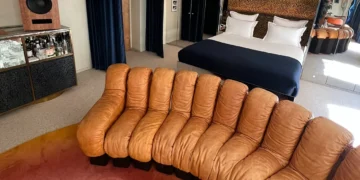
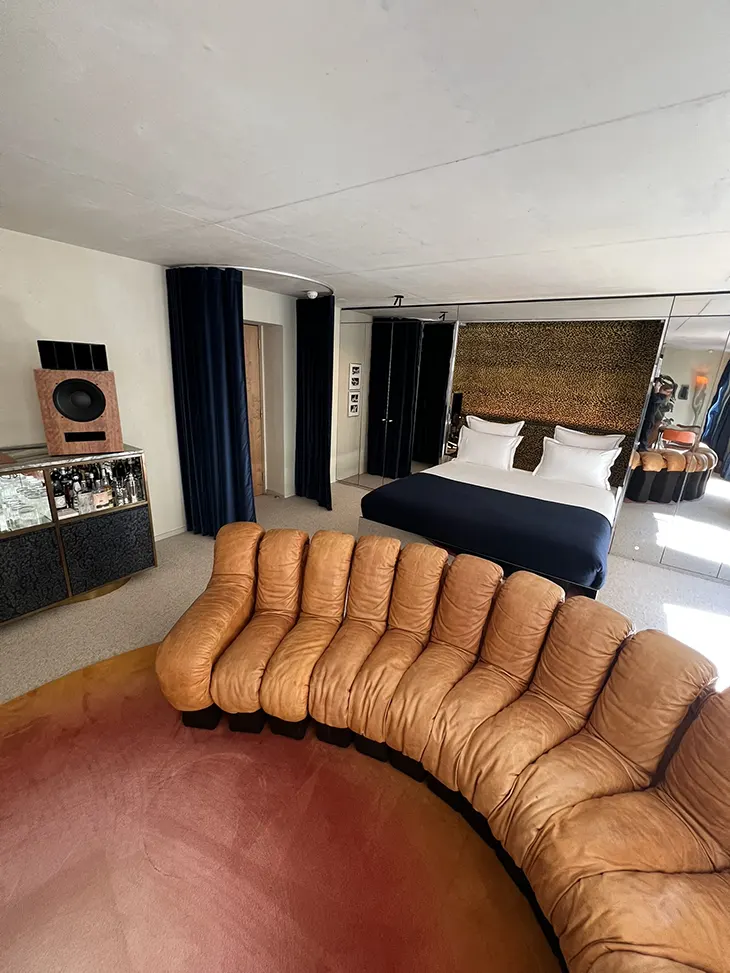
The above mentioned Dalí Suite demands mention. An icon of furniture the modular De Sede sofa, seventies to its core. A foldaway bed set within a mirrored alcove can transform the room into a club of your own. An original balcony overlooking the red neon sign. It is theater without pretension, effervescent space designed equally for rest and for celebration.
Bus Palladium Is One With The Music
The sensory architecture extends beyond sight. Caroline de Maigret, artistic director, composed four exclusive playlists broadcast through Ojas wooden speakers in each room: “In the Mood for Love” (Fleetwood Mac, Bill Withers, Frank Ocean, Marvin Gaye), “Boogie Nights” (Prince, Grace Jones, Run DMC, Rita Mitsouko), “The French Connection” (Jacqueline Taïeb to La Femme), and “Round Midnight” (Miles Davis, Alice Coltrane, Julie London). The hotel exhales an amber-woody fragrance (sandalwood, cashmere, copper notes) sourced throughout its spaces. Toiletries are Diptyque. Teas are sourced globally by the founder of Conservatoire des hémisphères. Staff uniforms, designed with Husbands, are corduroy with precise cuts, flared high-waisted trousers, slim ties and lacquered red belts, the deep red threading through the hotel like a leitmotif of its neon past.
This approach to hospitality, attentive to every sensory layer, distinguishes Bus Palladium from hotels that merely look good in photographs. You stay here differently. You move through it differently. You remember it differently.
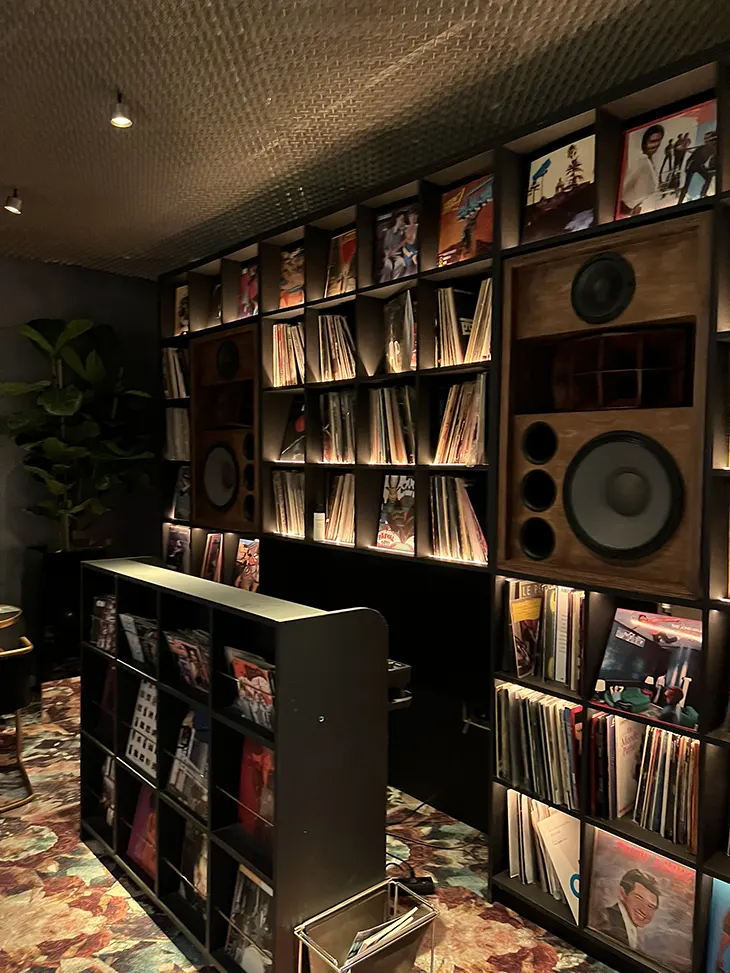
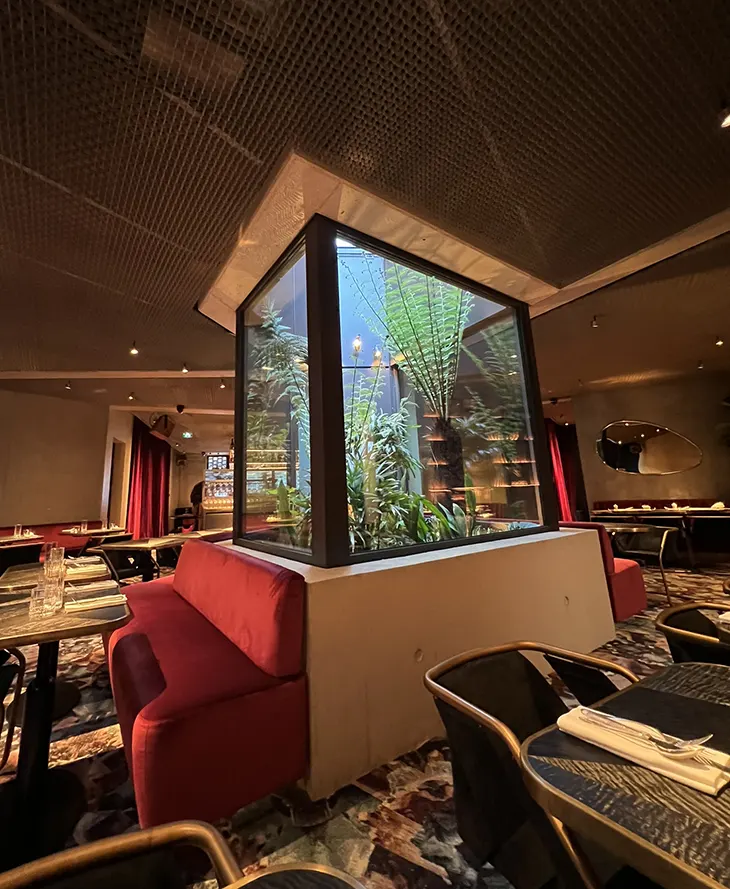
The restaurant, overseen by chef Valentin Raffali, continues this philosophy. Raffali trained alongside Meilleurs Ouvriers de France and embodies a generation marked by culinary independence freed from classical pretense. His menu is deliberately concise: smoked white asparagus with sweet vernal grass, amberjack with sorrel, barbecued red mullet with tartar sauce, Lozère lamb saddle, morel vol-au-vents. Ingredients come directly from Fishmonger Viot, Butcher Andrès, Terroirs d’Avenir farm, Vessières citrus orchards. As Studio KO seeks tension between rawness and refinement in materials, Raffali seeks the same on the plate: elegance and honesty, not one masking the other. A full wall of vinyl records, including collections from James Arch and Jean-Charles Dupuy, the DJ who shaped the original Bus‘s sound, sets the tempo. The restaurant and bar open Monday to Saturday, 7 pm until late. You dine facing history, quite literally.
Club vs The Hotel
The club remains the true test. Could any space balance the competing demands of a hotel (silence, sleep, privacy) with a nightclub (noise, abandon, oblivion)? This is where Bus Palladium‘s architectural audacity pays dividends. The sound insulation is exceptional. You sleep above the dance floor and hear almost nothing, which feels like a small miracle. The club breathes underground with a setup that includes an L-Acoustics system among the best in Paris, a stage for live performance, monumental lighting, and a screen capable of transforming the night into theater. Lionel Bensemoun, an iconic figure of Paris nightlife (former owner of Le Baron and Petit Palace), directs programming with Gary Gillet and Eddie Megraoui. The approach rejects fixed genres: neither too commercial nor too niche, it honors music itself. Once or twice weekly before the club opens, the venue stages discovery concerts, international musicians, and cabaret evenings that blend dance, performance and striptease. Open Thursday to Saturday, with hotel guests receiving privileged access.
What emerges from all this is not a hotel with a club appended, nor a club that opened a hotel. It is something rarer: a place that breathes at every hour. You sleep above the dance floor. You dine facing vinyl. You descend to dance in pajamas. You climb stairs to bed at dawn while Paris still sleeps. Nothing is fixed. The night begins when you choose. Music is not atmosphere but reason to exist.
The Bus Palladium has always promised that the boundaries between life and living could dissolve. Between the ordinary and the extraordinary. Between who you were before you walked through the door and who you become inside. For sixty years, a red neon sign flickered against Parisian darkness, making that promise. The sign is lit again. The Bus is back. And it has learned something crucial in the years it was gone: a legend does not survive by refusing to change. It survives by changing in service of what it always meant.
Discover more of Hotel Bus Palladium Paris in DSCENE’s Gallery:
Address: 6 Rue Pierre Fontaine, 75009 Paris, France
Phone: +33 1 89 56 40 50
For more info and booking log on to buspalladium.com.