


How far can a single garment transform your life? This is the question Hidenori Kumakiri poses with Beautiful People’s Fall Winter 2026 collection, presented January 24th during Paris Fashion Week. The answer, rendered in reversible seams and modular construction, is: further than you might imagine.
The Philosophy of Système D
The collection takes its conceptual anchor from Système D, the French philosophy of débrouillardise: the intelligence of making do through creativity. For Kumakiri, limitations are not loss but room for reinvention. Creating the maximum from the minimum. Discovering infinite possibilities within a single, fixed form.
PARIS FASHION WEEK SHOWS
This is not new territory for Beautiful People. Since introducing the “Side-C” concept in 2019, Kumakiri has systematically dismantled the binary logic of clothing. Side A (front), Side B (back), and the revelation of Side C: the space between, the hidden third option. But Fall Winter 2026 pushes this framework into something more urgent, more practical, more attuned to how people actually live.
Structural Codes as Design Language
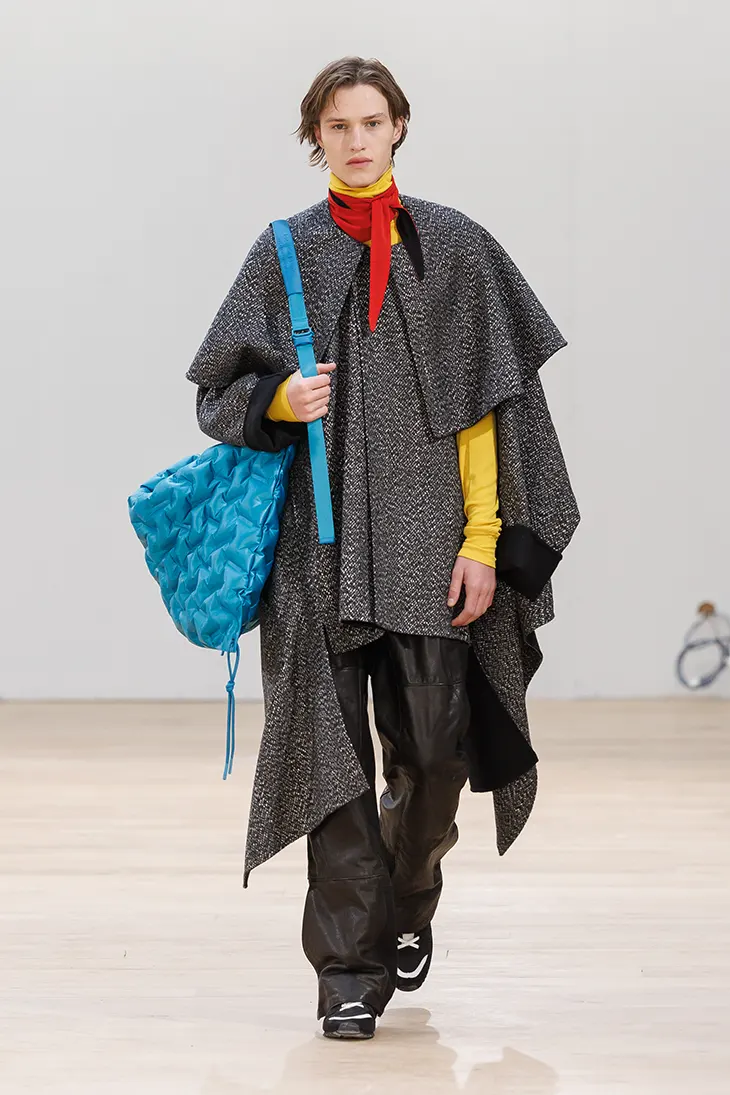
The collection’s vocabulary reads like engineering notation: Side-C, IN-BETWEEN, FLIP, DOUBLE-END, MULTIPLICITY. These are not marketing flourishes but construction principles made visible.
A coat whose structure shifts through layering. Garments that reverse inside-out, transforming sleeves, hems, and linings into entirely new expressions. Dual-personality fabrics and climate-adaptive utility pieces that respond to the wearer’s environment rather than dictating terms.
The show notes speak of “Up/Bottom, Inside/Outside, and climatic transitions appearing as shifting states.” In practice, this translates to garments that refuse singular identity. A jacket is also a vest is also a layering piece is also something else entirely, depending on how you choose to wear it.
Reading the Runway
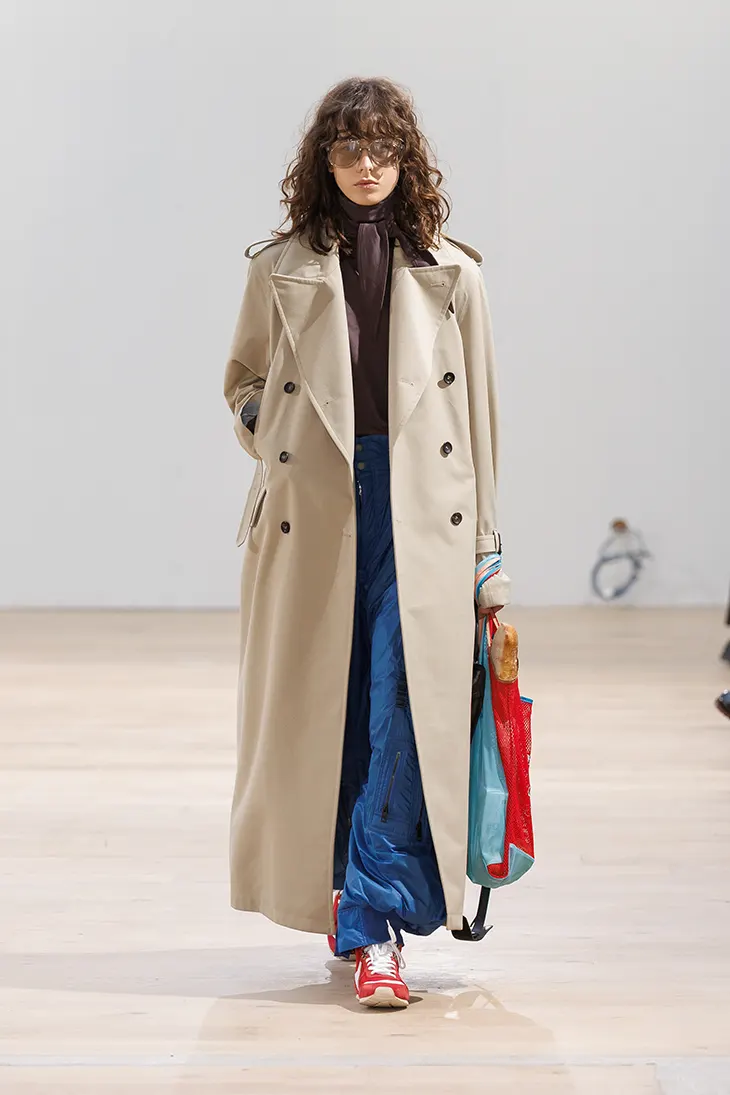
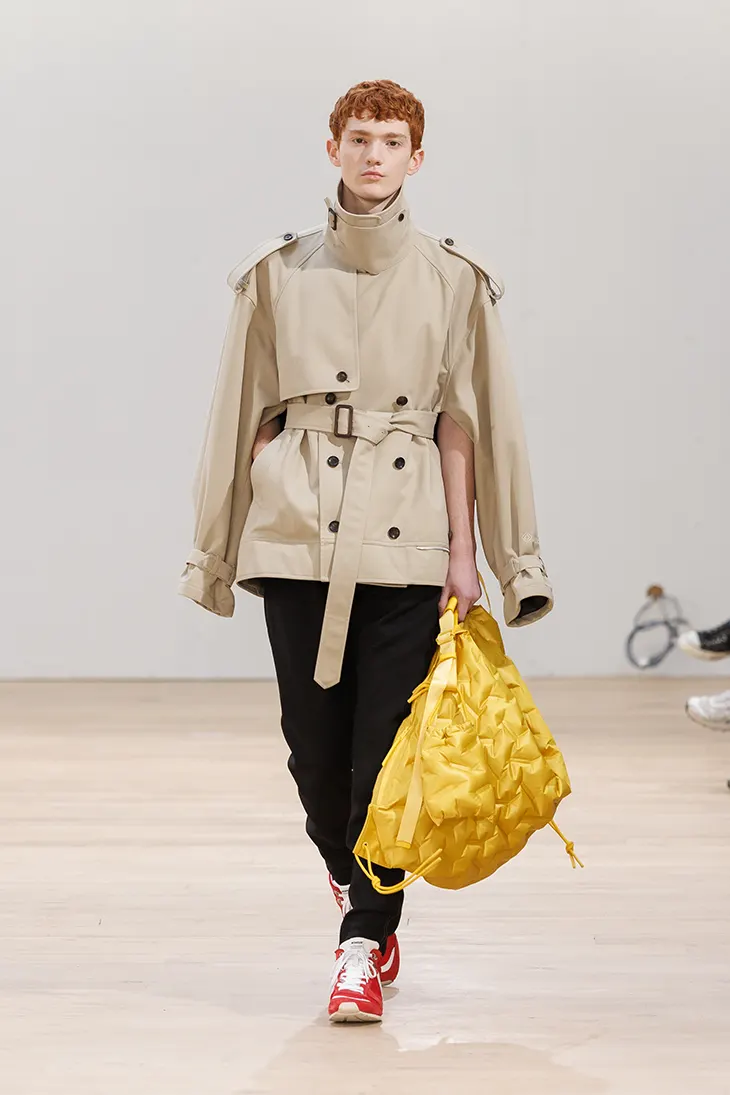
The collection opened with familiar archetypes rendered unfamiliar. A cropped trench coat in classic beige gabardine featured a high funnel collar and exaggerated shoulder epaulettes, the storm flap detached and restructured into a cape-like overlay. Belted at the waist, the silhouette cinched into an almost peplum shape. Paired with slim black trousers and bold red sneakers, the look balanced utilitarian heritage with contemporary ease. An oversized quilted yellow drawstring bag, its surface textured with origami-like folds, introduced a playful counterpoint to the tailored precision.
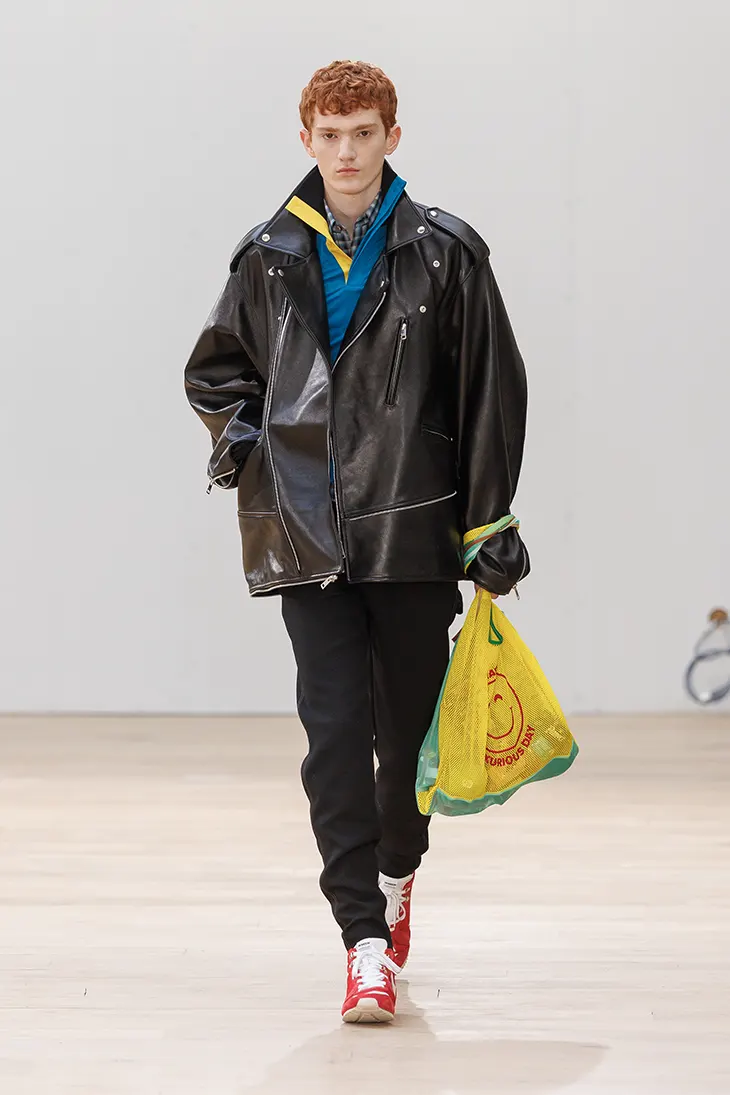
Mid-collection, the layering intensified and the palette darkened. An oversized black leather biker jacket with white piping details swallowed the frame, worn over a bright turquoise hoodie that peeked through at the collar and hem. Beneath that, a checked shirt. Black joggers and red-and-white sneakers grounded the look in street-inflected ease. A yellow mesh tote printed with a smiley face and “Furious Day” text injected irreverent humor into an otherwise tough silhouette. The effect was deliberate accumulation: garments not competing but conversing.
By the finale, the collection’s thesis crystallized. A floor-length dark plum coat with dramatic peaked lapels and structured shoulders swept open to reveal layered striped tops in contrasting scales: a fine black-and-white stripe beneath a bolder blue-and-white horizontal. The visual depth created a sense of effortless dishevelment, as if the wearer had simply grabbed what was closest and made it work. A full charcoal skirt with sheer paneling at the hem added movement. Amber-tinted sunglasses and vintage-style sneakers completed the portrait of someone who has figured out how to dress for a world that refuses to stay still.
The Kumakiri Method
Understanding this collection requires understanding its maker. Kumakiri spent years as a patternmaker at Comme des Garçons before founding Beautiful People in 2007 with collaborators from that same orbit. The brand’s debut introduced “kids’ series” clothing sized for adults, an early signal of Kumakiri’s interest in destabilizing assumptions about who wears what and how.
The Side-C concept, introduced in Spring Summer 2019, formalized this thinking. By eliminating the conventional separation between front and back, by sharing construction across what would normally be discrete surfaces, Kumakiri created garments with exponentially more wearing possibilities. A single piece could yield dozens of configurations.
Fall Winter 2026 extends this logic while grounding it in practicality. The show notes emphasize “textile engineering” and “climate-adaptive utility.” These are not clothes for a runway vacuum but for actual weather, actual travel, actual life.
Critical Perspective
There is a risk, with collections this conceptually dense, of the idea overwhelming the object. Kumakiri avoids this trap through sheer technical execution. The reversible seams maintain clean finishes regardless of orientation. The modular components connect and disconnect without visible compromise. The dual-personality fabrics read as intentional from every angle.
The collection also benefits from restraint. The color palette stays grounded in neutrals, blacks, and strategic pops of yellow, blue, and plum. The silhouettes, while layered, never collapse into costume. You can imagine these clothes in an airport, on a train, at a meeting, at dinner. That versatility is the point.
What emerges is a collection that respects the consumer’s intelligence without demanding specialized knowledge. You do not need to understand Side-C to appreciate a coat that works four different ways. You just need to wear it.
The Proposition
True richness, the show notes conclude, is not measured by what one owns. It is defined by how many possibilities a single garment can contain. Constraints do not restrict imagination. They ignite it.
In a market oversaturated with product, Beautiful People offers a counterargument: fewer pieces, more lives. It is a proposition that feels increasingly urgent, and Kumakiri has the technical vocabulary to back it up.
Discover more of the Beautiful People Fall Winter 2026 runway collection in our gallery: