


Jingyuan Fang is a product designer working where immersive technology, telecommunications, digital health, and artificial intelligence overlap, the territory where systems evolve faster than the everyday behaviors needed to use them. Based in the United States, Fang holds a Master’s degree in Entertainment Technology from Carnegie Mellon University, and her work consistently returns to one central challenge: how to make unfamiliar technologies feel navigable, not by dumbing them down, but by giving users structure, orientation, and confidence.
Across industries, Fang has built interactive systems that translate complex technical logic into accessible experiences. Her practice is less interested in polishing familiar patterns, and more invested in defining new ones, particularly in environments where the user is asked to make decisions without fully understanding the system beneath the surface. Whether the context is multi-network connectivity, remote rehabilitation, or spatial movement in VR, her design work treats clarity as a form of care.
Recognition for that approach has come from award bodies known for spotlighting applied innovation in product and experience design. Fang received Gold honors in two consecutive years at the MUSE Design Awards, a program recognized for its international juries and broad cross-industry categories. Her immersive VR project VR Boots Experience – VEKTOR was awarded for its exploration of spatial interaction and immersive storytelling, while her independent healthcare initiative Recovera later won Gold in the Medical category, alongside honors from the International Design Awards and the C2A Design Awards, both established platforms for evaluating design excellence across global creative industries.
Practice Built Around Uncertainty
Emerging technology tends to arrive as capability first, comprehension second. Fang’s work begins in that gap. Rather than optimizing established UI conventions, she focuses on the interaction problems that appear when the product itself is still new to the user, and sometimes new to the market.
Her approach emphasizes clarity, structured learning, and decision support. In practical terms, that means designing how information is introduced, how choices are framed, and how actions are guided when users are unsure what to do next. In healthcare, that uncertainty can be emotional and physical. In telecommunications, it is often technical and opaque. In immersive environments, it is spatial and embodied. Fang’s projects show a consistent ability to build interaction models that help users move forward, step by step.
Projects
VR Boots Experience – VEKTOR, EKTO VR
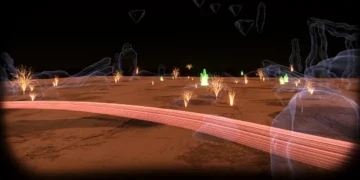
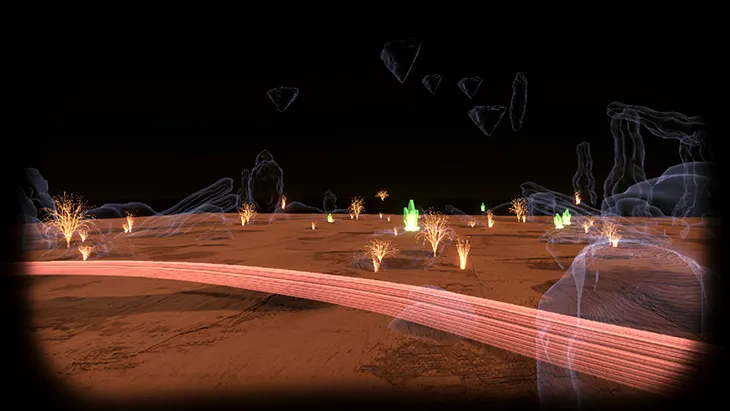
In immersive technology, the promise is intuitive movement, but the reality is often disorientation. On VR Boots Experience – VEKTOR, Fang led the first-time user experience and onboarding design, focusing on the most fundamental friction point: teaching the body how to move inside a digital space with confidence.
Developed with VEKTOR, a wearable technology company exploring natural locomotion in VR, the platform uses specialized boots that allow users to walk physically while navigating virtual environments. Fang led a cross-functional team of six focused on the first-time user experience, designing a tutorial that functioned less like a manual and more like a guided micro-journey. The tutorial introduced movement mechanics progressively, helping users understand spatial navigation while reducing early discomfort.
The team validated and refined the experience through eight rounds of usability testing with more than 90 participants, iterating toward clearer cues, smoother pacing, and better user comfort. This kind of onboarding system could help new users adapt quickly while reducing motion sickness during early interactions, a contribution later recognized with a Gold Award at the MUSE Design Awards.
Product design in telecommunications, US Mobile
Telecommunications is one of the most complex infrastructures people use daily, and one of the least transparent. At US Mobile, Fang led core product design initiatives aimed at making connectivity legible, especially as the industry shifts toward multi-network experiences.
Her work addressed a broader industry problem: connectivity is essential, but the logic behind it is largely invisible to the people paying for it. At US Mobile, Fang designed interfaces that help users understand and manage service across multiple network infrastructures within a unified product experience. Instead of treating network choice as a hidden technical layer, she built decision-support patterns that make performance comparisons, configuration options, and connectivity tradeoffs legible to everyday users.
She also led design for US Mobile’s international travel experience, treating it less as an add-on feature and more as a risk moment where connectivity failures become expensive fast. Fang shaped a pre-trip planning flow that helps users validate coverage by destination, confirm roaming readiness, and select the right option before departure. The intent was preventative clarity, moving the “will this work abroad?” question from a stressful airport problem to a decision users can resolve in advance.
Virtual physical therapy platform, Rightmove Health
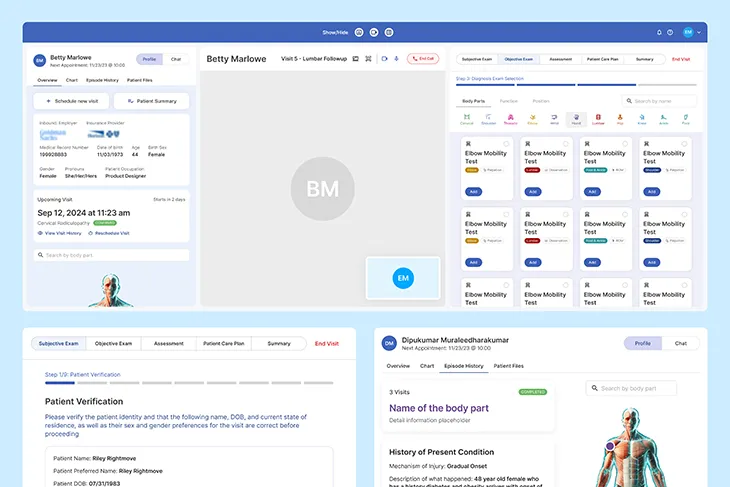
During the COVID-19 pandemic, remote care became a necessity, and rehabilitation services faced the challenge of maintaining continuity without in-person sessions. Fang helped define the product experience for a virtual physical therapy platform, shaping the core remote rehabilitation workflows used by clinicians and patients during the shift to telehealth.
The work translated clinical routines into structured digital interactions. Fang designed clinician dashboards and patient-facing workflows that supported remote sessions, treatment plan management, and progress tracking, while keeping communication around exercises and recovery milestones clear.
She also established the platform’s design system, defining visual and interaction standards across therapist and patient interfaces to support consistency and scalability as the product evolved. The project helped extend physical therapy beyond the clinic, and it later informed Fang’s thinking on home recovery support.
Recovera, AI-assisted home recovery guidance
If Fang’s telecom and rehabilitation work is about making complex systems legible, Recovera brings that same design logic into a more personal setting: the days after treatment, when patients are expected to monitor symptoms, follow instructions, and make judgment calls with limited support.
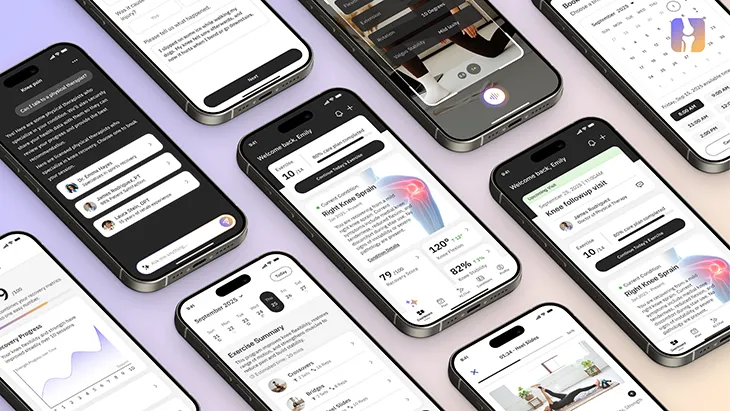
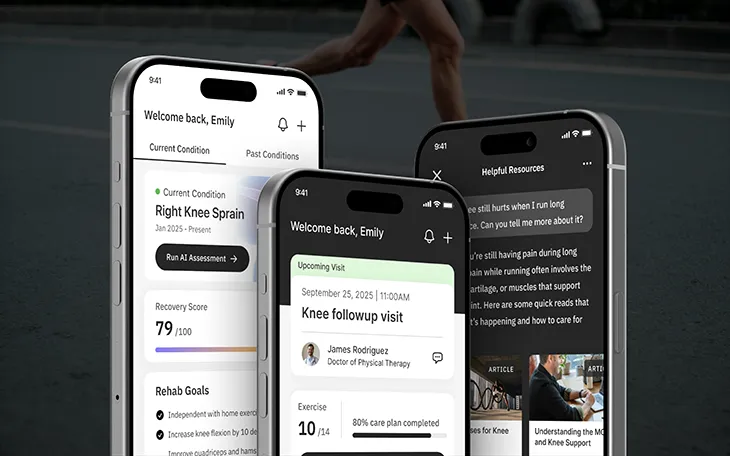
A self-initiated digital health project, Recovera explores how AI-assisted interfaces can provide structure during home recovery without pretending to replace clinical care. It is built for the gray areas patients often face, interpreting whether a symptom is normal, understanding what to track, and deciding when to escalate, all while feeling unwell and waiting for professional guidance.
Recovera proposes an interaction model centered on observation and orientation. Users can log symptoms, track recovery progress, and receive contextual prompts that translate complex medical information into more actionable, everyday language. The project received a Gold Winner at the MUSE Design Awards (Medical Category), alongside honors from the International Design Awards and the C2A Design Awards.
Designing what comes next
Fang’s work points to a practical shift already underway in product design: as AI, immersive systems, and networked services accelerate, the competitive edge is not only what the technology can do, but how quickly people can understand it, trust it, and use it correctly. In that landscape, interaction design becomes infrastructure. It determines adoption, safety, and support burden as much as it determines aesthetics.
Across telecom, digital health, and immersive systems, Jingyuan Fang has built frameworks that turn unfamiliar capability into usable behavior. Her impact is in the translation layer, the onboarding, decision support, and guided workflows that help users act with confidence when the system is new and the underlying logic is opaque. Rather than relying on borrowed UI patterns, Fang designs interaction models that make emerging technology legible, reducing friction, improving comprehension, and helping products move from novelty to something people can actually live with.
Words by DSCENE Features Editor Maya Lane