


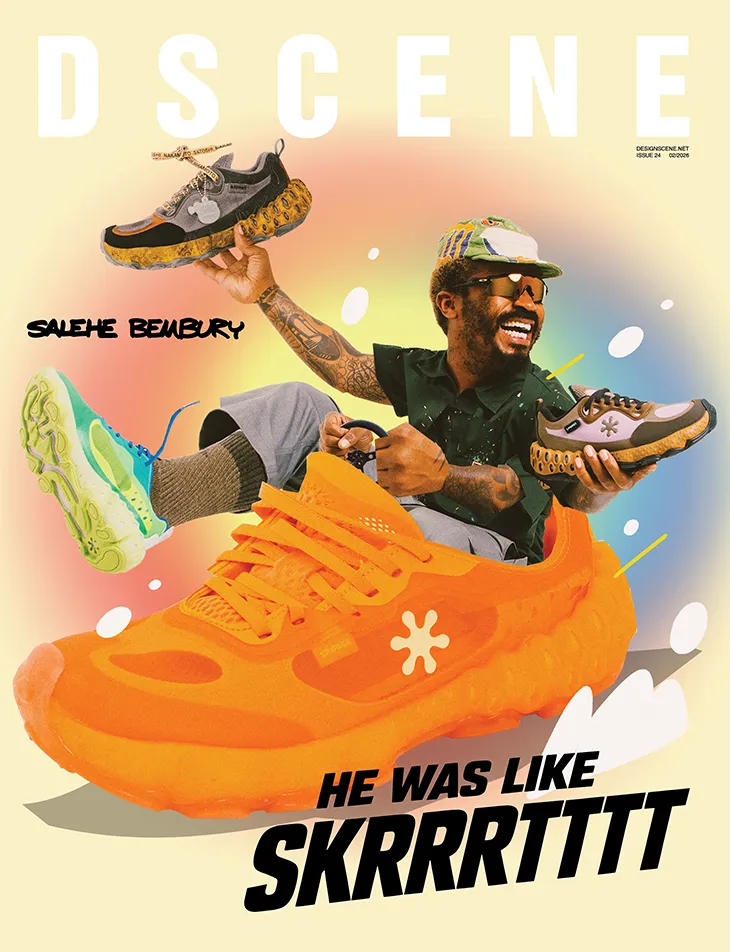
DSCENE Magazine reveals a Salehe Bembury cover artwork for the Design Under Pressure issue, created in collaboration with Troy Browne. Raised in New York and trained in industrial design, Bembury built his career in footwear through roles at Payless, Cole Haan, Yeezy, and Versace, later developing major projects with Crocs and New Balance. Across those chapters, he shaped a design language rooted in organic form, texture, and function, which now informs Spunge, his independent footwear brand.
ORDER IN PRINT AND DIGITAL
The cover artwork continues a creative exchange that began after Bembury discovered Browne’s graphic work on Instagram and responded to the way he digitally distorts images into new compositions. Their relationship developed over two years of work on Bembury’s Crocs campaigns, where Browne brought energy to the visuals and helped define the still imagery now associated with the collaboration. For Bembury, the DSCENE cover story felt like a natural next step, built from the history and creative shorthand the two developed over time.
Design Under Pressure looks at creative work under constant demand, shaped by speed, scrutiny, expectation, economics, and visibility. The issue examines how pressure changes the way ideas develop, how creative people protect their work, and what remains intact when ambition meets demand. For DSCENE, the theme reaches through fashion, film, music, design, architecture, art, and public life, treating pressure as one of the defining forces behind contemporary culture.
In conversation with DSCENE Magazine editor Katarina Doric, Bembury speaks about entering a new chapter with Spunge after years of collaborative partnerships with major corporations. He describes the shift as learning a new language, one connected to ownership, communication, retail, community, product, and brand identity. Collaborations gave him defined moments with clear beginnings and endings, while Spunge requires him to build a footwear brand that can earn trust over time.
He connects the brand to the idea of being a sponge, absorbing everything he has learned across 15 years in the industry. Bembury points to factory work, marketing, PR, startups, high fashion, Yeezy, Versace, Crocs, and New Balance as part of the education that shaped his point of view. Spunge becomes the place where those lessons enter his own company, while collaboration remains part of his wider practice.
The interview also looks at Osmosis as a key example of this change. Bembury explains that some people expected him to repeat the energy of earlier projects, while he had already shifted into a different phase. With Osmosis, he wanted to keep his design DNA while creating a shoe that felt familiar, distinct, and accessible to people beyond a niche footwear audience. That required a different way of speaking through design, one focused on building trust instead of chasing a reaction.
Bembury also reflects on instinct, function, and the way past projects reveal different versions of his mindset. He connects the Crocs Pollex to a period of proving himself and his Clarks collaboration to confidence and instinct. Throughout the interview, he returns to industrial design as his foundation: finding a problem, identifying the insight, and developing a product that works.
ORDER IN PRINT AND DIGITAL
Footwear Designer SALEHE BEMBURY
Artist and illustrator TROY BROWNE