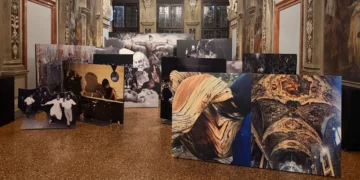



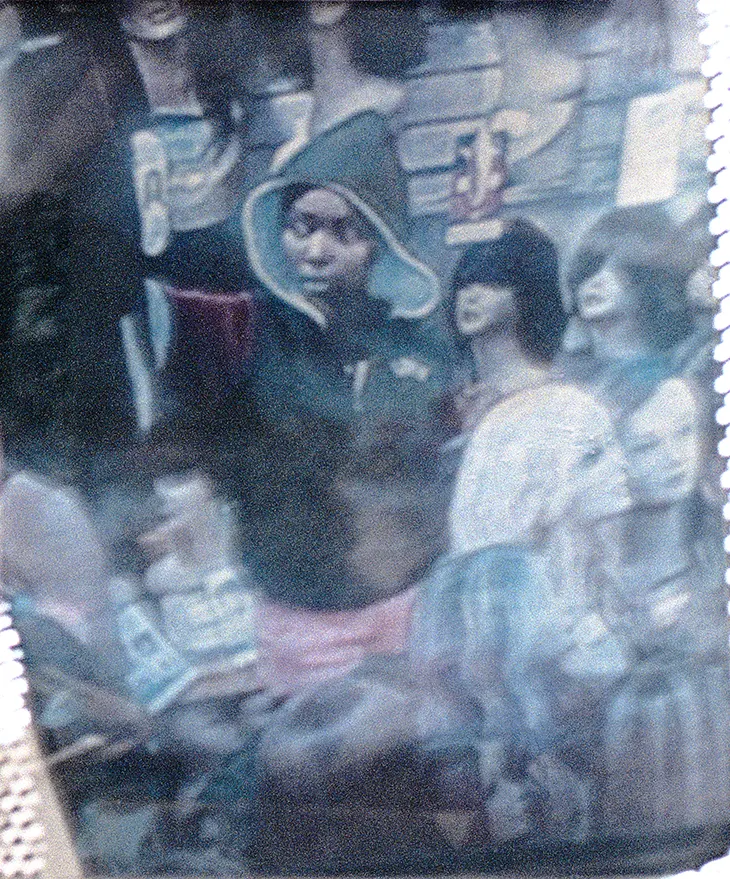
When Deana Lawson walks into a beauty supply store, she notices what most of us overlook: the security stills taped to windows and doors, those grainy, pixelated images meant to deter shoplifting. These photographs exist in a strange liminal space, too degraded to be portraiture, too human to be purely documentary. For most passersby, they’re background noise in a commercial transaction. For Lawson, they became the foundation of Edge Control, a series that transforms surveillance into something far more subversive: a meditation on agency, visibility, and the systems designed to monitor Black bodies in everyday spaces.
Opening September 10 at Gagosian‘s 24th Street location, this is Lawson’s first solo exhibition with the mega-gallery, and it marks a decisive moment in her practice. The artist has spent two decades interrogating how representation shapes identity, from her luminous large-scale portraits of individuals and families to her complex investigations of labor, migration, and the African diaspora. But Edge Control represents something sharper: a direct confrontation with the machinery of control itself.
The title derives from a product, the gel used to smooth baby hairs into submission, but it functions on multiple registers. Edge Control is about hair. It’s about surveillance. It’s about theft, beauty standards, and the late capitalist ecosystems that profit from selling women and girls the tools to modify their bodies. It’s about the aesthetic of paranoia. Lawson has said that “the aesthetic of surveillance imagery, deep-horizon blues and greens, opened my thoughts to an alien view of the supply chain, and its final landing point in the familiar beauty stores that I often frequent.” She frames these degraded stills in luminous black mirrors, a move that feels almost sacred. The mirrors reflect, they protect, they intensify. The work refuses moral judgment. It neither condemns nor celebrates the act of shoplifting; instead, it insists on the humanity of the people whose images have been flattened into evidence.
This is where Lawson’s practice becomes politically urgent. Beauty supply stores are anchors in Black communities. They are spaces of congregation, expertise, and cultural transmission. They are also sites of surveillance, monitored more heavily than most retail environments, their security footage a constant documentary of who comes and goes. By recontextualizing these images, Lawson performs an act of refusal. She says: I see you. Your face matters. Your agency matters, even in a system designed to deny it.
The exhibition also includes a series of large-scale domestic portraits, figures gazing directly at the camera in interiors composed with the meticulous attention to color and symbolism of seventeenth-century Dutch painting. These are collaborations between artist and subject, moments of mutual recognition. Then there are the new holograms, inspired by Philip K. Dick‘s A Scanner Darkly, that dystopian vision of “scramble suits” designed to obscure identity in an age of ubiquitous surveillance. Lawson’s holograms extend this logic: in a world where identity itself becomes scrambled data, what remains of personhood? What survives?
For an artist who was born in Rochester in 1979, her mother an administrative assistant at Kodak, her father a photographer at Xerox, the family camera has always been a tool of preservation. Lawson reclaims that logic. In Edge Control, surveillance footage becomes family album. The dehumanized becomes humanized. The forgotten becomes unforgettable. It’s a move that feels both deeply personal and urgently political, a reminder that in systems designed to reduce us to data points, representation remains an act of resistance.
Deana Lawson: Edge Control and New Works opens September 10 at Gagosian, 541 West 24th Street, New York. The exhibition continues through October 19.
For more on contemporary art, see our art coverage