


Marking his first new body of conceptual fashion work in ten years, Aitor Throup’s ULTRA VEIL brings together more than two decades of ideas, objects and experimentation. In conversation with DSCENE’s London Contributing Editor Lewis Stratton, Throup discusses the thinking behind the exhibition, the relationship between clothing and the body, and the importance of resisting convention.
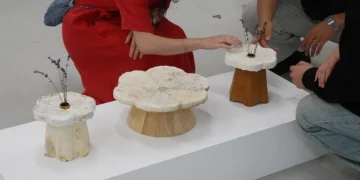
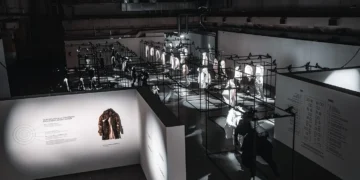
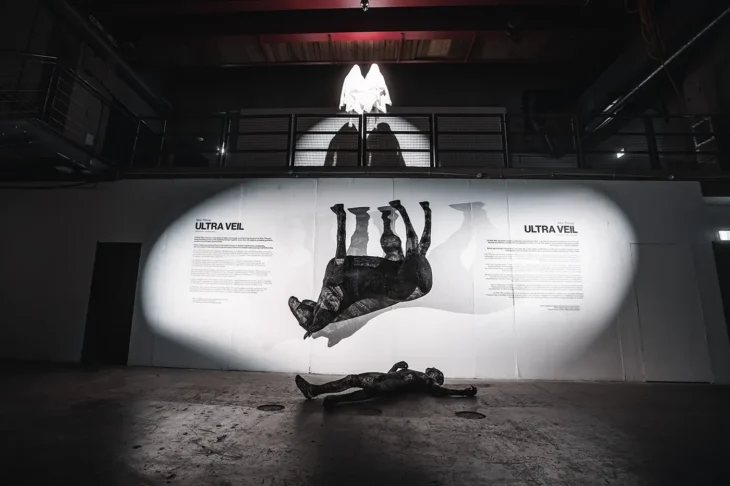
Open now at Ambika P3 in London, ULTRA VEIL offers an insight into the thinking and processes behind Aitor Throup’s multidisciplinary practice. Presented by the Westminster Menswear Archive and supported by Fred Perry, the exhibition brings together more than 100 objects, including garments, sculptural prototypes and drawings developed over more than twenty years. Part personal reflection, part exploration of identity and belonging, the exhibition draws on Aitor’s experiences of displacement and racism, as well as his complicated relationship with Britishness. Rather than presenting a conventional fashion collection or retrospective, ULTRA VEIL places the process of creation itself at the centre, revealing the ideas, experiments and original prototypes that precede the finished garment.
The exhibition also provides a conceptual foundation for AITOR ULTRA, Aitor’s forthcoming ready-to-wear project, scheduled to debut in 2027. We spoke with the designer about preserving the integrity of an original idea, the relationship between clothing and the body, and what it means to find an individual creative language.
In ULTRA VEIL, the prototypes exist as artworks in their own right, before eventually becoming ready-to-wear. What do you think is lost or gained in that transition, and how do you preserve the integrity of the original idea? – Typically, what’s lost is fidelity to the original idea, but also to the original archetype. I think I’m a purist, more than a perfectionist. I’ve always been interested in the purest expression of an idea. I’ve spent about 20 years trying to figure out my own process, ideology and the premise behind the brand, eventually developing its archetypes and the objects that will define it. It was important to create the original editions of those objects: the blueprints with 100% fidelity to the idea, before the inevitable changes that come with industrialisation.
“If you really want to root something, you don’t start with the tree. You start with the roots.”
When you industrialise something, you lose fidelity, but you also gain reach. This exhibition is a suspension between those two things. It’s a liminal space between the idea, the concept and the philosophy, and the objectified reality that results from them. I wanted to celebrate the prototype as a kind of holy grail, an aspirational object in its own right. Imagine going to an exhibition before Burberry became Burberry and seeing the original trench coat prototype, or the initial designs for the Nova Check. Those are the kinds of stories brands invest so much energy, resources and money into telling after they’ve started selling their products. For me, the brand is about those stories. It’s about rooting it in the beginning. If you really want to root something, you don’t start with the tree. You start with the roots.
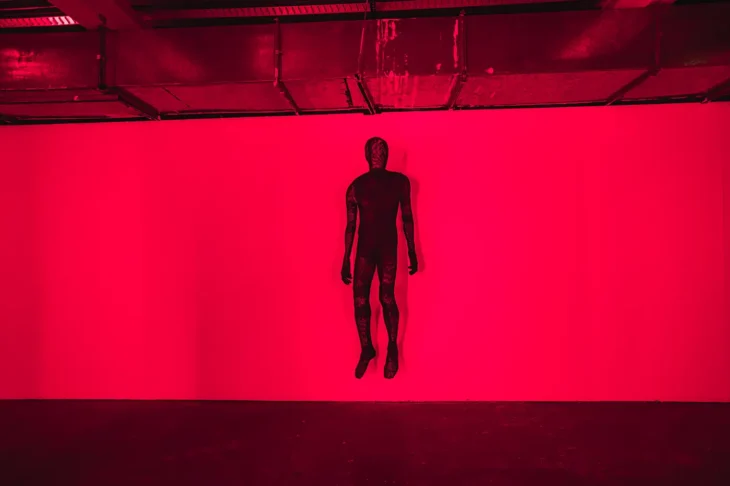
Thinking about the relationship between clothing and the body, the figures here feel exposed, while the garments almost become shells. How would you approach the tension between protection and vulnerability? – My work has always been about duality, particularly the duality between masculinity and femininity. For me, it’s not about gender, but energy. My past work has perhaps been more rigid and defined by masculinity in a conventional sense. However, the art surrounding it has always contained vulnerable elements. The poses of the sculptures and drawings from my early years often had this hunched quality. I made a series of sculptures over a long period with the head held in the hands, so vulnerability was always part of the expression, even if the garments themselves were generally more rigid and masculine.
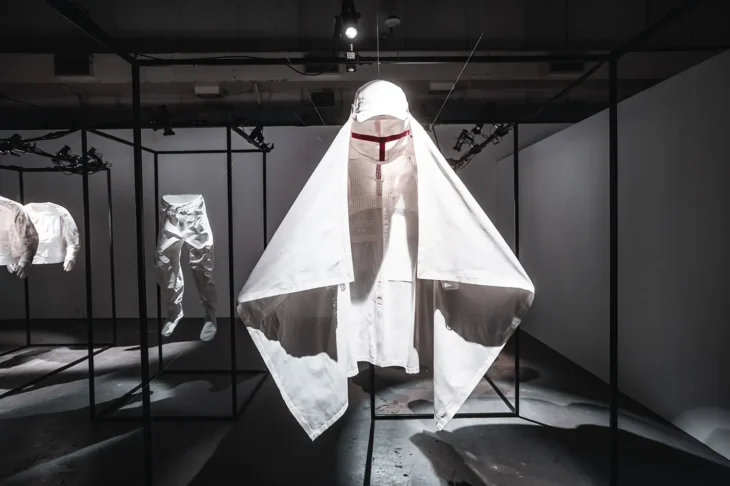
What I came to realise is that this rigidity came from what I felt was an out-of-balance expression of my masculine energy: something constricting and too limiting. With these figures, I didn’t want them to be read simply as garments on sculptures, or sculptures dressed in garments. I wanted them to be conveyed as garments in their own right. That’s why the structures inside them are minimal. They don’t fully fill the pieces, which are deliberately quite flat and flowy.
When you industrialise something, you lose fidelity, but you also gain reach.
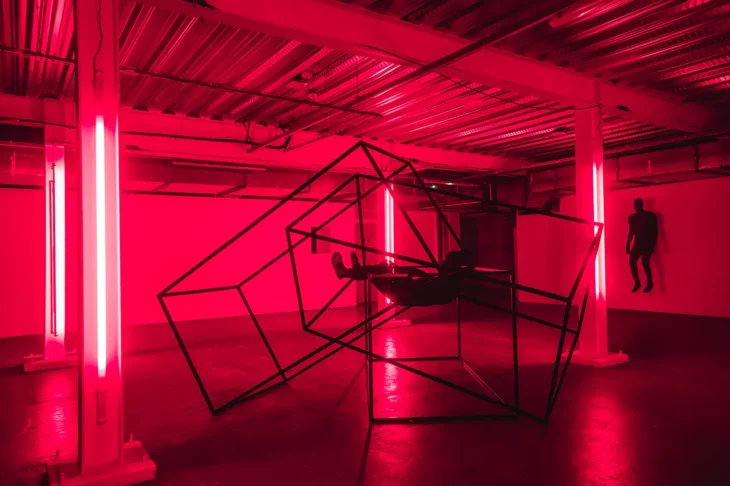
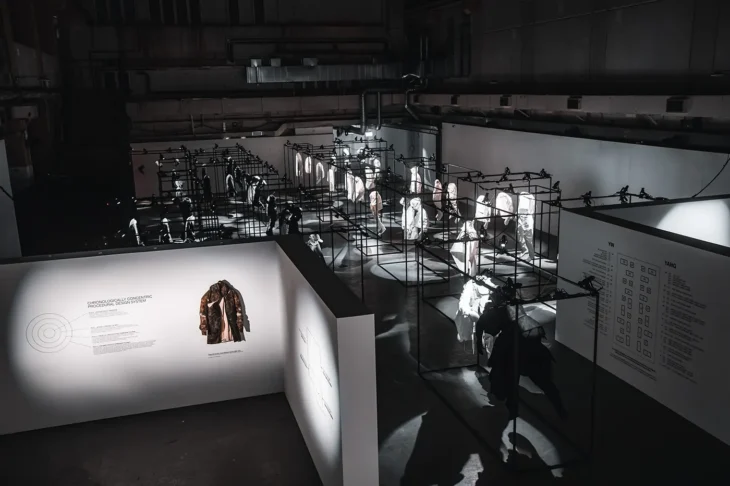
Historically, if I had presented a garment in an exhibition, I would have filled it with a sculpture to create the negative space of the body. Here, there’s a kind of magic trick. You get the feeling of a hanging garment, but it has some form in the shoulders before falling into a drape. That drape, alongside the slightly hunched feeling of my early drawings and characters, conveys vulnerability. It’s vulnerability within the constraints of rigid, linear structures: an expression of masculinity alongside a more feminine energy. You can see that duality in the exhibition’s architecture. In the first room, metal frames express masculinity and contain vulnerability. That vulnerability is oppressed. There’s a balance between yin and yang, but it’s still controlled by the yang: order, logic and the left brain.
In the second space, those symbols of order and constraint begin to collapse into chaos. The collapse represents a rejection of division and control. The final organic sculptures express the right brain: a positive vulnerability, a formlessness, a sacred feminine energy bursting out through the grid of containment.
When these ideas eventually leave the exhibition space and enter people’s wardrobes, what do you hope people experience through wearing them that they might not experience simply by looking at them here? – A sense of empowerment, probably. For me, it’s almost like an awakening. We take the physiological experience of putting on a garment for granted. But I try to engineer not just the garment, but the experience of wearing it. As you move your leg, you might feel tension across your back; as you bend your arm, you feel the garment working around your body.
They’re almost like machines that you can feel working around you, because they’re an engineered, anatomical reflection of your own human anatomy. I hope people experience a heightened awareness of themselves through the way the garment interacts with their body.
You stepped away from the traditional fashion calendar to protect your creative independence. Looking at the industry today, what do you think young creatives need to resist if they want to preserve genuinely individual ideas? – I call it Phase Zero: the rejection of convention. We need to look at how we live in a world full of conventions, because we live in an industrialised world. For things to be industrialised, mass-produced and mass-consumed, they need to be standardised. And for things to be standardised, there need to be conventions.
I call it Phase Zero: the rejection of convention.
We’re born into a world of conventions, which are essentially solutions established before us for a different objective, one that might have nothing to do with us. Someone established the convention of toothpaste tubes or car wheel arches to optimise yield, for example. But those archetypes become our foundational truths, when the foundational truths are actually the formless problems themselves: reality before it has been shaped into predetermined, conventional solutions.
I think people must unlearn and reject those conventions when they don’t apply to them. They need to go inward, search for the original problem and find an original solution.
Discover more of Ultra Veil in our gallery:
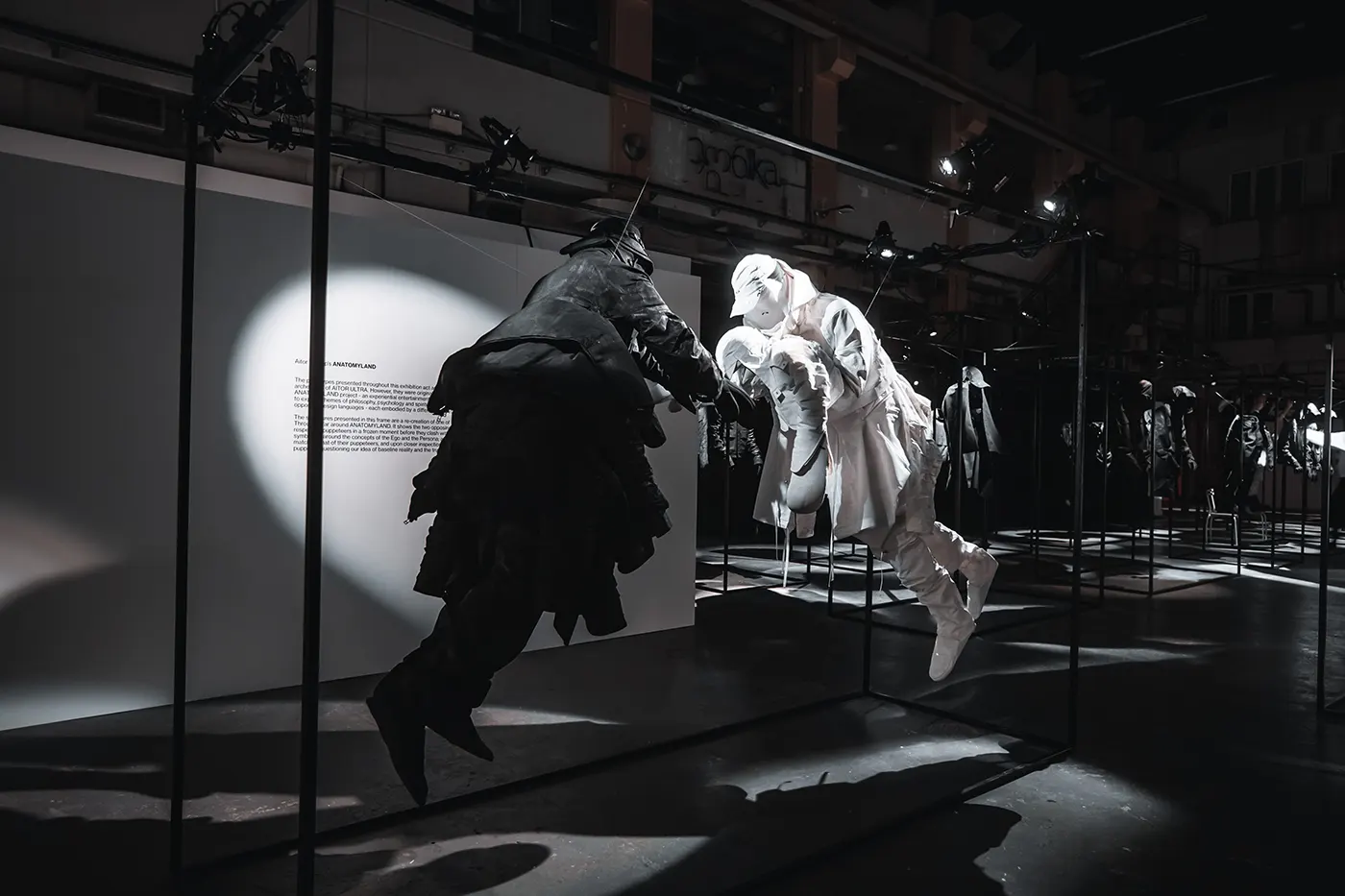
ULTRA VEIL is open to the public at Ambika P3, University of Westminster, 35 Marylebone Road, London NW1 5LS, from 30 October to 8 November 2026. Open daily, 11am–7pm. Admission is free.