


SPOILER ALERT: This review discusses major developments throughout the film, including its second half and ending.
Yesterday, I watched You Can See Everything at the Author Film Festival in Belgrade. Last night, I had a nightmare about it. This morning, I woke up to New York City Mayor Zohran Mamdani referencing Elizabeth Holmes and Billy Evans while signing housing legislation.
I would like to know when this documentary ends.
MOVIES
My Instagram feed has become a Nathan Fielder distribution network. Everyone has a theory. Everyone has discovered a hidden meaning. People are analyzing facial expressions, discussing the ethics of documentary filmmaking, and producing elaborate explanations of what the film tells us about truth, manipulation, and the human condition. In New York, the obsession has progressed to Nathan Fielder and Elizabeth Holmes lookalike contests, because watching the actual people for almost three hours has somehow left the public wanting more.

There is something deeply appropriate about a crowd of people dressing up as Nathan Fielder to demonstrate how well they understand a film about the impossibility of knowing who someone really is.
The response to You Can See Everything has been extraordinary. Critics have described its methods with the excitement usually reserved for the discovery of a previously unknown artistic medium. Viewers appear genuinely shocked that a documentary might manipulate its subjects, that a filmmaker might become part of the story, or that someone who agrees to appear on camera might behave differently because a camera is present.
I have some disappointing news. Nathan Fielder has been doing this for years.
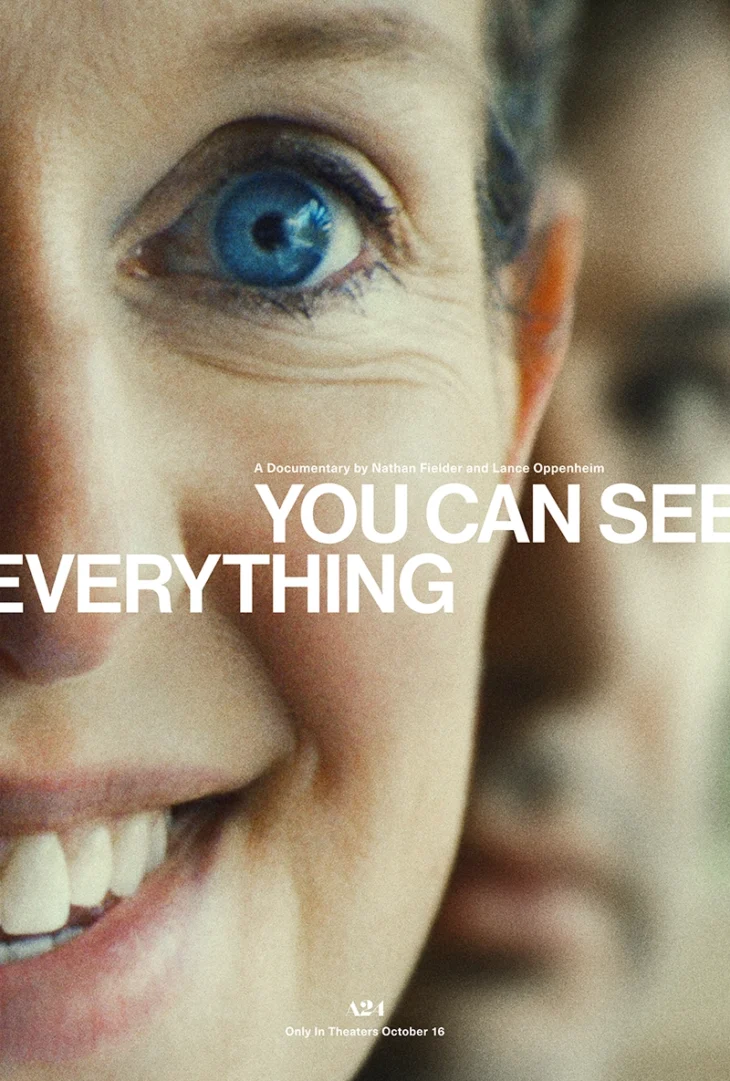
And while You Can See Everything, directed by Fielder and Lance Oppenheim, is an excellent film, one that kept me entertained for nearly three hours and subsequently invaded my sleep, I have a difficult time accepting the suggestion that it represents some extraordinary new development in Fielder’s practice.
I realize that saying this makes me sound like someone who insists she listened to a band before everyone else discovered it. The difference is that I have no desire to keep Nathan Fielder to myself. In fact, after last night’s dream, I would be delighted if somebody else took him.
Nathan Fielder has been doing this for years. Apparently, the internet has only just noticed.
In the second season of The Rehearsal, Fielder became interested in communication problems between pilots and copilots. A reasonable person might have interviewed aviation specialists, reviewed accident reports, and produced a documentary about cockpit dynamics.
Fielder learned to fly a commercial aircraft. I think about this whenever someone describes his interactions with Elizabeth Holmes as the most extreme thing he has ever done.
The man learned to operate a passenger aircraft because he had concerns about people being uncomfortable speaking to their bosses.
In Nathan for You, he offered businesses increasingly impractical solutions to relatively ordinary problems. The humor came from the enormous gap between the modest objective and the elaborate machinery he constructed to achieve it.
His methods have always involved manipulating reality, questioning authenticity, and examining the difference between what people say about themselves and what they actually do.
He has also repeatedly turned the camera on himself, exposing his own need for control and his inability to participate comfortably in ordinary human relationships.

So what exactly is new about You Can See Everything? The answer, I suspect, is Elizabeth Holmes.
After all, Holmes has spent years trying to convince the world that what it saw was somehow different from what actually happened. Now, facing prison, she invites two filmmakers into her home to show them the truth. Her partner, Billy Evans, appears equally enthusiastic about the arrangement. Both seem convinced that the more the cameras capture, the better the public will understand them.
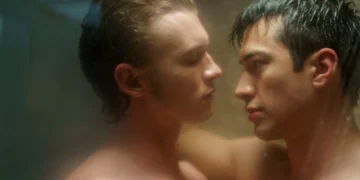
Naturally, this leads to a situation in which Billy Evans takes a shower. This would ordinarily be an unremarkable development in the daily routine of an adult man. Billy, however, decides to shower in front of the documentary cameras. He is completely naked. He is also brushing his teeth.
The film shows everything. I had assumed the title was metaphorical.
The camera records Billy’s full-frontal nudity, then reveals Fielder standing nearby, looking as though he has accidentally entered a situation that requires a complicated legal explanation.
Once a camera enters the room, even personal hygiene becomes a question of power.
The scene is funny for reasons that become increasingly difficult to articulate. Billy appears entirely comfortable. Nathan appears profoundly uncomfortable. The audience becomes uncomfortable because Nathan is uncomfortable, although we are also watching a man voluntarily take a shower.
The strangest part is that the shower subsequently developed its own publicity controversy.
Oppenheim has said that Billy offered to let the filmmakers record him showering. A source close to Evans later disputed that account, claiming he understood the footage would remain suitable for a general audience. Billy subsequently expressed dissatisfaction with the scene’s inclusion.
We now have competing accounts of why a man appeared naked in a documentary about his partner’s fraud conviction.
The scene also demonstrates something fundamental about Fielder’s work. He creates situations in which ordinary social behavior becomes impossible to interpret. Billy’s decision could represent confidence, exhibitionism, an attempt to control the filmmakers, or a misunderstanding of what unrestricted access means.
The audience immediately begins searching for psychological explanations. Perhaps Billy simply wanted to take a shower. But once a camera enters the room, even personal hygiene becomes a question of power. And once Nathan Fielder enters the room, the shower becomes a scene that people will discuss for several weeks.
The entire sequence is absurd, invasive, revealing, and somehow entirely consistent with the film’s subject. I would argue that it tells us more about the relationship between the filmmakers and their subjects than several of the more explicitly philosophical conversations.
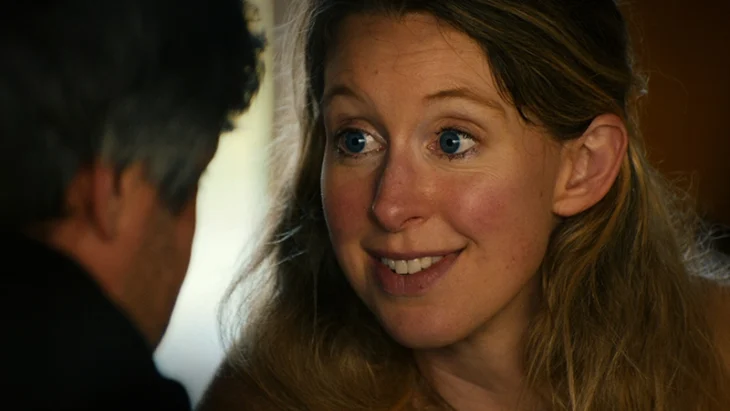
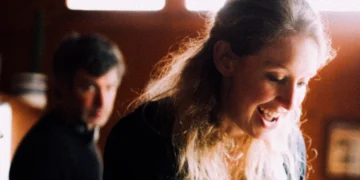
Elizabeth Holmes presents a different challenge. Her story already contains everything a documentary filmmaker could want: extraordinary ambition, enormous financial stakes, a spectacular corporate collapse, criminal convictions, and a protagonist who continues to maintain her innocence.
The filmmakers enter her home during the final weeks before she begins her prison sentence. She wants to explain herself. They want to understand her. Billy wants to ensure that everyone understands her correctly.
The resulting conversations become exercises in mutual frustration.
Holmes speaks with the certainty of someone who has rehearsed her explanations so thoroughly that she may have stopped distinguishing between the explanation and the event itself.
Fielder asks questions that expose the distance between her account and the established facts. She responds by returning to her intentions, her beliefs, and her conviction that the world has misunderstood her.
Then he asks another question. And another. The exchanges become increasingly uncomfortable because neither participant appears willing to accept the other’s understanding of reality.
One of the film’s most revealing moments involves Fielder showing Holmes Abbott and Costello’s famous Who’s on First? routine. She struggles to understand the joke, despite his attempts to explain it.
There is something almost impossibly funny about Nathan Fielder trying to explain comedy to Elizabeth Holmes.
It is also an unexpectedly useful scene. The routine depends on a misunderstanding between two people who believe they are communicating clearly. Each interprets the other’s words through a different set of assumptions.
Holmes struggles with the mechanism. Fielder attempts to explain it. They become trapped in a real-life version of the problem he is trying to demonstrate.
I suspect Fielder could have made an entire film about this conversation alone.
View this post on Instagram
As the film continues, Billy becomes an increasingly important character. He wants the documentary to show the woman he loves, challenge the public account of Holmes’s actions, and convince audiences that their relationship is exactly what he says it is.
He also wants considerable influence over how the filmmakers present that material. His negotiations with them, including a request for a share of the film’s profits, complicate the idea that the couple offered access purely in the interest of transparency.
Then we learn that Billy holds power of attorney for Holmes and manages her social media accounts while she is in prison. He admits to publishing posts in her name without always consulting her because he believes he knows what she would say. He effectively gets to speak as Elizabeth Holmes, which seems like a rather significant responsibility to give someone who has already demonstrated questionable judgment.
Billy later insists that his authority reflects their mutual trust and that Holmes remains fully involved in decisions about her public image. Still, the arrangement raises an obvious question: when we read something from Elizabeth Holmes, whose voice are we actually hearing?
Billy seems to understand that cameras and social media can change public perception while underestimating how little control he has over that change.
He believes that if the filmmakers see enough of their domestic life, they will eventually understand the truth of their relationship. The shower scene is the most literal expression of that belief.
You want access? Here is access. You want transparency? Here is my entire body.
Unfortunately, transparency has never guaranteed understanding. The more Billy shows, the more people speculate about what he is hiding. And the more he attempts to explain himself, the more complicated the explanation becomes.
This is a recurring problem throughout Fielder’s work.People participate because they believe they can control the outcome. The experiment gradually reveals how little control they actually have.
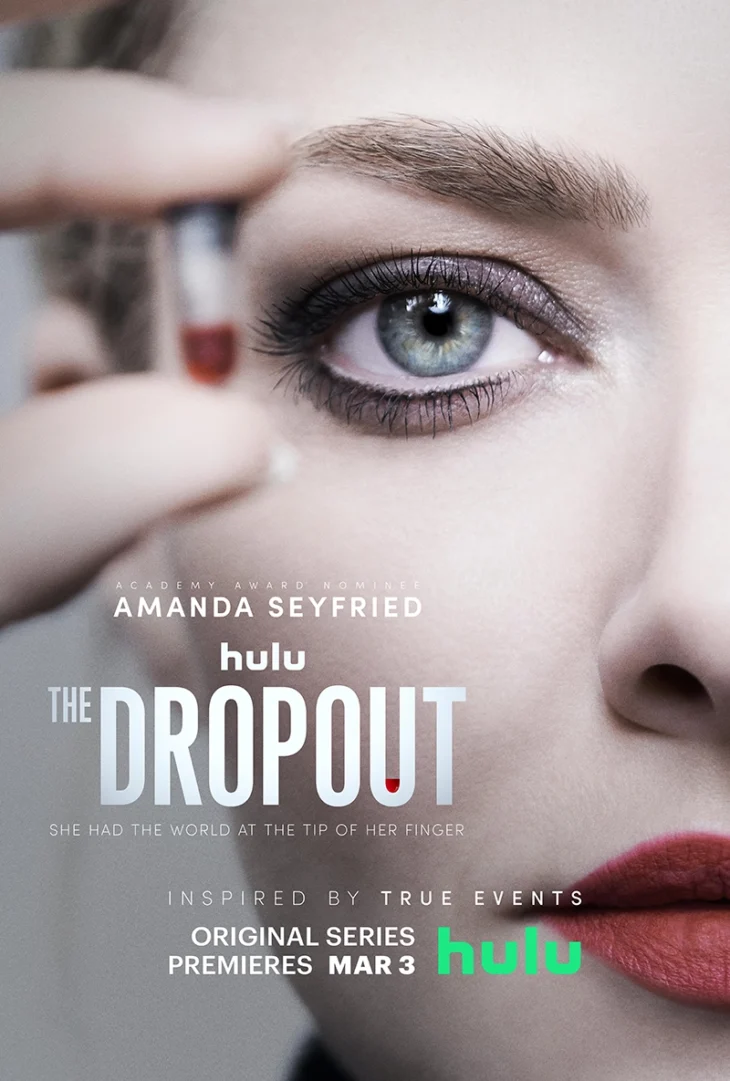
The film takes a fascinating turn after Holmes begins her prison sentence. Amanda Seyfried, who portrayed Holmes in The Dropout, enters the project. Fielder turns toward reenactment, attempting to reconstruct conversations and investigate experiences that the documentary cameras could no longer capture.
Things become complicated when Seyfried questions Fielder’s growing sympathy for Holmes. He insists on accurately representing the woman he encountered, but his emotional involvement begins to undermine his position as an objective observer.
The investigator becomes part of the investigation.
Anyone familiar with The Rehearsal will recognize this development. Fielder has spent years constructing experiments that eventually expose his own need for control. His attempts to understand other people frequently reveal more about him than his subjects.
The difference here is Holmes. Audiences arrive with established opinions about her, and Fielder’s uncertainty challenges their expectations. The film raises an uncomfortable question: does understanding someone require reconsidering our judgment of them? Perhaps. But empathy can easily become confused with exoneration.
I have enjoyed watching the public reaction almost as much as the film itself.
Holmes can be a complicated person and still bear responsibility for her actions. Fielder can sympathize with her without becoming an authority on her innocence. The film’s strongest moments allow these possibilities to coexist.
I have enjoyed watching the public reaction almost as much as the film itself.
People have become fascinated by Fielder’s methods, particularly his willingness to expose the filmmaking process and acknowledge the uncertainty surrounding his subjects.
Critics describe the film as a radical examination of truth. Viewers debate whether the filmmakers manipulated Holmes and Billy. Others question whether Fielder’s awkwardness represents his actual personality or a carefully developed performance.
View this post on Instagram
Then there is Zohran Mamdani. The morning after I watched the film, I encountered footage of the mayor referencing Holmes and Evans while discussing housing legislation.
During the event, Mamdani invoked the couple’s language of love, suggesting that the legislation would empower tenants to build the sort of monuments to love that Holmes and Evans claimed to be creating for one another.
I find this development extraordinary. A documentary about the collapse of a Silicon Valley blood-testing company has become a reference point for New York housing policy.
The mayor has apparently decided that the most effective way to communicate tenant protections involves Elizabeth Holmes’s romantic relationship.
I cannot imagine explaining this sequence of events to someone who has never watched Nathan Fielder.
- First, a technology entrepreneur goes to prison for fraud.
- Then, a comedian moves into her house.
- Then, her partner takes a shower on camera.
- Then, Amanda Seyfried enters the documentary.
- Then, people dress up as the comedian and the convicted entrepreneur in public parks.
- Then, the mayor of New York references the couple while signing housing legislation.
And perhaps that is the most interesting achievement of You Can See Everything. The film has created a cultural environment in which reality begins behaving like Nathan Fielder’s television work. The absurdity continues after the credits.
I want to return to my original argument, because the increasingly ridiculous public response has made it easy to forget.
You Can See Everything is an excellent documentary. Its nearly three-hour running time passes remarkably quickly, with Oppenheim’s direction giving domestic footage an unsettling intensity and Fielder turning ordinary conversations into psychological investigations.
But Holmes’s story already contains the drama that Fielder previously had to create through elaborate experiments. In The Rehearsal, he built entire environments to examine human behavior and even learned to fly a commercial aircraft to investigate cockpit communication. Here, he enters a situation already full of contradictions and knows exactly which questions to ask.
I find his earlier work more radical. You Can See Everything may be more accessible and emotionally immediate, but its methods remain familiar. The enthusiasm surrounding the film also reveals our tendency to confuse cultural impact with artistic advancement.
You Can See Everything may be more accessible and emotionally immediate, but its methods remain familiar.
A film can generate enormous discussion without breaking new ground. It can be excellent without being revolutionary.
Fielder has spent years perfecting his ability to create discomfort and expose contradictions. This time, he found an almost impossibly suitable subject.
He knows exactly what he’s doing. Or at least he knows how to make us question whether he does.
The title You Can See Everything makes a promise the documentary spends nearly three hours dismantling. We see Holmes defend herself, Billy naked, actors reconstructing events, and filmmakers questioning their own judgment. Yet by the end, I’m uncertain how much closer we’ve come to understanding anyone.
Perhaps that explains the public obsession. We examine expressions, debate motives, develop theories, and organize lookalike contests. We begin behaving like Fielder, searching for certainty in material that can never provide it.
https://t.co/SvAR7kICWI
— Billy Evans (@per_asp3ra) November 11, 2026
I still find Fielder’s earlier work more radical. You Can See Everything is an excellent film, and I would recommend it to almost anyone, particularly those unfamiliar with his work. They may leave convinced they’ve witnessed something entirely new.
I left convinced I’d watched a filmmaker do something he had already mastered.
And yet, here I am.
I watched the film. I went home and dreamed about it. I woke up to the mayor of New York discussing it. I spent an unreasonable amount of time scrolling through Billy Evans’s X account, and writing an essay explaining why everyone should be slightly less impressed.
I suppose the film’s greatest trick is making you believe you’re watching an experiment when you’ve already become part of it.
At some point, I became exactly the kind of person I was making fun of in the opening paragraph.
I had set out to argue that Nathan Fielder’s latest experiment was hardly revolutionary. Instead, I spent an entire day voluntarily investigating its participants, questioning their motives, and examining evidence that I knew would never give me a satisfactory answer.
I suppose the film’s greatest trick is making you believe you’re watching an experiment when you’ve already become part of it.
I would like to stop participating.
Unfortunately, I have a few more things to say about Billy’s shower.