


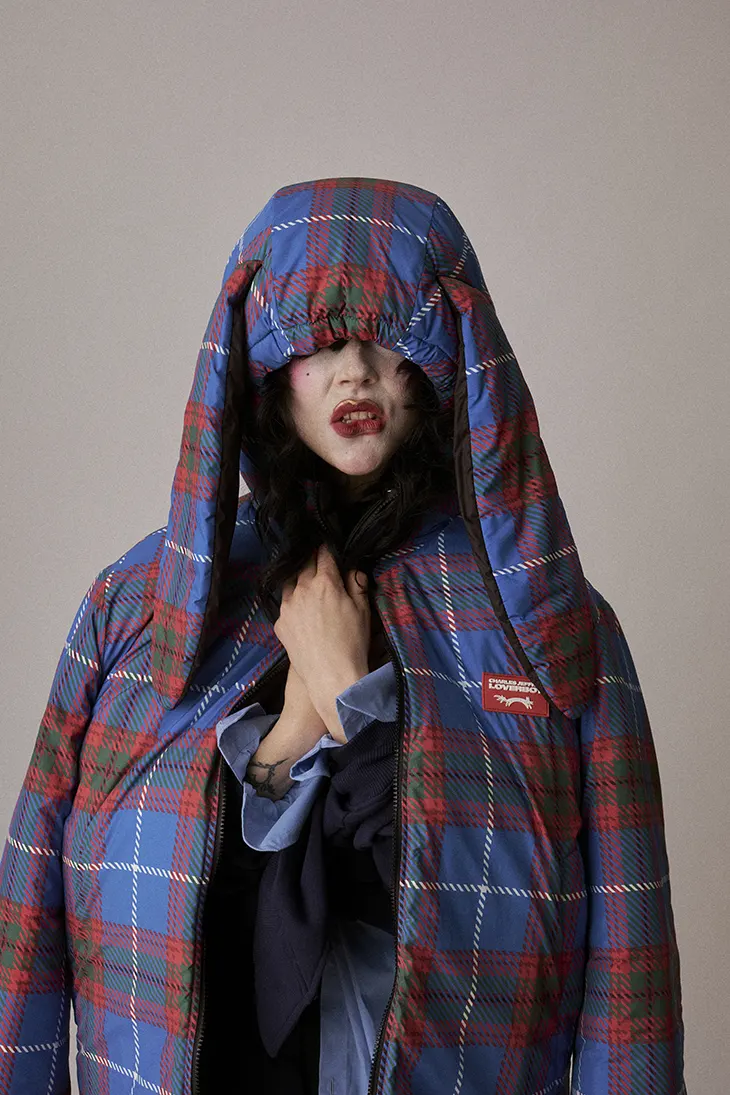
Charles Jeffrey Loverboy has never been interested in fashion shows as passive spectacle. Today at Dover Street Market Paris, the Scottish designer staged his Fall Winter 2026 collection, titled Thistle, as a live happening that collapsed the distance between audience and performance, past and present, fashion and instinct. It was a deliberate return to the energy that birthed Loverboy over a decade ago in the basement of Vogue Fabrics in Dalston.
LATEST FROM PARIS FASHION WEEK
The presentation unfolded in the Marais location at 35-37 rue des Francs-Bourgeois, where metres of hand-painted fabric, created by Jeffrey himself in a giant scenic paint frame outside London, transformed the space into what the designer describes as a “pagan-punk environment.” A small cast of four models, friends and new friends, moved through the immersive installation wearing Loverboy in its full state of madness and defiance. Amsterdam-based post-punk trio Baby’s Berserk, founded by Mano Hollestelle, Eva Wijnbergen, and Lieselot Elzinga, performed live, their danceable new wave sound providing the sonic architecture for the happening.
The Legend of the Thistle
Jeffrey grounds the collection in Scottish mythology, specifically the legend of Viking soldiers who removed their shoes and crept barefoot into a Scottish camp, aiming to be as silent as snowfall. They did not anticipate the thistle. Sharp, defensive, and evolved to protect itself, the plant pierced flesh and shattered stealth. Cries of pain gave the game away. The thistle became Scotland’s national flower: a symbol of resilience, vigilance, and unexpected strength.
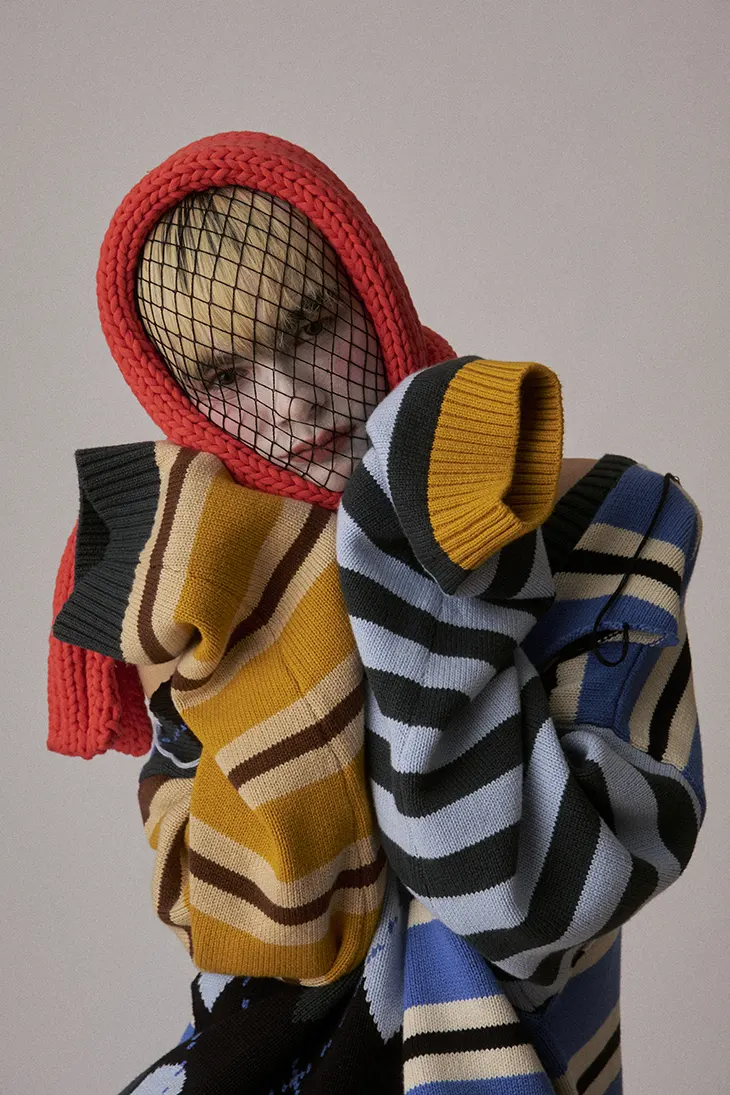
“Is any of it true? History is rarely that neat,” Jeffrey writes in his collection notes. “That’s the trouble with big-R Romanticism. It can be artful. A little deceptive. A soft burnishing over gruesome facts.“
The designer embraces this ambiguity, using romanticism as structure rather than nostalgia. “You can’t have nostalgia for something you never lost,” he argues. Instead, Jeffrey positions Loverboy as actively writing Scottish history, a seed sown in London’s underground club scene, in “the net and lace and wool and silk, the ripped denim, soft tweed, torn tartans. The blue faces, bleary eyes, sweat-soaked shirts on flailing limbs.”
Discover the close up of the beauty looks:
Layered Resistance
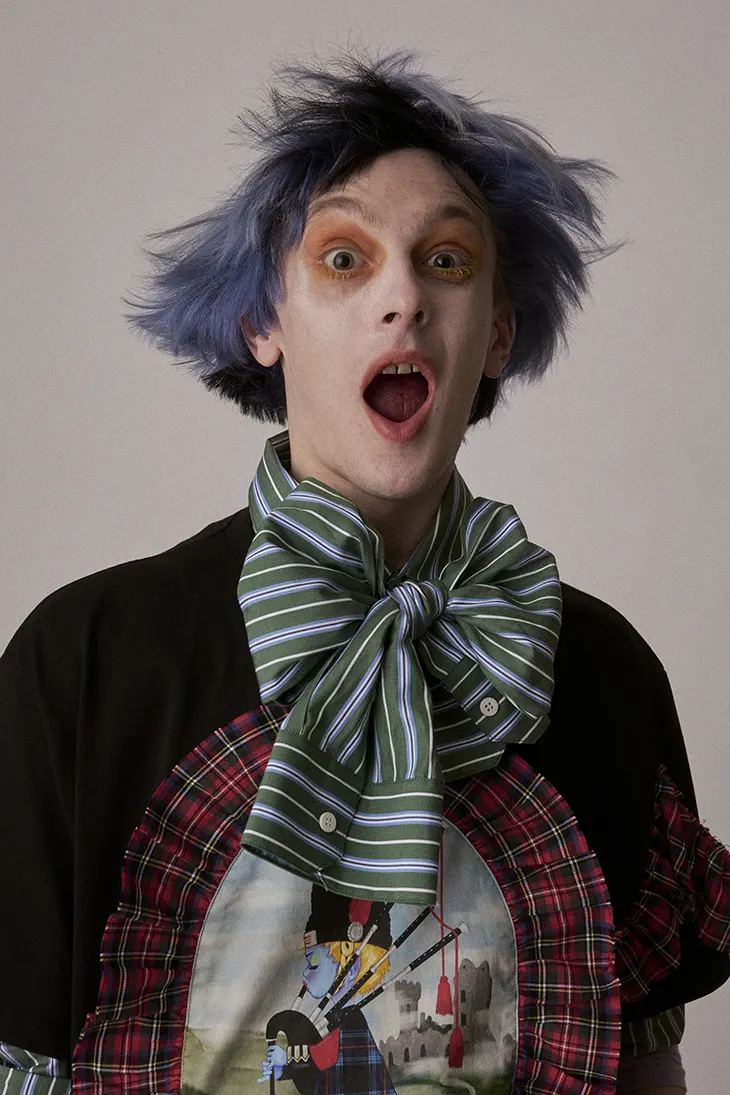
The collection manifests this philosophy through radical accumulation. Tartans clash deliberately, sleeves are tied as sashes, and every incarnation of Loverboy is layered in what Jeffrey calls “carefully curated mess.” Hot hourglass silhouettes meet ruffled dresses and 80s cuts. Textures multiply: bobbly crochet, soft moss, worn denim, slouch leather. Knits stack from mushroom spots to apple-green Fair Isle.
Jeffrey explicitly rejects the Coco Chanel dictum about removing the last accessory before leaving the house. “Absolutely not,” he counters. “We want more. Do more.“
The Frankenstein tailoring approach sees oversized, spliced suits where one jacket melds with another to create unprecedented shapes. Beanies are dissected and reassembled, half and half. Sleeves are added to shirts and tied around hearts. Sweaters layer with cardigans layer with scarves. Tights pull up, then socks, two pairs.
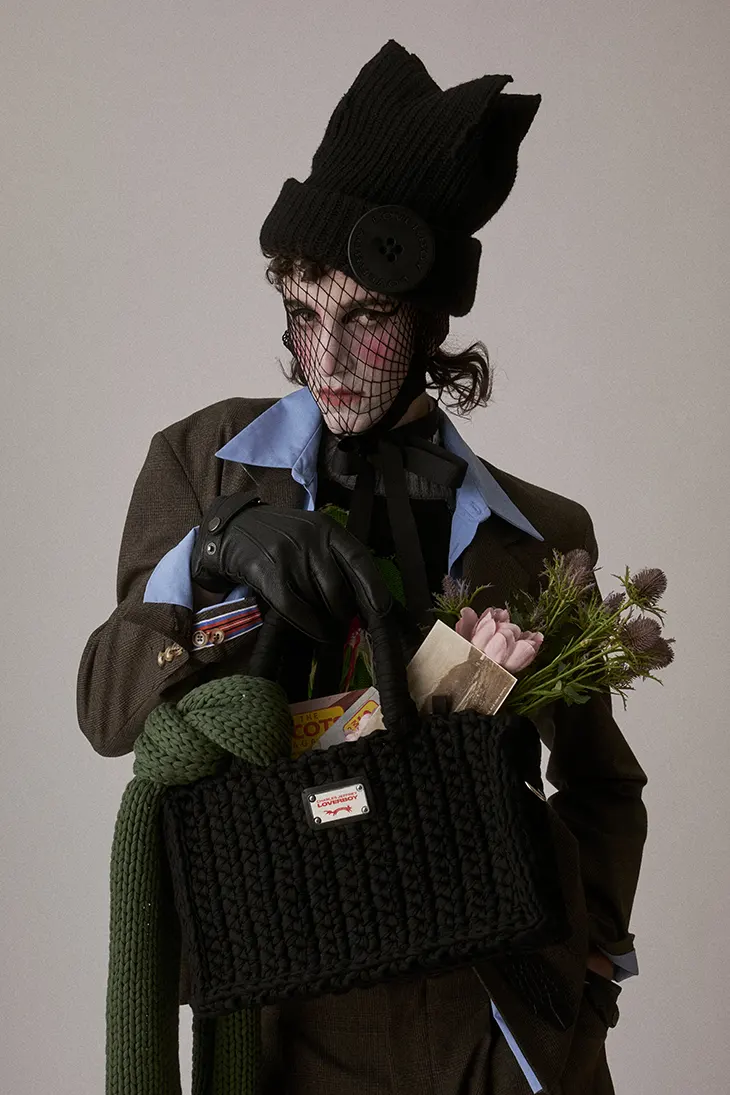
The Loverboy Formula
Jeffrey articulates the brand’s methodology as: Laughter, Refusal, Care, Mess. This formula produces different outcomes each time, embracing the entropy of a night out where outfits peel and dishevel, gowns tear, sleeves roll up, shoes scuff. “We are still showing up, as we always have, in defence, in defiance. The thistle.“
The presentation at Dover Street Market Paris carries particular significance. The retailer, conceived by Rei Kawakubo and Adrian Joffe, has supported Loverboy since its earliest days. Jeffrey acknowledges this relationship directly: “Times might get tough throughout the industry but it’s having friends like these in cities like this that are our lifelines.”
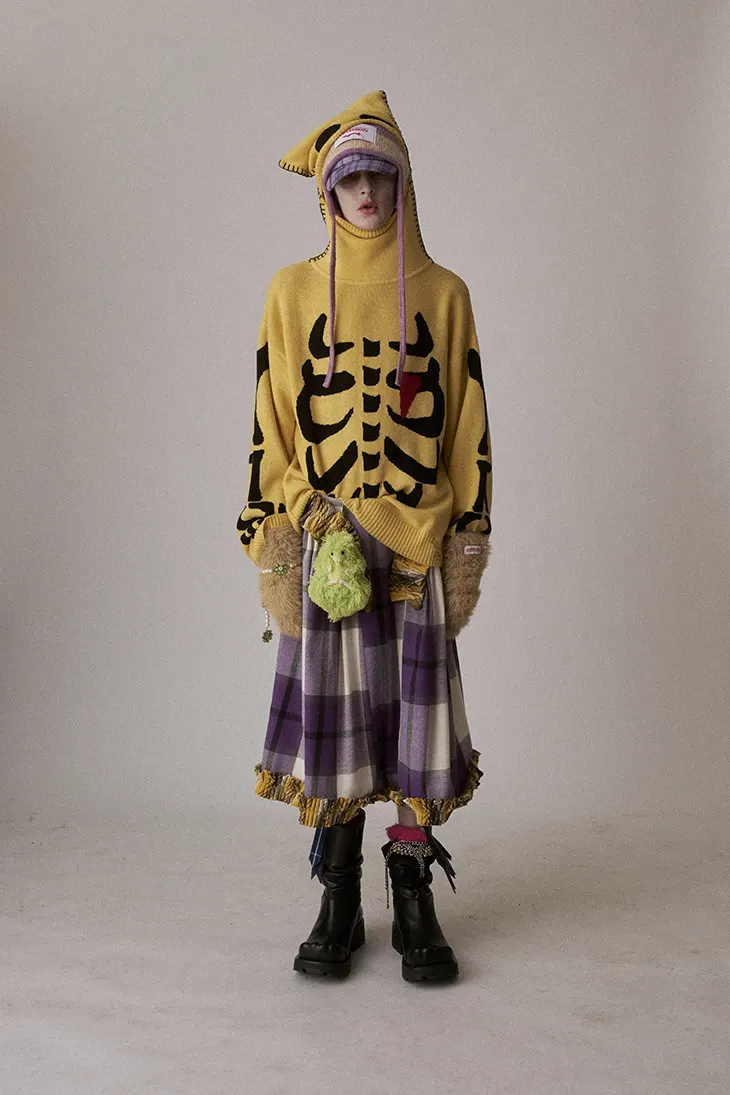
The staging echoes the original Loverboy club nights that Jeffrey began at Vogue Fabrics in 2014 to help fund his MA at Central Saint Martins. Those nights, inspired by 1980s clubs like Blitz and Taboo and legendary queer performers such as Leigh Bowery and Boy George, became what Jeffrey has called a “no-rules nocturnal laboratory” where fashion, music, bodies, and instinct collided without hierarchy.
A Decade of Defiance
Jeffrey, born in Bellshill, North Lanarkshire, and raised across Germany, England, Wales, and Cumbernauld due to his father’s British Army career, has built Loverboy into one of London’s most distinctive fashion voices. Tutored by the late Louise Wilson at Central Saint Martins, the same professor who mentored Alexander McQueen and Christopher Kane, Jeffrey has been described by Vogue as “the upholder of all that is human, creative and cheerful about British fashion.”
The brand’s celebrity following spans Harry Styles, Tilda Swinton, Bimini Bon Boulash, and BTS’s J-Hope. Jeffrey won the British Fashion Award’s Emerging Talent: Menswear Award in 2017 and the GQ Man of the Year Award for Breakthrough Designer in 2018.
With Thistle, Jeffrey reasserts Loverboy’s founding principles in a moment of industry uncertainty. “In this dark moment of unrest and instability, we’ll do it again,” he writes. “We carved out space with our bare hands.”
The collection, he promises, “will forever be for the weirdos by the weirdos.”
Discover more of the collection in our gallery:
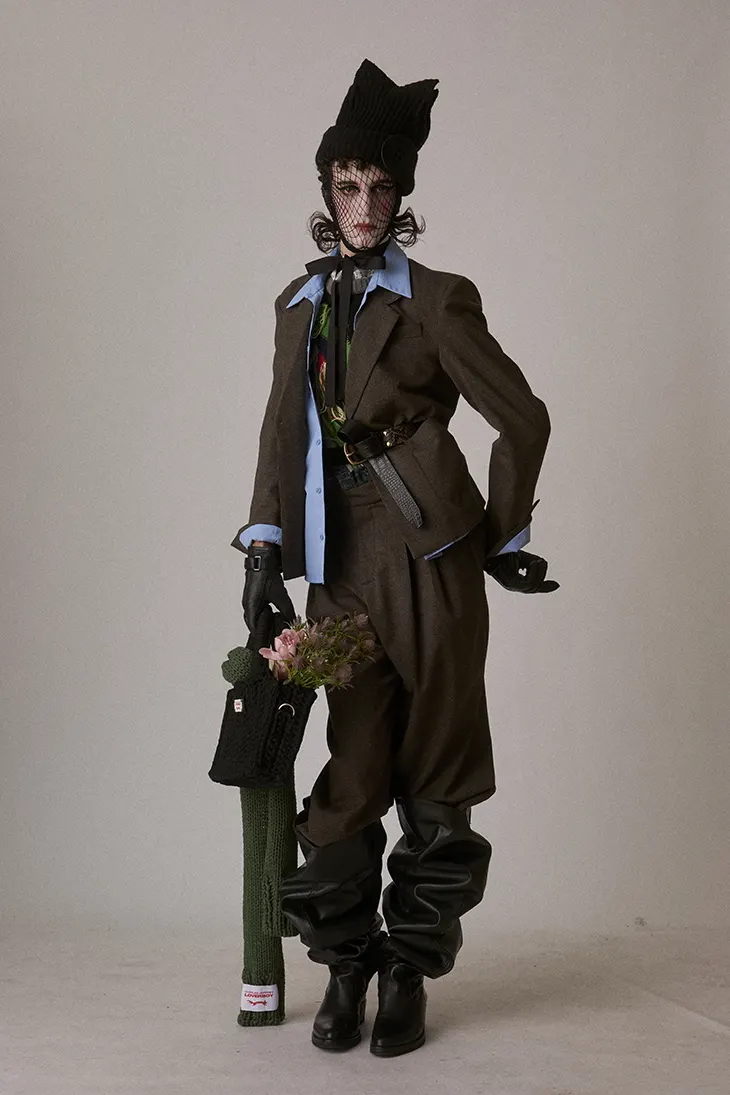
Lookbook Credits
Creative Director: Charles Jeffrey Art Director: Alice Lees Stylist: Anders Sølvsten Thomsen Photographer: Oli Kearon Hair: Charles Stanley Makeup: Mari Kuno Casting: Max Kallio Movement Director: Kate Coyne Film: Tom Eames Press: PURPLE
Models: Henry Sharples (Present), Malik Derdak (Present), Sophia Maas (Present), William (Menace), Saffron Yin Ying Cary (Present), Aaron Lewins (W MGMT), Agne Kaminskaite (MGMT), Greta Kahlhamer