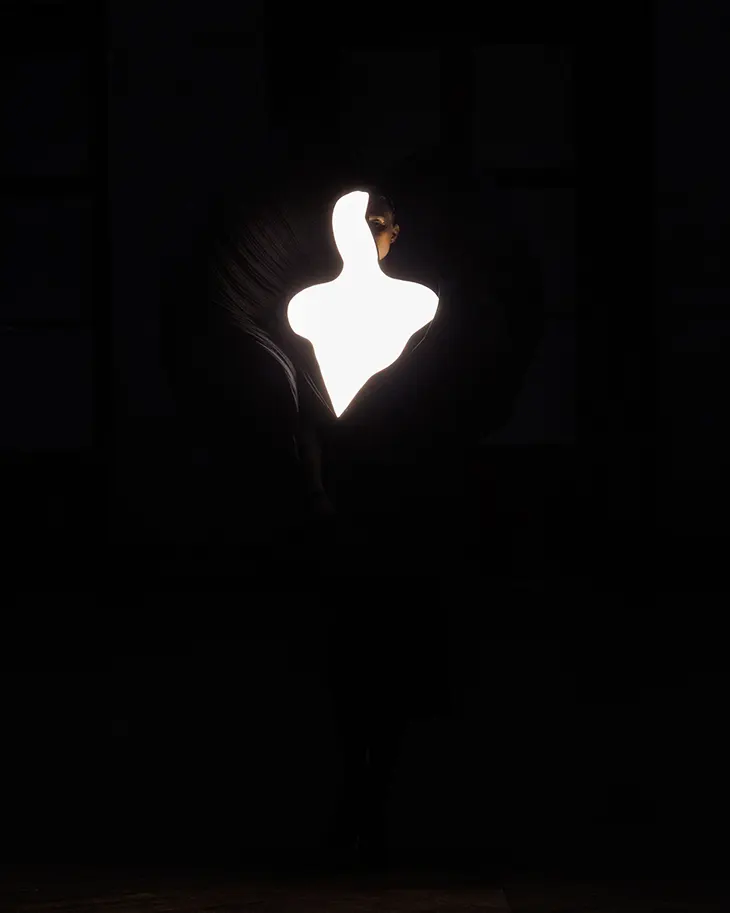



Gaurav Gupta presents the Spring Summer 2026 collection, The Divine Androgyne, at Paris Couture Week shaped by reflection and refusal. The starting point reaches back to the Spring Summer 2025 show Across the Flame, when several media outlets referred to Gupta’s life partner, Navkirat Sodhi, as his wife. For Gupta, the moment raised questions that resisted correction. Why must relationships pass through rigid frames. Why must identity submit to hierarchy. Why must energy receive a name before it registers as experience. The misnaming opened inquiry.
COUTURE COLLECTIONS
The collection challenges binary structures that govern how relationships and bodies receive meaning. Its conceptual foundation draws from Advait, the ancient Indian philosophy of non-duality, which views existence as a single, indivisible whole. Gupta treats time as material and space as architecture. The body operates as a site of negotiation, where anatomy and structure meet memory and energy. Creation and dissolution exist as interdependent conditions that generate life through balance.
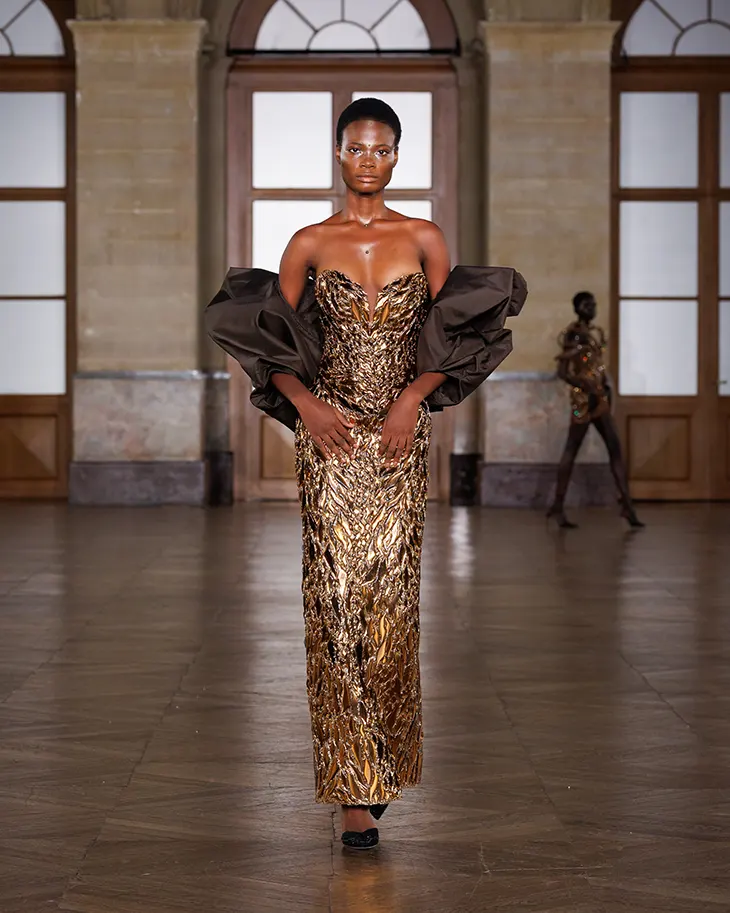
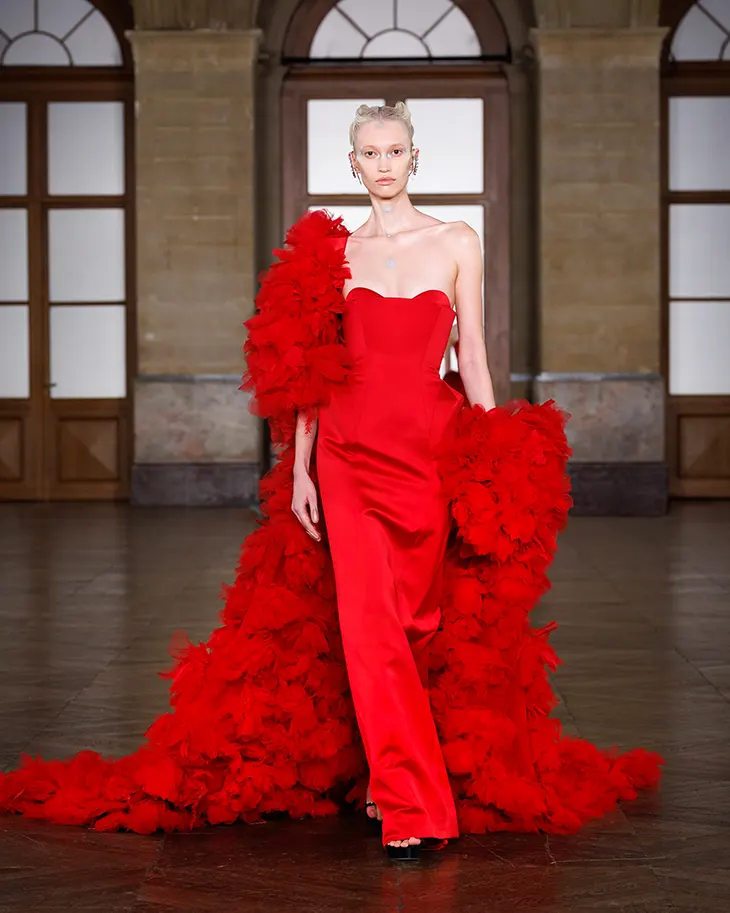
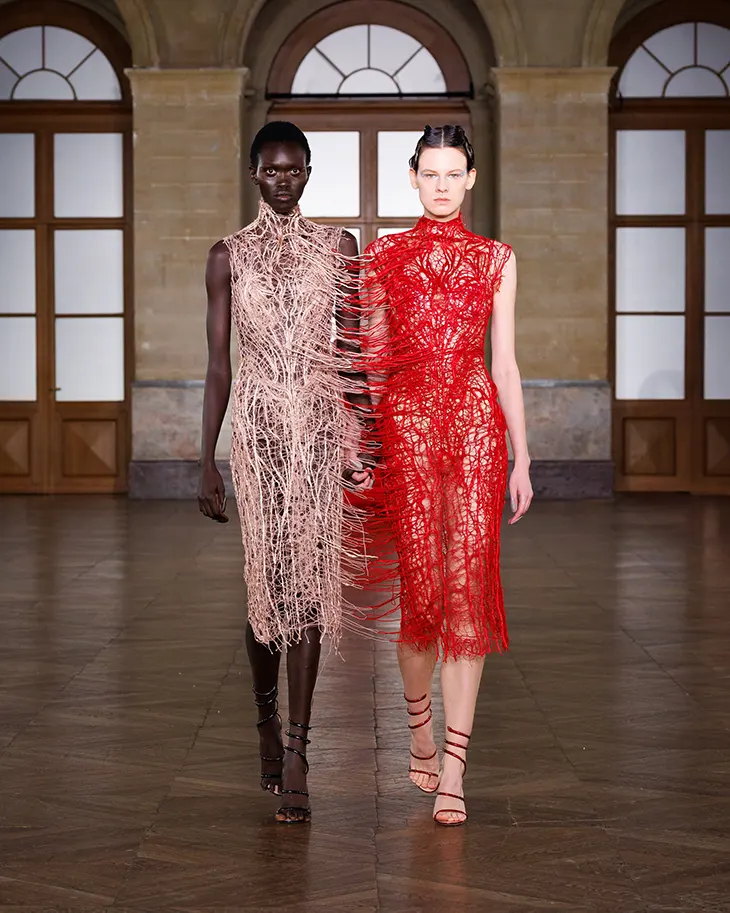
Gupta’s atelier engineers thousands of fine threads into web-like networks that trace nervous systems and energy points across the body. This proprietary technique appears most clearly in paired twin silhouettes, where continuous cords physically connect two bodies, and in a black gown mapped directly to the human form. Each piece requires approximately 700 hours of hand embroidery, transforming thread into a living system.
The collection then enters a restrained fantasy forest, where bloom and decay operate as parallel states. A sculpted bridal gown and a sari gown integrate mogra, Indian jasmine, directly into their architectural frameworks as sacred material language. In these white silhouettes, rebirth replaces ceremony, and the bride appears as transformation. These pieces demand over 900 hours of embroidery and the work of nearly 50 artisans.
From there, the collection turns toward origin and early states of becoming. Hybrid surfaces and engineered resin constructions imagine matter’s first attempts to organize into life. A cosmic gown composed of more than 2,000 individually placed resin elements forms a shifting, extraterrestrial skin.
Crystallized networks and deconstructed watch components trace orbital paths across the body. Clock hands, silver bases, and mechanical plates appear as surface elements that reveal time’s anatomy. Rooted in Vedic concepts of cyclical time, the designs compress past, present, and future into one form. Preciosa crystals introduce controlled luminosity, while sculpted ruffles and corded lattices express balance as an unstable, living condition.
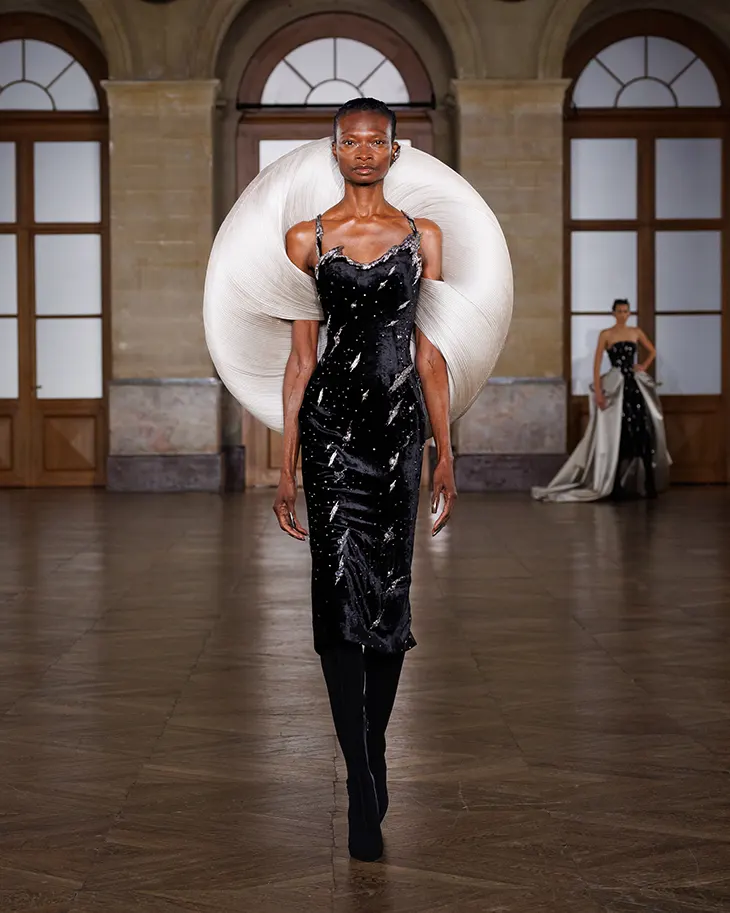
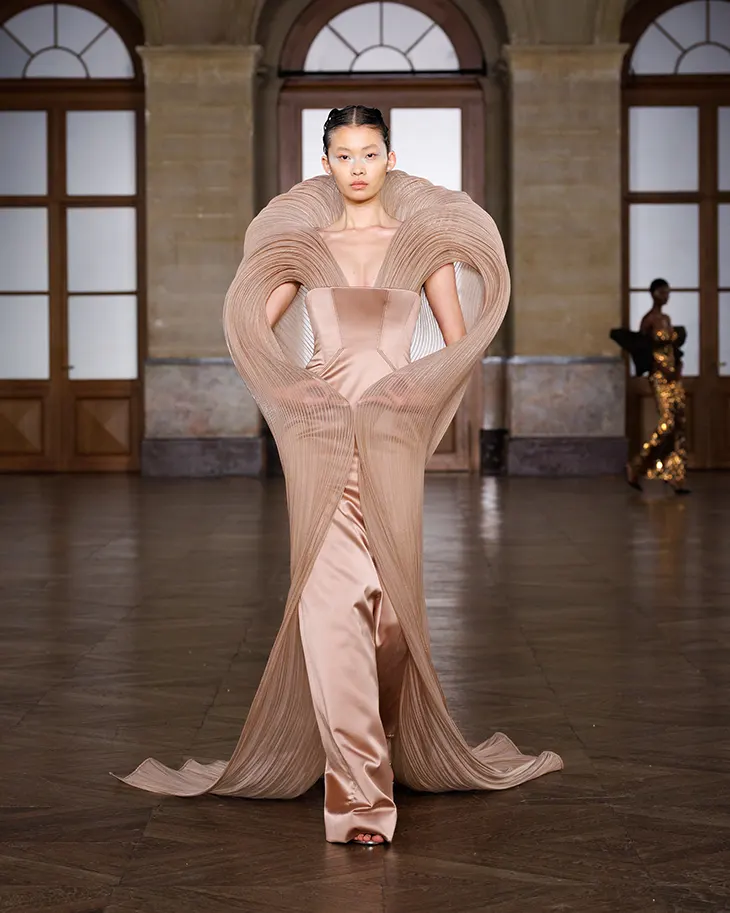
This search resolves in a monumental corset inspired by temple statuary. Gupta shapes the piece through a custom fiber-molding technique, requiring roughly 700 hours from conception to completion.
Gupta describes each silhouette as a living structure that maps consciousness, memory, and movement onto the body. Collaborations extend this language. Preciosa integrates over 30,000 crystals across the collection. Indriya creates jewelry that reworks temple forms and uncut diamond traditions as modern heirlooms. MAC designs makeup that traces marma points across the face, while Kérastase shapes hair. Rene Caovilla footwear carries architecture into motion.