


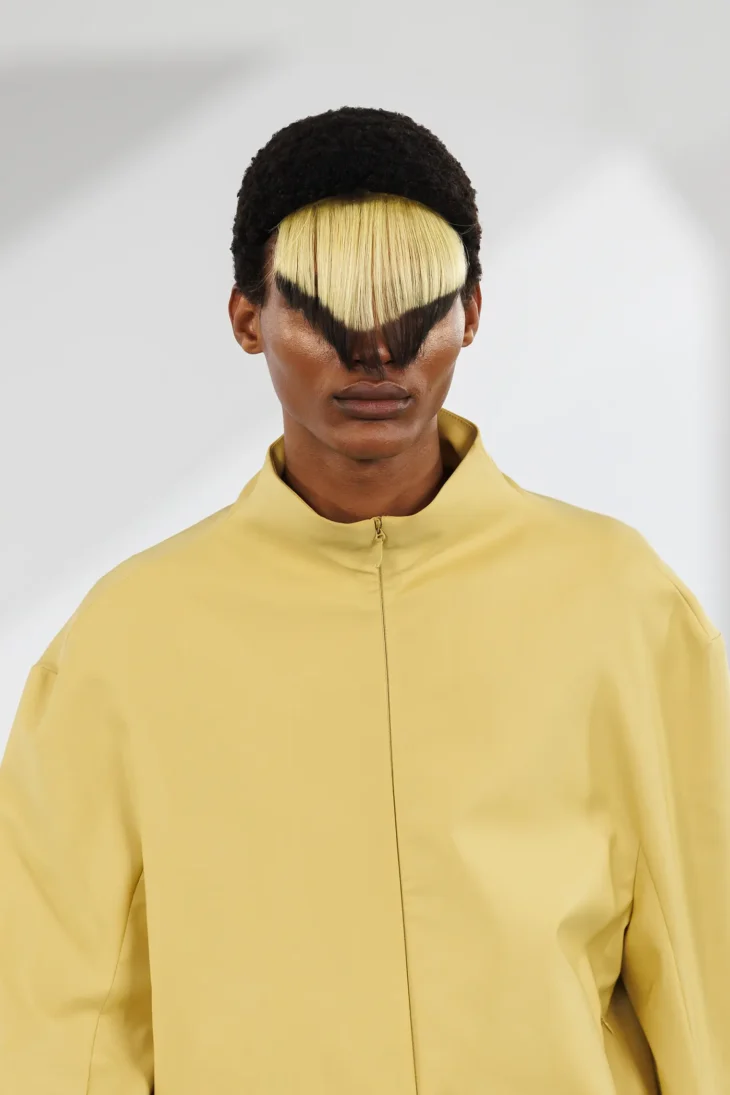
After seasons spent constructing elaborate characters and narrative archetypes, Kiko Kostadinov strips back to essentials for Fall Winter 2026. The collection, presented at Paris Fashion Week, represents a deliberate return to the primary language of garment making, construction, material, and the inherent logic of cloth against body.
Philosophical Reset
The central inquiry driving this collection asks what garments might become when engaged with on their own terms, liberated from imagined end users or framing narratives. This is fashion as pure investigation, where time has been invested in developing new vocabulary and techniques while simultaneously re-establishing the fundamentals of construction.
LATEST FROM PARIS FASHION WEEK
The collection builds through sequential variation, developing fundamental cuts and silhouettes that are gradually adapted and evolved. Simple ideas repeat and refine, expanding a design language and building momentum. The approach recalls scientific methodology, hypothesis, iteration, refinement—applied to the creation of clothing.
Dom Hans van der Laan: The Architectural Muse
A key influence emerges in the work of Dom Hans van der Laan (Dutch, 1904–1991), the Benedictine monk and architect who created buildings, furniture, and uniforms according to recurring mathematical formulas of his own devising. Van der Laan developed what became known as the “plastic number”—a proportional system that governed every aspect of his architectural practice, from the scale of rooms to the dimensions of liturgical objects.
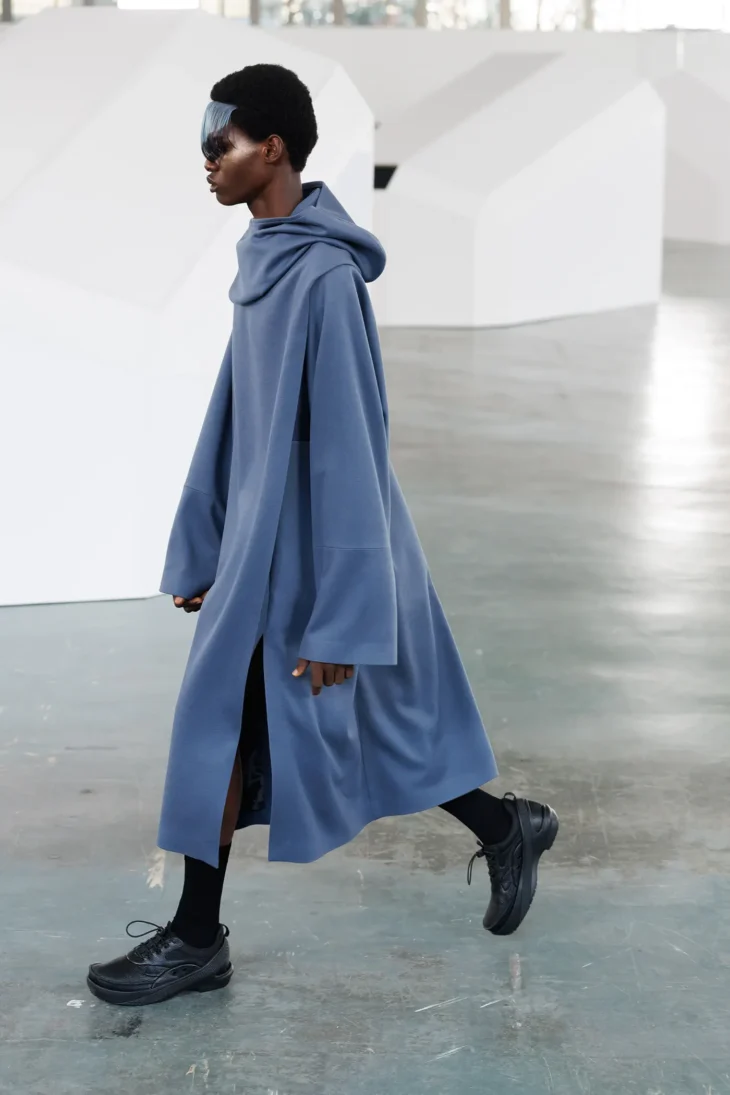
This reference proves illuminating. Like Van der Laan’s monastic architecture, Kostadinov’s garments operate within self-imposed constraints, finding freedom through limitation. The collection’s internal logic, its recurring motifs, proportional relationships, and systematic variations—mirrors the architect’s approach to sacred space.
Silhouette and Construction
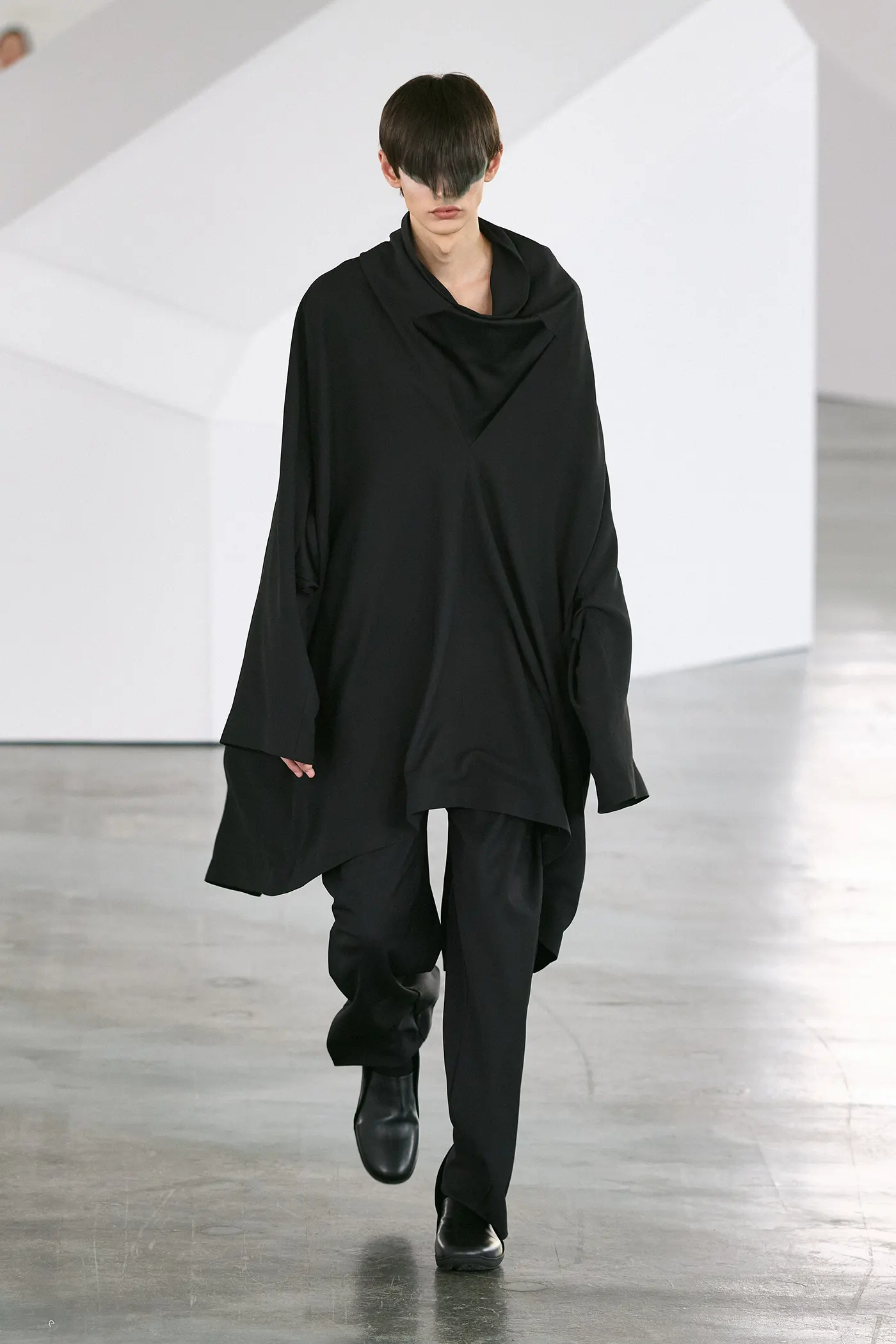
Garments exist in intimate dialogue with one another. Silhouettes fluctuate between geometric and gently warped, fitted and voluminous. Precise, clean lines give way to intricate slits, cinches, darts, and folds. Diagonal cuts and rhombus gusset motifs appear and reappear in different forms, creating visual continuity across disparate pieces.
Many garments resist easy categorisation. Blousons arrive with softly curving shoulders, wide necklines, and low-cut arms. Tops occupy territory somewhere between pullovers, shirts, and jerseys. Trousers blur into skirts. Items featuring drapes, wraps, and ties transform on the body, allowing multiple interpretations when worn.
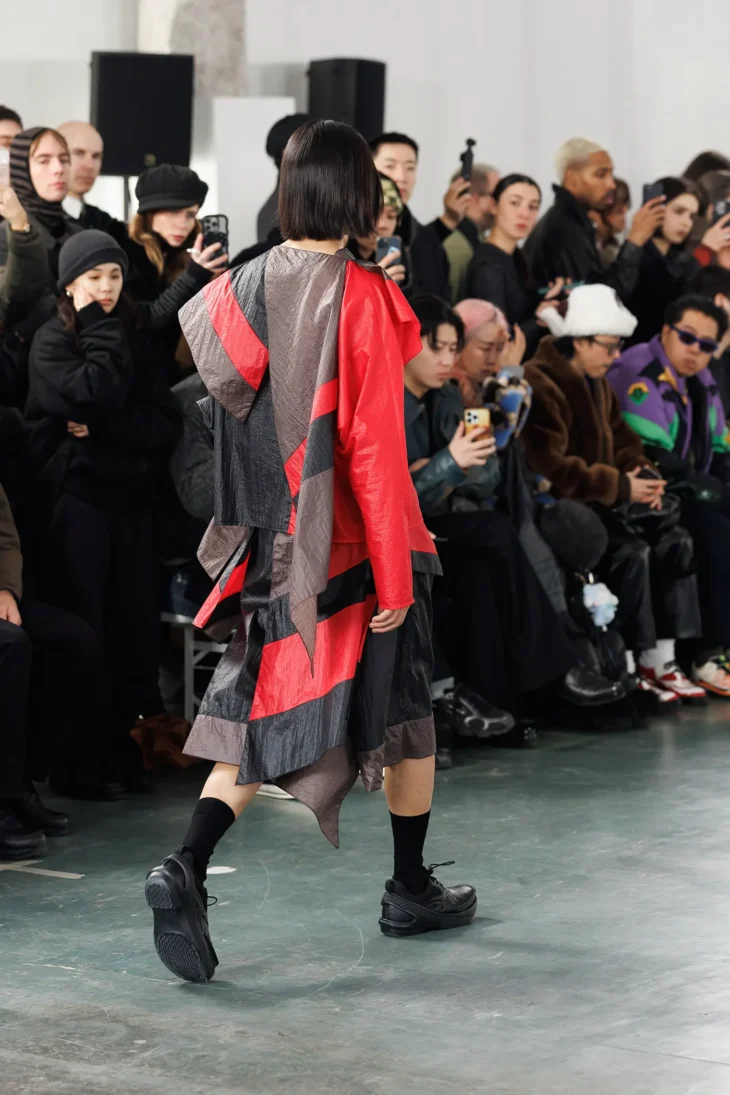
A recurring series of striped knit pieces and layered looks in lightweight crinkled nylon punctuate the collection, providing moments of patterning and expanded colour within the otherwise restrained palette.
Material Philosophy
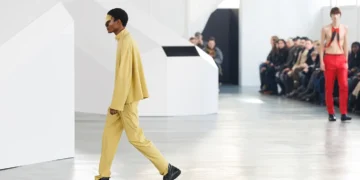
Throughout, material choices favour elevated simplicity over treatments and finishes. Colour palettes work through subtle tonalities of blacks, blues, creams, and greys, disrupted by occasional bursts of vermillion and sulphur. There is an abundance of silk, cashmere, and Loro Piana wool, deployed with a sense of generosity and playfulness.
The label’s made-in-Japan suiting expands into a series of blazers, trousers, and overcoats, all rendered in black wool to further foreground the subtle details of cut and proportion. This is clothing that rewards close examination, the pleasure lies in discovering how seams fall, how fabric drapes, how proportions relate.
Discipline of Restraint
Embellishments such as topstitching, piping, tapes, and trims are kept to a minimum, further emphasising the legibility of garments. There are no visible zippers. Buttons hide behind plackets or are matched with fabric to avoid visual interruption.
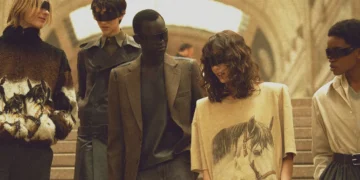
Rather than allow accessories to disrupt silhouettes, they are replaced by a series of coloured wig bands by Tomihiro Kono, which echo the geometric motifs of the collection. The effect is striking, models appear almost otherworldly, their faces partially obscured, attention directed entirely toward the clothing.
Footwear Evolution
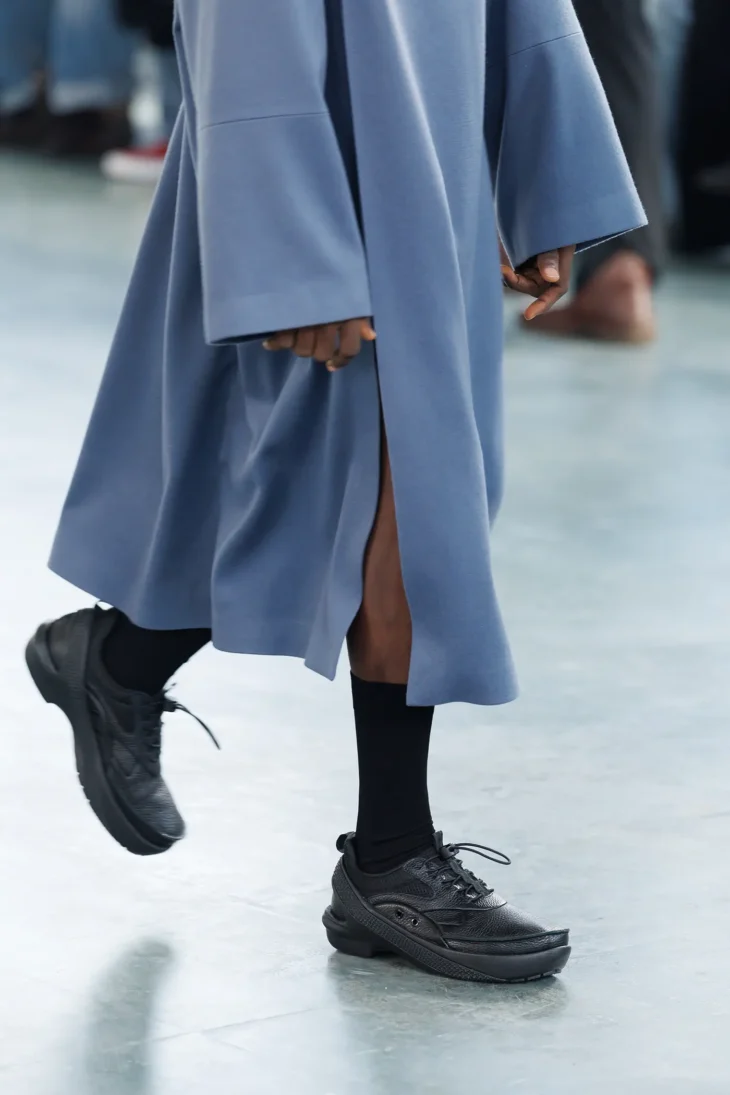
Footwear follows a similar internal logic, working and reworking variations on core silhouettes. A new slip-on appears in two styles: one with a padded leather upper, the other with an extended heel that comes both lined and unlined in black shearling wool. A series of slim-profile leather lace-ups further adapt and refine the Sargo silhouette.
Closer looks of the Details from the KIKO KOSTADINOV Fall Winter 2026 collection:
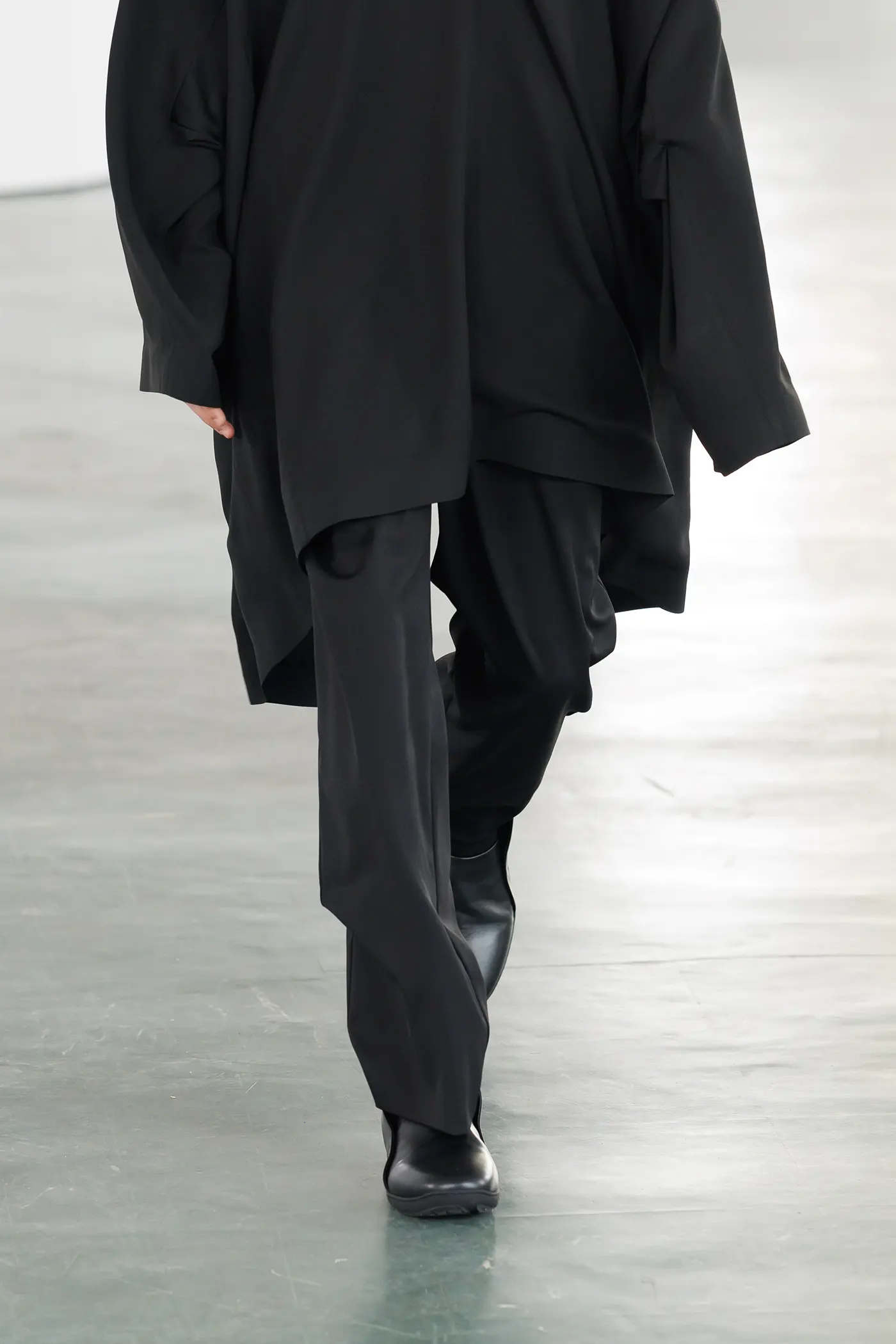
This season also marks the debut of a new collaboration with Crocs, featuring architectural lines and utilitarian directness crafted with minimal topstitching, no eyelets, and the brand’s signature heel tab integrated into the body of the shoe.
Oscar Tuazon’s Spatial Intervention
In the show venue, three sculptures by artist Oscar Tuazon (American, b. 1975) fill the space. The minimal architectural forms, each constructed from cardboard and paper tape, are arranged linearly and placed at angles to one another, echoing the rhythm and subtle variation throughout the collection.
Tuazon, known for working with natural and industrial materials to create inventive structures and installations, provides the perfect counterpoint. His cardboard constructions share Kostadinov’s interest in fundamental forms and honest materials. Both artist and designer ask similar questions: What happens when you strip away the superfluous? What remains when you return to first principles?
Finally, This is a collection that is happy being challenging, with an emphasis on producing clothes that actually bring something new to a wardrobe. In an industry often obsessed with novelty for its own sake, Kostadinov offers something rarer: genuine innovation rooted in deep understanding of craft.
Discover all the runway looks from Kiko Kostadinov Fall Winter 2026 runway show presented in Paris:
The Fall Winter 2026 collection represents Kiko Kostadinov at his most intellectually rigorous, and paradoxically, his most wearable. By returning to fundamentals, he has created garments that feel both timeless and utterly contemporary.
Images courtesy of Kiko Kostadinov