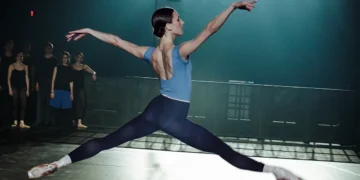



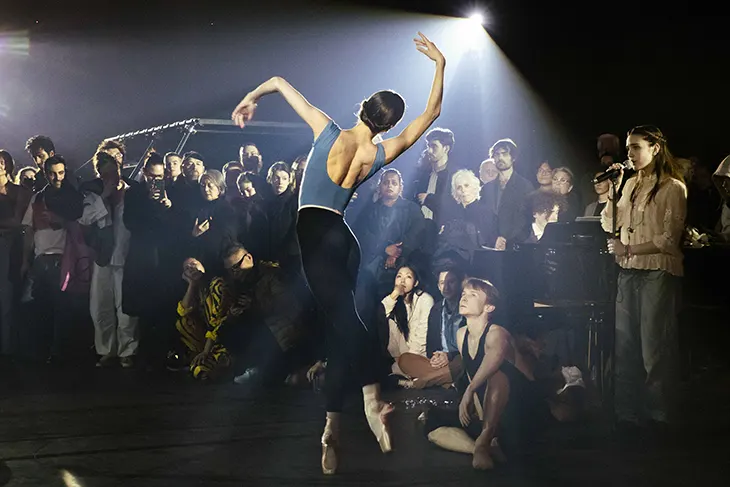
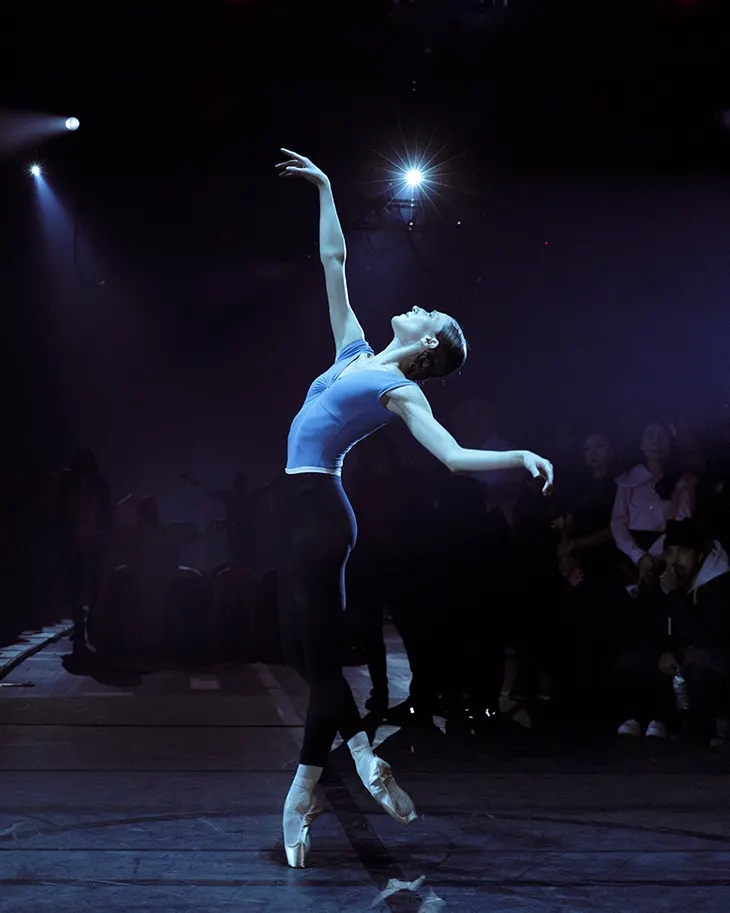
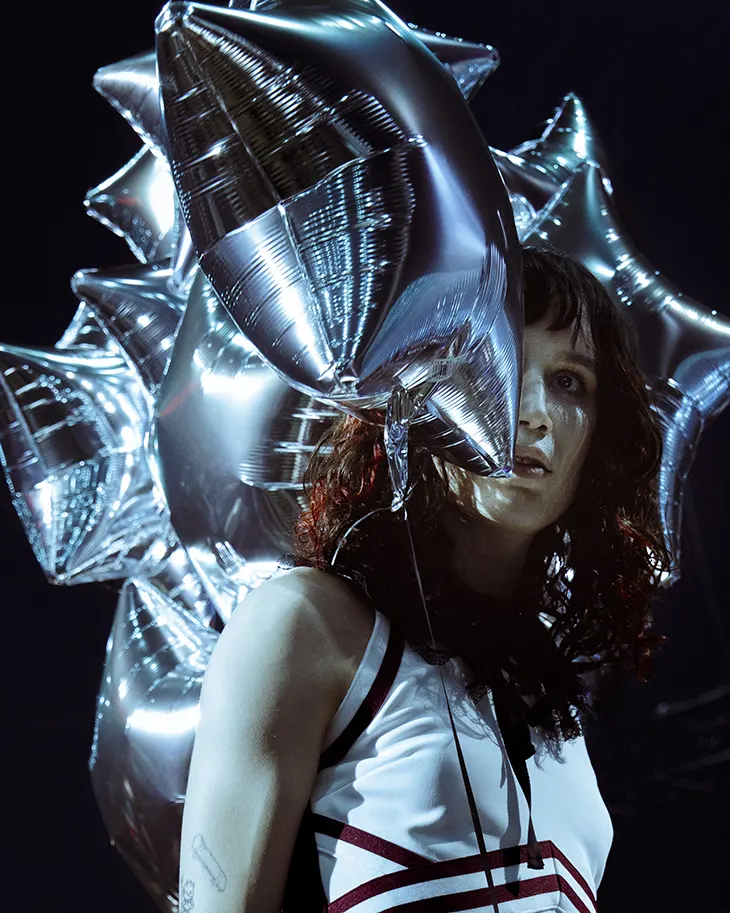
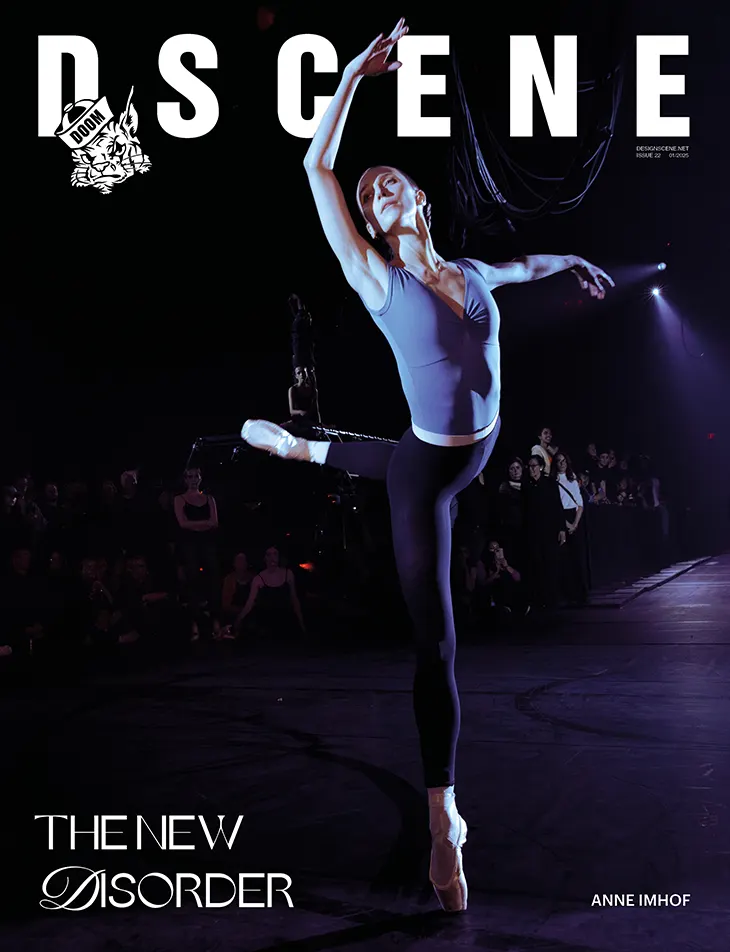
Anne Imhof’s DOOM: House of Hope (2025) transforms the Park Avenue Armory’s Drill Hall into a charged prom-like arena layered with streamers, balloons, and Cadillac Escalades. The work restages Romeo and Juliet in reverse and stretches across three hours of dance, skating, music, and fractured scenes that move through a landscape shaped by youth culture and emotional intensity. Cameras occupy every corner of the piece. They are held by performers or audience members or built into the set, creating a dense network of viewpoints that turn DOOM into its own system of watching.
ORDER IN PRINT AND DIGITAL
For Art21’s Extended Play series, producer Ian Forster stepped into this environment with a film crew of his own and became part of the shifting field he was documenting. His perspective introduces a conversation about authorship, proximity, and the way Imhof invites multiple subjectivities into the construction of an image. Their dialogue moves between the atmosphere of rehearsals, the precision of performance, and the quieter moments where DOOM began to take shape.
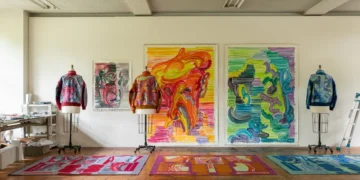
Imhof describes DOOM as a work rooted in personal experience, marked by memories of youth and the desire to carve meaning from wounds that still carry weight. The interview builds on the conversation the pair began while filming “Anne Imhof: DOOM,” tracing her path from early self-recorded videos made at night, to the collaborative approach to image-making in DOOM, to the exhibition Wish You Were Gay, which places early videos beside new sculptures and paintings that deepen the emotional and visual vocabulary of the piece. The conversation reveals a practice built on constant movement, reinvention, and the search for forms that can hold vulnerability without softening it.
Ian Forster: My entry point into your work is from the experience of having filmed it myself for Art21. Whenever I am around other cameras, I pay a lot of attention to them, because that’s my natural interest. Within DOOM (2025), there are a lot of cameras: audience members’ cameras, the cameras of your crew, the performers themselves broadcasting a live feed to the Jumbotron, and then I’m adding a fourth camera. I’m curious to talk specifically about the significance of the cameras controlled by the performers in DOOM, what is the significance of the cast doing that camera work?
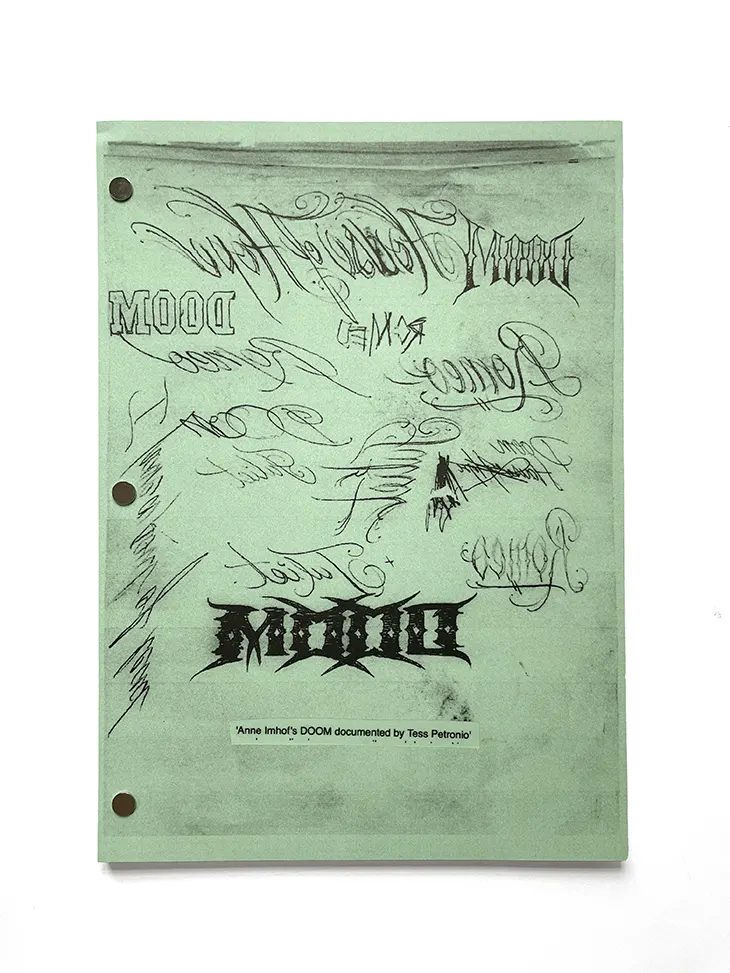
Anne Imhof: Yeah, that’s an interesting question because it was actually Tess Petronio, a young photographer, who applied for an internship to work with me, who began to document the work. While we were rehearsing in New York, she joined the cast and began documenting the piece with an iPhone.
I thought it was best to lean into the simultaneity of this piece. Since there were so many little stages, with nothing visible at the same time, I thought it would be a good idea to project those things on the Jumbotron. The best way to do that was Tess because she was already part of the performance. So, she followed certain characters, including the Romeo character, played by Sihana Shalaj, and the other people Romeo met. In the end, there was a lot of footage because I streamed the different trajectories of the performers on the Jumbotron.
That simultaneity created cool moments, like when Perla Haney-Jardine, who played the role of “the dance critic,” is talking about the culture of dance in the main drill hall while in a side room, Xavier Days is performing a flexn solo. The Jumbotron brought together moments that were descriptions or juxtapositions of one another. It was good.
You mentioned this interesting idea of documenting from within, could you talk more about that interest? You’re interested in embracing the kind of different subjectivity that the different people within the cast brought to it in their own photography of the piece.
Photography was a part of the whole performance, and we embraced it. There is this idea of making everything that is happening visible. In the beginning, there was a plan to use social media as an outlet to introduce the characters before the doors of the Park Avenue Armory ever opened. I wanted to film the cast being themselves as actors and dancers, but also being their characters, introducing them while out in New York City, sitting in a diner, or in Central Park, going to a concert, all these things that the performers actually do in their lives. Tess ended up taking these pictures before and during the performance, which are now compiled in a small book, which is a sort of prequel to DOOM.
Photography was a part of the whole performance, and we embraced it. There is this idea of making everything that is happening visible.
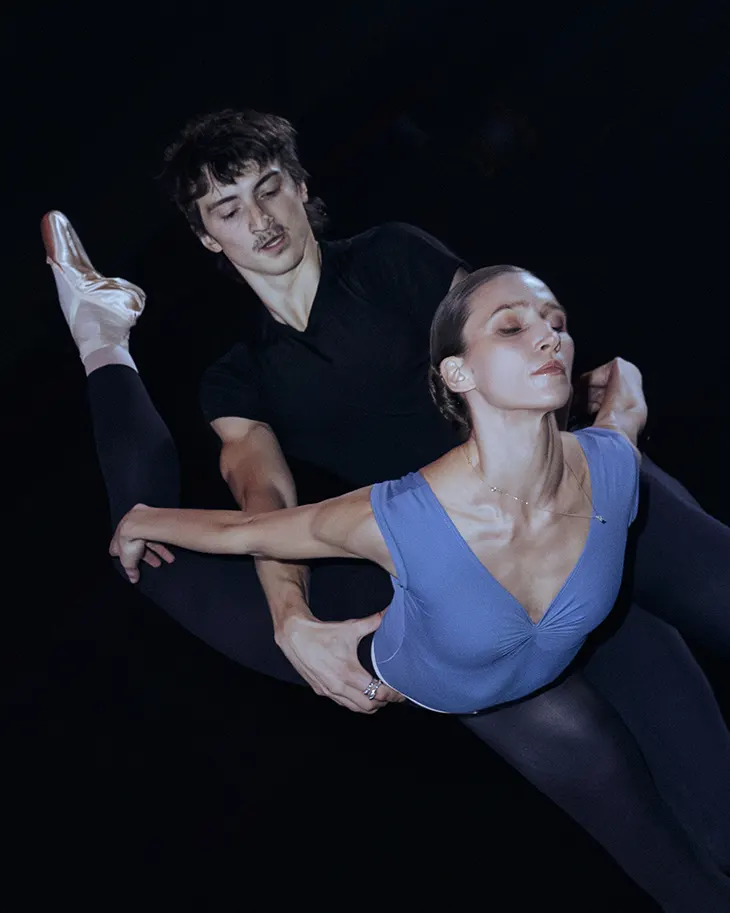
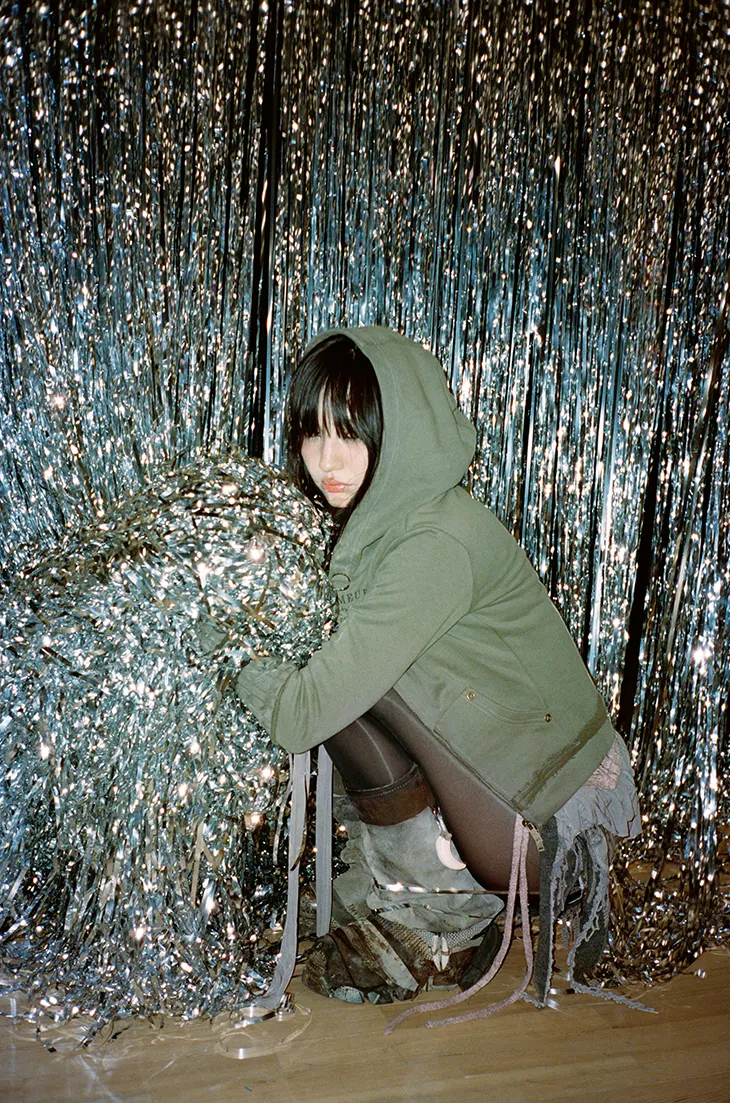
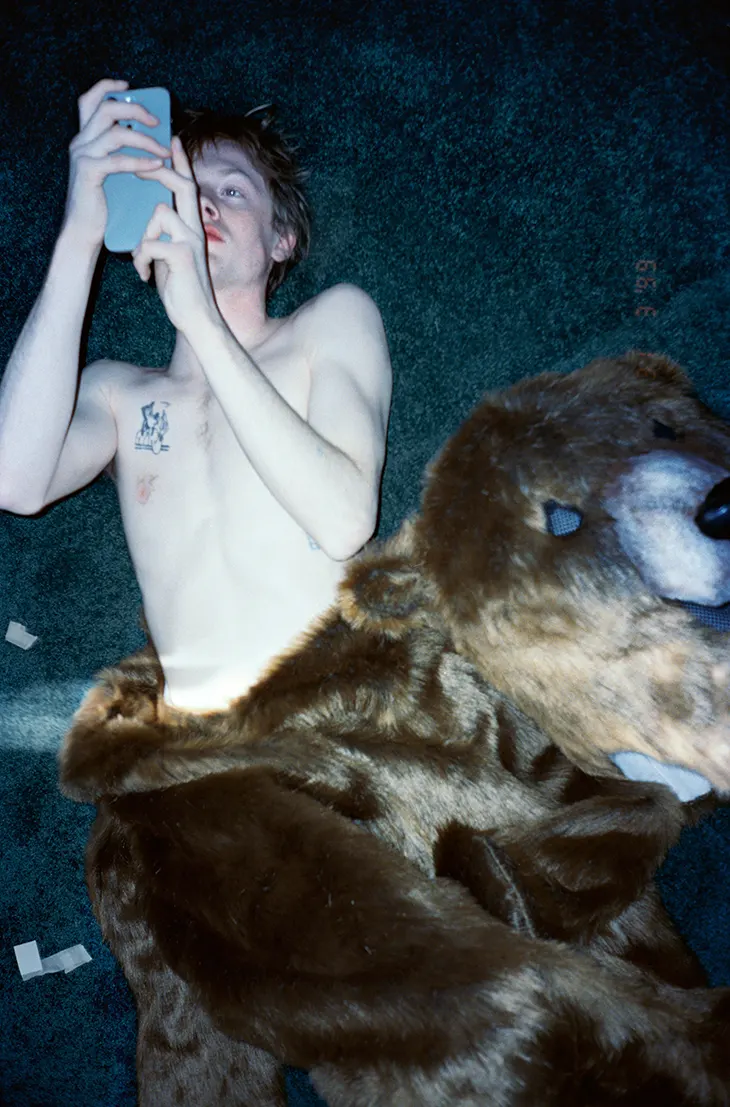
In addition to Tess, Sihana Shalaj also shot her own pictures on a Polaroid camera; Eliza Douglas took pictures of the cast and their costumes to figure out what they should wear, and took these beautiful behind-the-scenes portraits; and Efron Danzig, a young artist in the piece, photographed friends in the cast as well.
I’m curious to talk about other forms of documentation in your works. Given the ephemerality of performance, how do you think about your own photo and video documentation or the documentation that comes from an audience?
For me, when I make a photograph or video of a performance, that documentation wouldn’t be a work. However, I have made works based on documentation material, JESTER (2022), from the piece NATURES MORTES (2021), for example. That video is related to that performance, but it was the journey of the character of the Jester throughout the whole piece. There are a lot of changes in the editing process, of course. For me, it’s usually a choice of using completely different music from the performance. It’s a whole new edit, it’s a film work. The mere documentation, I wouldn’t say, is a work in its own right, though it very much shows what happened. The film work has to become a completely different thing in order for it to begin to capture what happened.
In a way, the cameras become a source of power, but the agency and power lie in the person who performs on stage as well.
In my performances now, there are a lot of cameras. In 2017, I did FAUST, and a lot of people recorded the piece with their own phones, and I gave into that. Instead of saying, “No, put a sticker over your camera. Please don’t take any photos,” I only said, “Please respect the performance” as a way of telling the audience not to come too close or not to be inappropriate with their phones.
That turned into an idea of allowing people also to take something home, orhave a part of the piece be theirs. With audiences making their own archives, their pictures were appearing on social media, and became the images that people saw before they went into the show, and that performers saw of themselves. So, the audience had a strong influence on the images that became iconic.
Could you tell me more about the idea of allowing other people’s images to become these iconic representations of the piece? How does that touch on your relationship to sharing control and authority within the work, given that the pieces are so collaborative and bring in so many different perspectives? Were you always comfortable letting other images seep into the world that then become a record that people see first and respond to?
The only intention that I really have is to relinquish control. It’s a ridiculous enterprise to start controlling images and how they travel, in the same way that I find it ridiculous to control every maneuver and every movement of a four-hour piece where there are 40 cast members involved.
In a way, the cameras become a source of power, but the agency and power lie in the person who performs on stage as well. I would never not allow pictures to be taken of the piece, or of the audience, because it’s a part of what this relationship is.
The only intention that I really have is to relinquish control.
Of course, I’m thinking about how to create a safe space inside the performance. There are so many people in the work, always performing together, so there are always people who can catch if something goes too far or if an audience member is really overstepping. We almost rehearse how to deal with cameras and audience members taking pictures.
Thinking about different relationships to the camera brings us to some of the early video works of yours that we filmed at the Kunsthaus Bregenz, like Zebra (2003), Work (2002), and even Turnpike (2003). What was your initial impulse in picking up a video camera and turning the lens on yourself?
The camera was a way to be seen by something; it was a way of seeing myself. These were the first cameras where you could turn the monitor around and see yourself while filming yourself. So it opened a possibility, almost like performing into a mirror and recording it. There was such urgency back then. I was doing so much, and I was constantly letting the camera be on me. It was a very messy time back then, and vulnerable, and angsty, and lost. But everything that was messy was also very beautiful to me, and the camera was a way to frame the beauty that I saw and the luxury that I felt in being with my friends at the time. But it was also about not being ready to ask somebody else to step in front of a camera and perform for me.I was basically being my own prototype for movement or choreography.It was very specific at that time because these videos were shot in my apartment,and also mostly at night. The night was very influential on me at the time, because I was a young mom and my baby was sleeping at night, so that was my time to do my work. That was also very much a part of this.
The camera was a way to be seen by something; it was a way of seeing myself.
And then of course, nightlife also influenced mywork as I was working as a door girl at a club. A lot of the origins of the movements that I’m now interested in came from that time. Dance was there, butdance was there in the club space, not in the theater. In the videos that came after that, a lot was filmed in public spaces. I think Turnpike was the first. It was kind of a twilight zone, in between public and private. It was a strange setting for performing, as I was sometimes half-naked. It was a lot.
I also wanted to reinvent myself every time I stepped in front of a camera. I wanted it to be visible that I was able to change from one thing to another.And that was related to me finding out who I am and exploring my sexuality and my desires. When I started making my first performance pieces, we always rehearsed them outside in public places and basically performed there as part of the rehearsal. It was always more interesting to me. Partly because these were the spaces that were available to me,and partly because I was already able to work with an audience in those spaces.
When I started making these performances, I felt very vulnerable about my video works because I felt I was in such a different place than I had been. A video like Maria (2002), in which I move to songs from West Side Story is an example of that. I loved West Side Story, I loved Bernstein’s music, but it was also an ironic thing to take something so established and classical and move to it in the way I did in my apartment. There is an interest of mine in having classical forms and languages expressing new ideas. West Side Story is also a story of Romeo and Juliet, and I myself am a Romeo, full of desire and angst in the video.
Everything that was messy was also very beautiful to me, and the camera was a way to frame the beauty that I saw.
Wish You Were Gay (2024), which happened right before DOOM, was the first time I showed this video, and I realized so many of my interests in DOOM came up way before the piece. So many of the texts included in DOOM were also from this time. For example, there is a text called “The Conceptor,” which speaks of a world in the future where, once a century, somebody is born without any parents. There’s something in that that is very much still following the same theme of finding yourself, of negating a heritage, or the ideas of who you are by gender or family.
You mentioned earlier that you use documentation as material to produce new work, so I’m curious how you’re planning to use documentation of DOOM in what you’re working toward now, and how working with the video documentation offers a different way of seeing or understanding the work?
I’m working on a new work from the documentation of DOOM for my next show, called Fun ist ein Stahlbad, to be shown at Serralves Museum of Contemporary Art in Porto. The phrase, which comes from Theodor Adorno’s text Minima Moralia, describes the culture industry being so intertwined with the transactional and not having the thing that art is supposed to do inside.
I wanted to reinvent myself every time I stepped in front of a camera.
The last room of the exhibition will be the projections of DOOM with one of my steel room sculptures in the very middle, with a stainless steel mattress, which reflects the projections. The projection is Devon Teuscher dancing Romeo’s solo from DOOM, set to the Tchaikovsky Concerto in D Major, which is different from the live performance. Taking new music and putting it atop these movements gives them a very different meaning suddenly, and I like that a lot.
Reflecting on my practice, there is something very similar about my early video works and DOOM, and there are lyrics I wrote at that time which appear in DOOM, and those feelings are still in the work: wanting to reinvent, and for change to be visible from one form into another, this strong sense of solitude, and of finding yourself, not defining yourself by things like family, or gender, or this external idea of who you are.


what a stunning cover! Ballet and Opera forever!
i am in love with this! Ballet is something so fascinating, I can’t believe we are even debating this today cause of a Kardashian boyfriend….