


Costume doesn’t just dress a character, it drives the plot, establishes visual motifs, and helps actors understand and embody their roles.
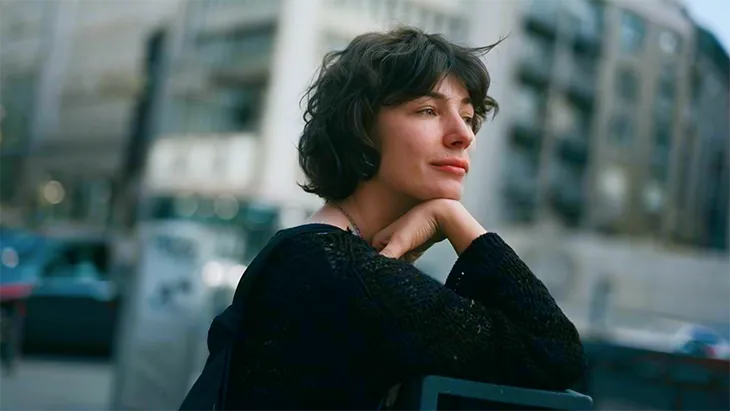
That is what Sasha Ageeva, an acclaimed costume designer with an impressive portfolio of international theatre and film projects, believes.
Her approach resonates with the tradition of psychological theatre, where a character’s inner world is inseparable from their outward expression. Konstantin Stanislavski and Vsevolod Meyerhold emphasized this interrelation, treating form and experience as a single process. Sasha Ageeva goes further, transforming the costume into a full-fledged collaborator: she works by a principle of co-authorship at the intersection of the director’s concept, the actor’s performance, and the design solution.
“Psychologism is an important part of my work. I try to convey to the audience even the smallest changes in a character. My main task as an artist is to lead the story through costume.”
Theatre: A Collaborative Journey
Our Class, New York, BAM Theatre, 2023
The play draws on Tadeusz Słobodzianek’s acclaimed work, which examines the lives of people caught up in the Holocaust, one of humanity’s most devastating chapters. This was Sasha’s first US-based project, in New York, and her first collaboration with the director Igor Golyak.
Her task was to prioritize the characters’ psychological journeys rather than adhere strictly to period-specific visual markers. She proposed dressing the performers in the opening sequence identically to the audience, to dissolve the boundary between audience and stage as the action began with actors reading the script.
As the drama unfolded, the cast progressively inhabited their roles. Instead of full costume changes, wardrobe pieces were continuously adapted with carefully chosen expressive elements that enriched the production’s visual language. Sasha introduced minute details that mirrored the protagonists’ inner evolution and signaled temporal progression alongside shifting destinies and temperaments. This blending of references and injecting nuance into basic garments created a profound theatrical encounter.
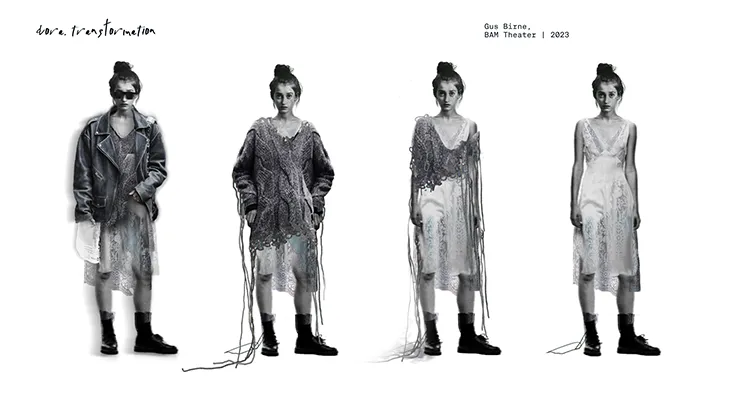
“Costume design is not a service function, it’s a full creative authorship. I bring my own artistic vision to a production, shaping its aesthetics from the inside. At the same time, I know when to lead and when to listen: the best costume work doesn’t announce itself, it deepens everything around it, the director’s concept, the actor’s presence, the story’s world. That balance is itself a creative choice, not a compromise.”
The production opened in New York and, after a strong audience reception, ran in Boston in 2025. It is scheduled to be presented in Los Angeles in Spring 2026. It earned wide critical attention and won the Lucille Lortel Award for Outstanding Revival, with additional honors for directing and ensemble. The work was named to The Wall Street Journal’s Best Theater of 2024 and received a Drama League nomination for Outstanding Revival of a Play. Following this success, the director invited Sasha to join his next project.
The Dybbuk, Boston, Vilna Shul, 2024
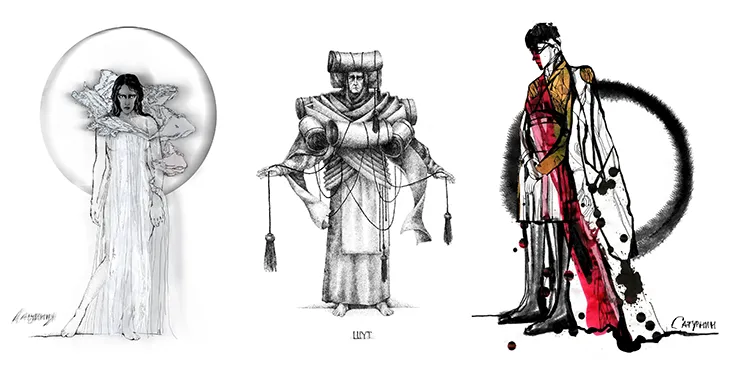
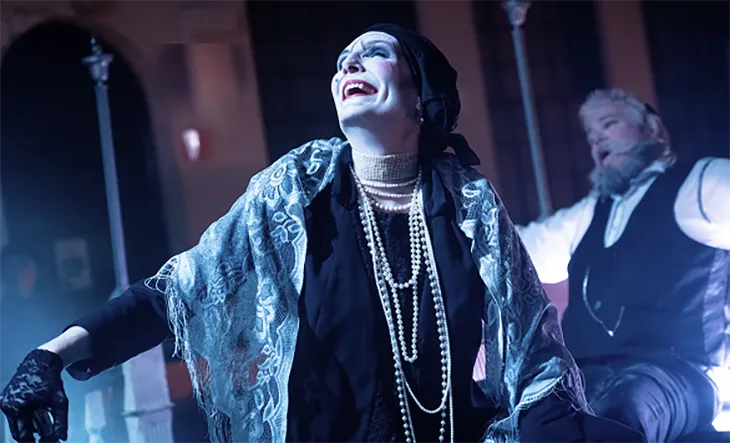
The Dybbuk marks a deliberate shift in the collaboration between Sasha Ageeva and director Igor Golyak, moving from relational staging to a self‑contained visual ecology. Performed in the sanctuary of the Jewish Cultural Center in Boston, the production treated the space itself as a central dramaturgical presence, not a neutral venue but a co-author of the concept. The entire visual language grew outward from the site: its accumulated memory, architectural atmosphere, and historical weight became the starting point from which costume, light, and staging were built. Rather than filling the space with theatre, the artists allowed the space to speak, and designed everything around what it had to say.
Ageeva’s design reframes character as liminal: figures appear half human, half spirit, their ironically sharpened silhouettes, graphic makeup, and black‑and‑white palette evoking silent‑film idioms while suspending literal period cues. Fabrics and cuts are engineered to extend movement and to respond to light and choreography, enabling performers to physically embody a state between life and death.
Film: Bridging Historical Contexts with Modern Aesthetics
The co-authorship that defines Ageeva’s theatre practice carries directly into her film work, though cinema demands a different register. On screen, the costume is read at close range: the camera finds what the eye at distance misses. Every seam, texture, and tonal shift becomes legible. For Ageeva, this is not a constraint but an invitation, to inject meaning into the smallest element, to let a single button or a fraying device carry the weight of an entire psychology.
Light, feature film, 2023
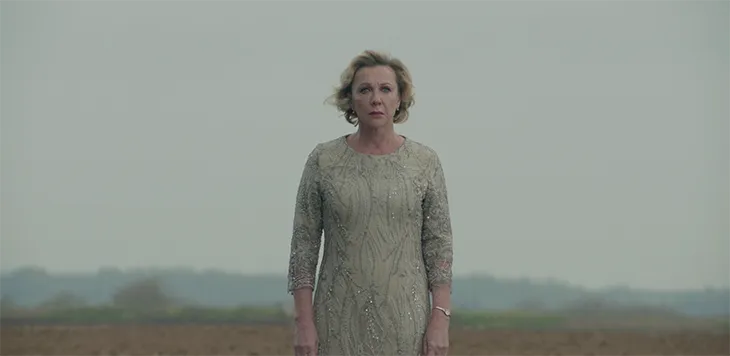
In the feature film Light, directed by Anton Kolomeets with cinematography by Ekaterina Smolina, Ageeva constructed visual identities across two distinct temporal worlds, the Soviet 1970s and contemporary Russia. Rather than drawing a sharp contrast between the eras, she deliberately softened the boundaries between them. The vivid colours of the 1970s were muted, lending the past a smoky, memory-saturated quality that allowed the editing to move fluidly between periods. Each character’s palette carried its own psychological logic, guiding the viewer through inner experience rather than chronology. In this way, costume became a narrative mechanism – a mediator between eras that dissolved historical distance and brought the audience closer to the characters’ emotional world. The work earned Ageeva a nomination for the Nika Award for Best Costume Design, Russia’s most prestigious film academy recognition
Reflecting on this work, Ageeva says: “I wanted my costume design to contribute to the unique atmosphere of the play.” Despite the conceptually demanding format, Ageeva successfully captured the director’s vision: the production won the prestigious Elliot Norton Award for Outstanding Production, and she received a personal nomination for Outstanding Costume Design.
Hero, short film 2021
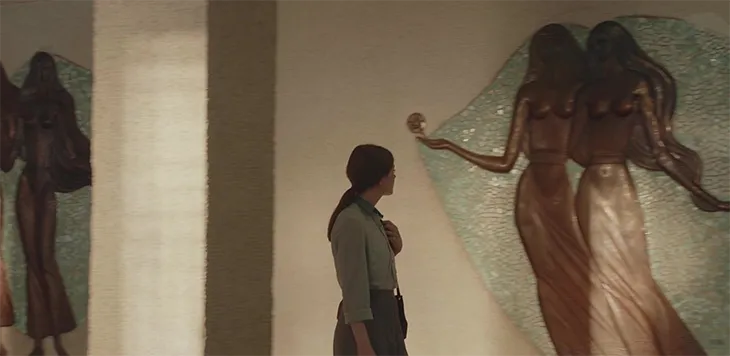
Sasha’s work on the short historical film Hero (2021), directed by Sofia Raizman, required the opposite precision. In this project costume became the primary carrier of historical context: the audience had to understand the period immediately. Working with the fashion of the 1850s, Ageeva built silhouettes that significantly contributed to visual storytelling. The design allowed the narrative to unfold without explanatory exposition. The costume conveyed social position, character psychology, and dramatic tension at first glance.
The main challenges of the project proved Ageeva’s high professionalism; neither the limited production budget nor the tight deadline scared her. She managed to do final fitting in just one day. The result confirmed this accuracy: the film received the Jury Prize at the Kinotavr, cited for its precision and purity.
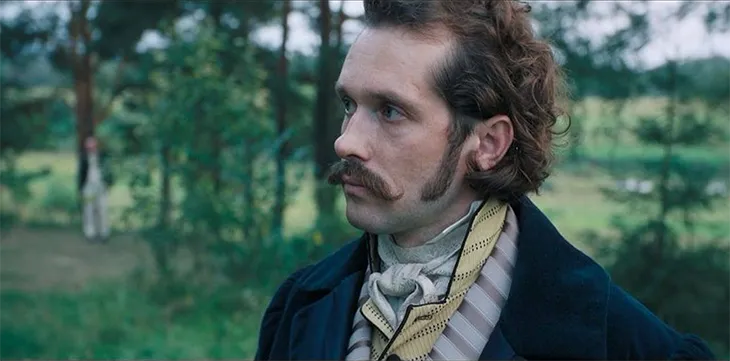
Across both films and theatre projects of Sasha, her costume design functions as a narrative mechanism, a close-range language that allows the viewer to read character, time, and memory simultaneously. Without any words.
The method of co-authorship that Ageeva develops in theatre remains central in cinema, where the focus shifts toward detail and close-up perception. Here the designer dresses the character “from head to toe”, carefully considering every element to create a cohesive image readable at intimate distance. This allows her to move organically between theatre and film: once her clear artistic method is established, switching between media becomes natural and intuitive.