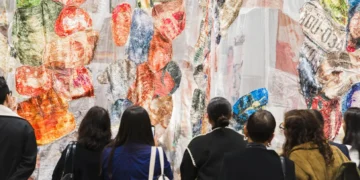



The New Museum is back in downtown New York, and the city is treating it like a return, not simply a reopening. On our recent visit, the building was full, not with the dutiful hush of a cultural obligation, but with the kind of crowd that arrives ready to spend time, to argue with what they are seeing, and to let the day unfold floor by floor. For a museum that has always positioned itself as a barometer of the contemporary, this matters. The New Museum is once again a place people actively choose, and in a city oversaturated with “must-see” lists, it has re-entered the conversation as one of the museums you actually visit, not just cite.
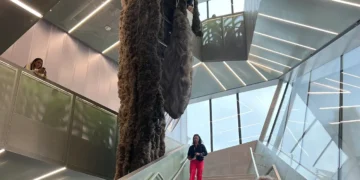
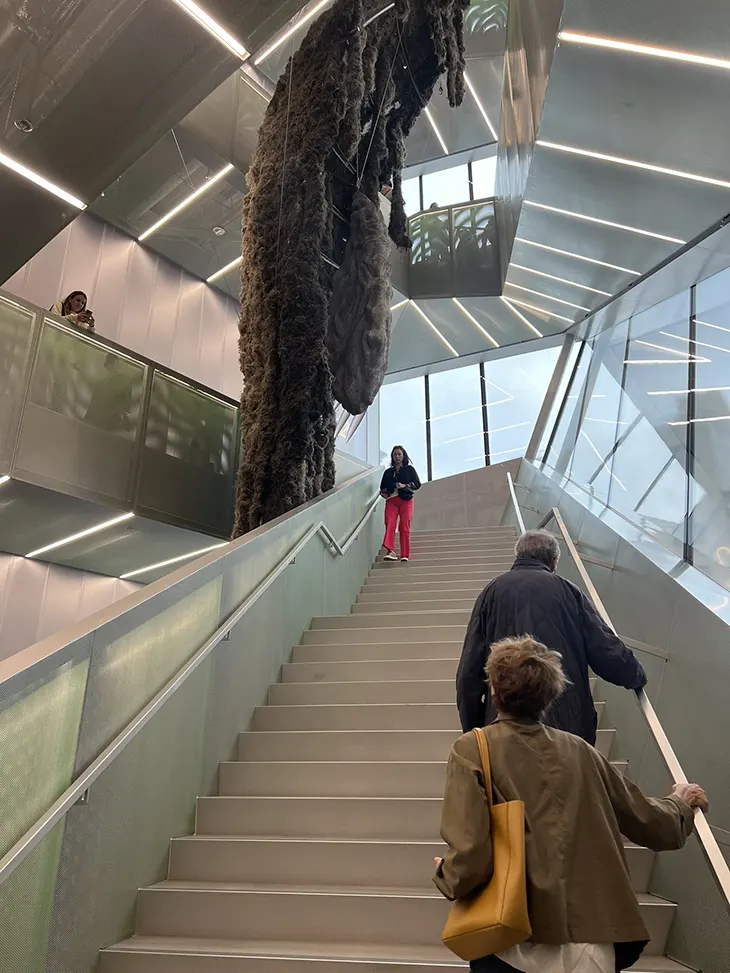
That renewed pull is not only about programming, it is architectural. The museum’s expansion, designed by OMA (for our fashion crowd, the practice behind every Prada set design and Fondazione Prada), is the sort of intervention that does not try to out-shout the original building, but it does insist on being felt. The most consequential change is also the least glamorous to describe: circulation. The New Museum previously relied heavily on elevators, which created a stop-start rhythm that made the institution feel more vertical than fluid. OMA’s addition addresses that problem directly, with a massive staircase running through all four floors, giving the museum a new internal tempo. It is a pragmatic fix, and also a curatorial one. When movement becomes intuitive, the visitor’s attention can stay on the work rather than on the logistics of getting to it.
The most consequential change is also the least glamorous to describe: circulation. The New Museum previously relied heavily on elevators, which created a stop-start rhythm that made the institution feel more vertical than fluid.
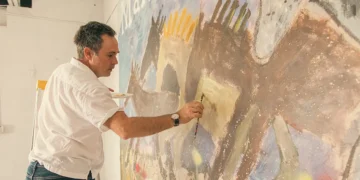
The building’s most legible metaphor arrives before you even enter. As part of the New Museum’s ongoing Facade Sculpture Program, Tschabalala Self presents a new site-specific work titled Art Lovers (opening March 21, 2026, and ongoing). Self depicts a romantic scene of a couple embracing, a gesture that mirrors the architectural “kiss point” where the SANAA-designed building meets the OMA-designed expansion. Visible from Bowery and Prince Street, the work reads as both a public image and a private moment, a contemporary portrait of New York life that understands how intimacy and spectacle coexist in this city. It is also, crucially, a piece that does not flatten the museum into branding. It adds a human register to the building’s hard edges, and it frames the museum as a civic space where connection is not incidental, it is part of the point.
Tschabalala Self: Art Lovers is curated by Massimiliano Gioni (Edlis Neeson Artistic Director) and Madeline Weisburg (Senior Assistant Curator). The curatorial framing is subtle, but effective: Self’s work is not presented as an isolated commission, it is positioned as a lens on architecture and public space. That emphasis matters because the New Museum’s expansion risks encouraging a familiar kind of institutional self-congratulation, more square footage, more spectacle, more “new.” Self’s facade commission resists that easy narrative. It insists that the museum’s most meaningful expansions are not only spatial, they are social.
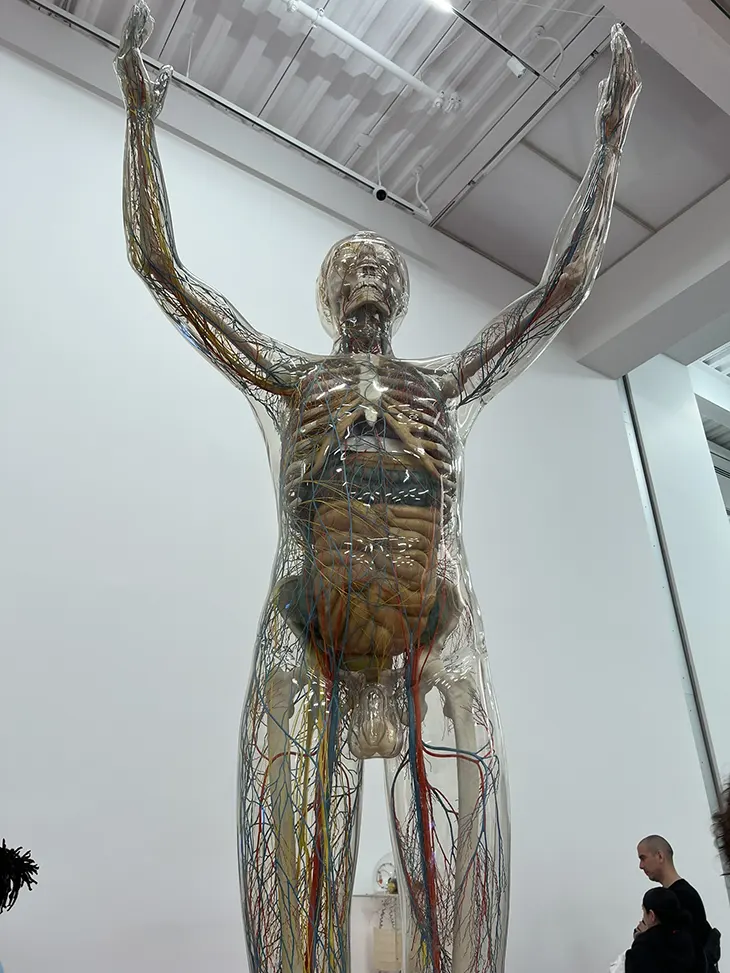
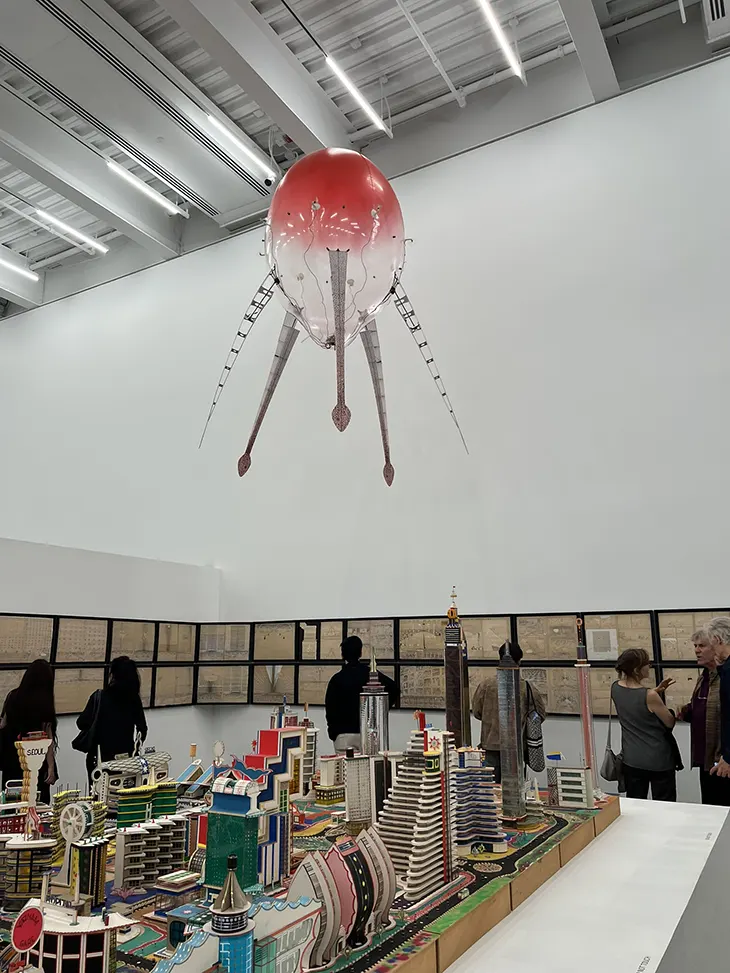
Inside, the reopened museum’s anchor is the sprawling group exhibition New Humans: Memories of the Future (also opening March 21, 2026, and ongoing), which inaugurates the New Museum’s expanded building with an exploration of artists’ enduring preoccupation with what it means to be human in the face of sweeping technological change. The exhibition spans multiple floors, and its scale is immediately apparent. It brings together more than 150 international artists, writers, scientists, architects, and filmmakers, tracing what the museum describes as a “diagonal history” of the twentieth and twenty-first centuries. The premise is familiar, technology changes, humanity redefines itself, but the exhibition’s strength is that it does not treat this as a clean narrative of progress. It leans into the mess: the utopian promises, the unintended consequences, the seductive aesthetics of futurism, and the persistent anxiety that we are always catching up to the world we built.
At its best, New Humans avoids the trap of treating technology as a theme park. Too many exhibitions about the future end up looking like product demos dressed in curatorial language.
The artist list is deliberately wide-ranging, and it creates productive friction. New and recent works by artists including Sophia Al-Maria, Lucy Beech, Meriem Bennani, Cyprien Gaillard, Pierre Huyghe, Tau Lewis, Daria Martin, Wangechi Mutu, Precious Okoyomon, Berenice Olmedo, Philippe Parreno, Hito Steyerl, Jamian Juliano-Villani, Andro Wekua, and Anicka Yi are presented in the context of twentieth-century artists and cultural figures such as Francis Bacon, Constant Nieuwenhuys, Salvador Dalí, Ibrahim El-Salahi, H.R. Giger, Kiki Kogelnik, Hannah Höch, Tatsuo Ikeda, Gyula Kosice, El Lissitzky, Lennart Nilsson, Eduardo Paolozzi, Carlo Rambaldi, Germaine Richier, and Elsa von Freytag-Loringhoven. The point is not to stage a tidy lineage, it is to show how recurring the question of “the human” becomes whenever the world’s tools change faster than its ethics.
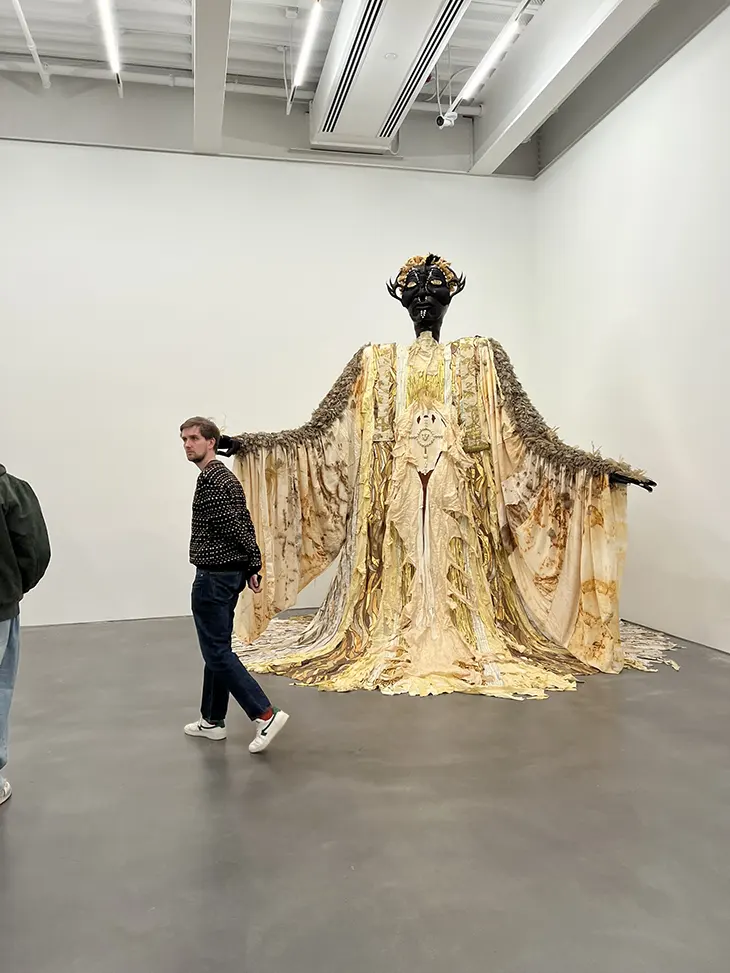
At its best, New Humans avoids the trap of treating technology as a theme park. Too many exhibitions about the future end up looking like product demos dressed in curatorial language. Here, the curators push beyond the field of art, bringing together utopian architects, sci-fi filmmakers, and eccentric writers who imagine physical, virtual, and post-human worlds. That breadth gives the show a richer cultural temperature. It acknowledges that the future is not only engineered, it is narrated, sold, feared, fetishized, and rehearsed in images long before it arrives in daily life.
There are moments when the exhibition’s ambition threatens to overwhelm its own argument, and visitors may find themselves moving quickly, absorbing impressions rather than building a sustained relationship with individual works.
The critical question, and the one the New Museum cannot fully escape, is whether scale becomes a substitute for clarity. When an exhibition gathers this many voices under a single conceptual roof, the risk is that “the future” becomes an aesthetic, a mood board of anxieties and shiny surfaces. There are moments when the exhibition’s ambition threatens to overwhelm its own argument, and visitors may find themselves moving quickly, absorbing impressions rather than building a sustained relationship with individual works. This is where the New Museum’s new circulation becomes both a gift and a challenge. The staircase makes it easier to keep moving, and the exhibition sometimes encourages exactly that.
And yet, we liked it, and not in the polite way critics sometimes say they “admire” something they do not actually want to revisit. The exhibition’s density feels appropriate to its subject. In an age when technological advancements and their unintended consequences seem to accelerate at uncontrollable rates, a clean, minimal show might have felt dishonest. New Humans proposes art as a collective form of creative prognostication, a self-portrait of the humans we may become. That is a heavy claim, but the show earns it through accumulation. It does not offer comfort. It offers a field of signals.
One of the most compelling time-based encounters is Anicka Yi’s In Love with the World, which “flies” at scheduled times. If you are planning a visit, it is worth timing your day around it:
Thursday: 11am–12pm, 1:30–6pm, 7–9pm
Friday: 11am–2pm, 3–6pm
Saturday: 11am–2pm, 3–6pm
Sunday: 11am–2pm, 3–6pm
This kind of scheduling does something important. It turns the museum visit into a lived sequence rather than an endless scroll. You wait, you anticipate, you notice other people noticing. It is a reminder that contemporary art is not only about objects, it is about conditions, timing, and attention.
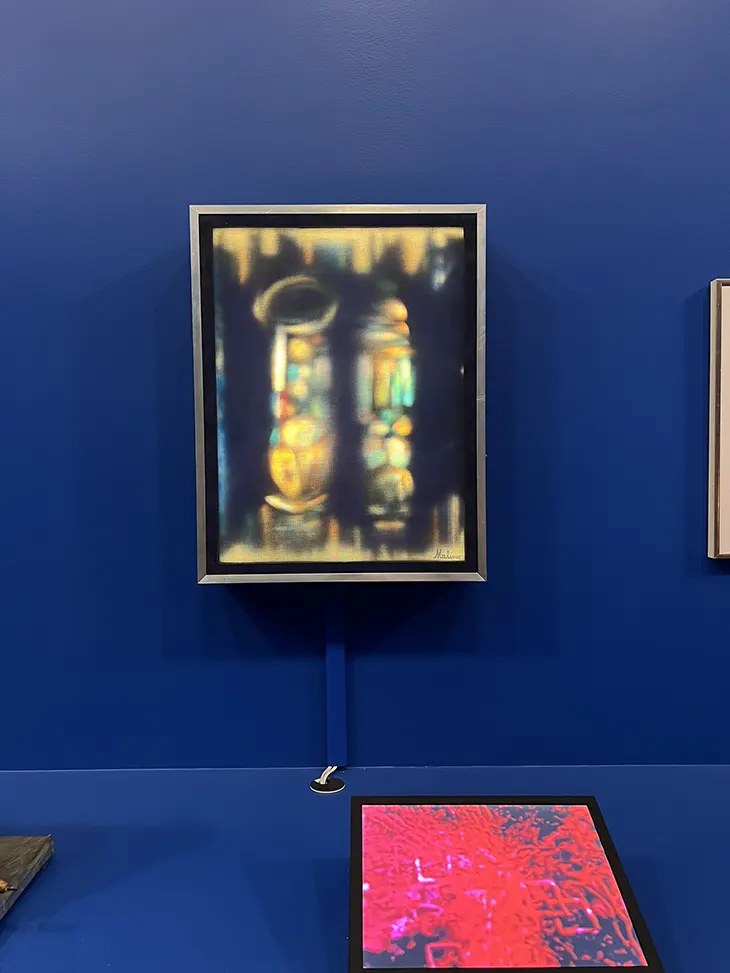
Museum Shop highlight: If you want to take New Humans: Memories of the Future home in a form that actually extends the exhibition’s argument, the New Museum Store has the official catalog, New Humans: Memories of the Future ($79.95, in stock), edited by Massimiliano Gioni, Gary Carrion-Murayari, and Madeline Weisburg, with Calvin Wang. The book frames the show as a “diagonal history” of the twentieth and twenty-first centuries, connecting the age of automatons to the current era of generative AI, and it mirrors the exhibition’s breadth by moving between contemporary voices and historical reference points. It also adds real value beyond documentation, with essays by Aaron Betsky, Erin Christovale, Meghan Forbes, Hal Foster, Sophie Lewis, Eric Michaud, Katy Siegel, McKenzie Wark, and Gary Zhexi Zhang (plus a flipbook built into the cover), making it less a souvenir and more a critical companion for anyone who wants to revisit the show’s central question after leaving the building.
RELATED: Spring 2026 at Guggenheim New York
The reopened New Museum also makes a statement about patronage and institutional identity. The presence of Dakis and Lietta Ioannou, major contemporary art collectors and founders of the DESTE Foundation, is visible in the building itself, with the fourth floor carrying their name. In a moment when museums are increasingly transparent about the financial ecosystems that sustain them, this naming is not neutral. It signals the museum’s alignment with a certain global contemporary art infrastructure, collectors, foundations, and the cultural capital that travels with them. The best outcome is that this support enables risk, commissioning, scale, and long-term programming. The worst outcome, and the one any critic should keep in view, is that museums begin to confuse expansion with inevitability, as if bigger automatically means better, as if the market’s logic is the same as cultural necessity.
LATEST ART STORIES ON DSCENE
Still, the New Museum’s comeback feels real. It is not simply refreshed, it is re-arguing for itself. The OMA expansion solves a fundamental visitor experience problem, and it does so without turning the museum into a generic “new cultural building.” The facade commission by Tschabalala Self gives the institution an exterior image that is not just architectural, but emotional, and pointedly local. And New Humans: Memories of the Future is the kind of exhibition that dares to be unwieldy because the subject is unwieldy.
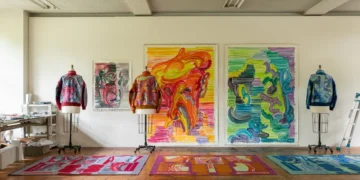
Discover more of the New Museum in our gallery:
If you are in New York for a few days, the New Museum is worth prioritizing, not because it is newly expanded, but because it is once again willing to take a position on how contemporary art should be shown. It suggests that the museum’s role is not to summarize the present, it is to test it, to stress it, and to let visitors feel the pressure of what is coming next.