


If you are mapping out Spring Summer 2026 in New York, there is one stop that feels less like a recommendation and more like a requirement: Carol Bove at the Solomon R. Guggenheim Museum. On view from March 5 through August 2, 2026, the exhibition fills Frank Lloyd Wright’s spiral rotunda with a survey that moves across more than 25 years of work, from intimate paper pieces and book assemblages to towering steel forms. It is also, crucially, a show that understands the present tense. It does not illustrate crisis, it stages the way crisis lives in the body, in the eye, in the nervous system.
LATEST ART STORIES ON DSCENE
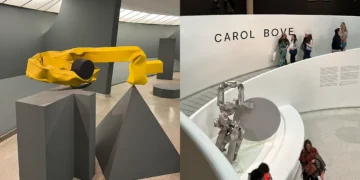
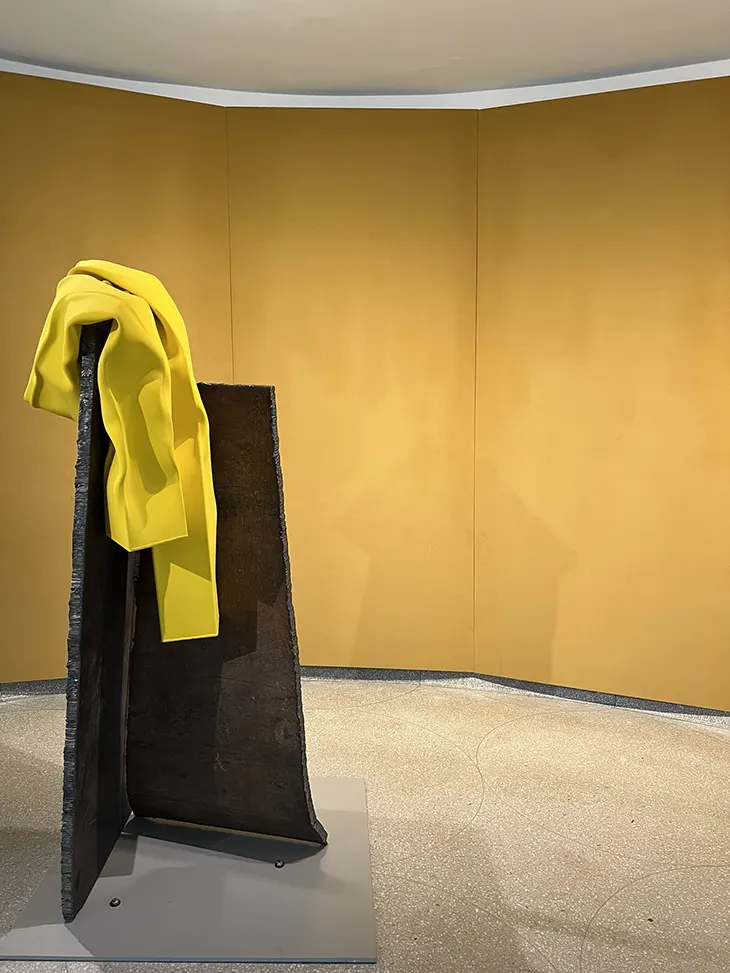
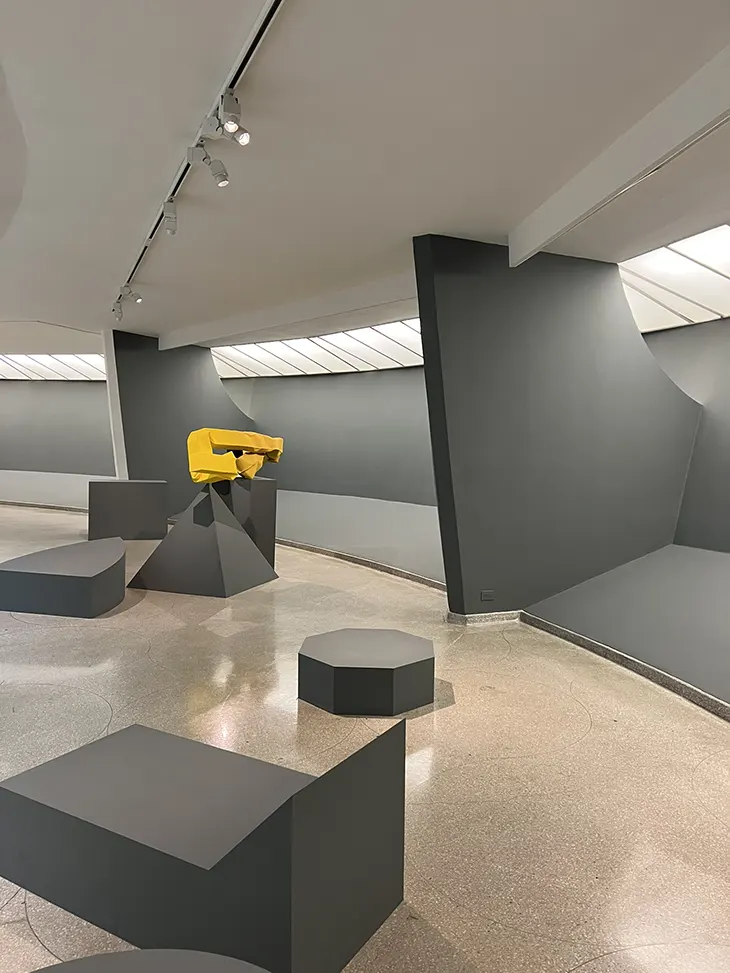
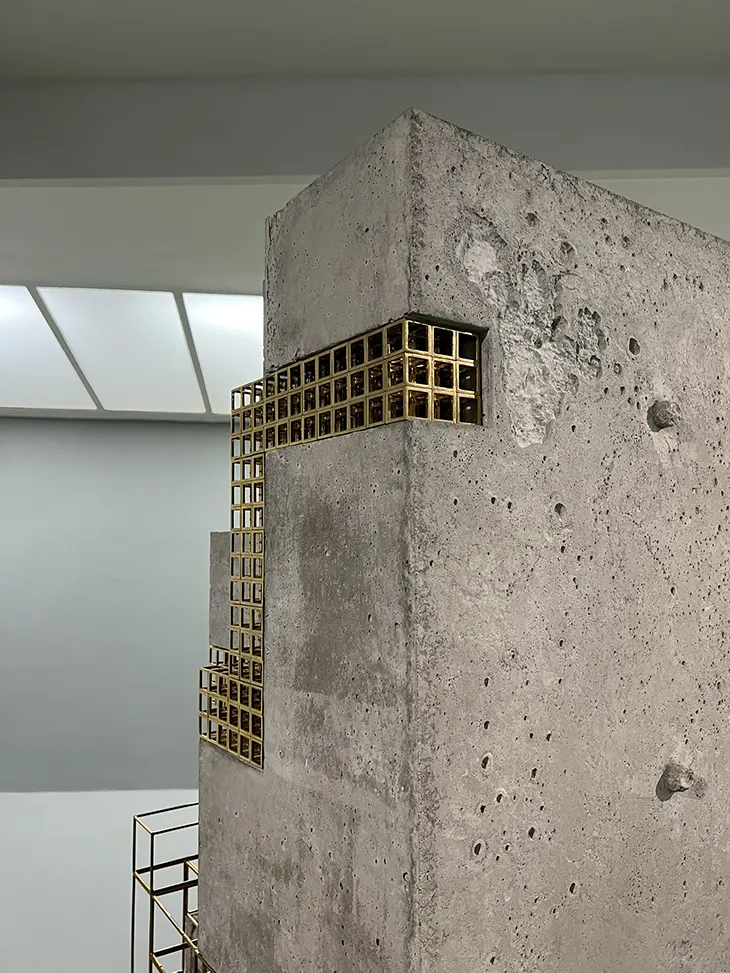
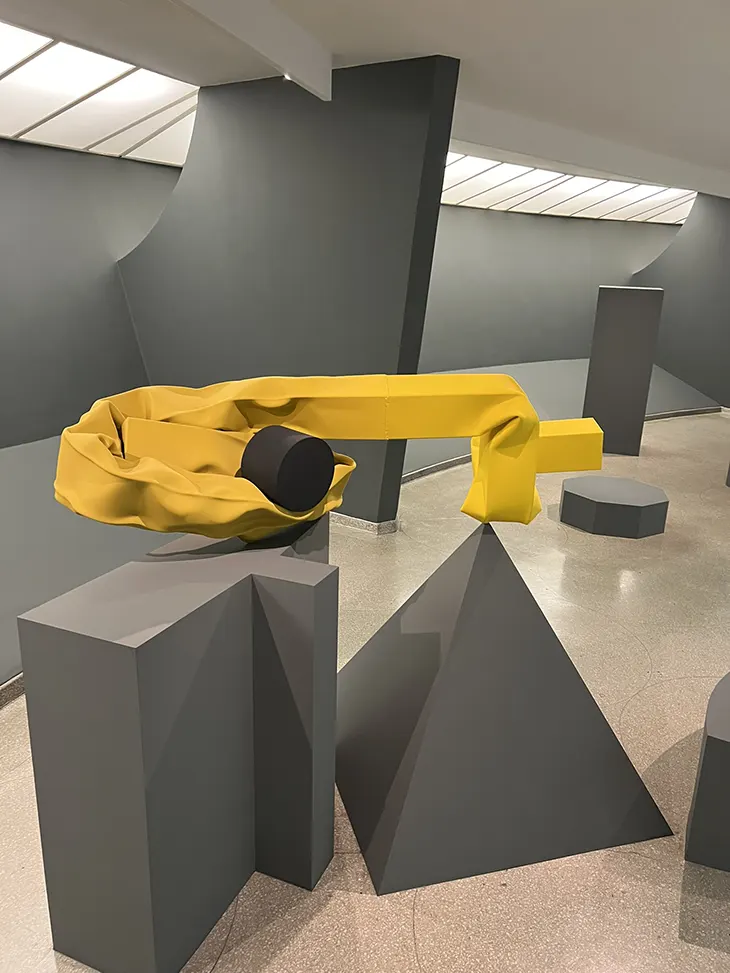
The immediate visual tension is hard to shake. The palette reads almost Play-Doh bright at moments, with surfaces that flirt with toy-like color and a kind of graphic clarity. Then the material reality hits: smashed columns, severe beams, charred-looking steel, weight and blunt force. It is sculpture that carries the memory of impact. The contrast feels like a portrait of daily life right now, the way we toggle between doomscroll severity and the small, stubborn attempts to escape it. Bove’s work does not moralize that oscillation. It simply makes it visible, and in doing so, makes it feel shared.
Guggenheim Survey That Uses the Building, Not Just the Walls
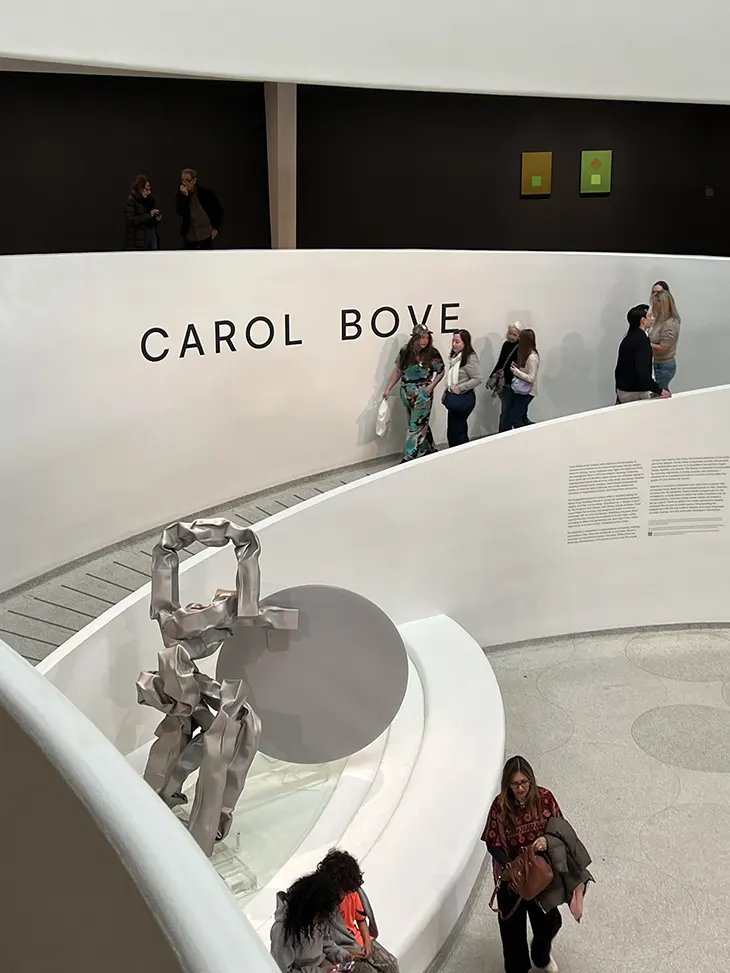
The Guggenheim’s rotunda is often described as a challenge for artists, a space that can swallow work whole or turn it into décor. Bove does something more ambitious. She treats the building as a collaborator, even as a sculptural object in its own right, activating the museum’s open sight lines so that works remain visually connected across levels. The exhibition’s structure is not just chronological, it is spatially authored. According to the Guggenheim, the presentation is arranged in a “loose reverse chronology,” winding backward from new works on the lower ramps to earlier drawings and installations at the top. That curatorial decision matters because it changes how the body reads the show. You do not simply proceed through time, you ascend through changing material density.
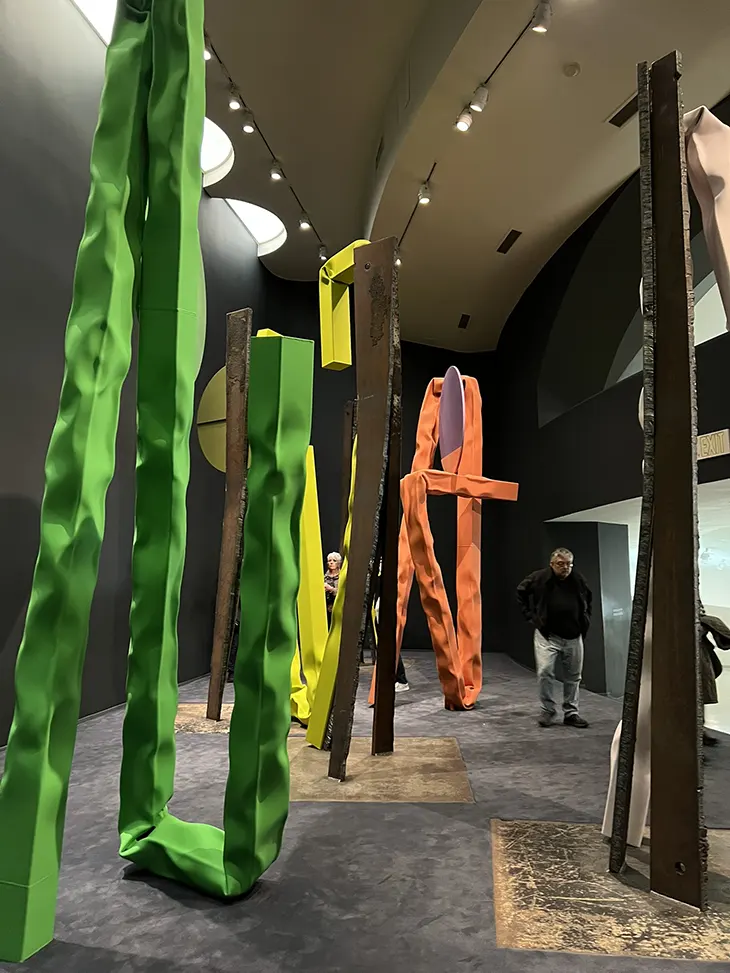
As you move upward, the physicality “lightens,” with large steel abstractions giving way to more fragile compositions involving beads, feathers, and thread. The effect is almost architectural in its pacing, a slow recalibration of weight, touch, and attention. The museum notes that this sensation of ascension is echoed by a gradated gray paint applied to the ramp’s back wall, shifting from dark to light. It is a subtle device, but it turns the rotunda into a kind of instrument, tuning perception as you climb.
The Column That Pulls Your Eye, and Your Thoughts, Upward
At the heart of the rotunda, a vertical column of six polished aluminum disks rises through the space. The Guggenheim press materials note that these disks were originally created as elements of sculptures commissioned for the nearby Metropolitan Museum of Art façade in 2021, and here they become a reflective spine that draws the eye toward the skylight. In a building already obsessed with upward motion, Bove adds a second axis of ascent, one that is less about walking and more about looking.
LATEST DSCENE NEW YORK COVERAGE
Those disks do something psychologically specific. They do not just reflect the architecture, they reflect the viewer, and they fracture that reflection across levels. You become part of the exhibition’s geometry, caught in a loop of surface and scale. This is where Bove’s long-standing interest in perception becomes more than an art-school keyword. It becomes a lived experience. You are not outside the work, you are inside its optical consequences.
Rest, Play, and the Politics of Attention
One of the smartest choices in the exhibition is its insistence on rest and play as serious curatorial gestures. Bove incorporates seating built into the architecture, a tactile library where materials from her studio can be handled, and artist-made chess tables that invite visitors to actually sit down and play. These are not add-ons. They are a direct response to what museums have become in the smartphone era, spaces where attention is extracted, where viewers are trained to consume images quickly and move on.
Bove’s interventions slow that down. They propose a different tempo, one that feels quietly radical right now. In a cultural moment defined by acceleration, the invitation to pause becomes a form of resistance. The show understands that “escape” is not always avoidance. Sometimes it is repair.
The Miró and Artigas Mural: A Reveal That Rewrites the Rotunda
The exhibition’s most talked-about surprise is also one of its most historically loaded moves. Bove partially reveals, for the first time in decades, a mural by Joan Miró and Josep Llorens Artigas that was built into the Guggenheim’s ramps in the 1960s. The Guggenheim notes that Bove created a diamond-shaped cutout that frames a view of the mural, turning it into an element within her reimagining of Wright’s “temple of spirit.”
This is not nostalgia. It is a reminder that museums have layers, and that those layers can be activated rather than sealed off. The diamond cutout functions like a cinematic aperture, a controlled reveal that makes you aware of what institutions choose to show, and what they choose to hide. It also positions Bove’s work in a lineage of modernist visual language while refusing to be trapped by it. She is not quoting Miró, she is staging him as a presence, a ghost in the architecture, a reminder that the past is always embedded in the present’s surfaces.
Who Is Carol Bove, and Why Does This Survey Matter Now?
Carol Bove (born 1971 in Geneva, lives and works in New York) has long been known for an inventive practice that moves between assemblage, collage, drawing, and sculpture. The Guggenheim press release notes she relocated to New York in 1992 and earned a BS from New York University in 2000, and that her work has been shown at institutions including MoMA, the Nasher Sculpture Center, and the Met. The point of listing credentials is not to inflate the résumé, it is to underline that this Guggenheim survey is not a mid-career check-in. It is a statement of scale and seriousness, a museum acknowledging an artist whose influence has been building for years.
The exhibition also debuts new bodies of work, including a monumental group of steel “collage sculptures” conceived for the rotunda and a series of wall-mounted aluminum panel works. That matters because the show does not read like a retrospective that ends in the past. It reads like an artist using the survey format as a launchpad, proving that the museum survey can still be a living, forward-facing form.
Critical View: Where the Show Risks Becoming Too Smooth
If there is a risk here, it is the same risk that haunts any major museum spectacle: that the installation’s elegance can seduce viewers into treating it as a backdrop. The rotunda is photogenic by design, and Bove’s reflective surfaces, clean geometries, and dramatic vertical elements can easily become content. The museum’s emphasis on play and participation helps counter that, but the tension remains. The show asks for slow looking, yet it exists inside a cultural machine that rewards speed.
Still, Bove’s work holds up under that pressure better than most. The steel has real severity. The crushed forms do not feel like design, they feel like aftermath. The lighter, more delicate works upstairs do not read as decorative relief, they read as vulnerability, as the fragile materials of attention and memory. The exhibition’s strongest achievement is that it does not collapse into a single mood. It keeps switching registers, the way contemporary life does.
Why This Might Be One of the Guggenheim’s Strongest Recent Exhibitions
What makes Carol Bove at the Guggenheim feel unusually strong is not just the scale, or the institutional endorsement, or the cleverness of the Miró reveal. It is the coherence of the experience. The show uses the building’s spiral not as a constraint but as a narrative engine. It understands that perception is physical, that looking is something your body does over time. It builds in rest without turning the museum into a lounge. It invites play without turning the work into entertainment. It connects formal language to lived reality without resorting to illustration.
In other words, it does what the best exhibitions do. It makes you feel more awake when you leave than when you entered.
If you are in New York this season, go. Not because it is a “must-see” in the lazy sense, but because it is a rare museum survey that meets the moment with clarity, tension, and genuine invention. It is, quite simply, one of the strongest recent exhibitions the Guggenheim has staged.
Discover more of the Carol Bove exhibition in our gallery:



Best thing to see now in New York on your museum stroll !