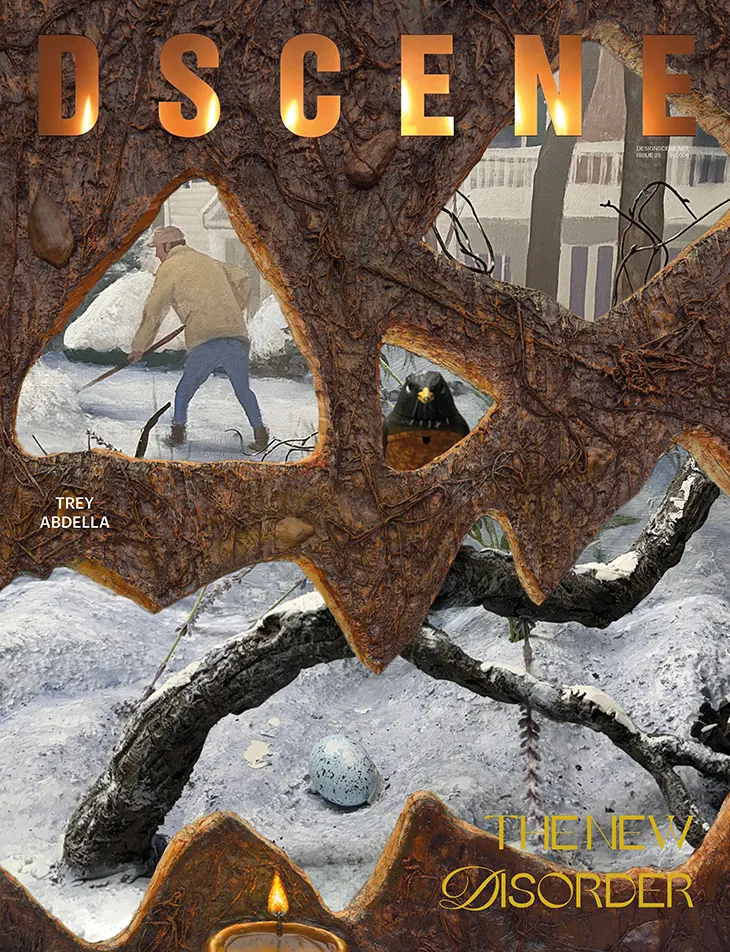


We were late. Fashion Week schedule left my sense of time unreliable and a confusion of overlapping addresses pushed us off course. Trey Abdella did not seem to care. The ride into Brooklyn began in a quiet residential stretch with neat houses and still sidewalks, the sort of place where you expect to be visiting a friend rather than arriving at an artist’s studio. Then the scenery shifted. Warehouses, storage yards and industrial pockets replaced the calm. Garbage trucks moved in and out of the street with such force that the pavement trembled as we stepped out. I wondered if we were in the right place.
AVAILABLE IN PRINT AND DIGITAL
The Uber had dropped us at the exact location from his message, but nothing looked like a studio. I called. “Just a sec,” he said. A black garage door rolled up as if summoned by the words.
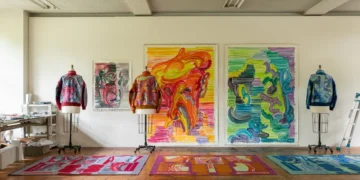
Inside, the reason for his calm became obvious. The studio felt less like a room and more like an engine in constant motion. Foam scraps, resin tests, animatronic parts, scorched branches, Christmas ornaments, screens glowing with half formed experiments and paintings in different stages of refusal crowded the space. Tools hummed and every corner suggested a project mid process. It was not lived in. It was worked in without pause.
I knew Abdella’s work before this visit, but standing inside that environment made its internal logic immediate. Paintings bulged or sagged. Sculptural pieces carried a tension between cartoon brightness and something closer to unease. Objects seemed caught in transition, waiting for the next step. In this room The New Disorder felt less like a theme and more like a working condition, a way of producing that invites lucky accidents, late nights, misbehaving materials and constant revisions mixed with precise technique and firm determination.
The moment the door closed behind us, the interview found its real setting.
Vuk: I walk into your studio and it feels like stepping behind the curtain of some unhinged theater. But anyway, you live here basically?
Trey: Pretty much. I hide in here like a hermit. I barely see people. It works for the kind of stuff I make. Everything takes time, tests, breaking things, fixing them, breaking them again.
I can recognize this weird loop where you finish one thing, and three new things land on your desk. It can be exhausting.
The balance is hard. I’m always on the hunt for new materials and am learning a ton of cool, unexpected stuff in the process. I have a lenticular printer I work with in Missouri, and I decided to try a new adhesive to adhere it. A big mistake, the glue reacted with the vinyl on the back of the print. It started bubbling, then disintegrating, but it kind of works in a way.
Everything takes time, tests, breaking things, fixing them, breaking them again.
You could just say that you chose adhesive in a way so that they would actually fail. I do that often in my work, haha. Do you build everything yourself?
It’s a hodgepodge of things I sculpt, program, buy, and paint. I have a friend that helps build some of the panels but it’s pretty much just me in here.
Out of choice or necessity?
Both. I am neurotic about it. It’s also hard to explain to someone exactly what I want when so much of my practice is rooted in experimentation and play. Since I don’t really have a recipe for the work, having others in here can feel like having too many cooks in the kitchen. Programming is the worst though I usually just want to tear my hair out.
I had the same with Arduino. I just knew I wanted kinetic work. My best friend is a programmer, we sat and decided to figure it out together. Without that kind of person, it is hard. But with AI now, I think it will change significantly. You can just type “give me Arduino code for this and that” and it will spit out something usable.
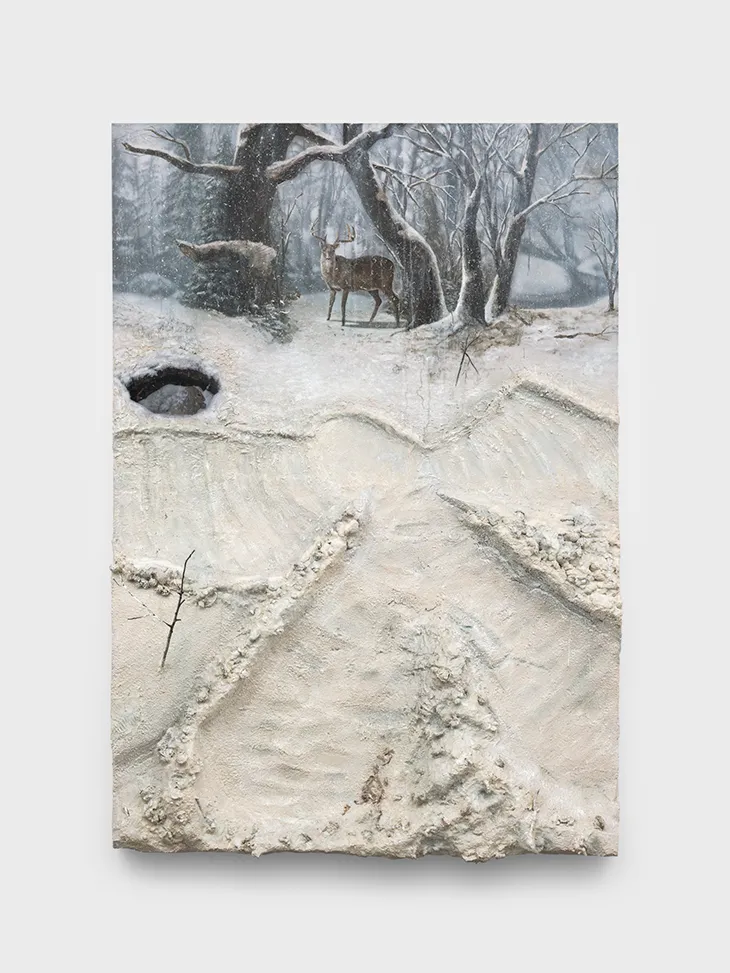
That is why some of it gets boring. Once it turns into pure repetition, I lose interest. I need some chaos in there. I am making a snow angel out of angels right now. Crushing plaster angels and camouflaging them into snow .
I like that you keep the crudeness. When artists start to become more acknowledged, everything start to get too sleek, and I find it very boring and predictable.
I need things to stay a little rough. If I can saw a child mannequin in half for a piece, I will. I still feel like a mess trying to finish these paintings.
What are you working toward at the moment?
Two shows. One with Kraupa-Tuskany Zeidler in Berlin which is going to be a winter themed show with some wall works and a large fireplace sculpture. Then a show at the KMAC Museum in Louisville, Kentucky, where there will be a mix of some works of mine over the past few years with a couple new additions.
Once it turns into pure repetition, I lose interest. I need some chaos in there.
Your work cannot really live online. The hologram does not photograph for example. You have to see it in person if you want to fully comprehend it.
I want to give people a reason to experience things in person, to subvert expectations of how something may look on a small screen.
That is what happens with your pieces. You have to come close, move around, understand the reflections. I saw your work online fi rst and liked it, but in person it looks even better. The painted and sculpted parts blend in a strange way which is very hard to achieve.
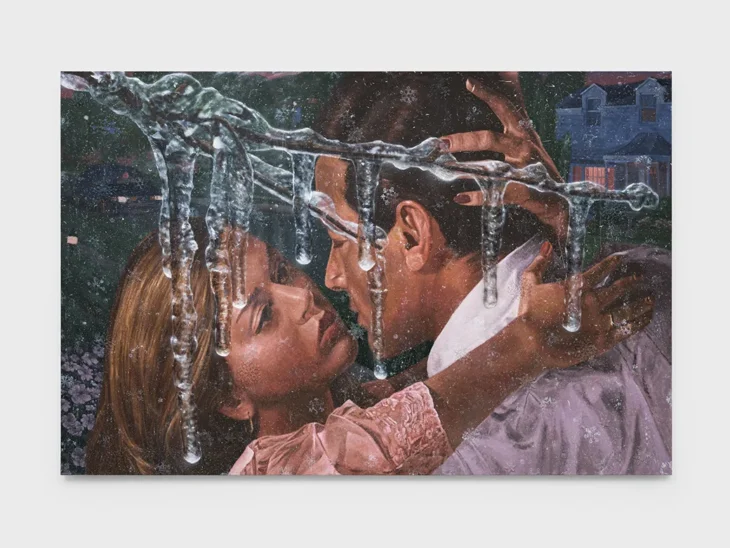
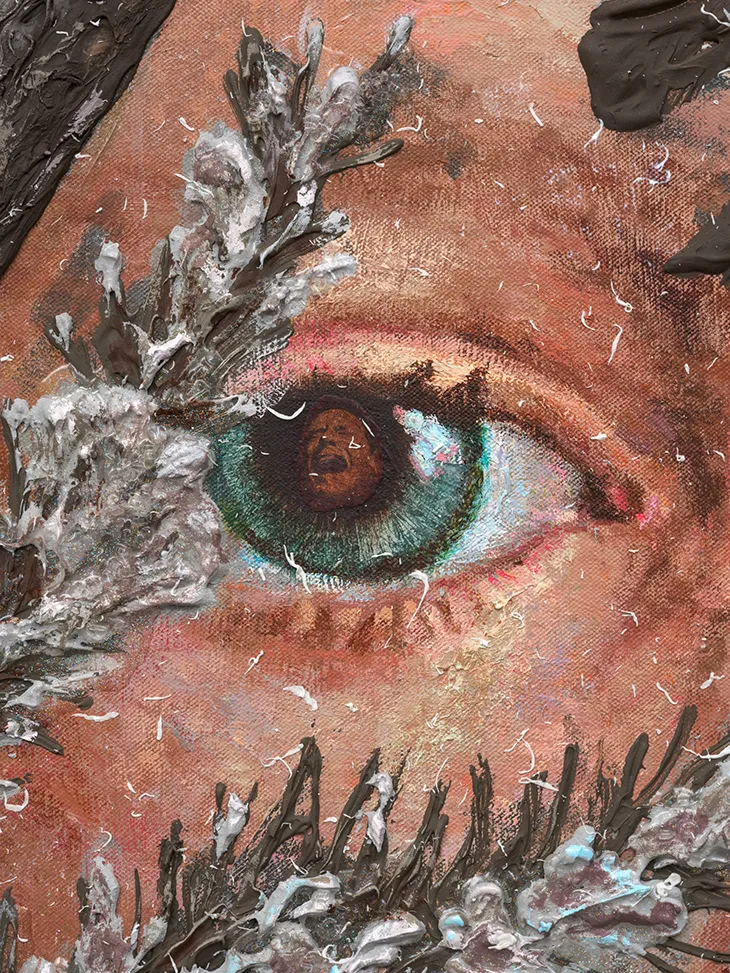
Thanks. Illusion is the core of a lot of my work. I like when people can’t tell the difference between what is painted or sculpted.
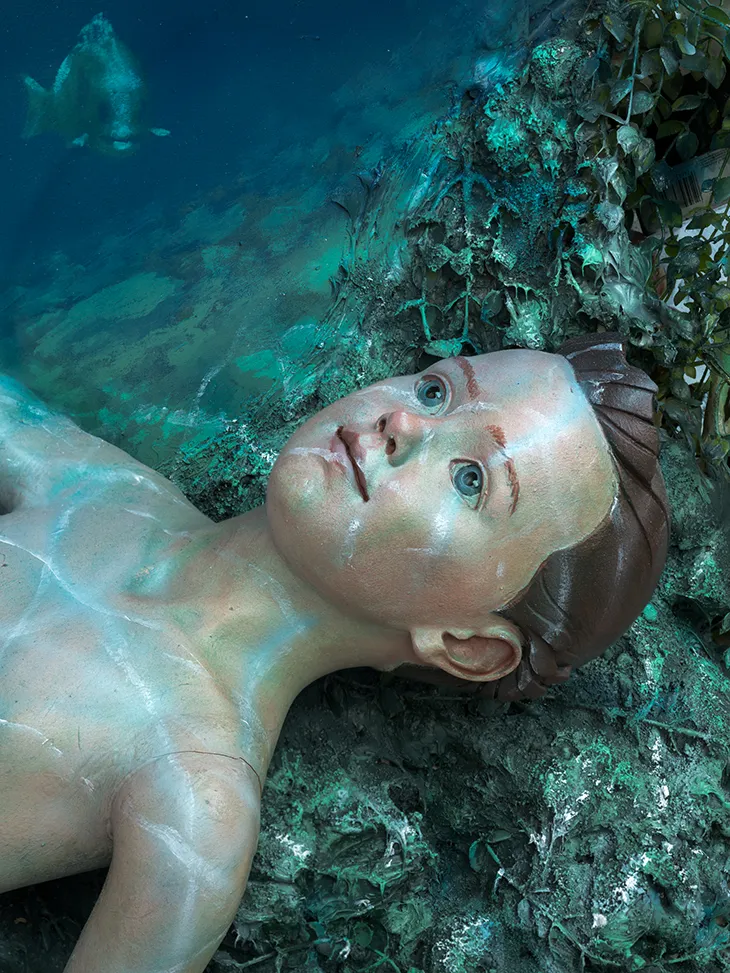
On photos, the fingers read as 3D. Someone could ask, why sculpt them at all. But the “why” is the whole point. Surprise is the answer.
Exactly.
Random question, where did @mysticfishstick come from?
Honestly, I can barely remember at this point. I think it was from the Kanye West episode of South Park.
How does New York feel from your side? I hear from a lot of people that the market has not been this bad since 2008.
It’s in a strange place it kind of feels like the wild west with no one knowing where it’s going. The landscape of galleries has been rapidly changing so you see a lot of shows that people think will be more market friendly but they start to kind of blend together.
Illusion is the core of a lot of my work. I like when people can’t tell the difference between what is painted or sculpted.
Maybe the oversaturation will force change.
Maybe. Some of the most interesting things I’ve seen lately are outside of the art world. If you are ever near Philly, go to the American Treasure Tour Museum.
What is it exactly?
It is a giant warehouse outside Philadelphia. You ride through it on a little trolley. It is someone’s collection of Americana from the last hundred years. Looking at your work I know you will like it. Kinetic sculptures everywhere, old one-man band machines, Halloween masks, the animatronic Chuck E. Cheese band, Snow White, everything stacked together. The whole place made me realize that magic still exists.
It sounds insane.
It is. And none of it is considered “art.” No one cares about it from that angle. But the engineering is wild. These things are fifty years old and still moving. There are no spare parts for half of it. It is better made than most things in galleries.
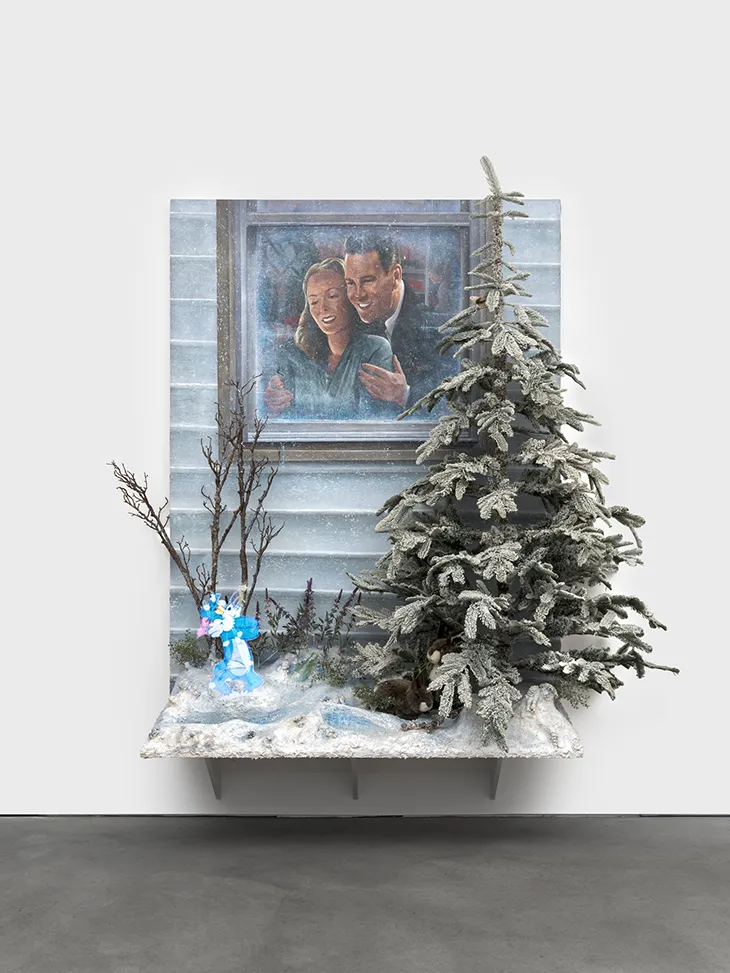
That is exactly what we were saying. You go to a huge blue-chip gallery, the rent must be 100k a month or more, and you see a painting that feels like the same school assignment as the one next to it. Abstract, figurative, realist, it doesn’t matter, it all feeds from the same source.
The work just keeps referencing things that the market has already validated. It feeds on itself. We are at a late stage of that loop where you end up with something that is technically new but spiritually tired.
Interesting for a PhD, but boring to live inside as an artist.
It’s more confusing trying to figure out where to go from here.
That is why it is important that artists like you are building a name with work that goes in the opposite direction. It gives some hope.
I hope so.
Try to understand the system, then forget it. You need to know how the sausage is made, so you can decide when to ignore it.
You are turning 31 soon, and there is already a strong wave attached to your name. When you talk to younger artists, what do you think they should keep in mind? I know advice is impossible, but still.
I always say: see as many shows as you can. See what part of the art ecosystem resonates with you. Try to understand the system, then forget it. You need to know how the sausage is made, so you can decide when to ignore it.
Same as classical painting. You learn to do it properly so you know exactly what you are destroying and why.
Definitely you need the training wheels to start but they only hinder you the faster you try to go.
So: learn it, then tell it to fuck off .
Pretty much. The hard part is that once you learn it, the rules get into your bones and breaking them is tough. The art world is weird and heavily based on timing and luck. The more you know, the less you know.
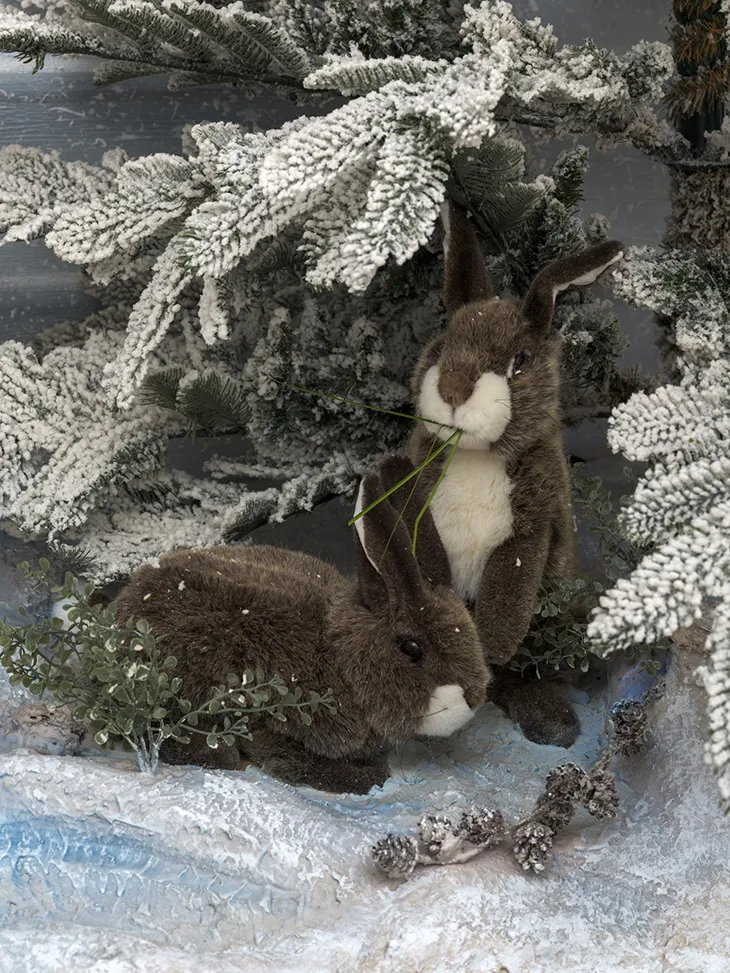
That is why there is no clear path. People say “believe in yourself,” which sounds cliché, but it is real. Show up, keep working, care.
Figure out not just what you love, but what you hate. The things you hate define you in a strange way. They tell you what not to become.
Who do you talk to about your work?
My partner mostly, she’s basically my sounding board for everything and my little brother is brutally honest. I will spend weeks working on plans and after showing it to him he’ll just say “this is boring.” And he is often right.
The art world is weird and heavily based on timing and luck. The more you know, the less you know.
Do you show them ideas before you make the work?
Yes. I plan shows 1-2 years ahead. I screentest just about every idea a while before I make them to see the responses and how I still feel after sitting with them for a bit. If they say “it’s fine,” that is the worst. I can work with “I hate it,” I can work with “this is weird,” but “fine” means it is dead.
Let’s talk materials. How do you build the sculptures?
Foam, epoxy resins, fiberglass, wood, sometimes metal, aqua resin, a product called Magic Smooth that feels like snot. It really depends on the work and what material will best suit it.
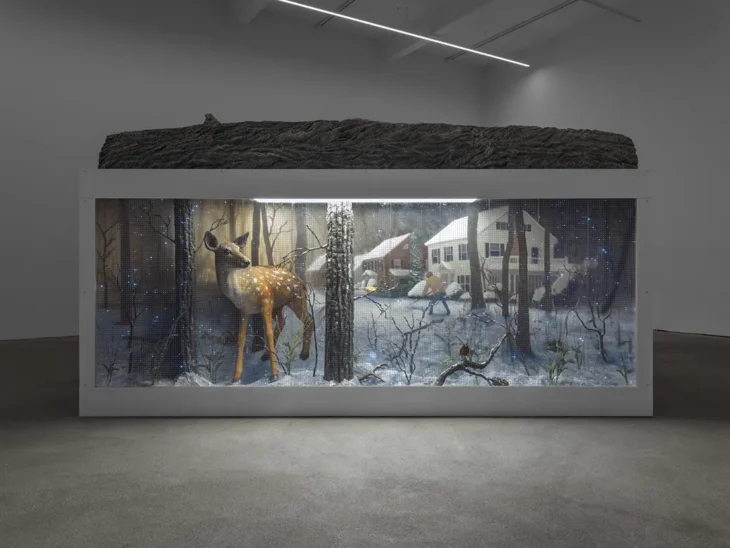
It is clever to do something unexpected with the back or sides of a work. With every surface online, people can spin images around, zoom in, screenshot. Doing something that raises the question “why” becomes the whole reason.
There are so many directions painting can go and figuring out that “why” is one of the hardest parts.
You mentioned film in a previous interview. Where does that sit now?
Before I got into art, I wanted to do animation. My dream was to have a show on Adult Swim. I make a lot of references to film and I’m always trying to figure out ways to integrate more video into the work.
I think a lot about attention: how you keep someone with something for longer than a few seconds.
So just like you blur painting and sculpture, film might be another place where you erase a border.
That is the goal. I think a lot about attention: how you keep someone with something for longer than a few seconds.
A lot of your references come from animation and older pop culture.
I am always mining old stuff. For example, when rewatching 40’s Looney Tunes there was an episode titled “Bug Parade” that had this great moment where this Fly angrily puts out a fire. I thought he was perfect so I cut him out in After Effects and put him on a hologram fan stomping on an irritated eyelid.
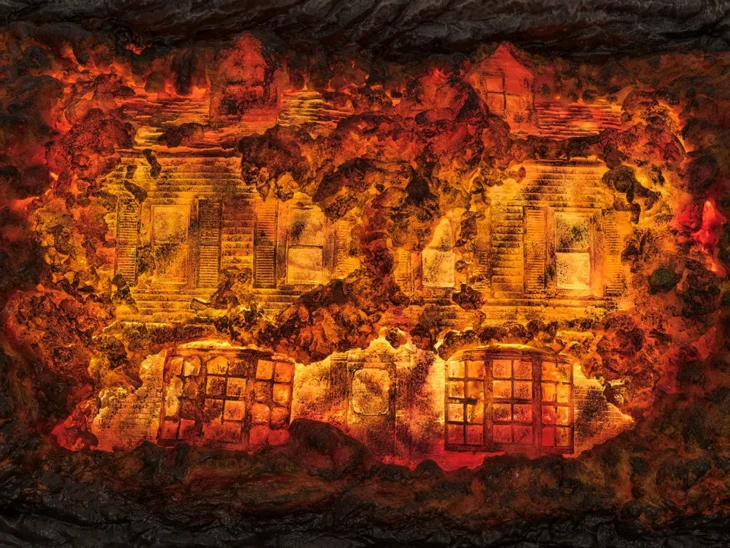
I think art today has to draw from more than art history and literature. There is so much forgotten pop culture, vintage internet, dead websites. I spend time on old rental-car sites with photos of fancy 90s cars. Totally useless, but full of mood.
I love that realm. I often think about Disneyland and Universal Studios where the design and engineering of every square inch is considered. Imagineers think through every sightline, every shadow. You walk past a window and see the witch’s silhouette appear for only just a moment.
How does your digital world look? Is your phone full of images?
The phone is fine. The computer is a disaster. Constantly crashing. Multiple hard drives. A few hundred tabs open and filled with Screenshots, clips, random notes. It never stops. I am always scavenging for references even at a bar or on the street.
The things you hate define you in a strange way. They tell you what not to become.
Speaking of bars, or anything fun actually, give us your New York recommendations?
The Spook-A-Rama ride at Coney Island. Everyone should ride it at least once. One of my partner and I’s favorite spots is The Museum of Moving Image in Astoria, especially the Jim Henson retrospective. Seeing Miss Piggy wearing a bridal dress in a vitrine is worth the trip. And there is a place in Williamsburg called Surf Bar. Sand on the floor, fake surfboards, a fake shark, usually Jaws playing on a small TV. It is perfect.
The theme of the issue is “The New Disorder.” What does that phrase mean to you?
I don’t really have an answer, but maybe that is the answer.
Lack of an answer as an answer.
Exactly. I wish I had a good riddle ready, but that is all I have.
Interview by Vuk Cuk.
Originally published in DSCENE “The New Disorder” Issue.