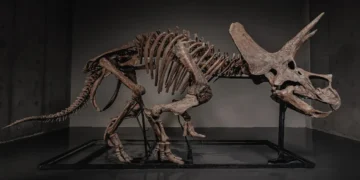



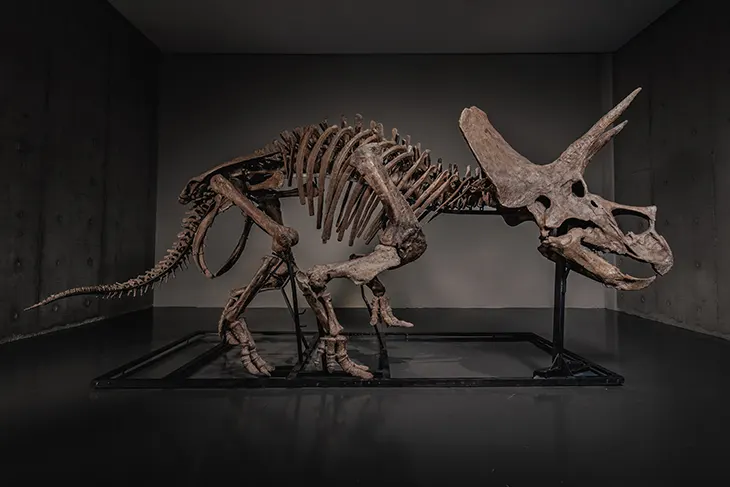
JOOPITER has announced the sale of Trey, a Triceratops skeleton, which achieved $5,550,000 in an online-only auction. The result sets a new record for a dinosaur skeleton sold through a digital format. Interest grew steadily after the auction opened in early March, drawing global attention to a specimen with both scientific and public significance.
EVENTS
Trey dates to more than 66 million years ago, to the Late Cretaceous period. Paleontology expert Andre Lujan studied and contextualized the skeleton, placing it within one of the most examined ecosystems in North America. The specimen represents a sub-adult Triceratops, a stage that offers insight into growth and anatomical development within chasmosaurines.
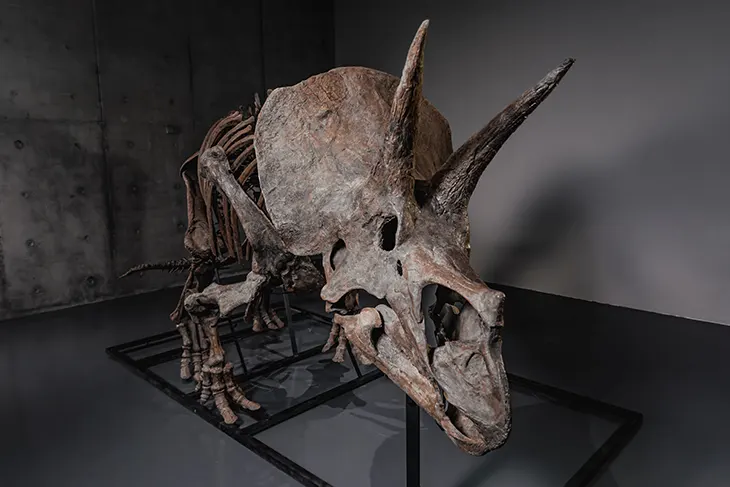
The skeleton remained on continuous public display for nearly thirty years, reaching over one million visitors. It served as a central attraction at the Wyoming Dinosaur Center in Thermopolis after its installation in 1995. During that time, audiences encountered a rare example of a dinosaur mount with strong preservation across key skeletal elements. Few comparable specimens return to market after such a long public life.
Triceratops holds a central role in paleontology, first named by O.C. Marsh in 1889 and later defined through early reference material such as the holotype YPM 1820. Trey enters this scientific lineage as a specimen from the Lance Formation, a Late Cretaceous rock unit associated with the final phase of the dinosaur era. His skull and axial structure provide clear reference points for comparative study, particularly in understanding development before full maturity.
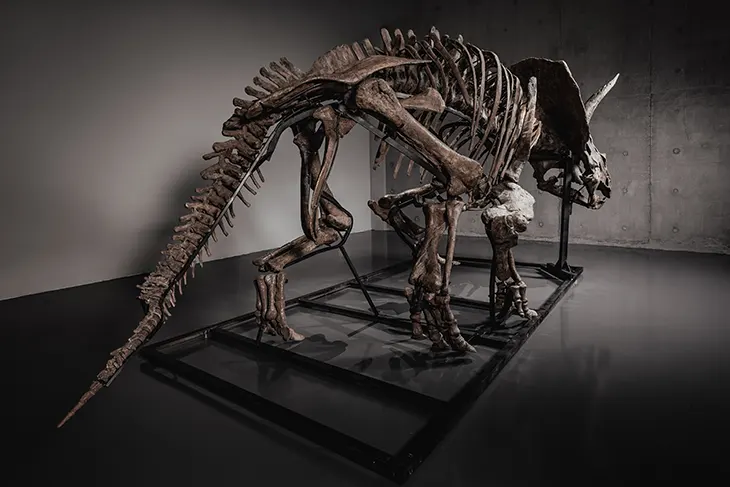
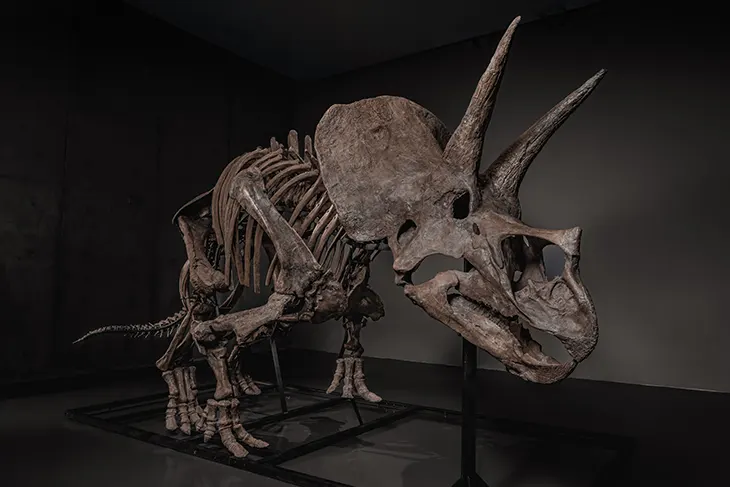
The animal itself reflects scale and structure associated with the species. Adult Triceratops could reach nine meters in length and weigh as much as two elephants. Trey, preserved at a sub-adult stage, measures 5.3 meters from nose to tail and stands over 2.2 meters tall. His skull extends two meters, defined by a beaked front, an expanded frill, and prominent brow horns.
Discovered in 1993 near Lusk, Wyoming during the modern “Bone Rush,” Trey was excavated by Lee Campbell and Allen Graffham of Geological Enterprises, Inc., whose work includes more than fifty new species and multiple genera, with this specimen now the only dinosaur from his discoveries to return to market in two decades. After preparation in Germany, the skeleton returned to the United States and entered long-term display at the Wyoming Dinosaur Center, where it remained for nearly thirty years. Over millions of years, mineral replacement from groundwater and iron deposits shaped the surface of the bones, preserving key structural elements while giving the skeleton its distinct appearance.
Opportunities to acquire a specimen of this scale and documentation remain limited. Most examples remain within institutional collections or enter permanent holdings. Trey’s return to auction followed decades of public access.
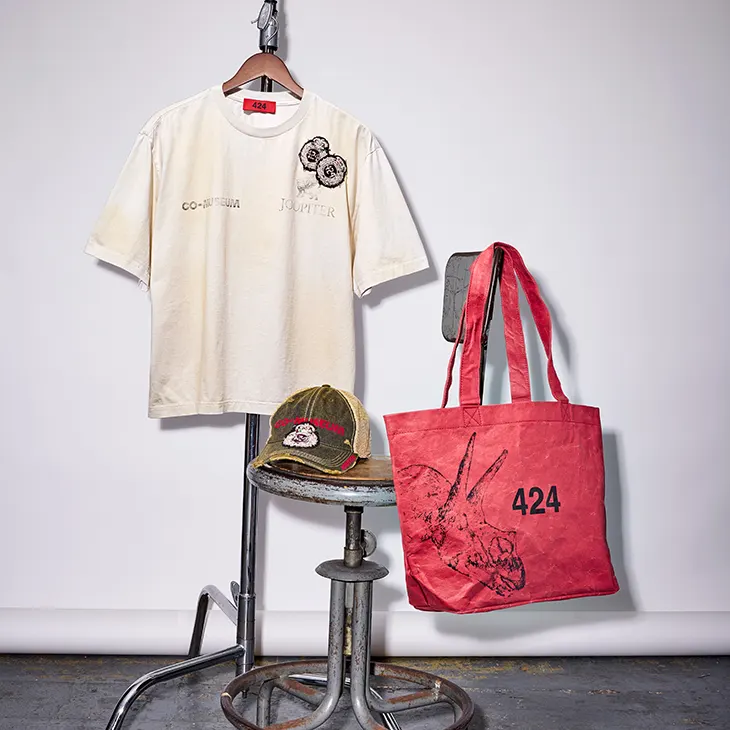
To mark the event, JOOPITER and Co-Museum partnered with Los Angeles brands 424 and Hoorsenbuhs on a limited capsule collection. The release remains available online through JOOPITER, fourtwofour, and Co-Museum platforms.








is it fake like that Louis Vuitton bag of Pharrells ?