


For a few seasons, the prevailing logic in footwear was reduction. Strip the shoe down, lose the hardware, let the silhouette carry the weight. It was a coherent position, and certain houses executed it well, but by the time Spring Summer 2026 collections landed on the runway, it was already starting to feel like a constraint rather than a conviction. The ornament was coming back, carefully at first, then unmistakably.
What’s worth paying attention to isn’t simply that embellishment has returned. It’s the different arguments being made about what embellishment should do. The recent Spring Summer womenswear collections produced a footwear conversation unusually rich in distinct positions, but the surprising outcome was that each house arrived at the decorated luxury heels from a different direction and with a different set of intentions. And in this context, the divergence is certainly the more interesting story.
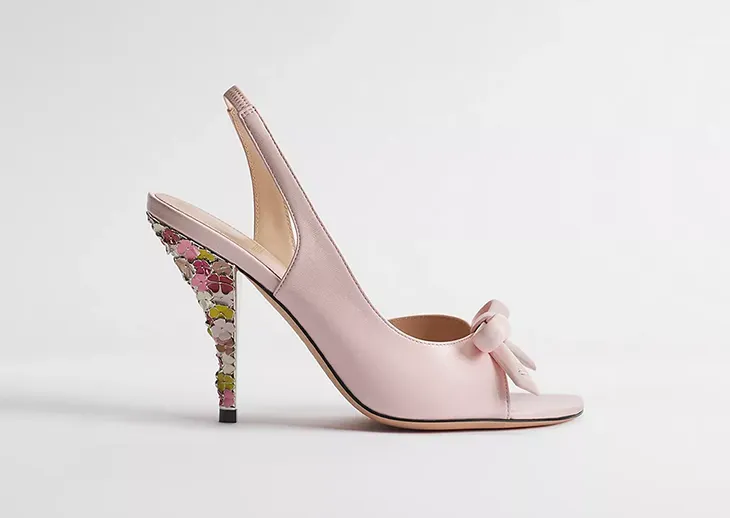
Jonathan Anderson’s Dior debut made the clearest case for ornament as structure. Oversized rosettes and bows shaped the spring heels from the outset, turning decoration into the architecture of the shoe. The bows gave the heels their reason for existing, shifting embellishment from accent to core design logic.
Jacquemus took a lighter version of the same idea. The pointed-toe pumps with delicate bows that closed his recent women’s show gave the argument a slimmer, sharper form, placing the bow directly in the line of the shoe. Small in scale, the detail still carried the pump’s character: it drew the eye, sharpened the silhouette, and gave the shoe its final note.
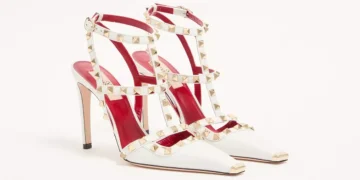
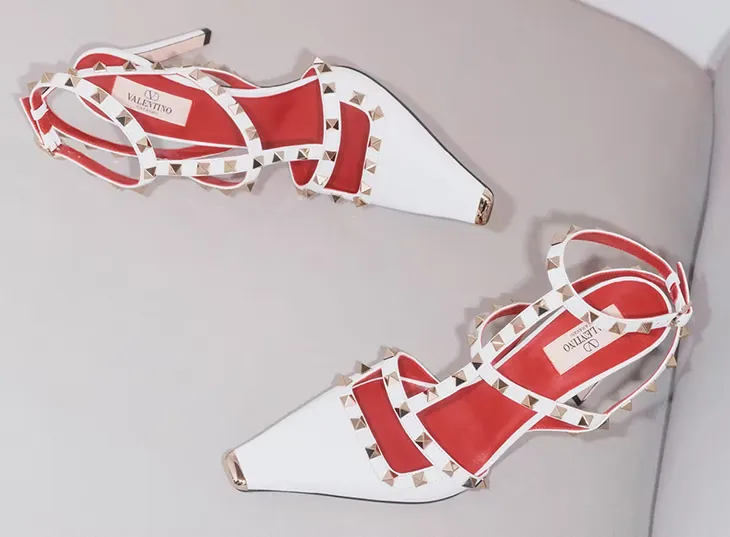
Alessandro Michele’s work at Valentino presents a contrasting case. The Rockstud’s return this season reads as a reconsideration of what the house’s most recognisable hardware piece is actually for. The stud placement in recent iterations has moved away from its original rigid grid, the distribution is looser, more apparently casual, which changes the register of the shoe considerably. Earlier Rockstud heels put the hardware first, and Michele’s versions pull that emphasis back. Whether that’s a refinement or a softening depends on where you think the Rockstud’s value lay to begin with, and that tension is part of what makes it worth looking at right now.
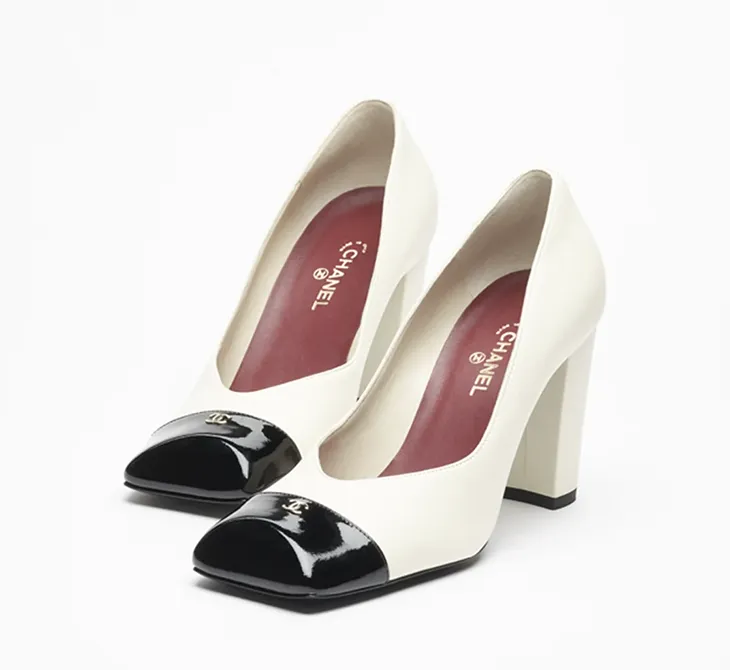
Matthieu Blazy’s Chanel produced a different kind of statement. The cap-toe heels that became the most talked-about footwear of the season were, in isolation, formally conservative: the two-tone construction is one of the house’s oldest codes. What Blazy did was push the proportions until the shoe stopped reading as archival and started reading as contemporary. The ornamentation is entirely internal: with no hardware and no applied detail, it is just a precise manipulation of shape and colour that functions as its own kind of decoration. It was the quietest version of the season’s broader argument, and arguably the most sophisticated one.
High-vamp construction, the glove-like upper that covers the top of the foot, appeared across enough collections to warrant its own discussion. Chanel’s version established the commercial moment, but the silhouette’s logic is more broadly relevant: it elongates the leg without requiring height, and it frames the foot in a way that brings a specific intentionality to how a shoe reads against longer hemlines. That it emerged at a moment when hem lengths have been dropping across women’s ready-to-wear is not a coincidence. The high vamp and the long skirt are solving the same problem from opposite ends.
None of this constitutes a single trend. What it constitutes is a return to the idea that footwear design can carry a point of view worth examining. The category spent a few seasons in the background, supporting the clothes without generating its own conversation. But that period appears to be ending, as across houses and across approaches this season’s luxury heels are operating as design statements rather than seasonal refreshes. Whether it’s structural ornament, a reconsideration of hardware, proportion considered as decoration, or construction as concept, it is undeniable that the embellishment is intentional and central.
The question now is which of these ideas will carry forward and which will remain tied to a single house or season. The ornamented heel has returned, but its meaning is still taking shape.