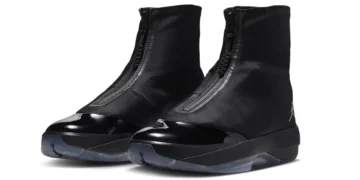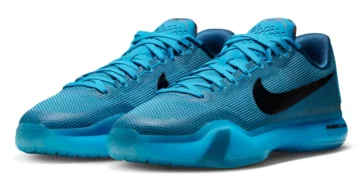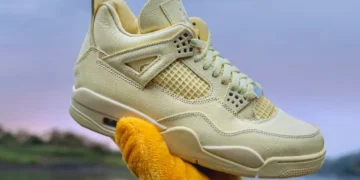



Nike announced its most popular sneakers on SNKRS for 2025, and the list follows a clear pattern. Each release paired a proven silhouette with a story that fans already understood. Nike leaned on archive accuracy, athlete legacies, and limited timing windows that pushed demand fast. The majority of the ranking consists of silhouettes originally designed for the court, with Air Jordan and Nike Kobe leading the way. Only two entries fall outside that core category, underscoring how strongly basketball footwear continues to drive demand on the platform.
SNEAKERS
Jordan Brand accounts for most of the list through established models such as the Jordan 4, Jordan 5, Jordan 11, and Jordan 12, while the Kobe line appears multiple times through the Kobe 6 and Kobe 8 Protros. Collaborations play a limited role, with only two collaborative releases included. Overall, the ranking shows that SNKRS popularity in 2025 concentrated around familiar basketball silhouettes rather than experimental designs or short-term fashion-driven releases.
Below are the sneakers that made Nike’s US SNKRS top ten for 2025.
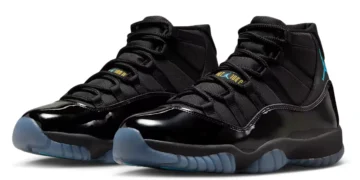
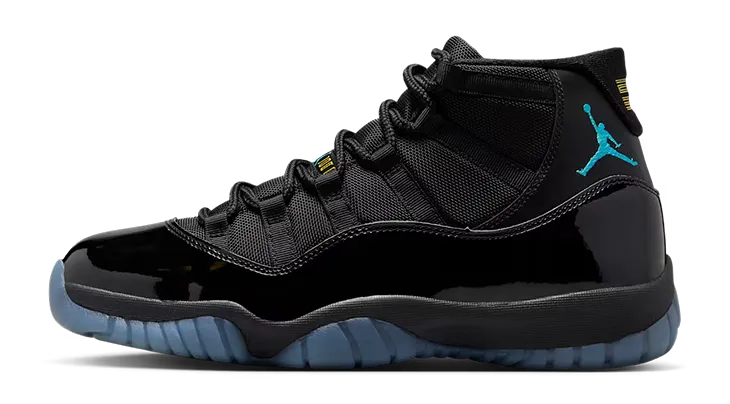
01. Air Jordan 11 Gamma
The Air Jordan 11 Gamma first released in 2013 and returned in 2025 as a direct reissue. The model is designed by Tinker Hatfield, and defined by its use of patent leather as a functional containment layer. The Gamma colorway applies a black ballistic mesh upper combined with a black patent leather mudguard that wraps the full circumference of the shoe. Blue accents appear on the Jumpman logo, outsole, and midsole strip, replacing the red detailing seen on most Jordan 11s and eliminating the white midsole entirely.
From a construction standpoint, the shoe retains the Jordan 11’s full performance architecture. A carbon fiber midfoot shank provides torsional stability, while full-length Air cushioning sits inside the midsole. The translucent rubber outsole includes blue tinting and herringbone traction pods for court grip. The higher patent leather cut distinguishes it from low-patent Jordan 11 variants, giving the shoe a sharper profile. In 2025, the reissue preserved the original shape, patent height, and material finishes, aligning closely with the 2013 version without redesign or technical alteration.

02. Air Jordan 4 Nigel Brick by Brick
The Air Jordan 4 originally debuted in 1989, and the Nigel Sylvester Brick by Brick edition arrived in 2025 as a collaborative reinterpretation. The sneaker uses a suede upper in muted red-orange tones, paired with grey structural elements, black netting on the quarter panels, and a matching midsole. The Air Jordan 4’s defining components remain intact, including the plastic wing eyelets, heel tab, and visible Air unit in the heel.
Construction follows the standard Air Jordan 4 architecture, with layered suede panels, mesh ventilation windows, and a polyurethane midsole housing Air cushioning. The outsole uses a rubber traction pattern consistent with the model’s original tooling. Surface finishing shows intentional abrasion detailing, distinguishing this version from standard Jordan 4 releases while keeping the silhouette and technical layout unchanged.

03. Air Jordan 4 Black Cat
The Air Jordan 4 Black Cat first released in 2006 and returned in 2025 as a retro edition. The upper applies black nubuck across the toe, quarters, and heel, paired with black mesh side panels and matching plastic wing eyelets. Branding appears in tonal black on the tongue and heel, removing contrast and keeping attention on silhouette, material texture, and the model’s angular panel layout. The color treatment stays uniform from top to bottom, reinforcing the shoe’s compact, monochrome profile.
Structurally, the Air Jordan 4 keeps its original build intact. A polyurethane midsole houses visible Air cushioning in the heel, while the forefoot rests on a rubber outsole with dedicated traction zones. Plastic wings connect the lacing system to the midsole for lateral support, and the heel counter provides rearfoot stability. Tooling, panel geometry, and material thickness remain consistent with prior releases, preserving the model’s firm, supportive feel.

04. Nike Kobe 8 Protro What The
The Nike Kobe 8 originally released in 2012, and the What The colorway returned in 2025 under the Protro line. The upper uses an engineered mesh construction split into mismatched panels, each referencing different Kobe 8 colorways from the original run. This patchwork approach applies contrasting colors, patterns, and graphics across the left and right shoes while preserving the Kobe 8’s low-cut profile and minimal overlay design. Despite the visual complexity, the silhouette remains clean, with the color blocking confined to the mesh surface and not extended through additional structural elements.
From a technical standpoint, the Kobe 8 Protro retains the model’s lightweight construction while updating cushioning for modern performance standards. The midsole houses revised Protro cushioning tuned for responsiveness and court feel, paired with a rubber outsole that keeps the original traction pattern designed for rapid changes of direction. The low collar, thin padding, and flexible forefoot remain unchanged, maintaining the Kobe 8’s emphasis on mobility, ground contact, and speed-oriented stability.

05. Air Jordan 12 Flu Game
The Air Jordan 12 debuted in 1996, and the Flu Game name refers to Michael Jordan wearing this black-and-red colorway during Game 5 of the 1997 NBA Finals while experiencing severe flu-like symptoms.. The 2025 release features black tumbled leather across the forefoot and ankle, paired with varsity red pebbled panels wrapping the lower portion of the silhouette. Radial stitching defines the panel geometry, creating a segmented, structured surface, while metal lace hooks and reinforced eyelets contribute to the model’s upright form.
From a construction standpoint, the Air Jordan 12 uses a firm midsole with Zoom Air cushioning for impact absorption and responsiveness. A full-length carbon fiber shank plate supports torsional stability through the midfoot. The rubber outsole applies a herringbone traction pattern across the entire base, and the high-cut collar, reinforced heel counter, and stiff sole geometry give the shoe its stability-focused build.
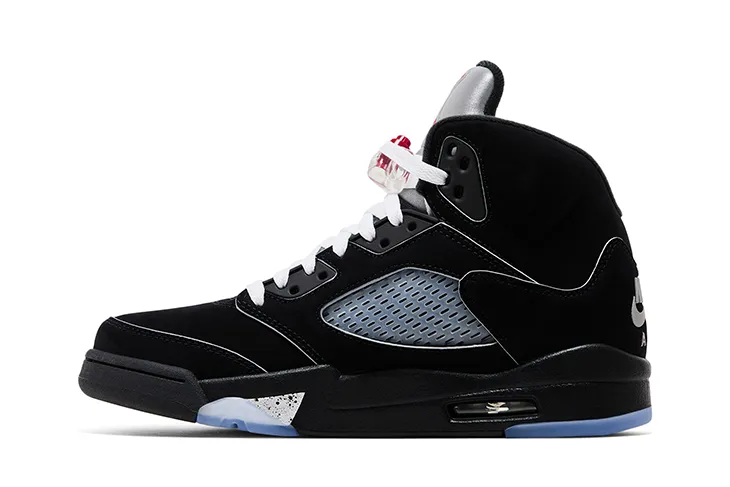
06. Air Jordan 5 Black Metallic Reimagined
The Air Jordan 5 released in 1990, and the Black Metallic colorway returned in 2025 as part of the Reimagined series. The upper uses black nubuck across the toe, quarters, and heel, maintaining the original panel layout and silhouette proportions. A reflective silver tongue remains the most visible contrast element, paired with black laces and tonal side netting. Translucent outsole sections and metallic silver accents on the midsole preserve the defining visual elements associated with the original release.
The Air Jordan 5 retains its original tooling and structural setup. Air cushioning sits within a firm polyurethane midsole, which features the model’s shark-tooth detailing along the lateral side. The outsole combines solid and translucent rubber sections arranged in a herringbone traction pattern. A padded collar, reinforced heel structure, and rigid sole geometry support the shoe’s stable, supportive build, consistent with the Air Jordan 5’s original performance design.
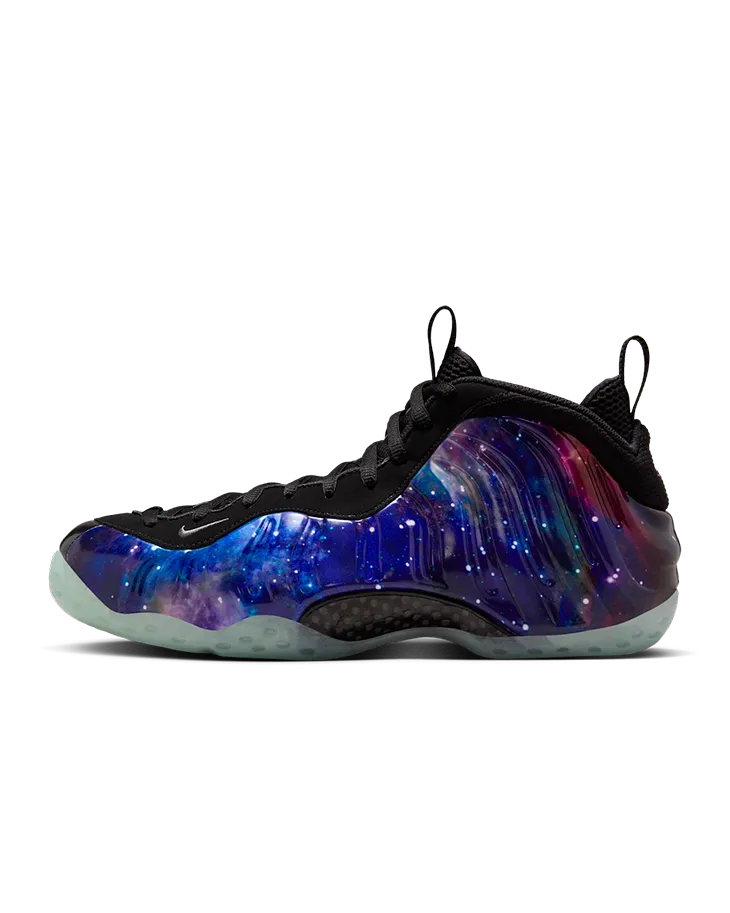
07. Nike Air Foamposite One Galaxy
The Nike Air Foamposite One released in 1997, and the “Galaxy” colorway originally appeared in 2012 before returning in 2025. The upper consists of a molded Foamposite shell finished with a galaxy graphic print that covers the entire exterior surface. Black nubuck eyestays and a matching collar frame the shell, while minimal external overlays allow the sculpted form to remain uninterrupted. The one-piece construction gives the shoe a rigid, contoured profile that visually separates it from layered leather or mesh basketball models.
Structurally, the Air Foamposite One relies on a dense internal build. A full-length Air cushioning unit runs beneath the foot, supported by a carbon fiber midfoot shank that controls torsional movement. The inner bootie construction provides containment inside the hard shell, while the rubber outsole uses a translucent compound with traction pods and glow-in-the-dark properties. The stiff shell, reinforced heel, and solid sole geometry define the model’s heavy, stability-focused feel.
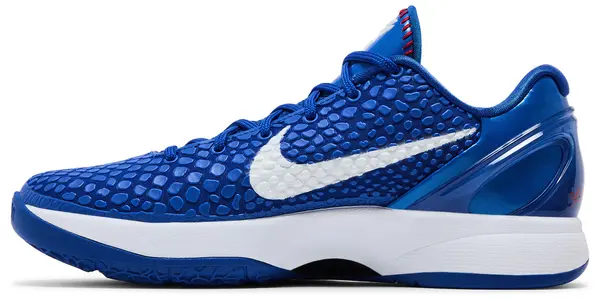
08. Nike Kobe 6 Protro Dodgers
The Nike Kobe 6 debuted in 2010, and the Dodgers Protro version released in 2025. The upper uses a low-cut silhouette with a textured synthetic skin designed to mimic a scaled surface, a defining feature of the Kobe 6 line. The colorway applies a blue base with red accent details at the heel and outsole. Panel layout remains uninterrupted, keeping the surface visually continuous from toe to heel.
The Protro version updates cushioning while retaining the Kobe 6’s original tooling. The midsole houses responsive cushioning tuned for court feel, paired with a rubber outsole using the same traction geometry as the original model. The low collar, minimal padding, and streamlined heel structure remain intact, preserving the shoe’s close-to-ground profile and lateral stability.

09. Nike Kobe 6 Protro All-Star
The Nike Kobe 6 originally released in 2010, and the All-Star colorway first appeared in 2011 before returning in 2025 as a Protro. The upper uses the same low-cut silhouette and textured synthetic skin designed to mimic a scaled surface. A red-to-black gradient spreads across that texture, allowing color transition to interact directly with the scaled pattern rather than relying on overlays or panel contrast. Branding remains integrated into the surface.
The Protro construction updates cushioning while retaining the original Kobe 6 tooling. The midsole delivers responsive cushioning for court feel, paired with a rubber outsole using the same traction geometry. Collar height, padding, and heel structure remain unchanged, preserving lateral stability and quick directional response.

10. Travis Scott x Jordan Jumpman Jack Bright Cactus
The Jordan Jumpman Jack is a Travis Scott signature silhouette introduced in the 2020s, with the Bright Cactus colorway releasing in 2025. The upper combines layered textiles with reinforced panels and a forefoot strap that defines the shoe’s closure system and visual structure. Color placement emphasizes contrast between the upper and outsole rather than traditional panel segmentation.
The sole unit departs from retro Jordan tooling, using a flatter midsole profile and rugged rubber outsole. Internal structure, midsole geometry, and panel layout are unique to the Jumpman Jack, separating it from Air Jordan retros and establishing an independent construction language.