
Ju Xie is a Los Angeles–based graphic designer whose work spans brand identity, motion design, and cinematic 3D environments. She holds an MFA in Graphic Design from ArtCenter College of Design. Across these mediums, she investigates how visual systems translate complex ideas into clear and engaging visual systems.
GRAPHIC DESIGN
Rather than separating emotion from structure, Ju approaches design as a process of translation, transforming research, cultural narratives, and human experiences into visual languages that move across different media and audiences.
Design Practice
Ju Xie develops projects ranging from socially engaged visual identities to civic branding systems and motion-driven brand storytelling. Her work has received recognition from several international design awards, including the International Design Awards (IDA), C2A Creative Communication Awards, London Design Awards, MUSE Creative Awards, NYX Awards, and the New York Design Awards.
Alongside her independent practice, Ju contributes to companies within the digital beauty marketplace and wellness industries, developing marketing design and motion graphics for a leading beauty marketplace platform serving the U.S. market, while also developing visual assets and brand communications for a design-forward wellness brand with growing international recognition for its innovative kitchen products.
Trained in traditional painting before transitioning into graphic design, she brings a strong sensitivity to composition, light, and visual rhythm into both static and motion-based work, approaching visual systems as adaptable frameworks that evolve across audiences, platforms, and cultural contexts.
Human Narratives: Visualizing Mental Health
through Fragmented Collage
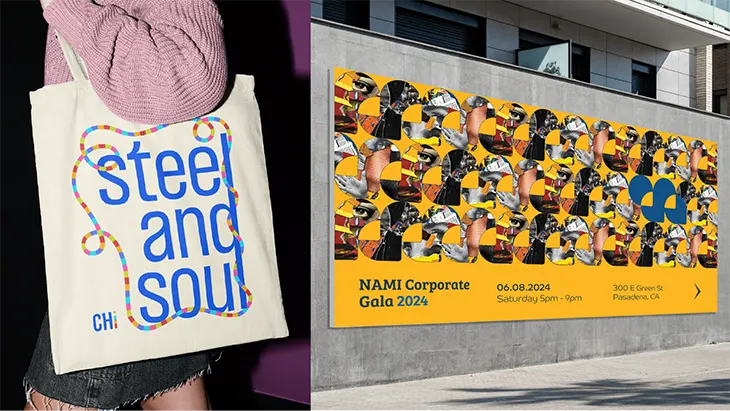
Ju’s human-centered approach is particularly evident in her visual identity project for the National Alliance on Mental Illness (NAMI), one of the largest grassroots mental health organizations in the United States. Developed as an independent research-driven project, the work explores how visual communication can respond to the stigma surrounding mental health conversations.
The project began with extensive research into discussions and personal reflections shared across professional platforms and social media communities. Through this research, Ju observed that many individuals living with mental illness described their emotional experiences through metaphors of fragmentation, often comparing recovery to the gradual process of repairing something broken.
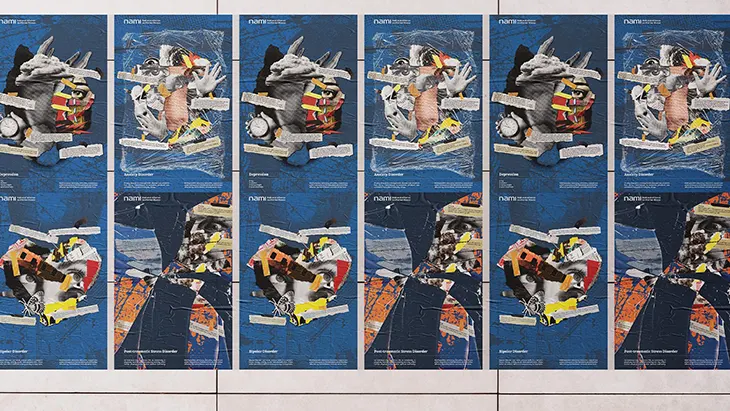
Responding to this insight, she developed a collage-based visual identity system that translates emotional fragmentation into a structured graphic language. The identity incorporates layered imagery, fragmented typography, and disrupted grid compositions that mirror the shifting emotional rhythms found in many first-person narratives about mental health.
In 2025, the project received international recognition from several design competitions, including an Honorable Mention from the International Design Awards (IDA), an international competition established in 2007 that attracts submissions from designers worldwide and is judged by a professional jury, along with a Gold award from the MUSE Design Awards.
“I didn’t want to design over those voices,” Ju explains. “The goal was to create a visual environment where those experiences could exist honestly, without forcing them into perfect order.”
Civic Identity: Reimagining Chicago
through a Modular Design System
While the NAMI project focuses on individual emotional experience, Ju’s The City of Chicago Branding project expands her design research to the scale of civic identity. Developed as a conceptual civic branding study, the project investigates how the cultural character of a city can be translated into a contemporary visual identity system.
Through research into Chicago’s architecture, cultural history, and community narratives, Ju identified six qualities that she believes capture the city’s spirit: Innovation, Intellect, Loyalty, Courage, Grit, and Ambition. These attributes reflect Chicago’s legacy of industrial resilience, neighborhood pride, artistic experimentation, and civic activism.
Based on this research, she developed a modular identity system in which each quality is represented through a geometric form derived from the city’s urban grid, the branching lines of the Chicago River, and the strong silhouettes of its architectural skyline. When combined, the modules form the letter “i” within the word Chicago, which functions as the central symbol of the identity system. The letter also references the pronoun “I,” emphasizing the role of individual citizens in shaping the city’s identity.
The project also proposes a cultural initiative titled Chicago Film Journey, mapping well-known filming locations across the city. As one of the most recognizable film production environments in the United States, Chicago has served as the backdrop for numerous films and television series. The initiative invites visitors to explore the city through cinematic landmarks while discovering surrounding neighborhoods and everyday urban life.
The project has also received recognition from several international design competitions, including the C2A Creative Communication Awards (Best of the Best in Brand Identity and Advertising Poster Design), the London Design Awards (Best of the Best), and the MUSE Design Awards (Gold), highlighting its approach to civic storytelling through contemporary branding systems.
Cinematic Motion: Expanding Graphic Design
into Moving Space
Alongside her branding practice, Ju develops motion design projects that explore the intersection of graphic design, spatial composition, and cinematic visual language. Working across both two-dimensional and three-dimensional formats, her work examines how light, texture, typography, and movement interact to construct atmospheric visual environments. Rather than treating motion as a decorative extension of graphic design, she approaches it as a spatial medium through which visual systems unfold over time.
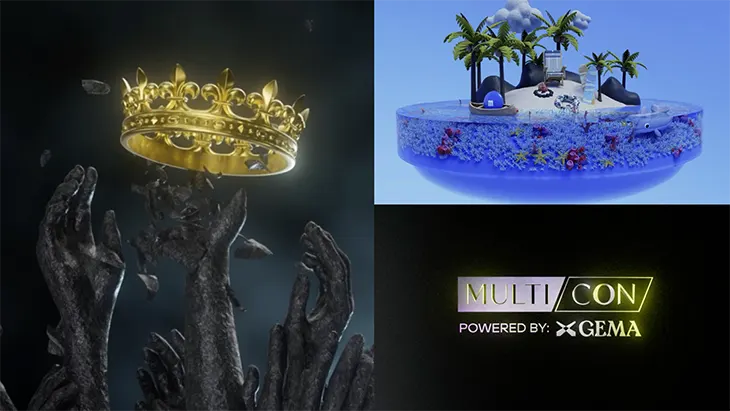
This exploration also extends into professional industry contexts. For a collaborative event between MultiCon and the Global Entertainment Marketing Academy (GEMA), Ju created a three-dimensional logo animation for the event identity. She also designed a two-dimensional animated logo for the social-impact initiative Make an Impact. Both animations were presented during the event as part of its official visual program.
Presented within a professional entertainment marketing environment, these works contributed to the event’s visual identity while increasing visibility for the organizations among industry professionals and audiences.
For Ju, motion projects function as an experimental ground where ideas of rhythm, light, and spatial perception can be tested and refined. Through this work, she examines how contemporary graphic design expands beyond static surfaces toward cinematic and spatial visual systems, reflecting a broader shift in the discipline toward time-based and immersive forms of visual storytelling.
Design as Visual Translation
For Ju Xie, design begins with listening. Understanding people, their experiences, and the environments they inhabit forms the foundation of her visual systems. Whether addressing social issues, exploring civic identity, or developing motion-driven brand storytelling, her projects translate complex narratives into clear and adaptable visual languages.
This approach appears across her work in different forms. In her project for the National Alliance on Mental Illness, design becomes a platform for empathy and dialogue around mental health. Her Chicago branding study translates the cultural identity of a city into a modular visual language shaped by its communities. In her motion design work across advertising and entertainment, visual storytelling expands into cinematic environments built through light, movement, and spatial composition.
Working across branding, motion design, and cinematic 3D environments, Ju continues to explore how graphic design can transform emotional narratives and cultural ideas into contemporary visual systems that function across media and audiences.
Her ability to bridge conceptual design thinking with real-world industry applications has also been recognized by collaborators in the creative industry. Nate Eckman, Vice President of Marketing & Strategy at Multihouse Ventures Corporation, noted: “Ju is a highly professional designer who listens carefully and collaborates without ego. She has a strong ability to translate ideas into solutions that meet real industry needs.”
Words by DSCENE Editor Maya Lane.