


Architecture is often discussed in terms of form, light, and material expression, yet beneath these visible qualities lies a quieter set of decisions, those that anticipate risk. Fire, in particular, exerts a subtle but persistent influence on how buildings are conceived. It informs spatial hierarchies, dictates material performance, and shapes how occupants move through a structure long before any emergency occurs.
Rather than being treated as an afterthought or purely technical requirement, fire awareness is embedded within the logic of design itself. In typologies such as warehouses, hospitals, and event spaces, this relationship becomes especially visible, where scale, occupancy, and function demand a careful balance between openness and control.
DSCENE team discusses the way fire-aware spaces shape today’s architecture:
Spatial Planning as a Form of Containment
At the level of layout, architecture plays a critical role in moderating how fire and smoke might spread. Large-scale environments like warehouses present a particular challenge: expansive, uninterrupted floor plates are ideal for logistics, yet they also allow fire to travel rapidly if left unchecked. To address this, architects introduce forms of compartmentation, fire-rated walls, sectional zoning, and strategic separations that break down volume without compromising operational flow.
These interventions are rarely perceived as barriers. Instead, they are integrated into the spatial rhythm of the building, aligning with circulation routes and storage logic. The result is a layered environment where openness is preserved visually, but controlled structurally.
Hospitals, by contrast, operate on a fundamentally different spatial philosophy. Rather than prioritizing evacuation, many healthcare environments are designed around a “defend-in-place” approach. This leads to the creation of smoke compartments, fire-rated corridors, and clearly defined zones that allow occupants to be relocated horizontally rather than evacuated vertically. The architectural layout supports this by organizing departments into interconnected but separable units, ensuring that movement remains calm, legible, and protected.
Event and public spaces introduce yet another dimension: crowd behavior. Here, spatial planning is not only about containment but also about clarity. Wide circulation paths, unobstructed sightlines, and intuitively placed exits reduce decision-making under pressure. The geometry of space, how corridors widen, where thresholds are placed, how entrances align, guides occupants without the need for instruction. In this sense, architecture becomes a form of silent choreography, directing flow in both everyday use and emergency scenarios.
Material Selection and Performance
If layout governs movement, materials determine endurance. The choice of materials is not solely aesthetic; it reflects a building’s capacity to withstand heat, resist ignition, and limit the spread of smoke.
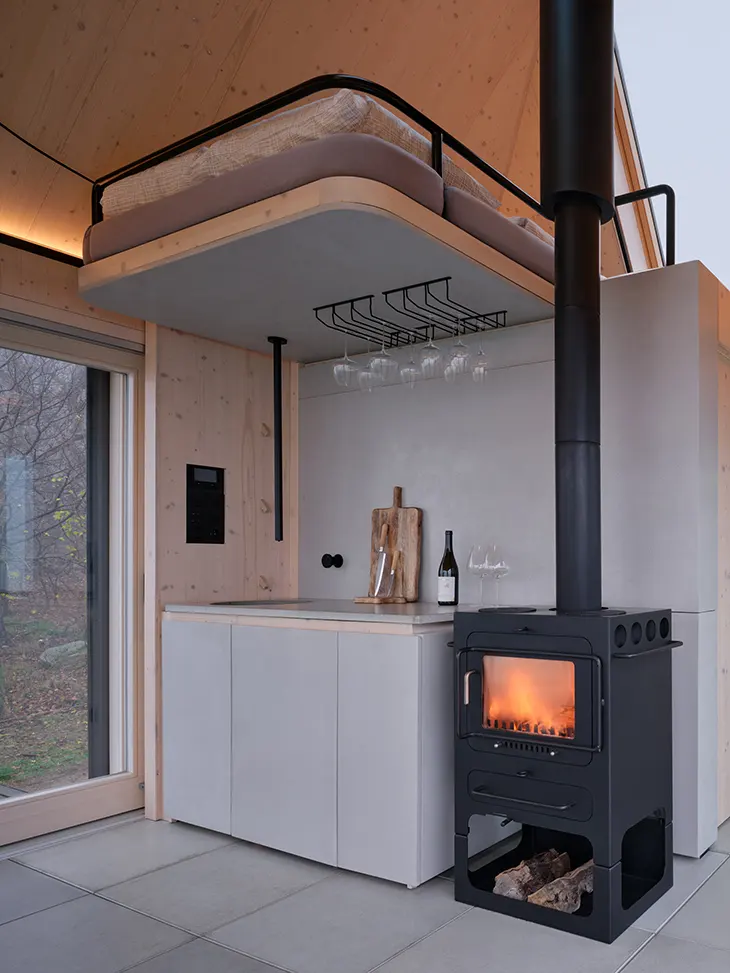
In industrial settings such as warehouses, materials like reinforced concrete and protected steel are often favored for their structural resilience. These elements can maintain integrity under high temperatures, slowing collapse and providing critical time for response. Increasingly, architects also consider the fire load introduced by stored goods, adjusting finishes and structural systems accordingly. In today’s environment, thanks to the fabrics and plastic used in our homes, the fire can break out in a matter of minutes, with a massive risk to the homeowner and the neighborhood itself.
Hospitals require a more nuanced palette. Surfaces must be hygienic, calming, and durable, yet also compliant with strict fire performance standards. This often results in the use of low-smoke, low-toxicity materials, as well as finishes that resist flame spread without appearing overtly utilitarian. The challenge lies in balancing clinical clarity with a sense of comfort, ensuring that safety measures do not undermine the therapeutic environment.
In public and event spaces, material expression tends to be more experimental, incorporating textiles, composites, and decorative panels. Here, fire-resistant treatments and coatings become essential, allowing designers to achieve visual richness while maintaining compliance. The interplay between regulation and creativity is particularly evident in these environments, where every surface must negotiate between performance and perception.
Movement, Egress, and Human Behavior
Circulation design is where architectural intention meets real-world behavior. A well-designed building does not rely solely on signage or alarms; it anticipates how people will move instinctively.
In warehouses, circulation paths are typically wide, direct, and unobstructed, accommodating both human movement and machinery. This clarity ensures that escape routes remain accessible even in complex operational conditions.
Hospitals emphasize continuity and ease. Corridors are designed to support assisted movement, with widths and turning radii that accommodate beds and medical equipment. Importantly, these pathways connect to protected zones, reinforcing the strategy of phased relocation rather than immediate evacuation.
Public venues, from exhibition halls to performance spaces, must handle high densities of occupants and must always come as fire-aware spaces. Here, egress design becomes a question of capacity and perception. Exits must be sufficient in number and clearly visible, but also positioned in a way that aligns with natural movement patterns. Subtle architectural cues, changes in lighting, ceiling height, or material, can guide occupants toward safety without disrupting the overall experience of the space.
Designing for Unseen Conditions
Not all fire-related design considerations are permanent or visible. Buildings often pass through phases and are designed from the start as fire-aware spaces, maintenance, renovation, or temporary system outages, where standard protections may be reduced. In these transitional moments, supplementary measures are introduced to maintain safety within the existing spatial framework. In certain regional contexts, references such as fire watch Alabama appear as part of broader safety protocols, functioning as a temporary layer within the architectural environment rather than a defining feature of it.
This highlights an important aspect of design: buildings are not static. They evolve over time, and their safety strategies must adapt accordingly. Architecture, therefore, extends beyond the initial blueprint, encompassing the ongoing life of the structure.
Quiet Driver of Design
Fire does not dictate architectural expression outright, but it shapes it in fundamental ways. It encourages the subdivision of space without sacrificing openness, informs the selection of materials that balance beauty with resilience, and guides the creation of circulation systems that feel intuitive under pressure.
In warehouses, one of the most fire-aware spaces, this is seen in the careful calibration between scale and separation. In hospitals, it emerges through layered zones that support protection and care simultaneously. In public spaces, it appears in the clarity of movement and the subtle guidance embedded in form.
These strategies often go unnoticed, yet they are integral to how buildings perform when it matters most. Good architecture does not merely respond to fire, it anticipates it, integrating safety into the spatial and material language of the design itself.