


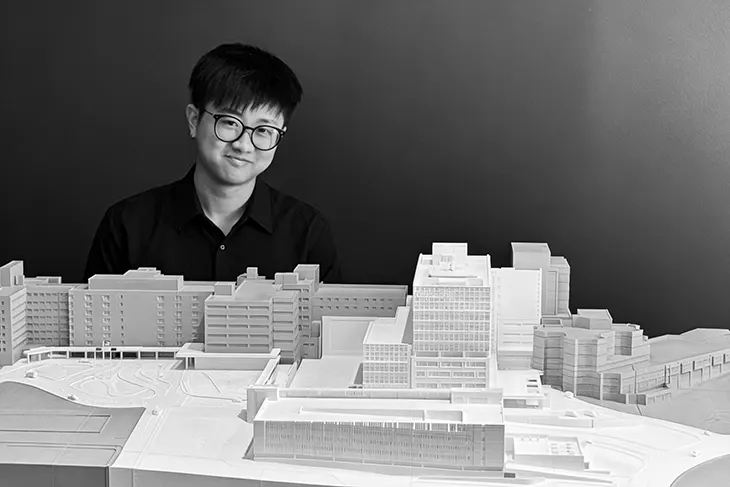
Zihua Mo is an architectural designer at EwingCole in Philadelphia, where he specializes in complex healthcare and science facilities. A former lecturer at the University of Pennsylvania, Mo brings a cross-scalar perspective rooted in urban planning training to both his professional work and an independent research practice that has earned sustained international recognition. His projects have received over a dozen awards from juried international design programs, including a Silver from the A’ Design Award, Gold from MUSE Design Awards, NY Architectural Design Awards, London Design Awards, French Design Awards, and the American Good Design Award, evaluated by professional panels across architecture, design, and environmental categories. His work has been published in Pressing Matters and recently featured on Designboom, and has been included in exhibitions associated with the Venice Architecture Biennale.
ARCHITECTURE
Across every project, whether a speculative competition, a research prototype, or a real-world hospital, Mo operates from a single premise: that architecture should function as a catalytic system, actively participating in material transformation, ecological regeneration, and the restructuring of complex human environments. He has developed this into a transferable methodology that moves between computational design, material chemistry, physical prototyping, and spatial narrative, offering a framework that extends beyond any single project.
Dissolving Boundaries in Lower Manhattan
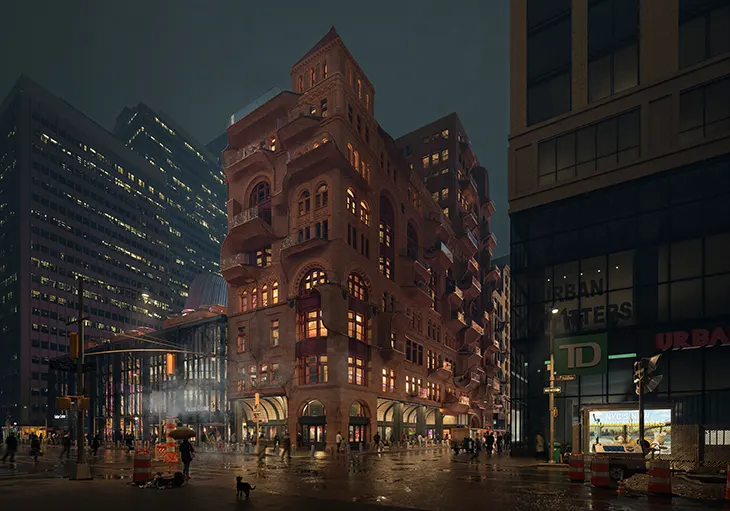
The Dissolving Corbin Building is Mo’s most widely recognized independent project. In it, he reimagines a Romanesque Revival landmark in New York’s Financial District as a vertical mixed-use hub where heritage, food culture, and contemporary living merge into a single productive system. The project has received more than ten international awards, including Gold from MUSE, NY Architectural Design, French Design, Global Future Design, and American Good Design Awards, Silver from IDA and A’ Design Award, and an Honorable Mention from Architecture MasterPrize, spanning architecture, design, and sustainability categories across multiple international jury platforms.
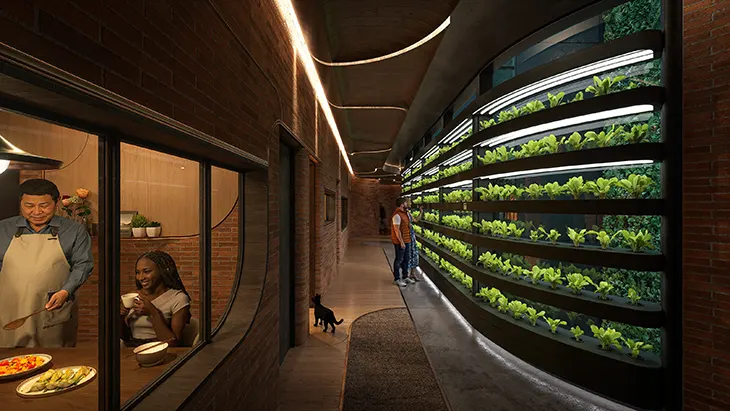
Mo began with a close study of natural morphologies, developing a strategy he calls “dissolving”: extending the historic facade’s two-dimensional ornamentation into three-dimensional spatial elements. The original brick-and-terracotta surface stratifies outward into planters, glazed recesses, and Y-shaped balconies through advanced 3D clay printing, complex geometries panelized, digitally fabricated, kiln-fired into terra cotta, and dry-mounted onto a new structural framework. Inside, Mo organized a six-story vertical farm through the central atrium, connecting an underground food court, shared kitchens on each residential floor, and a rooftop garden, treating food as a spatial and cultural connector capable of restoring collective belonging.
Published in Pressing Matters, the project offers more than a successful adaptive reuse proposal. Mo’s “dissolving” strategy constitutes a broader methodological contribution: a replicable framework for transforming heritage structures into living, productive urban systems through digital fabrication, biological growth logic, and programmatic intensification, rather than treating preservation as an end in itself.

Engineering New Terrain on the Danish Cliffs
Micro Ecologies extends Mo’s catalytic methodology to the geological scale. A landscape-level intervention on the chalk cliffs of Møns Klint in Denmark, developed in collaboration with Jorge Manuel Couso and published in Pressing Matters, the project has also been included in the CityX Virtual Pavilion presented in conjunction with the Venice Architecture Biennale. By comparing geomorphological drawings from 1849 with contemporary scan models, Mo mapped terrain lost over nearly two centuries and proposed to build only within previously eroded cliff volumes, creating what he terms a “synthetic nature.” His central material innovation is a low-carbon concrete derived from on-site chalk deposits: calcium carbonate is decomposed, reformed into calcium hydroxide solution, and dripped along facades where it reacts with atmospheric CO₂ to re-precipitate, causing the buildings to literally grow new mineral surfaces over time. Porous facade surfaces further extend the project’s ecological ambition, providing habitats for local bird species including peregrine falcons.
Micro Ecologies advances a proposition with implications beyond the project itself: that architecture can function as a medium of geological agency, actively generating terrain, mineral formations, and ecosystems. Mo’s integration of site-specific material chemistry with computational form-finding offers a model for how the discipline might engage with erosion, carbon cycling, and habitat creation as design parameters, not externalities.

Synthetic Incubators for a Post-Human Landscape
Rock and Roll, recently featured on Designboom, pushes Mo’s framework to its most radical conclusion. Developed with Chunyu Ma for the Inglewood Oil Field in Los Angeles, the project proposes autonomous architectural entities that drive ecological regeneration on a decommissioned industrial site without human control. At its origin is a pair of physical prototypes Mo conceived and built, the Rocker, a concrete-and-metal structure that extracts atmospheric moisture through condensers, and the Roller, a mobile seed-dispersal element driven by a double-pendulum mechanism Mo engineered for non-linear movement. These “Homunculi” are full-scale constructions, not renderings, demonstrating Mo’s commitment to testing speculative ideas through fabrication. The operational logic extends site-wide through four specialized incubators, animal, plant, fungal, and insect, each assigned a role within a closed-loop system of growth, decomposition, and redistribution that Mo structured as a single architecturally orchestrated ecological cycle.
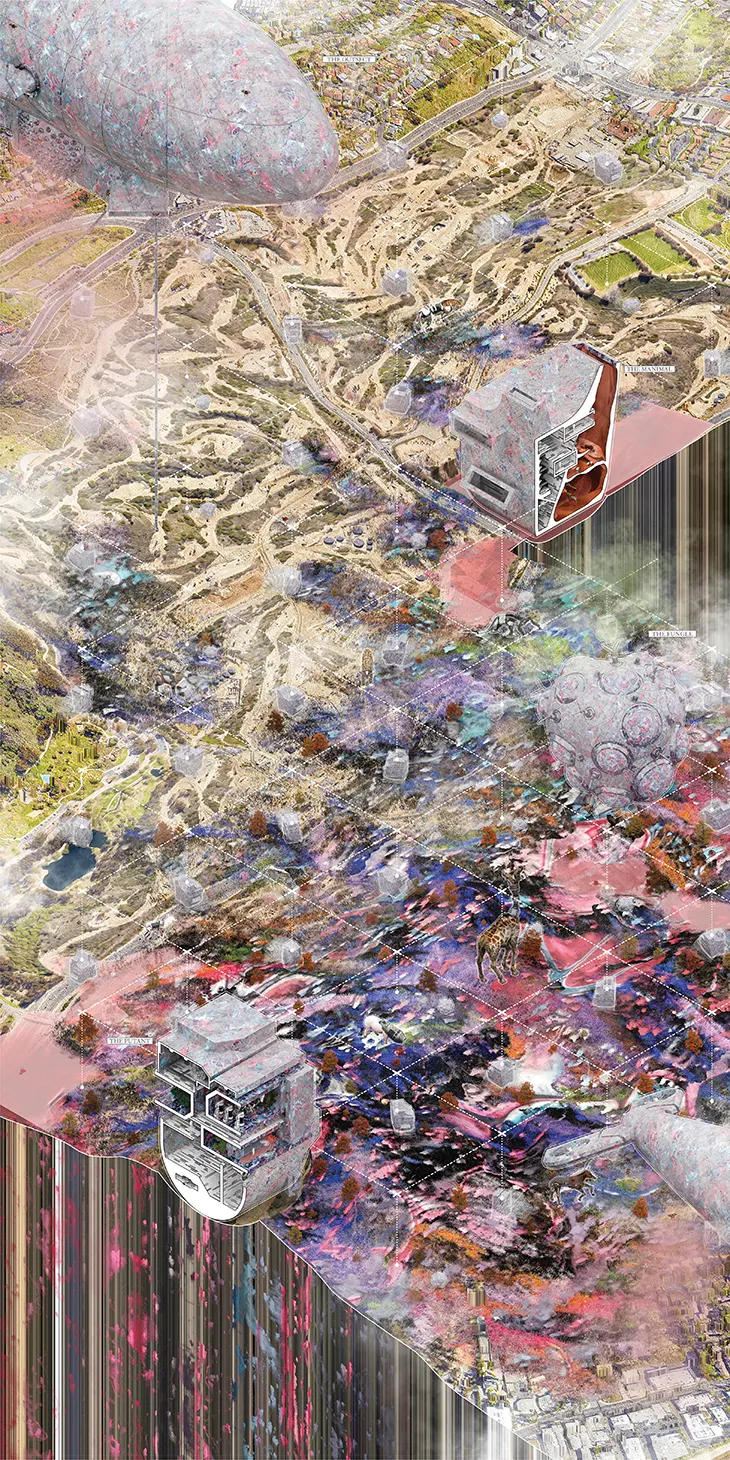
Mo’s shift from architecture-as-catalyst to architecture-as-autonomous-agent challenges a foundational disciplinary assumption: that buildings serve human occupants. By proposing systems that construct their own ecological frameworks, Mo extends the field’s understanding of what architecture can be asked to do, and bridges the gap between his independent research and professional methodology through the act of building.
From Speculation to System:
Healthcare Architecture at EwingCole
Mo’s independent research operates in parallel with a professional practice grounded in one of architecture’s most technically demanding sectors. At EwingCole, his role spans the full design arc: from competition proposals developed to secure new commissions, through schematic phases resolving planning, landscaping, massing, envelope, and interior strategies, to detailed 3D construction documentation guiding fabrication on site. This end-to-end involvement reflects the same cross-scalar fluency that defines his independent work. Healthcare and science facilities impose constraints few other building types demand simultaneously, infection control, complex mechanical systems, equipment clearance, circulation separation, and varying regulatory frameworks, and Mo navigates these overlapping systems by developing spatial strategies that satisfy clinical function, engineering coordination, and design intent at once. His professional experience also includes large- and small-scale 3D printing applications, a direct methodological link to projects like the Dissolving Corbin Building.
Alongside his work at EwingCole, Mo served as a lecturer at the University of Pennsylvania, teaching in the AAD Design Studio with Professor Hina Jamelle and Architectural Design Innovation with Professor Ali Rahim, mentoring graduate students in computational methods and design experimentation, extending his catalytic methodology into pedagogy.

Architecture That Acts
In the Dissolving Corbin Building, Mo transforms a historic facade into the substrate for cultural, agricultural, and material growth. In Micro Ecologies, he engineers buildings that generate terrain, cycling minerals through their own surfaces. In Rock and Roll, he achieves full architectural autonomy, designing systems that drive ecological regeneration without human intervention. This trajectory, from catalyzing human exchange, to catalyzing geological processes, to catalyzing autonomous ecosystems, is the systematic development of a single methodology: that buildings are instruments of transformation operating across scales from ceramic panels to post-industrial landscape. Mo’s contribution lies in demonstrating that this methodology is not only conceptually coherent but practically viable, validated through international award recognition, physical prototyping, peer-reviewed publication, and the daily demands of complex professional practice. At a moment when architecture is grappling with environmental agency and the limits of human-centered design, Mo’s work offers a rare example of a practitioner who has built a unified framework across these concerns, and tested it at every scale from research to execution.
Words by DSCENE Editor Maya Lane.