



Cen Shen is a New York–based architectural designer whose work explores how architecture can establish new relationships between design, production, and environmental systems. She graduated from Columbia University with a degree in architecture and is a LEED Accredited Professional. Her work spans facade engineering, architectural design, and experimental construction research. Rather than treating architecture as a static object defined only by form, Cen Shen approaches architecture as a system shaped by fabrication, installation, material lifecycle, and environmental processes, and her work seeks to redefine the role of architecture within both the city and ecological systems.
Cen Shen’s professional practice and research-driven investigations continuously inform and reinforce each other. Her work focuses on understanding how architectural design decisions interact with construction methods, fabrication processes, and environmental systems. In her methodology, architecture is not simply a formal outcome; it is the result of interactions between design intentions, production logic, material systems, and construction processes. Architectural form is therefore not the starting point, but the consequence of construction, fabrication, and ecological processes working together.
ARCHITECTURE
At Elicc Group, a facade engineering and construction company specializing in high-rise and super-tall buildings in North America, Cen Shen works on facade systems for super-tall residential towers in New York City. Her role focuses on translating architectural facade design into buildable production and installation systems. Her work includes facade panel layout coordination, embed and anchor adjustments, slab edge tolerance resolution, facade system optimization, and shop drawing coordination to ensure constructability and fabrication feasibility.
She also develops panel numbering, packing, and shipping logic, and coordinates installation sequences with site installation teams. In complex high-rise projects with irregular geometry and setbacks, Cen Shen works on rationalizing architectural geometry into buildable panel systems while coordinating structural, mechanical, and lighting systems integrated into the facade. Through this work, facade design is treated not only as an aesthetic building envelope but as a construction, fabrication, and coordination system that directly impacts fabrication efficiency, installation workflow, building performance, and construction scheduling.
Her work often focuses on solving constructability challenges, coordinating tolerances between concrete structure and facade systems, integrating lighting systems into facade assemblies, and improving fabrication and installation efficiency through system optimization. In this context, facade design becomes a production and construction problem rather than purely a design problem, and the building envelope becomes a system that connects architecture, structure, mechanical systems, fabrication, and installation.
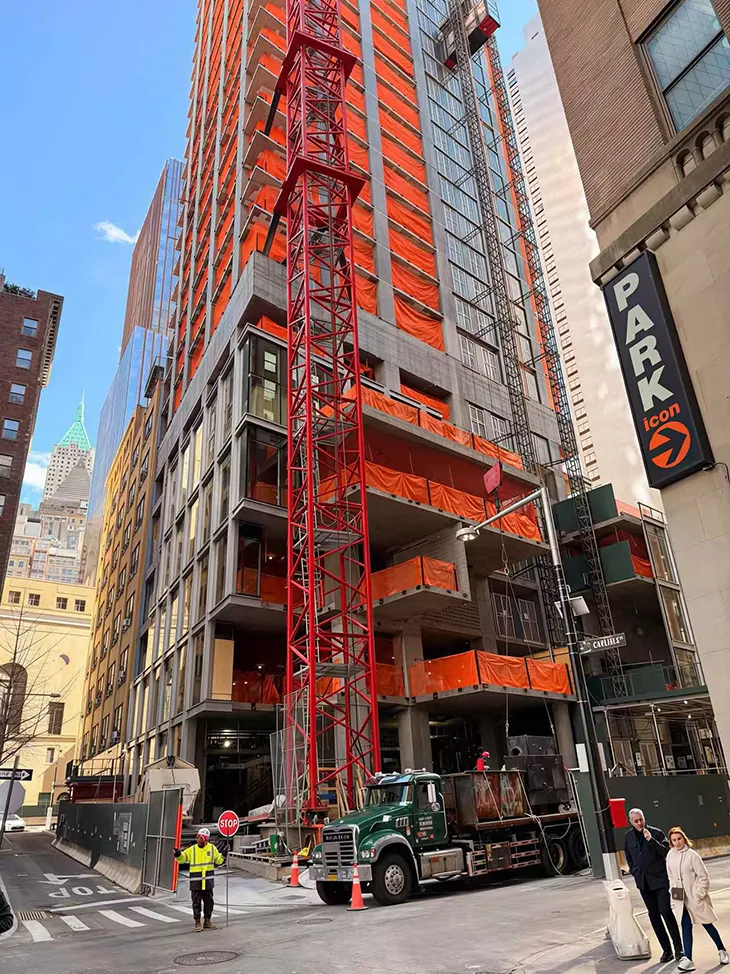
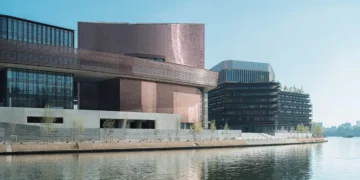
In the 8 Carlisle Street project in Manhattan’s Financial District, Cen Shen played a key role in facade system coordination and optimization for a 65-story residential tower with multiple setbacks and complex geometry. The project required coordination between concrete structure, steel structure, mechanical systems, facade fabrication teams, and installation teams to resolve constructability challenges related to facade installation and system integration.
Her work included facade system optimization, embed coordination, tolerance resolution, installation sequencing coordination, and rationalization of irregular facade geometry into buildable panel systems. Through these efforts, fabrication efficiency and installation workflow were improved while maintaining architectural design intent.
The project utilizes triple-insulated bird-friendly glass systems to improve building envelope performance while reducing environmental impact on surrounding urban wildlife. Facade system optimization in this project contributed to improving fabrication efficiency, installation sequencing, and overall building envelope performance.
Beyond the building itself, the project is part of the ongoing urban transformation of Lower Manhattan from a primarily office-based district into a mixed-use residential community. In this context, building envelope performance, long-term durability, and construction efficiency play an important role in the economic and environmental sustainability of the development. Cen Shen’s work therefore contributes not only to individual building performance, but also to the long-term performance and sustainability of urban development projects.
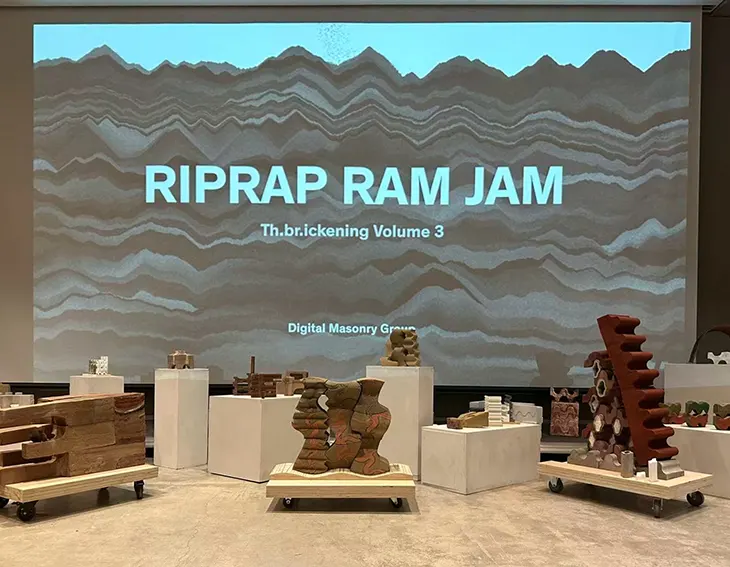
In parallel with her professional practice, Cen Shen founded CSLab as an experimental architecture and research platform that explores the relationship between architecture, fabrication, material systems, and ecological infrastructure. Through CSLab, she develops projects that investigate how architecture can be generated from fabrication processes, material behavior, production logic, and environmental systems rather than from form alone.
The work developed within CSLab includes robotic fabrication experiments, modular construction systems, reversible assembly methods, biodegradable material research, digital fabrication workflows, and ecological infrastructure prototypes. Many projects begin with material tests, fabrication constraints, or construction logic, and architectural form emerges from these production and material systems. Through this research, Cen Shen explores how architecture can be understood as part of production systems, material lifecycles, and environmental processes rather than as static building objects.
Across different scales, from building components to waterfront infrastructure, her work consistently explores how fabrication processes, material systems, and ecological systems can be integrated into architectural design. In this research framework, architecture is positioned not only as spatial design but as a system embedded within production networks, material lifecycles, and environmental systems.
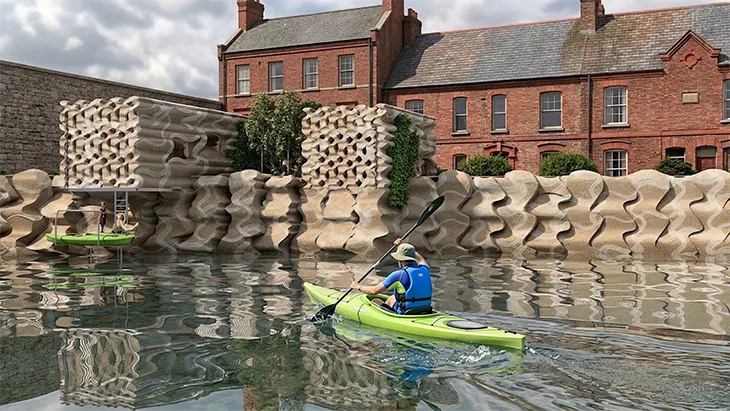
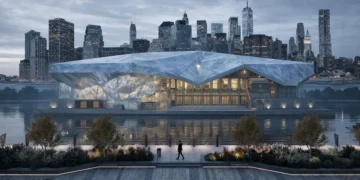
In the Riprap Ram Jam project, Cen Shen focused on ecological habitat reconstruction in the Gowanus waterfront area in Brooklyn, where industrial development has significantly reduced aquatic habitats. The project proposes an ecological shoreline infrastructure system in which brick components are fabricated using reusable mold systems and biodegradable material mixtures including oyster shells and organic binders.
The fabrication method allows multiple brick geometries to be produced from a modular mold system through rotation and combination of mold components. These bricks are assembled using a dry-stack system to form shoreline infrastructure that can support habitat formation and water flow interaction.
The bricks are designed with an intentional lifecycle: biological materials are gradually consumed by organisms and eroded by water flow, creating cavities and surface textures that provide habitats for aquatic organisms. Over time, the bricks gradually break down into smaller sediment particles and return to the river system. In this project, architecture is not a permanent object but part of an ecological lifecycle and environmental process. Fabrication methods, material lifecycle, and ecological systems are integrated into a single architectural and infrastructure system, where architecture becomes part of environmental transformation rather than a static built object.
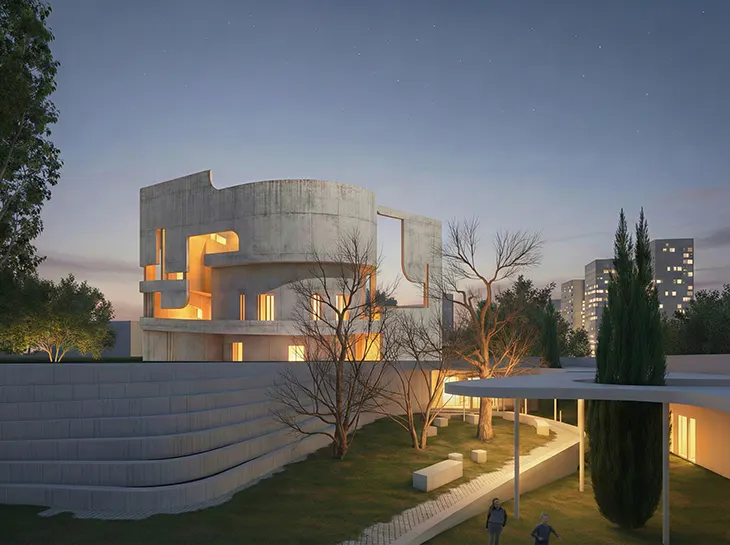
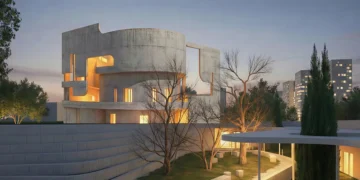
At a larger architectural scale, the Garden Clinic project explores the relationship between healthcare space, campus environment, and prefabricated construction systems. The project integrates garden courtyards and building spaces into a continuous spatial system, allowing landscape to function as spatial buffer, environmental filter, and privacy layer for sensitive healthcare functions.
The building envelope and structure are designed as a prefabricated panel system in which structural panels, facade panels, and landscape retaining components are coordinated as part of a unified construction logic. Prefabricated components allow building structure and garden infrastructure to be constructed simultaneously, reducing construction time and minimizing site disturbance.
In this project, architecture is not only defined by spatial organization but also by construction logic and prefabrication strategy. The project demonstrates how construction methods and fabrication strategies can influence spatial design and environmental performance, and how building and landscape can be constructed as a single integrated system.
The projects developed by Cen Shen through both professional practice and CSLab have received international recognition through multiple design awards, including the iF Design Award, MUSE Design Awards Platinum Award, Architecture MasterPrize, and New York Architectural Design Awards. Her work will be exhibited at NYCxDESIGN Festival in New York.
These awards recognize not only the architectural design of the projects, but also the integration of production logic, material systems, ecological infrastructure, and fabrication methods into architectural design. Across her award-winning projects, architectural design is developed together with production systems and material strategies from the pre-production stage rather than being applied after design is completed. This consistent approach across multiple projects demonstrates her ongoing research into architecture as a production and environmental system.
Across super-tall facade systems, modular construction research, fabrication experiments, and ecological infrastructure projects, Cen Shen’s work demonstrates a consistent approach in which architecture is understood as a system shaped by production, fabrication, construction, and environmental processes. Her work attempts to bridge the gap between architectural design and real construction processes, and to position architecture within larger production systems, material lifecycles, and ecological systems across building and urban scales.
Rather than treating architecture as a static object defined by form, Cen Shen’s work positions architecture as a dynamic system embedded within fabrication processes, construction workflows, environmental systems, and urban development. Through both professional practice and experimental research, her work explores how architecture can be produced, assembled, adapted, and eventually reintegrated into environmental systems over time.
Words by DSCENE Editor Eli Porter.