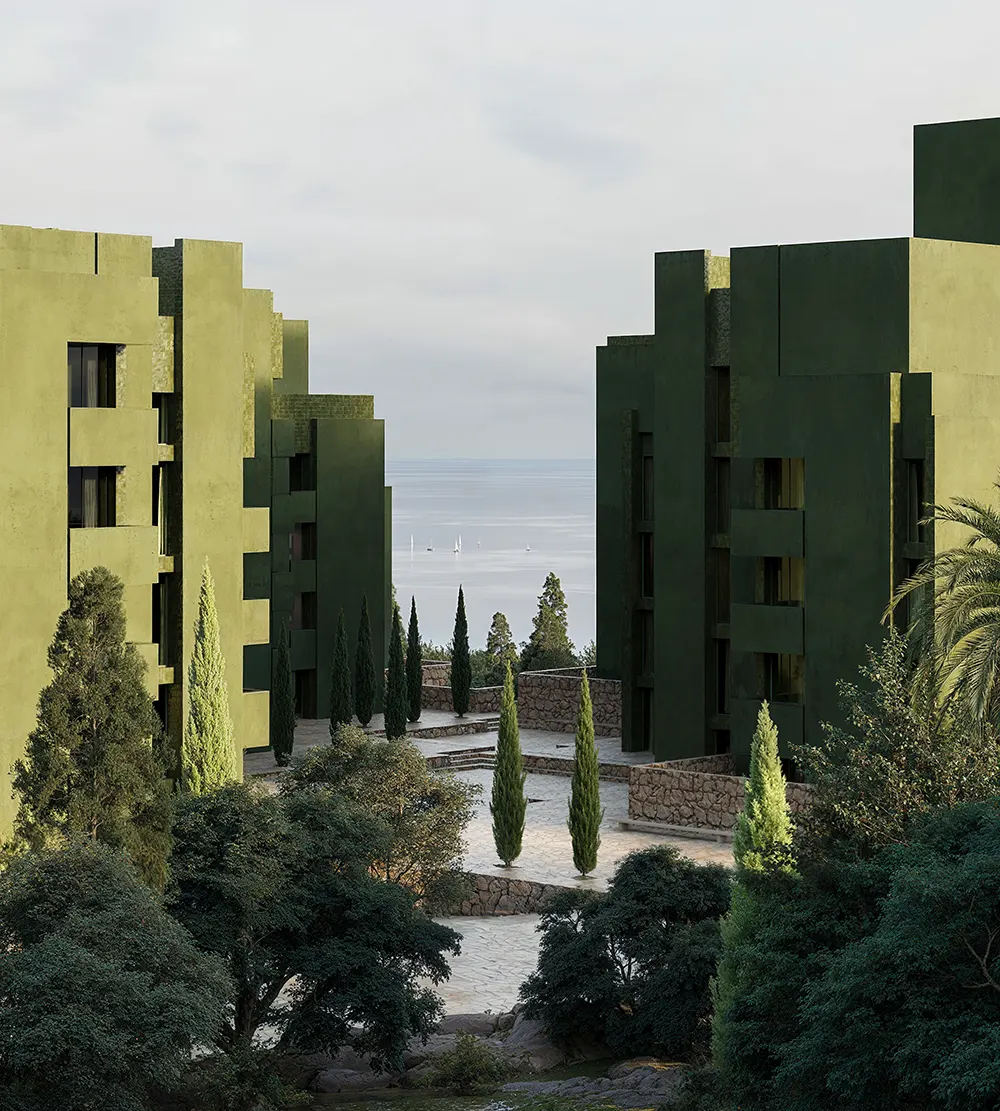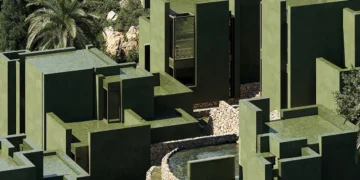



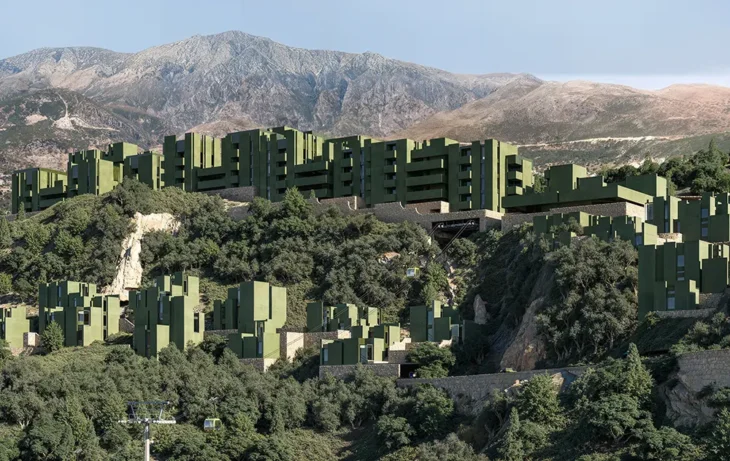
The Veil, currently under construction in Dhërmi, presents a large-scale intervention by Bofill Taller de Arquitectura that engages directly with a sensitive coastal landscape. The surrounding deciduous forests cover a significant portion of Albania’s terrain, and the mountainous coastline has remained largely untouched. The project acknowledges this condition from the outset, structuring its approach around minimal disruption and careful placement.
ARCHITECTURE
The development distributes 366 apartments and 77 villas across two plots, organized into sixteen typologies. Instead of imposing a singular masterplan, the layout follows the contours of the land. Buildings settle onto platforms that respond to existing slopes, avoiding extensive excavation. This approach defines the spatial logic of the project. The architecture spreads across the terrain in a dispersed configuration, allowing vegetation and topography to remain active elements. The concept of a “veil” emerges through this strategy, where built form maintains a light presence over the site.
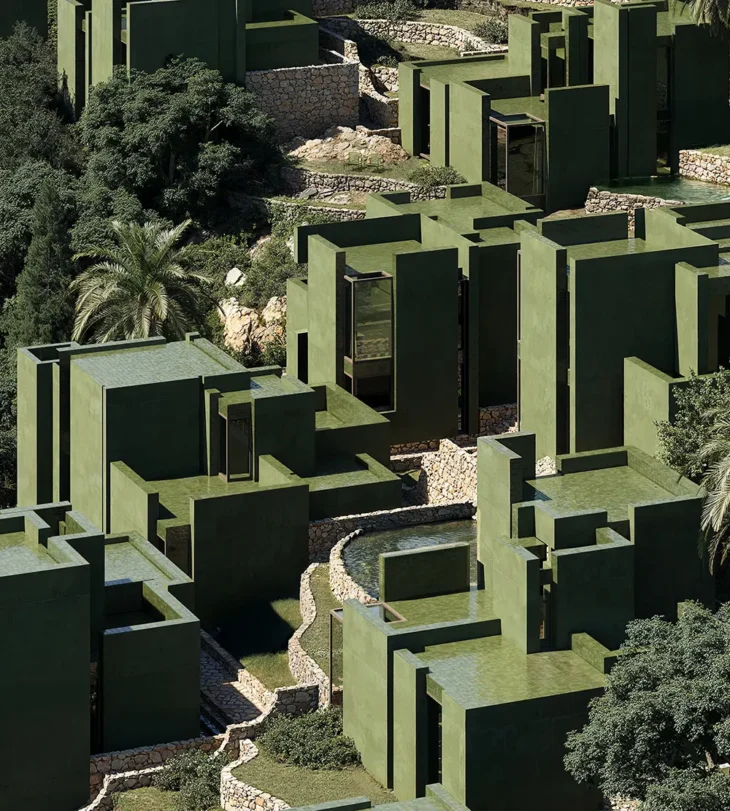
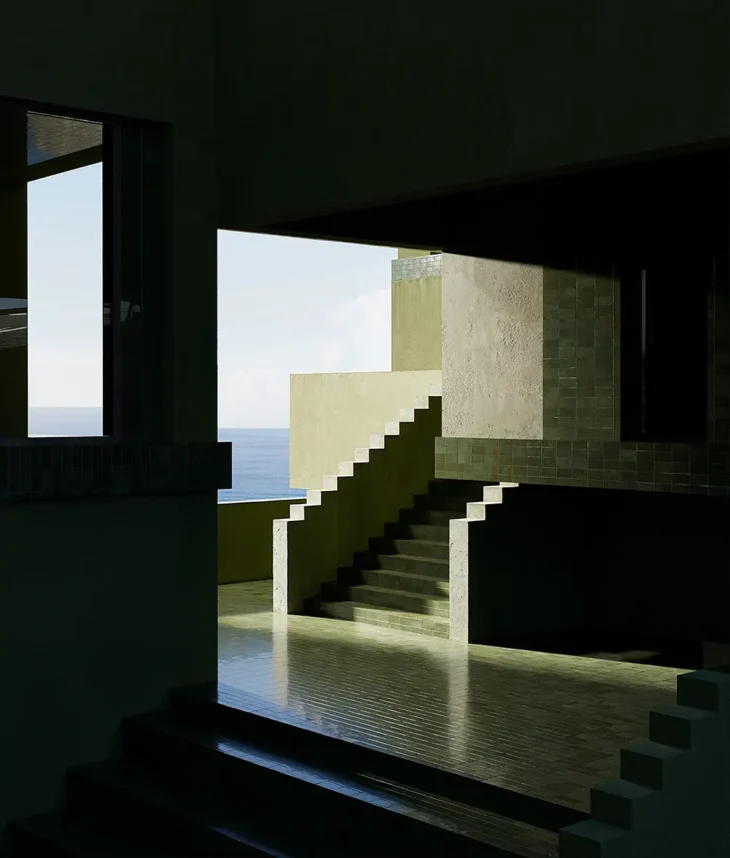
Circulation plays a central role in connecting the project. Locally sourced stone forms a continuous base that steps with the terrain, creating paths and stairs that move across the development. The material palette draws directly from the site, with four tones derived from surrounding samples. This decision grounds the project within its context while establishing a clear hierarchy of movement. The paths guide users without introducing unnecessary infrastructure.
Vegetation remains a defining factor in the composition. Key trees influence the placement of buildings, while other plant life stays largely untouched. The result is a layered spatial condition where horizontal platforms intersect with vertical growth. The residential volumes rise among the trees to capture views of the Adriatic Sea. Generous openings, terraces, and pools extend this relationship, maintaining visual continuity between interior and exterior spaces.
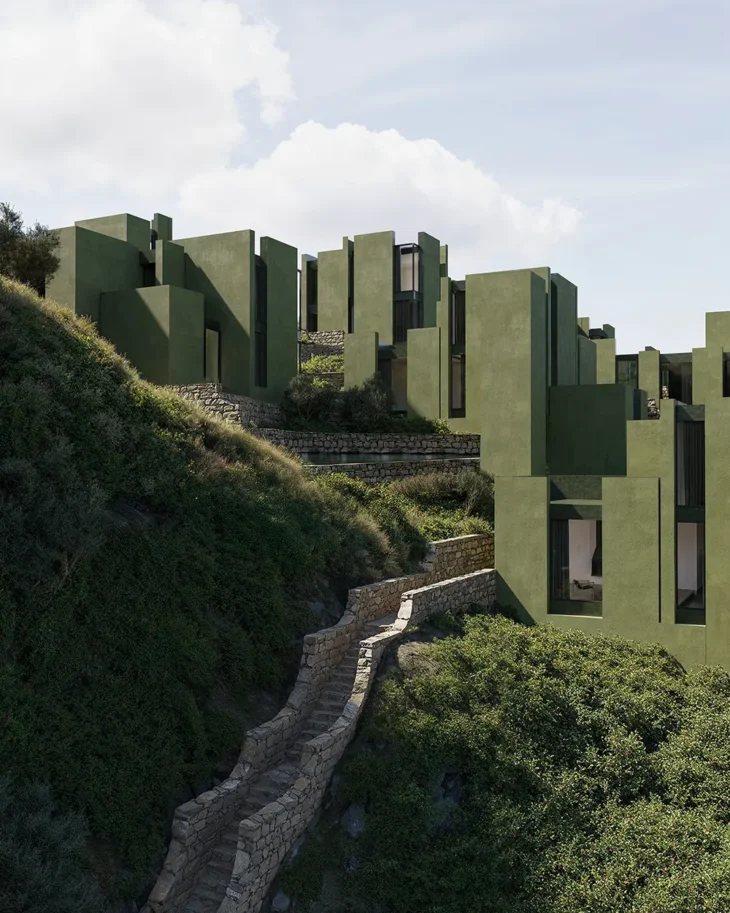
Despite variation in size and configuration, the units share a consistent facade treatment. Concrete and glazed ceramic tiles define the exterior surfaces, introducing subtle shifts in light reflection throughout the day. This consistency reinforces the cohesion of the development, while the reflective quality helps integrate the buildings into their surroundings. The architecture does not rely on contrast. It operates through alignment with existing conditions.
A central communal building organizes shared amenities, including a social club, restaurant, gym, and pools. Its courtyard introduces a deviation from the otherwise rectilinear geometry. It curves around a cluster of existing trees, placing them at the center of the space. This moment clarifies the project’s priorities, where architecture adjusts to the landscape instead of reshaping it.
Under the direction of Pablo Bofill, alongside design principals Hernán Cortés and Alborz Mohammadi, the project maintains a consistent framework across its scale. Landscape design by Vivian Rotie and technical coordination by Bàrbara Gimeno support a system where each intervention aligns with site conditions. The extended team contributes to a complex development that remains controlled in its execution.
The Veil addresses the challenge of introducing density within a fragile environment. Its strategy depends on distribution, material continuity, and precise placement. The project avoids dominant gestures, focusing instead on how architecture can coexist with the landscape. Its success will depend on how closely construction follows this intent, where the balance between development and preservation remains critical.