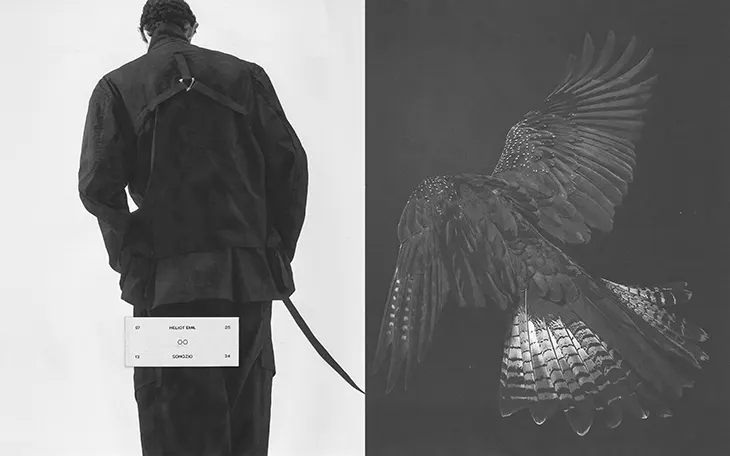



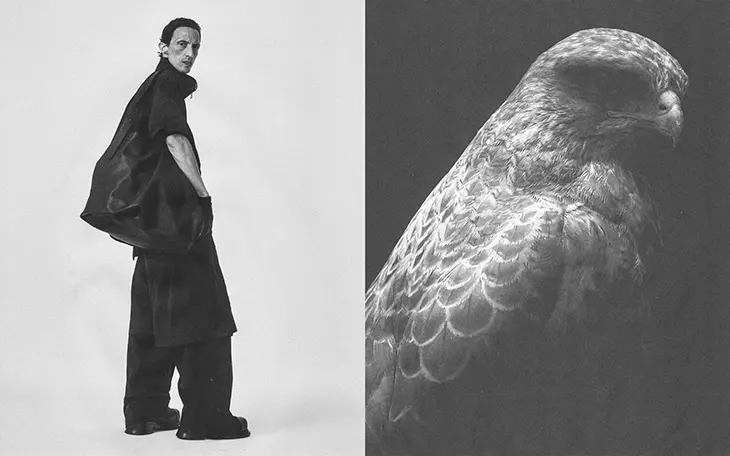
Songzio and Heliot Emil return with Falconry, their second collaborative collection for Summer 2026. The project takes its name from the ancient practice defined by trust, precision, velocity, and controlled distance. Songzio first presented the collection on June 5 at Galerie Noir, its art and fashion space in Seoul. The next opening will take place on June 12 at the Songzio Paris flagship store, while the collection is available internationally through the Songzio official online store.
AD CAMPAIGNS
Falconry provides the collection with a clear design system. The practice depends on the connection between the hand that releases and the body that returns, with each action governed by signals, timing, and restraint. Songzio and Heliot Emil translate those principles through garments that consider movement, protection, control, and speed. The designers use the wing as an aerodynamic blueprint, shaping layers that recall feathers and structures that respond to ascent and descent.
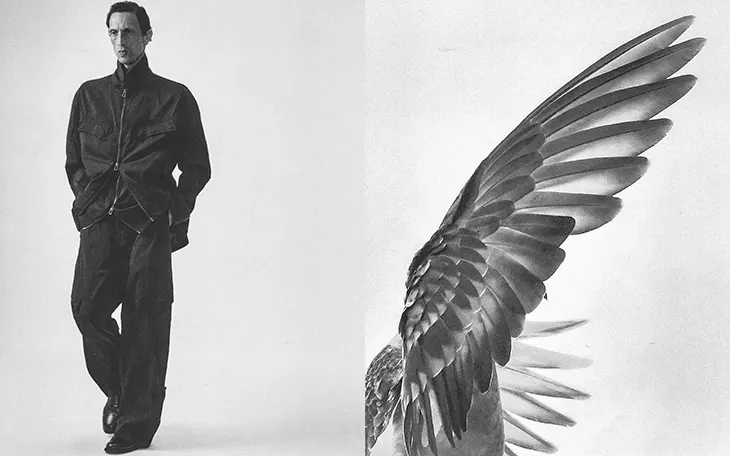
Voluminous forms narrow into streamlined sections, while soft materials meet controlled structural details. Layered panels give the clothing a feather-like rhythm and create depth across the body. Harness-inspired elements hold sections in place and introduce tension through straps, fastenings, and webbing.
Songzio brings its approach to poetic form and sculptural silhouettes, while Heliot Emil contributes a language grounded in engineered function and controlled performance. Falconry equipment gives both labels a shared reference point. Strapped constructions, reinforced sections, articulated seams, and performance textiles recall tools designed for grip, survival, and physical command.
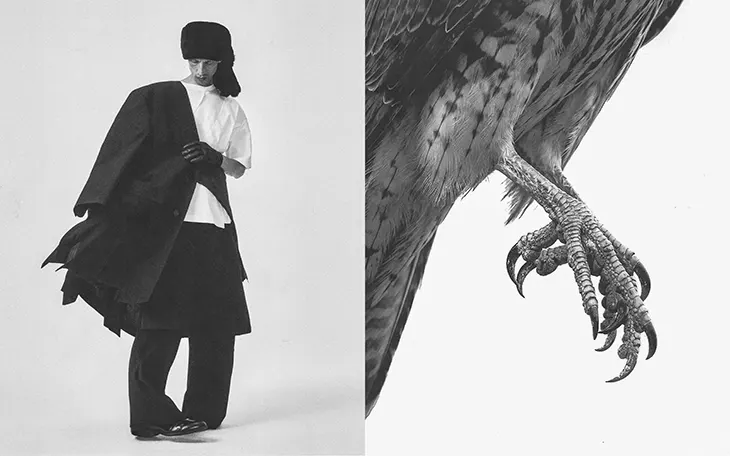
Panels taper toward narrow points, following the visual direction of feathers. Other sections guide air around the body through controlled lines and layered surfaces. Fastenings resemble functional equipment, with every buckle, strap, and connection placed as part of the garment’s structure. The collection treats hardware as a system for securing and adjusting clothing during movement.
The wing carries both physical and structural importance throughout Falconry. It offers a study of lift, weight, direction, and speed. Songzio and Heliot Emil examine the moment before release, when stillness contains the potential for sudden movement. Small actions can produce a rapid change in direction, and the garments reflect that compressed energy through tensioned construction and controlled volume. Falconry connects Songzio and Heliot Emil through a precise study of air and equipment. The collaboration turns the wing into a functional geometry and uses flight as a method for constructing form.