


The 82nd Whitney Biennial opened in March with the kind of institutional confidence that comes from eighty-two years of doing this. Spread across floors 1, 5, 6, and 8 of the Gansevoort Street building, it gathers fifty-six artists, duos, and collectives under a loose curatorial framework that resists easy summary. Co-organized by Whitney curators Marcela Guerrero and Drew Sawyer, the exhibition is framed as an invitation to “tune in to the moods” of contemporary American art, a premise that sounds generous and, at times, reads as a polite excuse for the absence of a stronger editorial point of view.
The Biennial’s restraint is, in places, its strength. But walking through it, floor by floor, one finds oneself waiting for a moment that does not always arrive.
That is not entirely a criticism. The Biennial’s restraint is, in places, its strength. But walking through it, floor by floor, one finds oneself waiting for a moment that does not always arrive. The show is thoughtful. It is well-intentioned. What it is less often is memorable.
And yet. There are works here that stay with you. Three of them, in particular, create a conversation that the curators may not have fully anticipated.
Taína H. Cruz: The Future at the Door
Taína H. Cruz greets you before you enter. Her billboard on Gansevoort Street, taken from the work “I Saw the Future and It Smiled Back,” shows a child’s wide, unguarded grin in green-tinted graffiti strokes. Born in 1998 in New York, Cruz is among the youngest artists in the exhibition, and her presence on the building’s exterior facade feels pointed. She is not inside the institution waiting to be discovered. She is outside, on the street, where her visual language was formed.
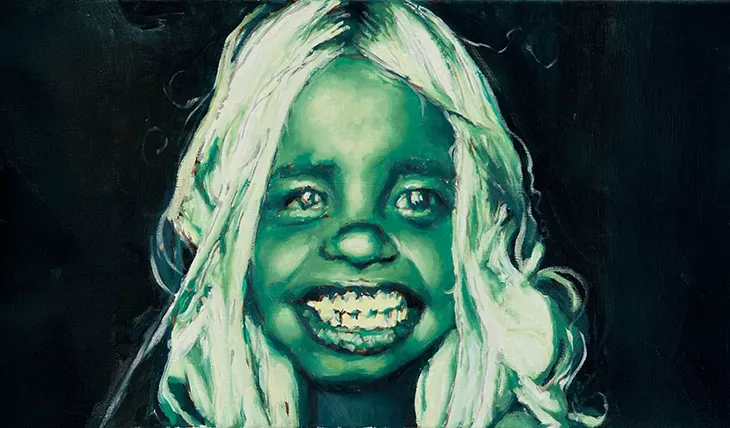
Inside, on the fifth floor, Cruz has painted directly onto the gallery walls. The gesture is consistent with her practice, art that belongs to its surface, inseparable from architecture and place. Her line is fast and uninhibited, carrying the looseness of someone trained in the open air, on walls that were never asked permission. The child-like quality in her imagery is not innocence for its own sake. It is economy. A refusal to over-explain what feeling already knows.
The billboard and the interior walls function as a single extended work, the outdoor optimism of a child’s smile pulling visitors inside toward something far less comfortable.
Ignacio Gatica and the City Looking at Itself
Before reaching the upper floors, Ignacio Gatica‘s work earns its own pause. His piece engages what he calls “Sanhattan,” a term that collapses geography and identity into a single, knowing word. It is a portrait of New York as it actually exists rather than as it is typically represented, a city shaped as much by Latin American presence, migration, and cultural layering as by the skyline images that dominate its global image.
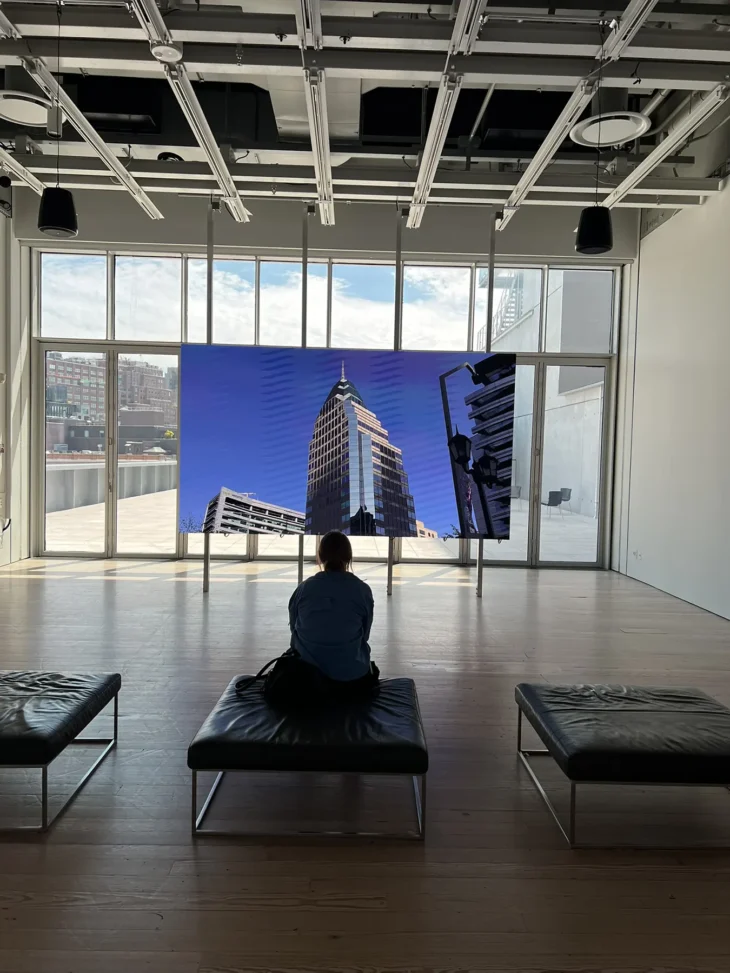
In the context of a Biennial that includes artists from Afghanistan to Vietnam and frequently references the reach of American power beyond its borders, Gatica‘s work turns that lens inward. The city hosting this exhibition is not neutral ground. It is itself a product of the same geopolitical and economic forces the show gestures toward. Gatica makes that visible without over-explaining it, which is precisely what good art inside a major institutional survey should do.
The city hosting this exhibition is not neutral ground. It is itself a product of the same geopolitical and economic forces the show gestures toward.
There is something almost self-reflexive about his inclusion here. The Whitney sits at the edge of the Meatpacking District, one of the most aggressively gentrified corners of a gentrified city. Gatica‘s Sanhattan asks who this building is actually for, and who the streets outside once belonged to. It is one of the few moments in the exhibition where the institution and the critique genuinely occupy the same room.
Precious Okoyomon: The Weight That Doesn’t Move
The eighth floor is where the Biennial earns its keep. Precious Okoyomon‘s massive composition stops the room. What registers at a distance as a large-scale installation of dolls resolves, on approach, into something that demands you stop breathing for a moment. The dolls have nooses around their necks. They hang. A single figure appears first on the fifth floor, so quiet you might pass it without recognition. By the time the full composition confronts you on the eighth floor, the scale has become its own argument. Dozens of dolls, arranged with deliberate precision, transform from objects into testimony.
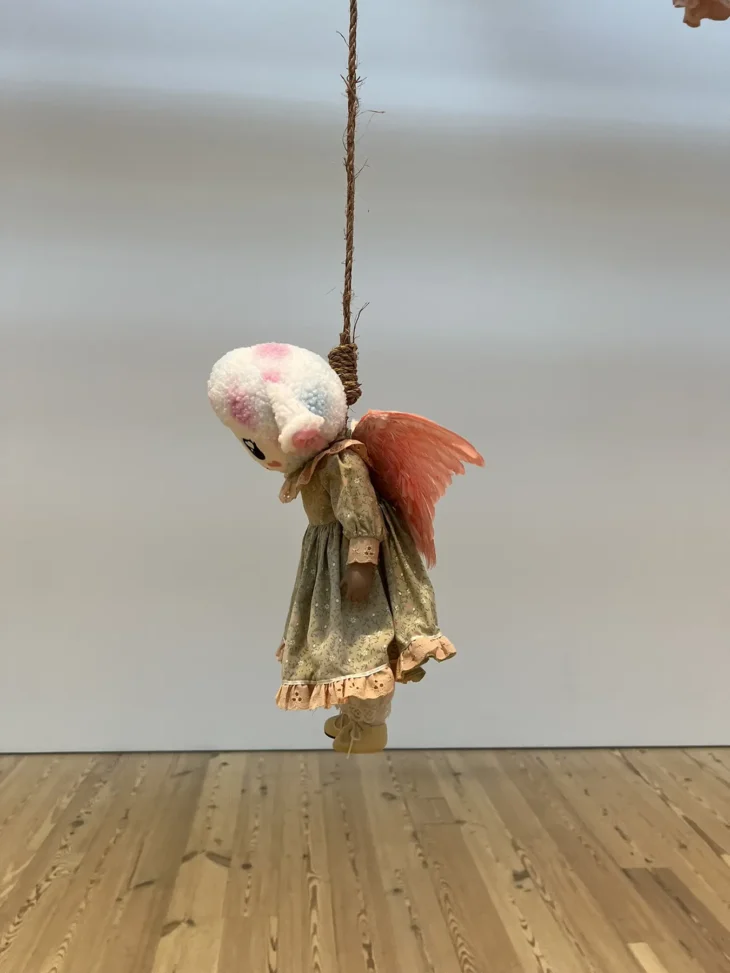
Okoyomon does not illustrate history. The work materializes its residue. The dolls are children’s toys. Their familiarity is not incidental. It is the mechanism. Lynching as spectacle, as social control, as American tradition: the imagery is direct, and the directness is necessary. In an exhibition that often prefers the oblique, Okoyomon‘s refusal to soften the subject is a form of clarity.
The Sum of the Parts
Read together, Cruz, Gatica, and Okoyomon stage the exhibition’s most coherent internal argument. Cruz‘s child smiles toward a future that is promised but not secured. Gatica maps the city that future is being built inside, and names who has always been there. Okoyomon answers both with what has been inherited: a past that refuses to recede, violence that wears the face of something soft.
That this triangle of meaning emerges without formal curatorial pairing is either an accident or a quiet curatorial success. Either way, it works.
The 82nd Whitney Biennial is not a landmark edition. It lacks the kind of defining image or argument that makes a survey exhibition something people cite a decade later. What it offers instead is a series of genuine encounters, moments where individual works do what institutions cannot mandate. Whether that is enough depends on what you came looking for.
Discover more of the Whitney Biennial 2026 in our gallery:
The Whitney Biennial 2026 is on view through August 23, 2026. Floors 1, 5, 6, and 8. Whitney Museum of American Art, 99 Gansevoort Street, New York. For more art coverage on DSCENE, visit designscene.net.