


COMME des GARÇONS HOMME PLUS Spring Summer 2027 began with a question rather than a declaration: “If The War Were To End..” Rei Kawakubo used that unfinished thought as the frame for a two-act presentation that moved from the Élysée Montmartre to the courtyard of Dover Street Market Paris. The collection rejected the weight normally attached to combat references and replaced it with color, distortion and release.
SPRING SUMMER 2027
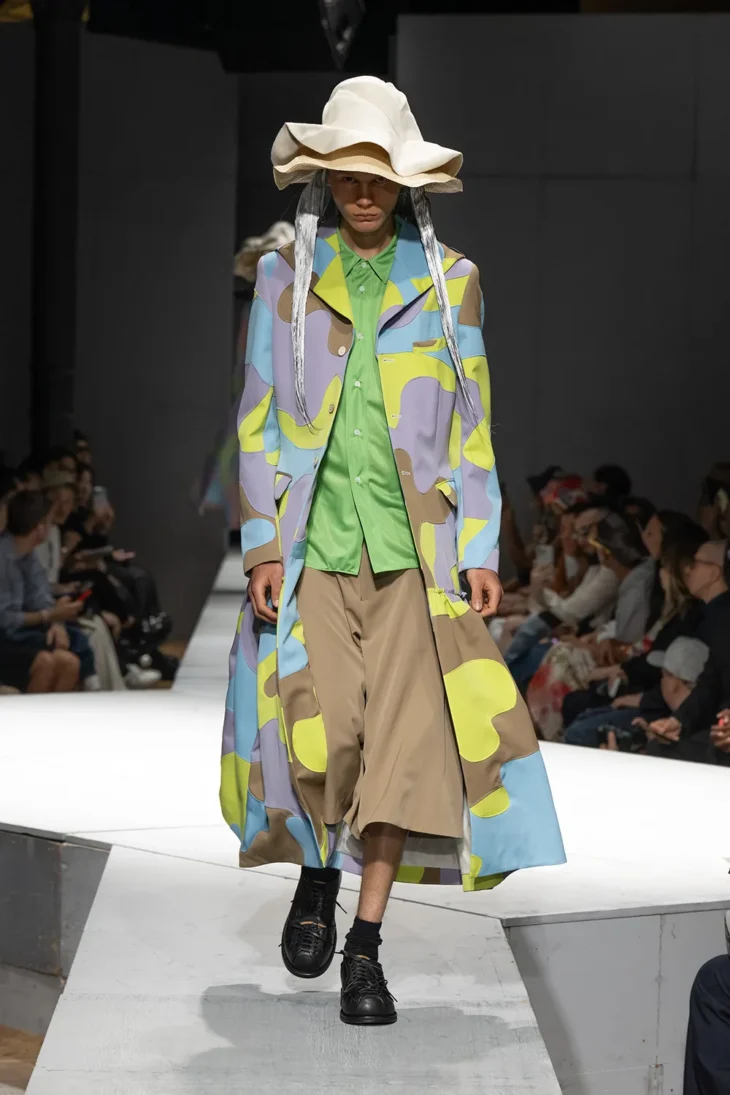
Kawakubo approached the idea of post-war dressing through subtraction and exaggeration. She removed the threat from military codes and pushed their visual language into a softer, stranger register. Camouflage appeared in lilac, seafoam, lemon and blush, stripping the print of aggression and turning it into something closer to emotional residue. The result felt less like peace as a clean resolution and more like peace as a rupture, a moment when clothing loses discipline and begins to misbehave.
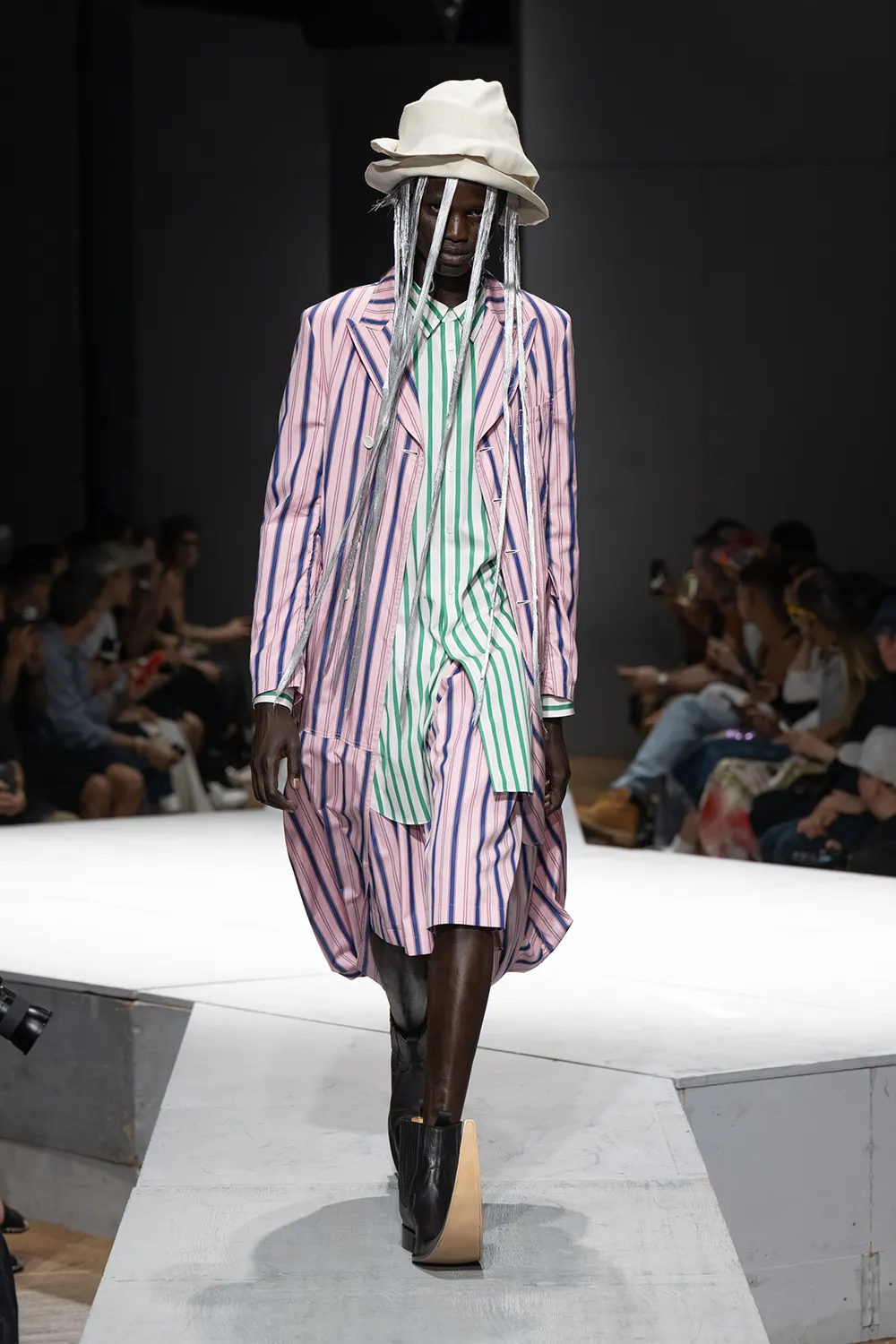
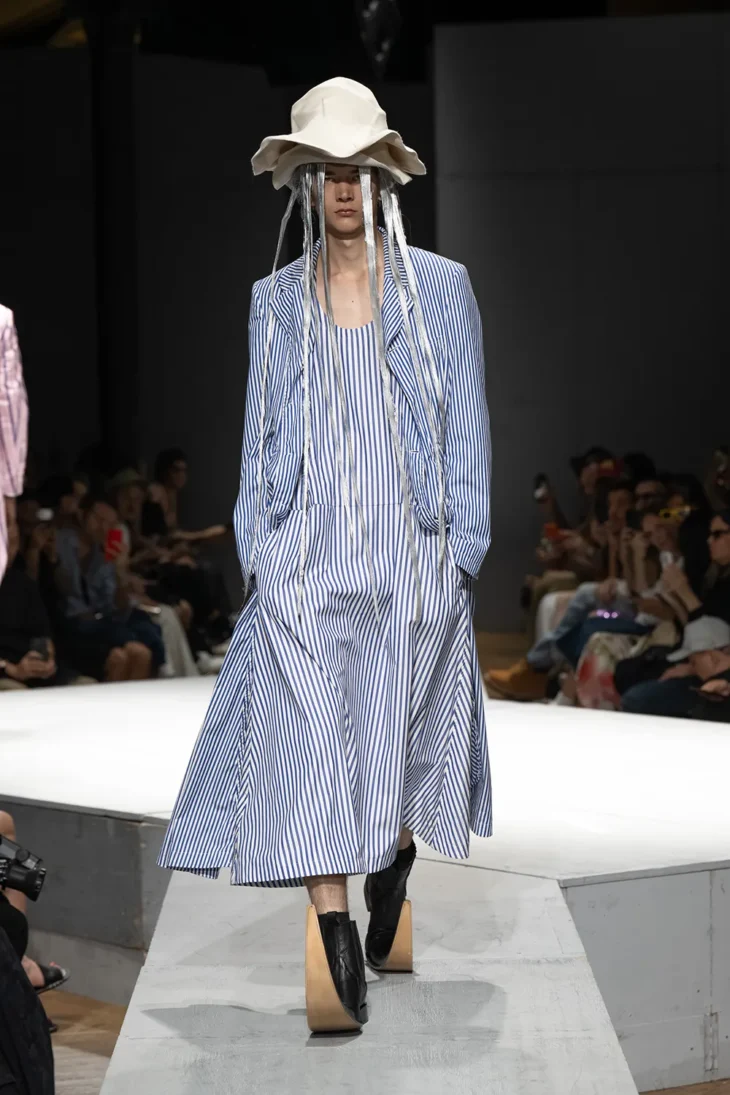
The first act opened at the Élysée Montmartre, where lighting by Thierry Dreyfus gave the room a stained-glass intensity. Ugo Nardini’s buoyant score brought movement to a show built around disruption. Awning stripes appeared across oversized coats and fluid pajama-like trousers in candy pink, jade, navy and sky blue. Kawakubo treated stripes as an unstable system, shifting scale and color until familiar tailoring started to wobble.
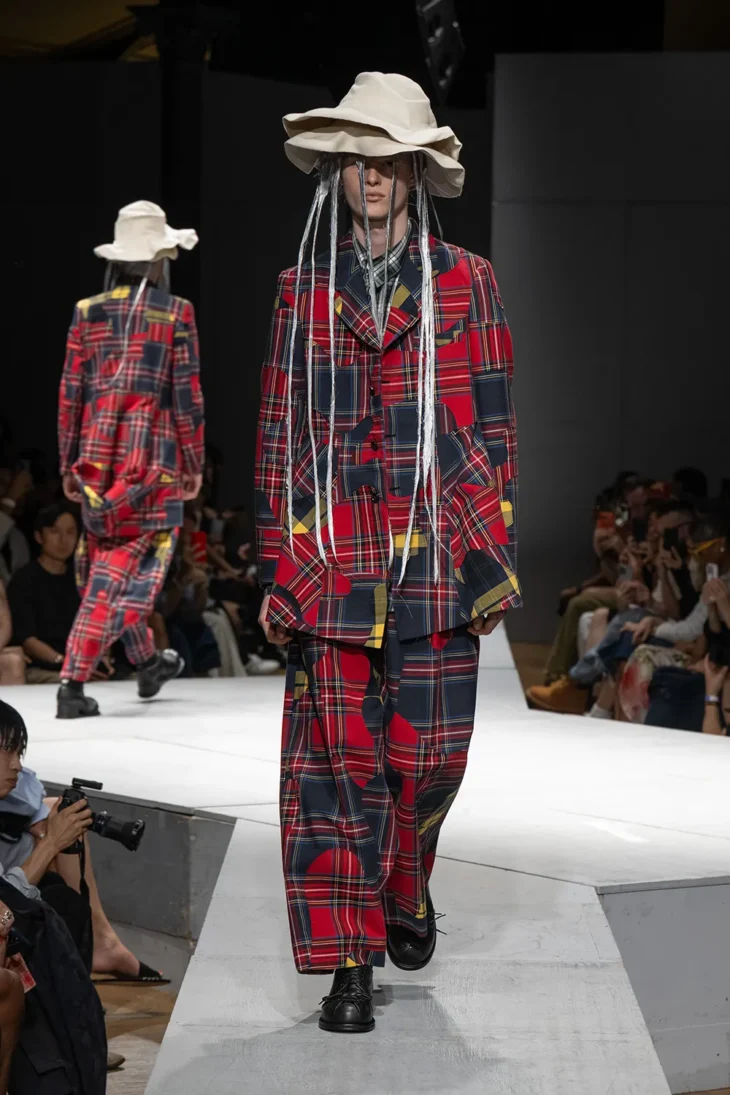
The silhouettes carried the house’s expected resistance to conventional menswear. Oversized coats dominated the body. Trousers moved with looseness rather than discipline. Double-breasted blazers arrived in electric chartreuse and lavender, taking a formal shape into louder territory. Asymmetric ruffled skirts and mesh layers pushed the collection further away from uniformity, while block-letter typography spelling out the house name added a blunt graphic charge.
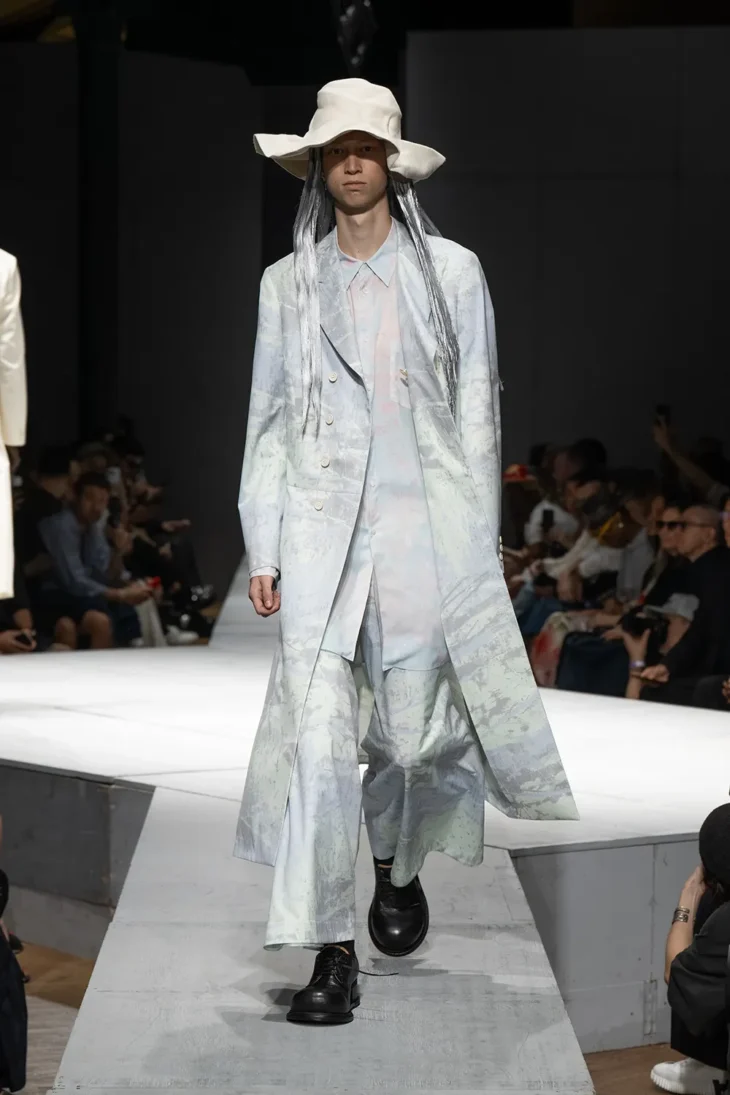
The second act at Dover Street Market Paris extended the runway into a spatial installation. A graphic collaboration with artist Nejc Prah sharpened the collection’s visual rhythm and gave the presentation another physical layer. The move from runway to installation suited the collection’s central idea. Kawakubo did not build a linear story. She created a sequence of fragments, each one suggesting what remains after structure breaks open.
Footwear gave the show its most immediate shock. COMME des GARÇONS HOMME PLUS brought back its ultra-pointy Mexican dancing boots, first seen in the Spring Summer 2015 season. Reworked with French shoemaker Mexicana, the Guarachero-inspired rancher boots returned with slightly modified, curved-up toes. Their exaggerated shape gave the collection its clearest symbol of refusal. They looked absurd, festive and defiant, turning the foot into a weapon of performance rather than combat.
Collaborative shoes with George Cox and Kids Love Gaite added further variation, although the Mexican dancing boots carried the strongest force. They anchored the collection’s excess and gave its color-driven chaos a memorable physical point.
Spring Summer 2027 worked because Kawakubo refused a literal reading of war or peace. She used camouflage, stripes, tailoring, mesh and footwear to ask what clothing might do after conflict ends. The answer came through distortion, color and movement. COMME des GARÇONS HOMME PLUS imagined release as something loud, unstable and full of mischief.