




Iris van Herpen presented Sonic Starquakes during Paris Haute Couture Week on July 6, 2026, turning the vibrations of stars, the turbulence of plasma, and the geometry of galaxies into a collection about energy, sound, and the body’s place in the universe. The collection begins with a scientific idea: stars are not silent. Like earthquakes, starquakes send waves through celestial bodies, creating subtle surface vibrations and rhythmic changes in brightness. Van Herpen translates that invisible motion into couture, using the body as a point where cosmic force and human presence meet.
COUTURE COLLECTIONS
The collection also looks to Victorian artist and inventor Margaret Watts Hughes, who created the Eidophone to visualize the human voice. By singing into the instrument, Hughes caused fine powders to move into intricate patterns shaped by vibration. Van Herpen draws a line between these experiments and the study of starquakes, suggesting that sound, matter, and energy share a language across scale, from the human voice to the surface of a star.
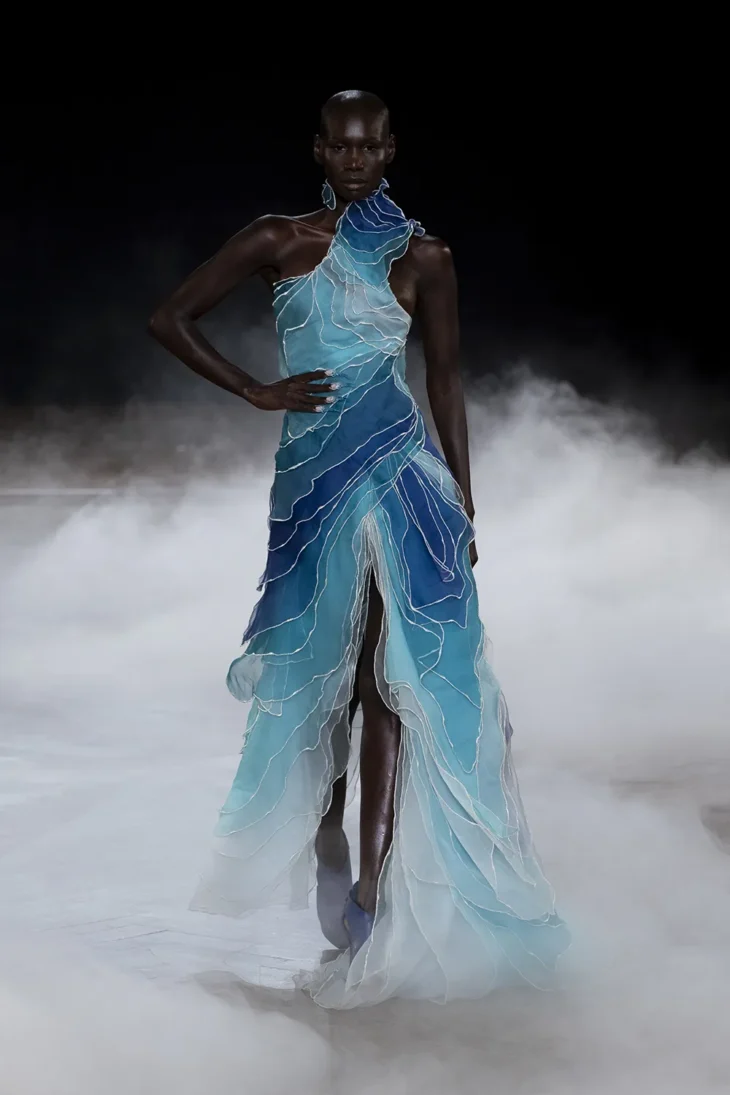
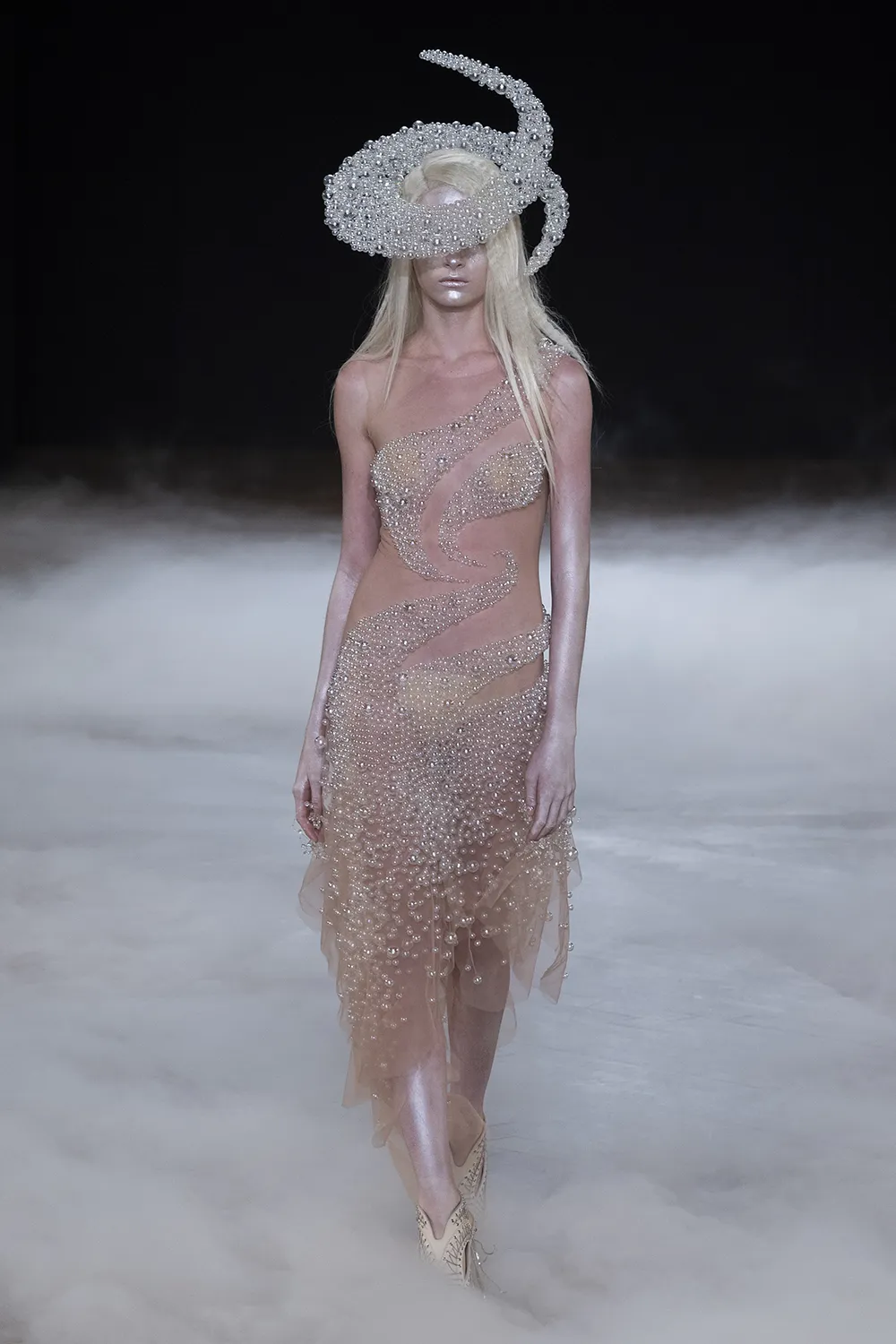
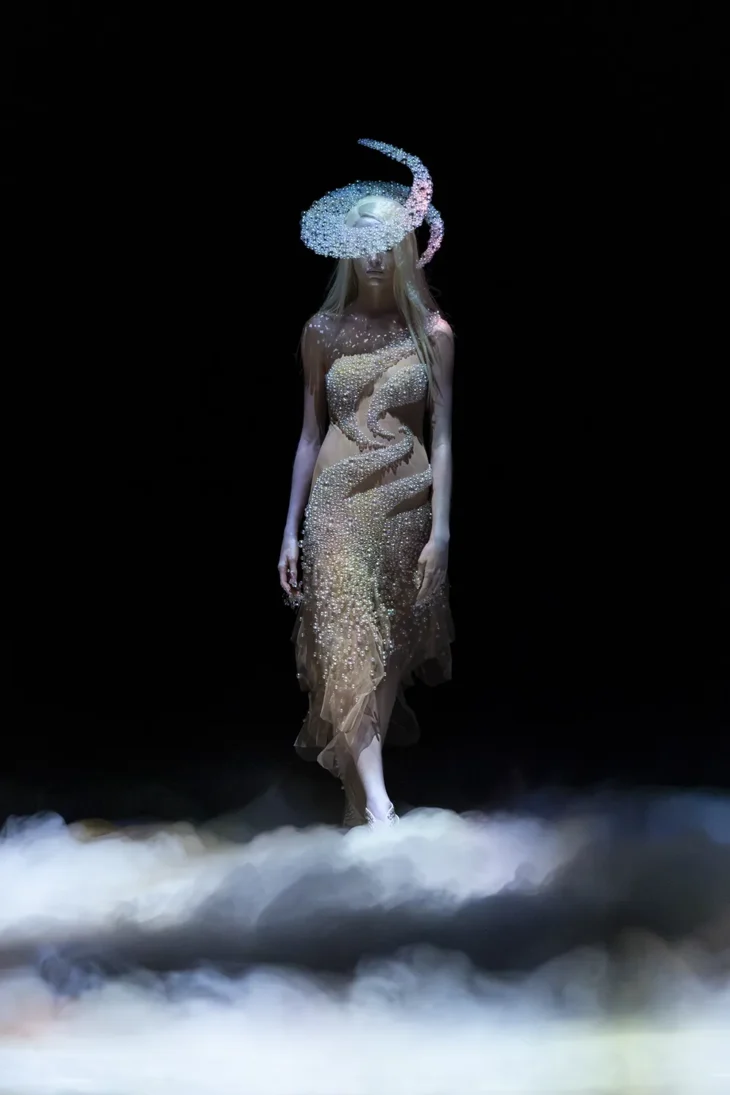
The Helix Nebula dress becomes one of the collection’s defining works. Built around two sculpturally floating lunar forms of hand-blown glass infused with plasma, the piece responds to human touch. Around it, 10,000 hand-blown glass spheres graduate in size and attach to illusion tulle with UV light. When worn, the body acts as a conductor, interacting with the plasma’s electrical field. The dress places couture in contact with the fourth state of matter, turning energy into a visible and reactive element within the garment.
The collection’s centerpiece, Fractal Universe, pushes that idea further. Charged inside a particle accelerator and cryogenically preserved before the show, the dress became a reservoir of trapped electrons. The original plan involved the model discharging the piece on the runway, but the garment began transforming itself before the presentation. Fractal patterns spread across its surface as lightning-like channels etched through its structure. What began as a loss of control became the most powerful expression of the collection’s theme: creation completed by an elemental force.
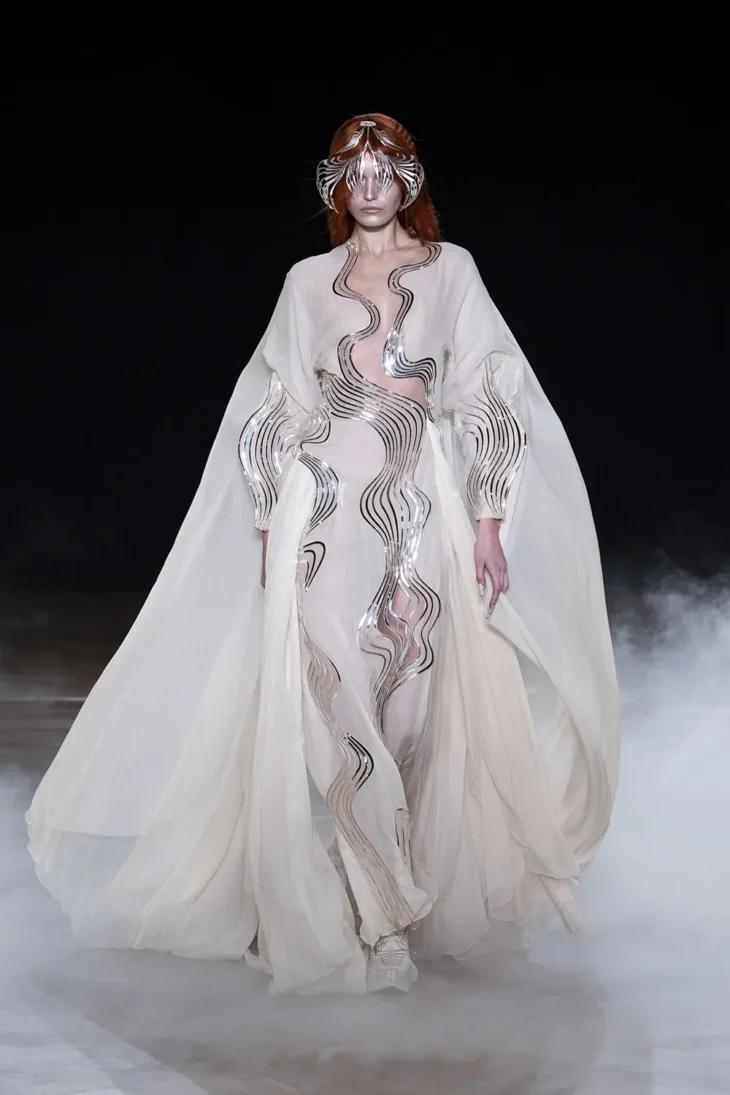
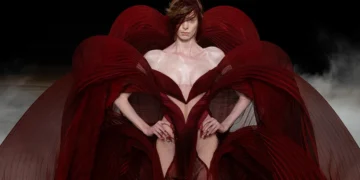
Across the runway, van Herpen resists fixed silhouettes. Laser-cut velvets move across the body in undulating vertical motifs, continuing onto the skin through hand embroidery. More than 30,000 iridescent glass spheres float over illusion tulle, dissolving the body into particles of light. Chiffons and organzas are hand-pleated into sweeping half-wheels and suspended within moon-curved carbon fibre boning, giving fabric the sensation of drifting through an invisible field.
The palette moves through the night sky, from midnight black and sapphire to cobalt, moonstone green, nebula red, and storm-lit silver. Light becomes an active material, shifting across transparent surfaces, glass, embroidery, and plasma. The body appears less as a fixed form than as a temporary meeting point between cellular, planetary, and cosmic structures.
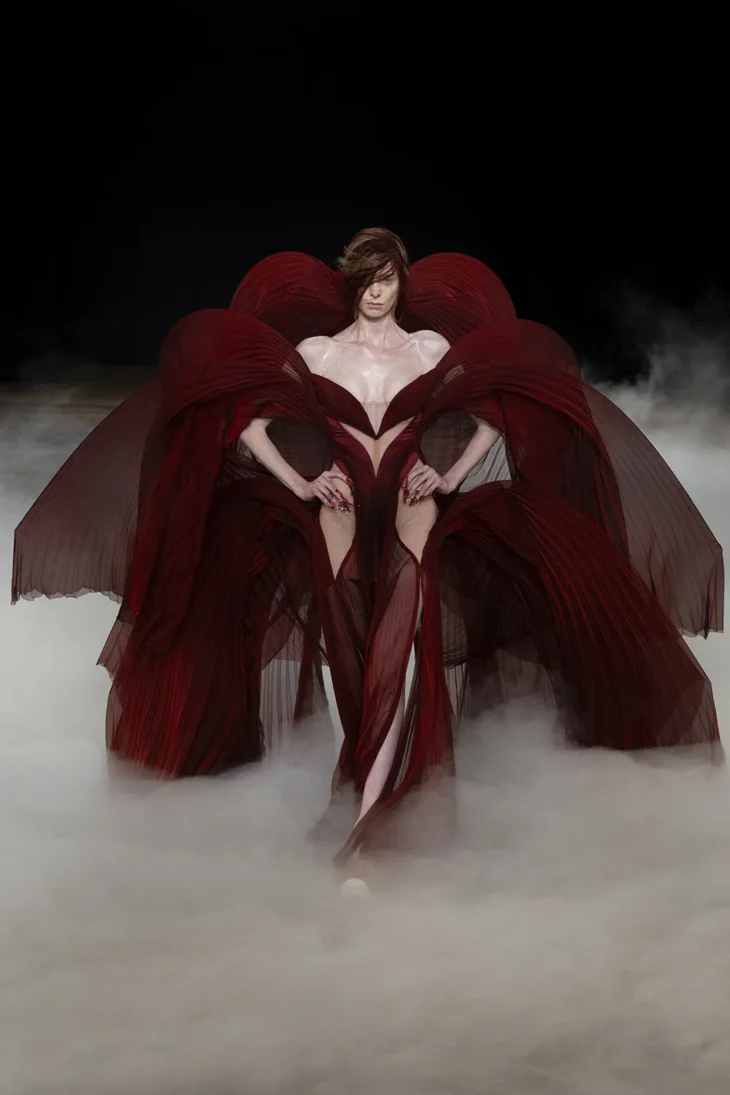
With Sonic Starquakes, Iris van Herpen continues to expand the definition of couture. The collection does not simply borrow from science as visual reference. It brings scientific forces into the construction of the garments themselves, allowing vibration, electricity, plasma, glass, and light to shape the experience of the clothes. Van Herpen proposes the body as a living field of energy, connected to the same patterns that form stars, storms, rivers, and neural networks. In her hands, couture becomes less about surface and more about the unseen forces that move through everything.