



The most advanced technology rarely reaches the people who could benefit from it most. It tends to be built for those who already have scale, capital, or full physical ability, and everyone else adapts, or is left at the door. Qilin Li has spent her career refusing that trade-off. Working at two of the most demanding frontiers in design, agentic AI and spatial computing, she uses them to do something deceptively simple: hand powerful systems to the people they were not built for.
DESIGN
Qilin leads product design at Alibaba US, a global commerce platform serving buyers and suppliers across more than 190 countries. Her projects have earned the iF Design Award and a UX Design Awards; her AI interaction innovations are the subject of multiple patent filings in the United States and China; and she now serves as a juror for international design awards. What that record describes is not a string of unrelated wins, but a single idea pursued across very different technologies.
That idea is access. In each of Qilin’s projects the barrier is different, physical ability, working capital, scale, expertise, but the move is the same: take a capability that once required something most people don’t have, and put it in the hands of the people the market underserves. Her conviction is that emerging technology earns its name not by being impressive, but by widening who gets to use it, and that the designer’s job is to make sure the system adapts to the person, never the other way around.
Inquiry Agent: leveling the field for small buyers
International trade has always rewarded scale. A large company can field a procurement team to negotiate with hundreds of suppliers at once; a small buyer, sending near-identical inquiries one at a time, cannot keep up. The work is punishing, and it quietly excludes the smallest players from competing at all.
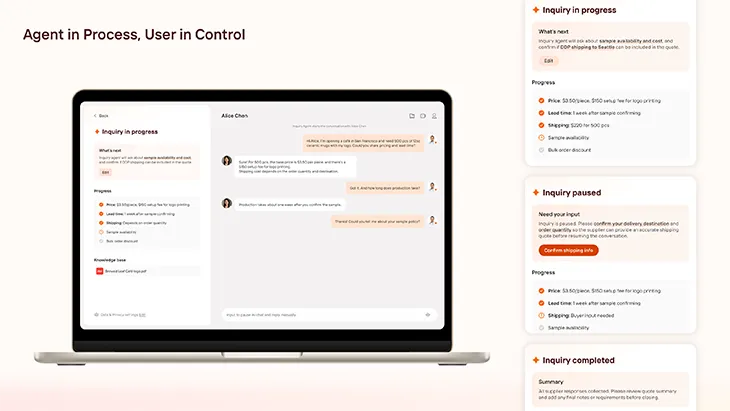
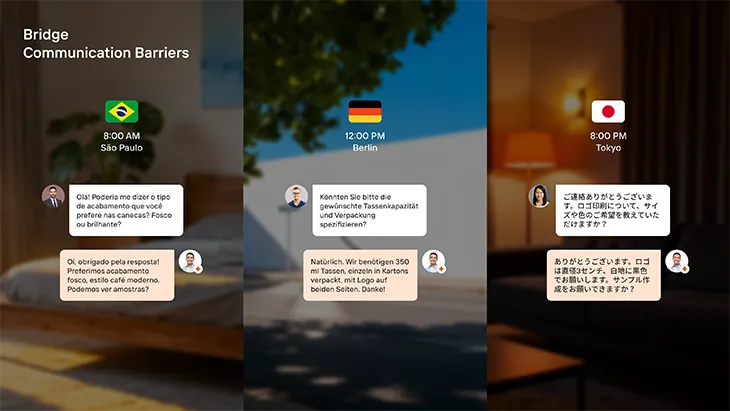
Inquiry Agent, which Qilin led from the ground up as lead UX designer at Alibaba.com, closes that gap with agentic AI. In this capacity, Qilin defines the buyer journey, AI interaction model, intent-clarification flow, transparency controls, and supplier-outreach experience. Her guiding principle was that the AI should feel intelligent but never opaque: it does the heavy lifting, but the buyer stays informed and in command. For Qilin, access never means surrendering control to a black box.
According to internal product measurement, the Inquiry Agent was associated with a 58% lift in inquiry-to-purchase conversion compared to standard inquiry flows. It proved original enough to earn the iF Design Award, a UX Design Awards nomination, and patents in two countries — evidence that designing for the under-resourced and designing for impact are the same project.
Pay Later for Business: access to capital
As founding designer of Pay Later for Business, Alibaba.com’s first embedded-financing program for the U.S. market, Qilin was responsible for the end-to-end user experience in collaboration with FinTech partners, including eligibility communication, credit application flow, financing disclosure, checkout integration, and post-purchase repayment management. She set out to extend credit to buyers the financial system tends to overlook.
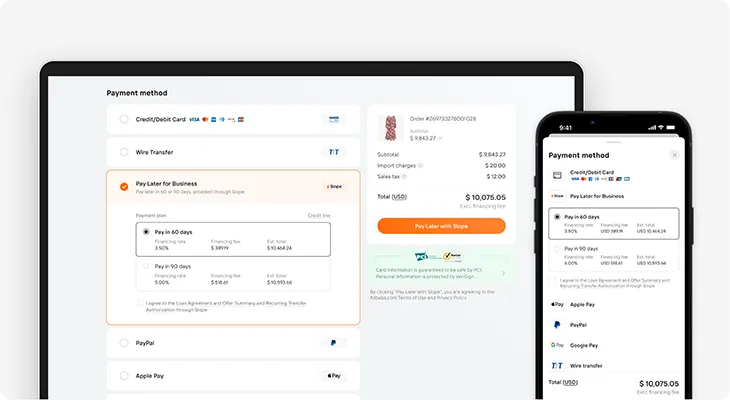
In its first year the program generated roughly $40 million in gross merchandise value. The launch was covered across fintech publications, including Digital Commerce 360, The Fintech Times, Financial IT, and IBS Intelligence, confirming the market relevance of the program, while Qilin’s role as founding designer connects her directly to the experience layer that made the financing product usable for small buyers.
iGYM: access regardless of ability
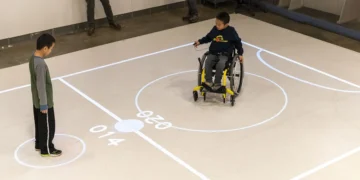
In her spatial computing work, Qilin’s commitment to access becomes literal. iGYM is an inclusive, projector-based augmented reality game in which children of differing physical abilities play together in real time, its mechanics adapting continuously to each player so the field stays fair. Working alongside developers and rehabilitation specialists, Qilin’s contribution centered on interaction design for adaptive play: defining how the system translated different physical abilities into balanced game mechanics so children could compete and cooperate on equal terms. In this design, a child’s physical ability stops determining whether they can join the game.
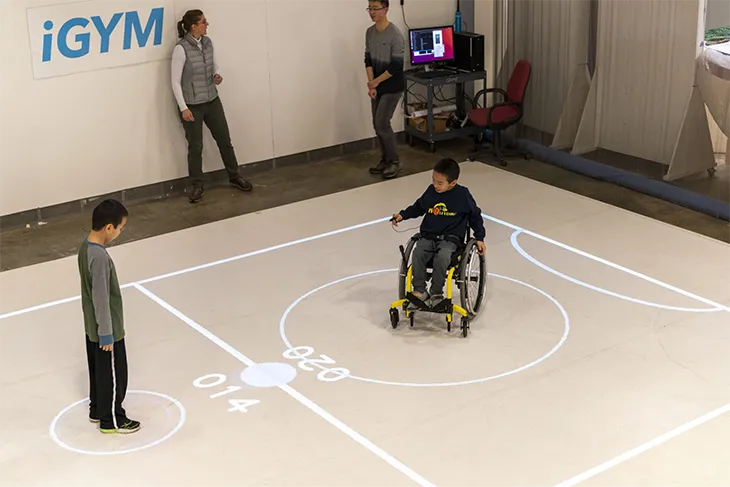
It is the purest expression of her method: rather than asking people to meet the technology where it is, the technology meets them. This commitment to ‘access as design’ anchors a spatial computing practice that navigates between physical accessibility and economic inclusion. This approach has gained recognition in a competitive global landscape, most notably through her award-winning work for Meta’s Presence Platform.
For instance, SuperEats earned top honors at the Meta Presence Platform Hackathon, chosen from more than 2,000 entrants. With SuperEats, Qilin specifically addressed the economic barriers of spatial computing by bridging mobile and mixed-reality devices, ensuring that immersive social interaction is not gated by the high cost of specialized head-mounted hardware.

Together, iGYM and SuperEats show how Li’s spatial computing work moves between accessibility and social interaction, using mixed-reality systems to redesign participation rather than simply add immersion.
Why it matters
Put side by side, Qilin’s projects describe a coherent contribution to her field: a way of using the newest, most powerful technologies specifically to dismantle the barriers, ability, capital, scale, that decide who gets to take part. It is a stance with growing currency. As agentic AI and spatial computing move from novelty to infrastructure, the question of who they actually serve becomes one of the most important in design, and Qilin has been answering it in shipped products, patents, and award-winning work rather than manifestos.
That she does this at the technical frontier is what makes her rare. Plenty of designers care about inclusion; few are defining interaction paradigms for AI agents and mixed reality at the same time, and fewer still are bending those paradigms toward the people such systems usually skip. As that work moves to the center of the industry, the designers who can make the frontier reach everyone will be among its most consequential. On the evidence so far, Qilin Li is already one of them.
Words by DSCENE Editor Maya Lane.