



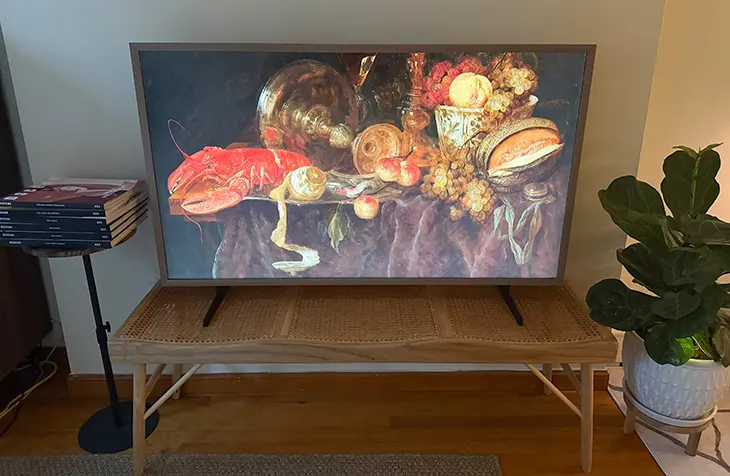
The Hisense CanvasTV arrives at a moment when living space has become a luxury and every object in a room must earn its place. In New York, Paris, Belgrade, cities where square footage commands premium prices, the television has long posed a design dilemma: functional necessity, visual liability. A black rectangle that dominates when off, consumes attention when on. The CanvasTV dissolves that tension entirely.
For years, the American market has accepted a false premise: design and technology are separate conversations. You choose a beautiful living room or a functional entertainment system. You compromise. You hide cables. You accept the black void on your wall as the price of convenience. The CanvasTV challenges that assumption at precisely the moment when Hisense, a globally dominant television manufacturer, is entering the American consciousness with a product category that shouldn’t work but absolutely does.
Different Kind of Television
We’ve tested enough smart TVs to recognize when a company is solving a real problem versus manufacturing a feature. The CanvasTV solves a real problem. In compact apartments where every wall matters, where Instagram-worthy interiors are not vanity but intentional living, a television that functions as both technology and decor is revolutionary. It is not a TV that simply happens to look good on your wall. It is, fundamentally, a different approach to what a television can be.
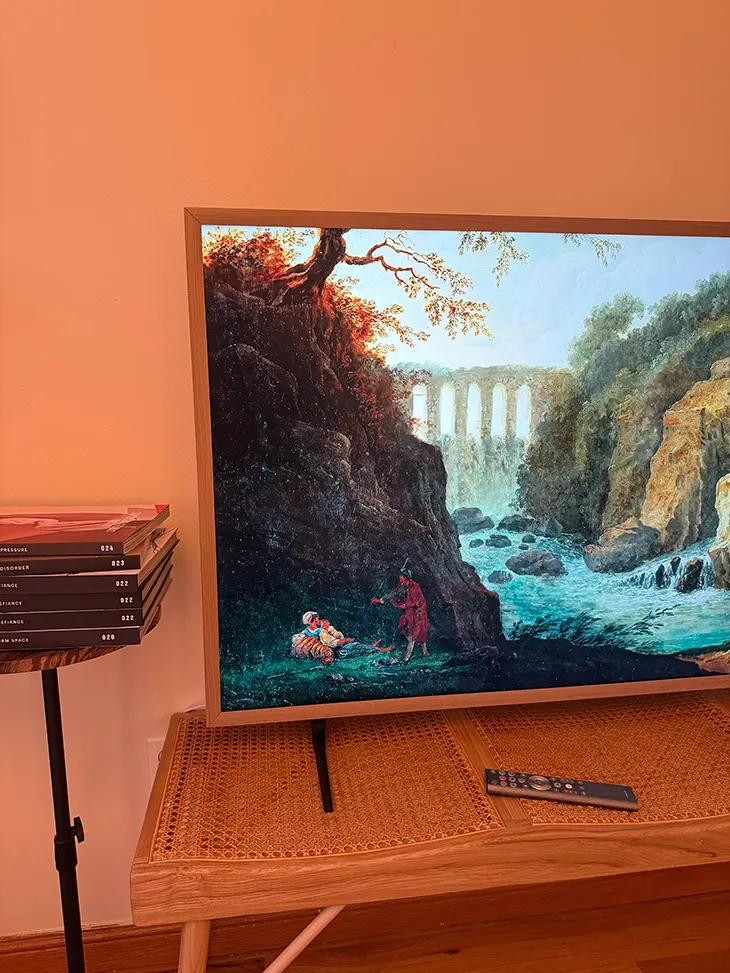
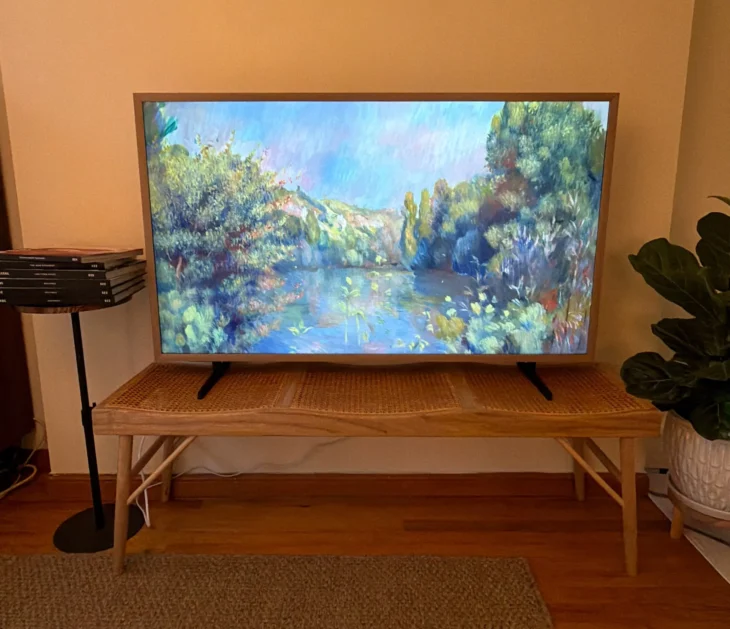
The Art Gallery mode is not a gimmick. It’s the primary interface when the TV is idle. When you’re not watching, the screen displays artwork. Open the library and you navigate through thousands of artworks, contemporary pieces, classical paintings, photography, installations, without paying a subscription, transforming the living room into a curated gallery rather than a dead screen staring back at you. Family photographs rotate in. Seasonal palettes shift with intention. The television becomes a tool for styling your space, not fighting against it.
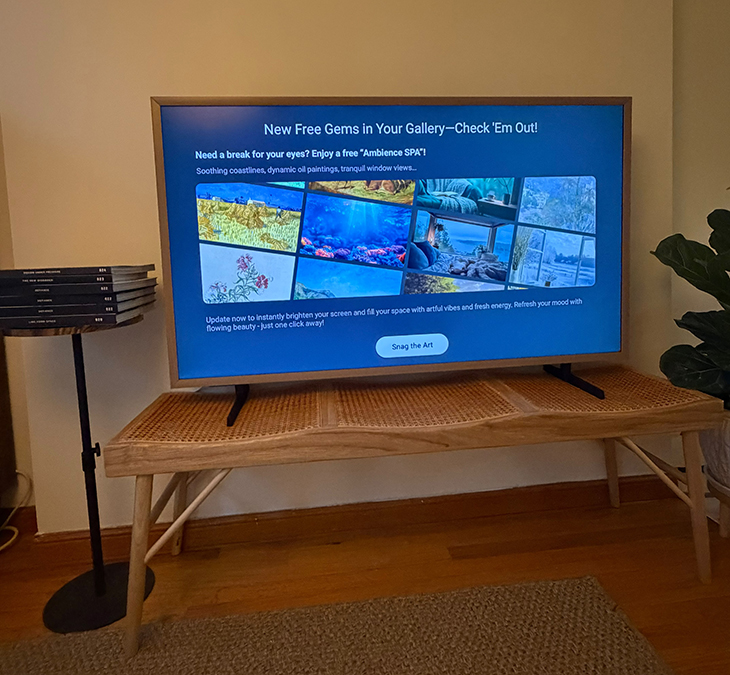
Hi-Matte Screen is the Innovation
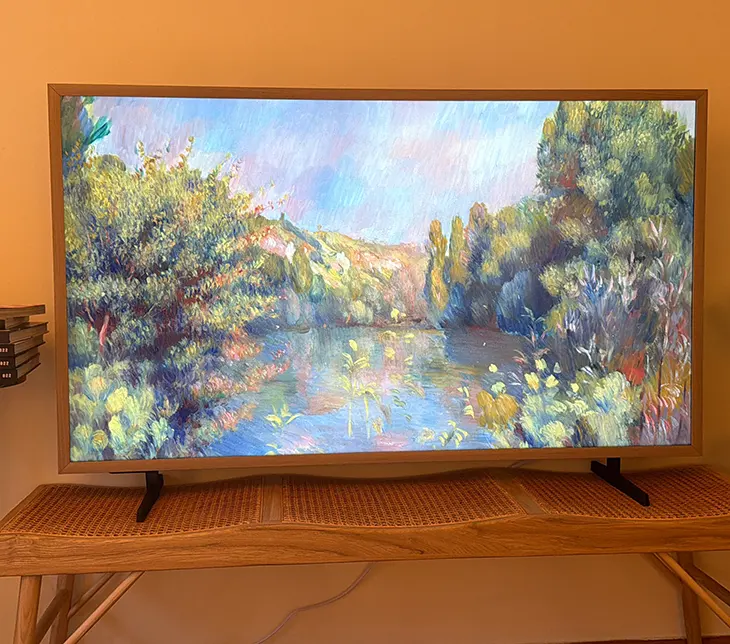
The hardware obsession in television marketing usually circles resolution, brightness, refresh rates. Hisense’s CanvasTV leads with something quieter but more consequential: the Hi-Matte Display. This paper-like matte screen is engineered to preserve the texture and shadow detail of artwork, the exact qualities that make a painting feel alive on a wall. Art keeps its canvas-like texture even in bright rooms. Morning sun, evening floor lamps, overhead fixtures: the screen doesn’t surrender to glare, and neither does the work on display.
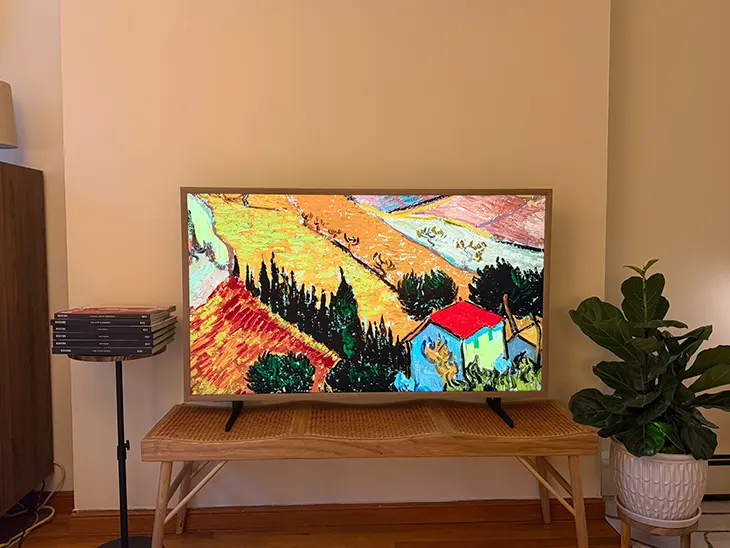
This is the technical detail that separates the CanvasTV from competitors making similar promises. Other brands offer “art mode” displays. They lack the optical engineering to make it matter. Their matte finishes muddy color. Their brightness dims under ambient light. The Hi-Matte Display on this Hisense model maintains color accuracy while preserving that paper-like, almost tactile quality. When you display a Rothko or a family photograph, it reads as art, not as a digital reproduction.
When artwork displays on this screen, it reads as authentic. The blacks are deep without being flat. The colors hold their vibrancy under different lighting conditions. When you watch films or daily content, that same paper-like surface keeps the image immersive without the reflective distraction of a glossy panel. Sit at an angle and you don’t catch your own reflection. Position it near a window and you don’t watch the room’s light reflected back at you. This is where other brands fail. They promise seamless integration and deliver a reflective slab that catches every light source. The CanvasTV actually solves the problem.
Color, Brightness, and 4K That Justifies Itself
The color accuracy on this display is exceptional. With 4K Hi-QLED Color Technology, artworks appear with nuanced color and dimensional depth that smaller, cheaper displays simply cannot match. Family photographs retain their warmth and tonal subtlety. The contrast range allows shadow detail to emerge without crushing blacks into obscurity.
Given our experience with previous TVs, where we often disabled the automated picture settings almost immediately, we approached AI Ambient Light Sensor with considerable skepticism. In practice, however, it delivered an excellent experience. The system adapts to changing room light through subtle, intelligent adjustments that feel natural and unobtrusive. By maintaining balanced brightness, accurate color and strong contrast throughout the day, it allows the 4K QLED panel to present artwork and cinematic content with impressive depth and consistency, creating a richer and more immersive viewing experience.
Where this display truly showcases itself is with IMAX-format cinema. Dune: Part Two, Avatar: The Way of Water, Top Gun: Maverick, Interstellar, films engineered for visual spectacle render with the scale and precision they demand. The cinematography becomes the point. You’re not watching a film on a TV. You’re experiencing cinema in your home. The Grand Budapest Hotel, a masterpiece of color and composition, becomes immersive in ways standard displays struggle to achieve. Wes Anderson’s deliberately composed frames, the symmetry, the pastel palettes, the meticulous production design, all of it registers with clarity that transforms passive viewing into an experience closer to being present in that world.
Live concert content, often shot in 4K, translates exceptionally well on the CanvasTV. We streamed performances that ranged from classical orchestras to contemporary music festivals. The detail registers, the texture of instruments, the lighting design, the energy of performance, in ways that make the experience feel immediate rather than mediated. The paper-like matte screen actually enhances this. There’s no glare competing with the stage lighting. No reflections fragmenting your attention.
This is a display built for people who care about what they’re watching, not just that they’re watching something.
Gaming Without Compromise
Gaming reinforces the point without dominating it. We tested the Hisense CanvasTV across multiple titles: Cyberpunk 2077, Marvel’s Spider-Man 2, Forza Horizon 5, Black Myth: Wukong, Elden Ring, Gran Turismo 7. These are not twitch-shooter titles. They’re games that prioritize visual artistry, atmospheric depth, and compositional care. On the CanvasTV, they read as extensions of the room’s design language rather than intrusions into it.
CanvasTV brings an elegant, immersive quality to the home, while its native 144Hz refresh rate keeps everyday gaming smooth and responsive. The Game Bar appears when needed, offering quick access to settings, but it doesn’t clutter the interface. Cyberpunk 2077’s neon-soaked Night City renders with color precision that makes the dystopian world feel lived-in. Elden Ring’s atmospheric landscapes, the golden Erdtree visible across vast distances, the interplay of light and shadow in underground caverns, benefit enormously from the display’s color accuracy and matte finish.
You can play a demanding title in the evening and display a Caravaggio or family photograph the next morning without feeling like the TV is compromising either experience.
Design and Practicality
The Hisense CanvasTV ships with its own stand. Wall mounting is optional, not required. This matters significantly. For renters, for those hesitant about permanent installation, for anyone who wants the flexibility to relocate, the stand proves that canvas-like presence doesn’t demand structural commitment. On a console, positioned on a shelf, or mounted flush to the wall-the device reads the same way: as furniture, as art, as a conscious choice about how you want your space to feel.
Setup is direct. The initial calibration takes minutes. No elaborate menu-diving. No buried settings that require a manual to navigate. The experience is front-loaded toward ease, which matters for people who want technology to serve their lifestyle, not the other way around.
Hisense’s American Moment
The American market has long accepted the premise that a premium television means a larger screen, higher refresh rates, and more features. The CanvasTV says: what if a premium television means one that doesn’t visually dominate your space when you’re not using it? What if it’s actually designed for the living rooms people are building, not the entertainment systems they think they should want?
This is a significant entry point. It positions Hisense not as a value alternative to established brands but as an innovator solving a genuine design problem. The product is exceptional. The execution is thoughtful. The price-to-performance ratio is compelling. But more importantly, the CanvasTV proves that Hisense understands the American consumer in a way that goes beyond specifications.
Finally, if you live in a compact urban apartment and treat your walls like a gallery. If you’ve spent time curating your space and refuse to let a television undo that work. If you want a screen that performs when you need it and disappears when you don’t. If you believe cinema and visual art belong in the same conversation. If you’ve compromised on design for functionality and you’re tired of it. The CanvasTV is the answer these readers have been waiting for.
It’s not the cheapest option. But it’s the only one that genuinely integrates rather than merely tolerates design-conscious living. And it signals that Hisense, a company known for global scale and manufacturing excellence, is ready to reshape how Americans think about what a television can be.
Specifications:
Model: Hisense CanvasTV 55S7SG
Resolution: 4K Ultra HD (3840 x 2160)
Panel Technology: QLED with Quantum Dot Color
Refresh Rate: Up to 144Hz VRR
Operating System: Google TV
Audio: 2.0.2-channel sound system
Gaming Features: AMD FreeSync Premium, Auto Low Latency Mode (ALLM), Low Latency MEMC
Design Features: Hi-Matte anti-glare display, UltraSlim Wall Mount included, interchangeable magnetic frame
Art Mode: Access to curated artwork collection and personal photo uploads
Additional Features: Motion sensor and AI RGB light sensor
Available Sizes: 50″, 55″, 65″, 75″, 85″
Purchase at: BestBuy 55S7SG, Amazon 55S7SG, and Hisense USA 55S7SG.
More on design-forward tech at DSCENE’s tech coverage.