


There’s a particular kind of luxury that has nothing to do with excess. Instead, it shows up in precision, in how spaces are shaped around daily rituals, light conditions, and movement. Author Houses, aka homes conceived as complete and intentional projects, are where this approach is most visible, especially when furniture is not an afterthought, but a structural element of the architecture itself.
In this context, it’s interesting to see how designers and architects have approached signature residential projects, such as Villa Domus in Sestri Levante, which is furnished with Arflex furniture. Designed by Luigi Daneri in the 1930s, this Rationalist villa overlooks the sea and reflects a long tradition of custom pieces, iconic designs, and site-specific solutions. This approach is also evident in projects such as Villa Earth by Sou Fujimoto Architects on Ishigaki Island and the Bubble House by Maurice Medcalfe in New York, where the furniture and architecture are conceived as an integrated whole.
1) A Milan Apartment by Patricia Urquiola with Pieces from Cassina and Moroso
This Milan apartment, surrounded by greenery, occupies the entire first floor of an elegant 1920s building. A long sequence of windows facing the street floods the interior with natural light, transforming illumination into an active design element.
The living area best exemplifies Patricia Urquiola’s vision: cool-toned lime plasters in shades of blue and pale azure interact with textile boiserie in earthy hues, creating a subtle gradient between public and private zones.
A standout element is the double-sided wooden unit, which serves as a library on one side and storage on the other.
Ultra-soft upholstered pieces and armchairs from Cassina and Moroso sit alongside bespoke designs throughout the space, including a brass bar cabinet and a striking hammered metal dining table.
Wood serves as the project’s primary connector and is treated as a malleable surface.This is evident in the three-dimensional corridor boiserie and the French herringbone floor, which is designed as a faceted carpet framed by Fior di Pesco marble skirting, referencing aristocratic interiors of the past.
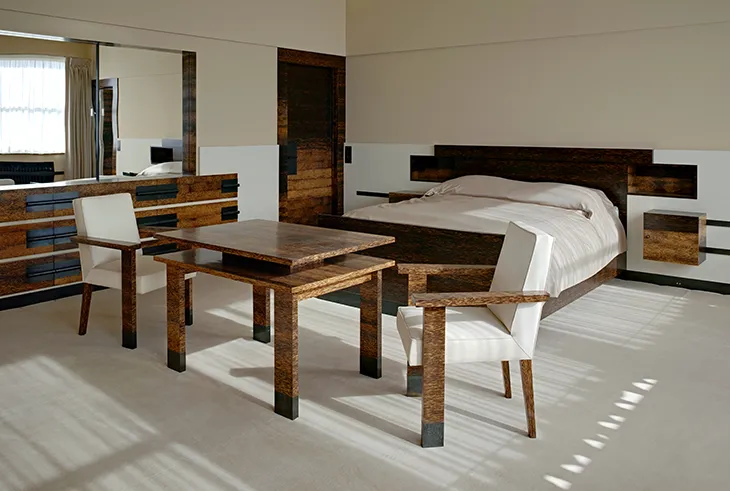
2) Villa Cavrois: Where Modernism Controls Every Detail
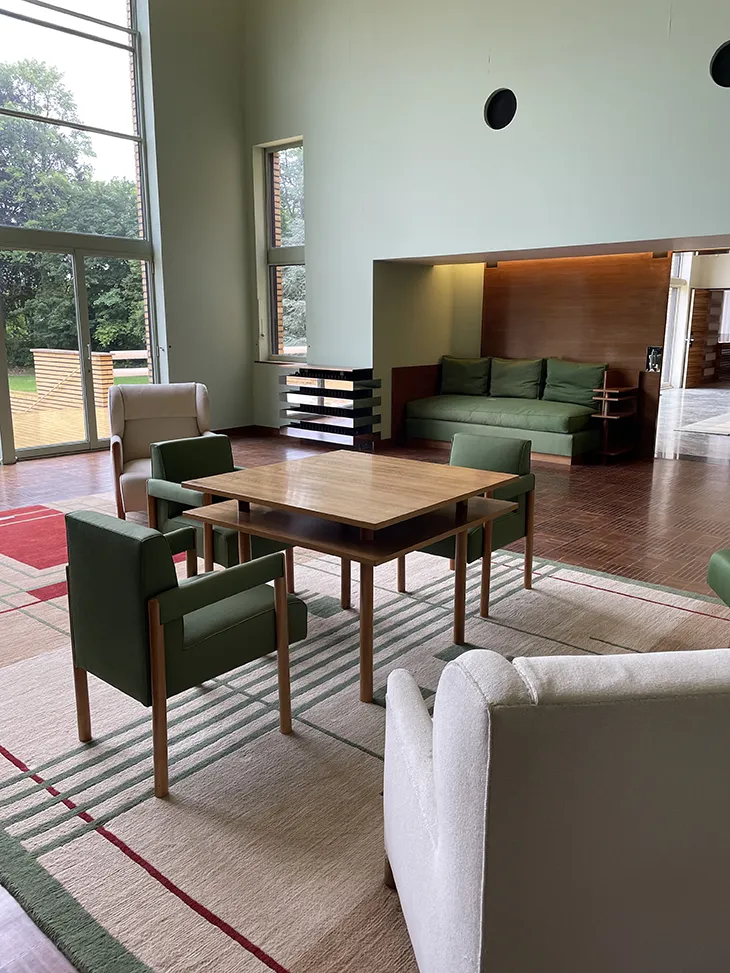
Built in 1932 on the outskirts of Lille, Villa Cavrois is a prime example of European modernism. Designer Robert Mallet-Stevens received complete creative freedom from his client, textile industrialist Paul Cavrois, making the project extraordinary for its time.
Mallet-Stevens designed the architecture and the entire interior furnishing system. He selected materials, colors, and furniture for each room, creating a sequence of atmospheres influenced by the dominant artistic movements of the 1930s, such as Art Déco, De Stijl, Viennese Secession, and Bauhaus functionalism.
His background in scenography is evident throughout the house, from the pastel tones and rounded, rationalist forms to the function-driven furniture. The villa enjoyed a quiet life until the 1980s. After that, it fell into severe neglect and suffered vandalism and looting.
A turning point came in 2001 when the property was entrusted to the Centre des Monuments Nationaux. After undergoing extensive restoration, Villa Cavrois reopened to the public in 2015.
3) Dimorestudio’s Saint-Tropez Apartment: Modernism Kept Intact
Located within the former Latitude 43 Hotel, a modernist landmark built in the 1930s, this 120-square-meter apartment in Saint-Tropez is an elegant example of balance. Led by Emiliano Salci and Britt Moran, Dimorestudio approached the space with restraint, choosing not to disrupt its original layout.
The long corridor, with porthole-style openings reminiscent of a ship’s deck, and the central living room are both original features. Rather than rewriting the plan, the designers focused on layering references and materials. In the dining area, coral-red Vietri ceramic tiles arranged like a rug evoke the iconic majolica floors designed by Gio Ponti for the Hotel Parco dei Principi in Sorrento.
Marine blue and soft green dominate the palette, extending across floors, walls, and large custom-made furniture pieces. Wood and natural fabrics ground the interiors, while carefully selected smaller furnishings introduce historical depth: some of these pieces were designed by iconic designers from the 1900s, such as Gabriella Crespi, Marcel Breuer, Le Corbusier, Romeo Rega, Luigi Caccia Dominioni, and Eileen Gray.
Dimorastudio’s apartment is a contemporary interior that absorbs history without becoming trapped by it.
4) Casa Soskil: Ludwig Godefroy’s Brutalism Softened by Nature
In Mérida, Mexico, Casa Soskil, designed by Ludwig Godefroy, flips the traditional hierarchy between architecture, furniture, and landscape. Here, vegetation takes center stage. Native trees and plants, such as guava, mamey zapote, pitaya, and tamarind, soften the brutalist concrete structure of the house.
The architecture relies on contrast, using raw concrete volumes with a variety of textures to engage both sight and touch. Instead of merely decorating the space, these surfaces create a dialogue between the built environment and the surrounding nature.
There is no overt celebration of design authorship inside. The furniture consists of custom-made pieces and Mexican artisanal elements. Nothing calls attention to itself. Everything serves the same purpose: to reinforce a sense of equilibrium between human intervention and natural growth.
It’s a reminder that the most radical interior statement is sometimes restraint.
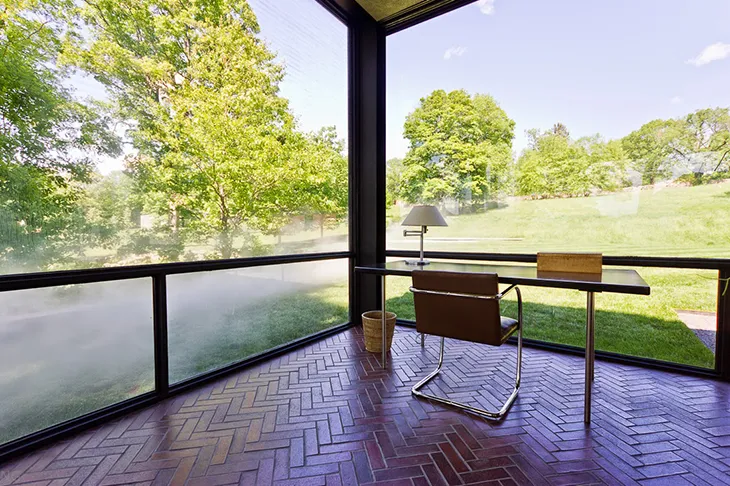
5) Philip Johnson’s Glass House: A Mies van der Rohe-Fueled Interior
The Glass House, completed in 1949 in New Canaan, Connecticut, remains one of the most influential residential projects of the 20th century.
Designed as a dark, steel-and-glass pavilion, the Glass House operates as a transparent observatory, dissolving the boundary between the interior and the landscape.
The house clearly takes inspiration from the Farnsworth House, which was designed by Mies van der Rohe and is located near Chicago. This lineage is reflected in the furnishings as well. Many of the original pieces come from Johnson’s New York apartment, designed by Mies in 1930. One notable piece is the famous Barcelona Daybed, which Mies created specifically for Johnson and is now produced by Knoll.