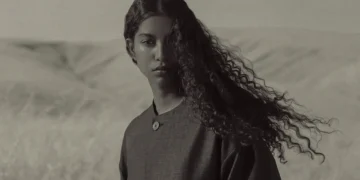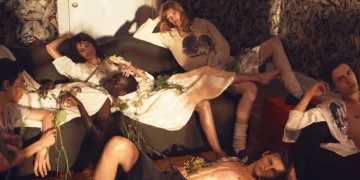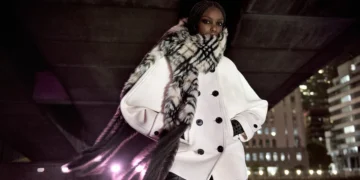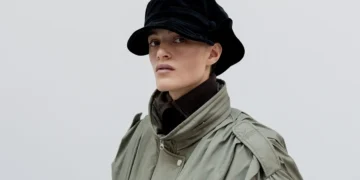



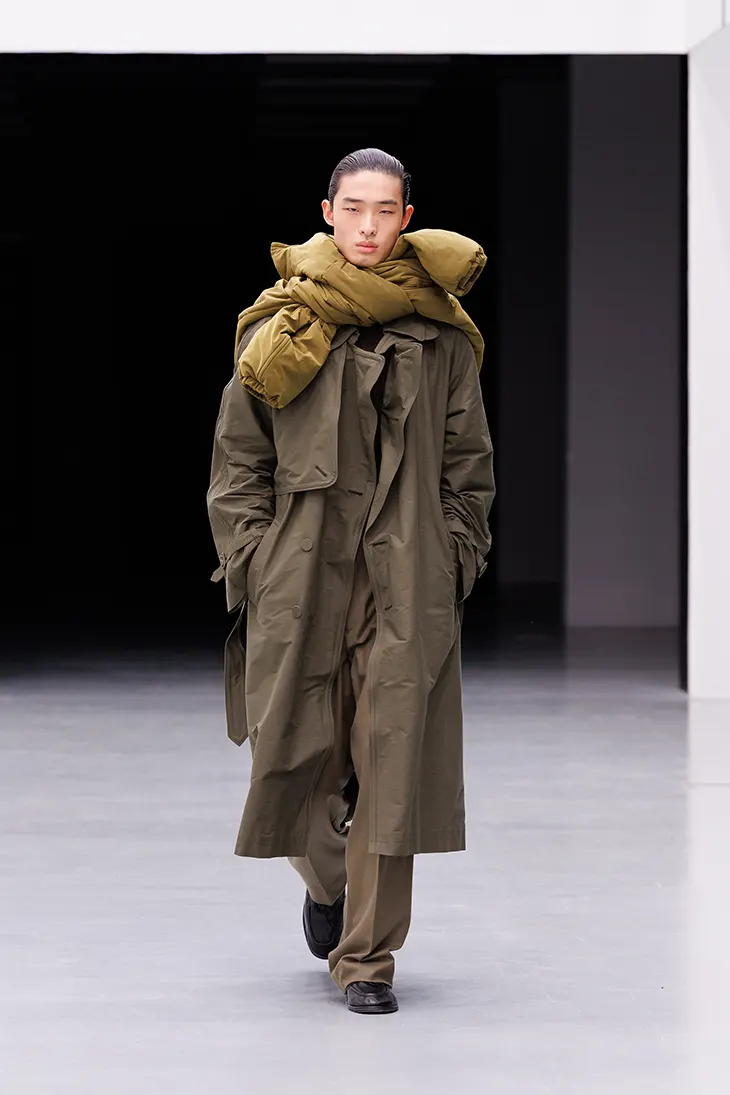
For Norio Terada, the act of making clothes has always been an exercise in connection. The name YOKE itself derives from the tailoring term for the piece of cloth that joins shoulder to body, a structural element that binds and shapes. With his Fall Winter 2026-27 collection, titled “Beyond Form,” the Japanese designer extends that philosophy into more conceptual territory, drawing direct inspiration from the surrealist sculptor and painter Jean Arp to explore what happens when organic curves infiltrate the architecture of tailoring.
Presented on January 22nd at Paris Fashion Week Men’s, the show marks YOKE’s first runway presentation in the French capital, a milestone supported by the Fashion Prize of Tokyo 2026. It’s a significant moment for a brand that has quietly built a reputation since its founding in 2018 for elevated everyday wear rooted in Japanese craftsmanship and understated refinement.
Arp’s Ghost in the Garment
Jean Arp, the Alsatian artist who moved fluidly between Dada, Surrealism, and pure abstraction, believed that “nature knows no straight lines.” His biomorphic sculptures, with their smooth, undulating surfaces and suggestion of growth and transformation, rejected geometric rigidity in favor of forms that felt almost alive. Terada has taken this principle and applied it to the body.
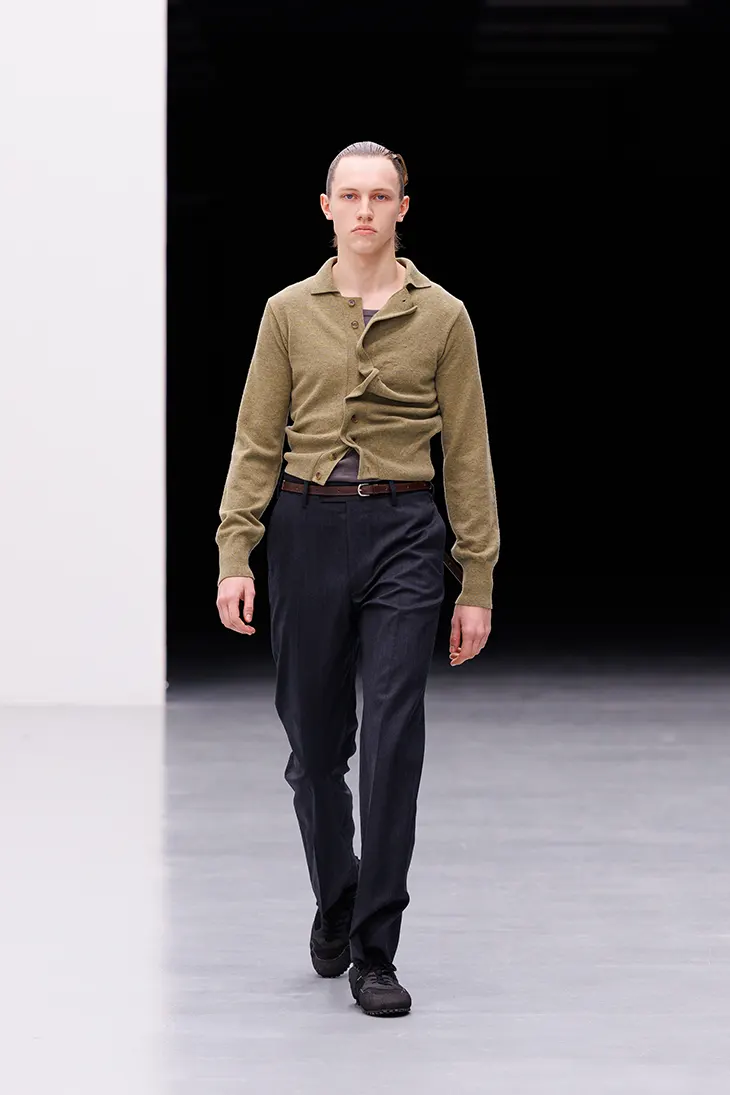
At first glance, the tailoring in “Beyond Form” appears classically structured. But look closer, and a subtle roundness emerges, a softening of edges that makes each coat and jacket feel less like armor and more like a second skin. Structured coats are reshaped through internal wiring, allowing the silhouette to shift freely, to breathe and move with the wearer rather than against them. Glen check coats capture what Terada describes as the state of “messily and ‘accidentally’-placed fabric via bonding,” a technique that echoes Arp’s embrace of chance and the beauty found in the unplanned. Trench coats can be freely reshaped by the wearer, their forms malleable rather than fixed.
Tactile Dimension
Terada’s obsession with form extends beyond the garments themselves. For the Paris presentation, he handcrafted ceramic pieces placed on the seats of the show venue, each one an invitation for guests to “touch the organic curves” and “experience the collection with both eyes and skin.” It’s a gesture that underscores YOKE’s fundamental belief that fashion is not merely visual but sensory, that the relationship between cloth and body is intimate and physical.
This tactile philosophy aligns with the brand’s broader ethos. YOKE has never been interested in spectacle for its own sake. As the press materials note, the label “is not a brand that chooses to array a series of stand-out show pieces in order to create an impactful presentation.” Instead, Terada introduces what he calls “iwakan,” a Japanese term for a subtle sense of unease, into familiar daily wear. It’s a quiet disruption, a gentle challenge to the wearer’s expectations that keeps the clothes from ever feeling predictable.
From Tokyo to Paris
Norio Terada’s path to this Paris debut has been methodical. After graduating from Bunka Fashion College with a major in design, he worked in design and production management at several domestic Japanese brands before launching YOKE in 2018. The brand won the Tokyo Fashion Award in 2022, which first brought Terada to Paris for showroom presentations, an experience that pushed him toward more pattern-driven explorations. The Fashion Prize of Tokyo 2026 recognition has now elevated that presence to the runway.
The timing feels right. Japanese designers have been commanding increasing attention on the international stage, and YOKE’s particular blend of minimalist sensibility, artisanal craft, and conceptual depth positions it well within the current appetite for thoughtful, wearable luxury. Terada’s ability to “connect” craftsmanship from Japan and around the world, as the brand describes it, speaks to a global design conversation while remaining rooted in a distinctly Japanese approach to materiality and form.
Duality of YOKE
What defines YOKE, ultimately, is duality. Terada’s creations “appear simple yet possess immense depth, appearing serene while harboring a quiet ambition.” The Fall/Winter 2026-27 collection embodies this tension. The clothes are wearable, even comfortable, yet they carry the weight of art historical reference and technical innovation. They are classic in silhouette but subversive in construction. They invite touch while maintaining an air of restraint.
Discover more of the collection in our gallery:
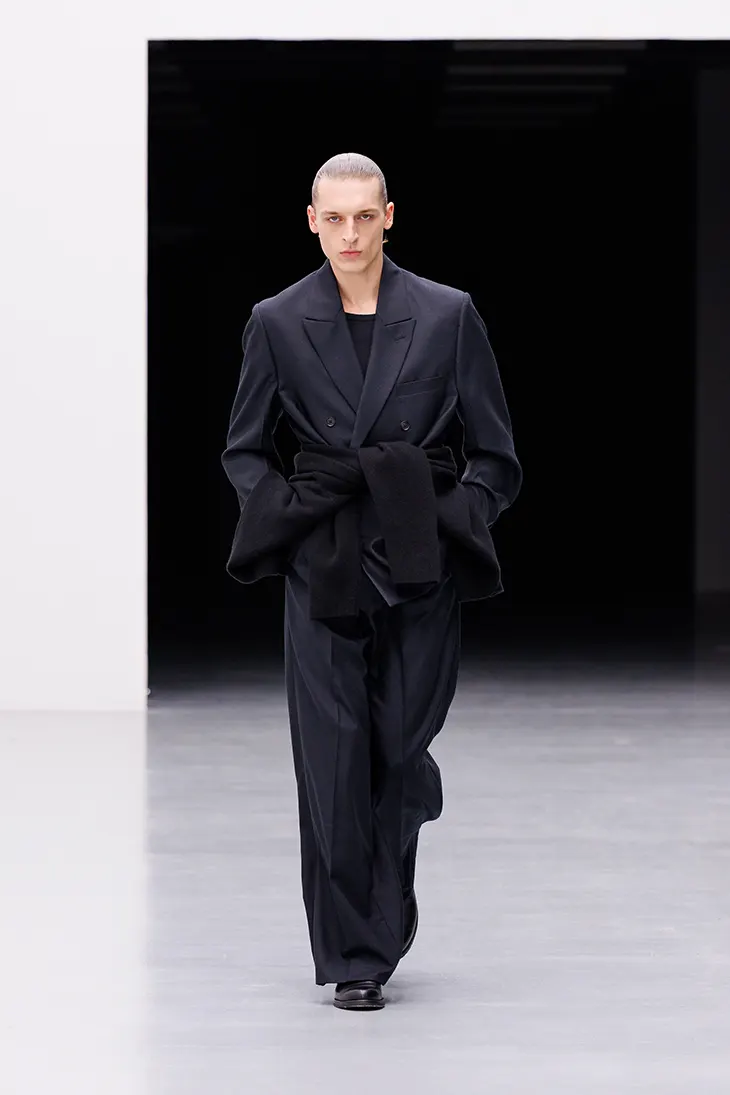
This is the essence of Norio Terada’s vision: fashion as an extension of daily life, elevated through craft and concept but never removed from the body’s reality. In channeling Jean Arp, he has found a kindred spirit, an artist who understood that the most profound forms are often those that feel inevitable, as if they emerged not from intention but from nature itself. “Beyond Form” suggests that YOKE is ready to take its place among the designers who matter, quietly, carefully, and with a subtle roundness that makes all the difference.